
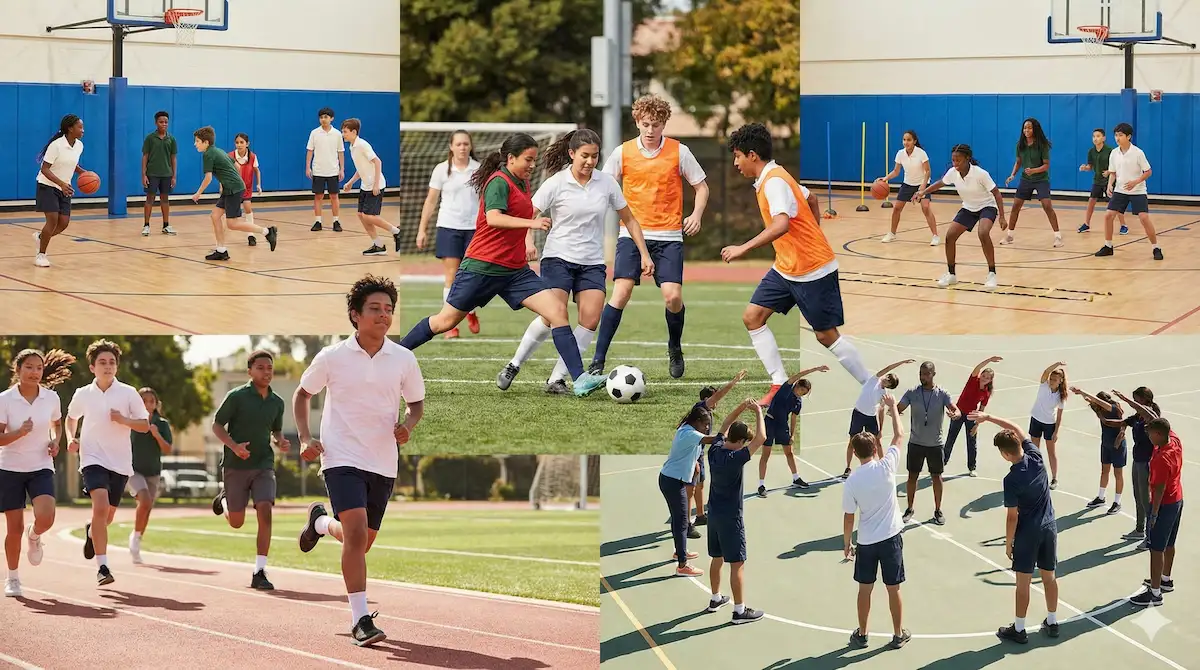
The purpose and objectives of physical education focus on developing physical fitness, mental strength, social skills, and lifelong healthy habits.
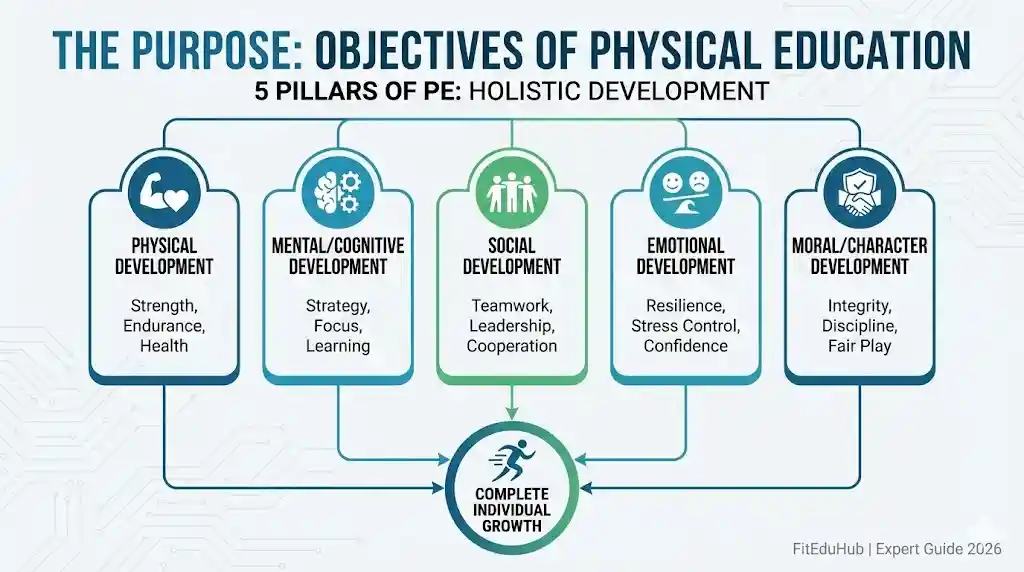
1. Physical Development Objective
Meaning
The physical development objective focuses on improving the physical fitness and functional efficiency of the body, which is a core part of the meaning and definition of Physical Education.
Explanation
Through regular participation in physical activities, students develop strength, endurance, flexibility, speed, agility, coordination, and balance. Physical Education also helps in maintaining proper posture, healthy body weight, and overall physical efficiency.
Real-Life Example
A student who regularly participates in PE classes can climb stairs without fatigue, maintain better posture while sitting in class, and show higher energy levels throughout the day compared to inactive students.
2. Mental (Cognitive) Development Objective
Meaning
This objective aims to develop mental abilities through physical activities that require thinking, planning, and decision-making.
Explanation
Games and sports involve understanding rules, applying strategies, making quick decisions, and solving problems under pressure. Physical Education also helps students understand scientific concepts related to movement and fitness, explained through the logic of sports science.
Real-Life Example
A student playing chess-like strategy games in sports such as basketball or hockey learns how to analyze situations quickly, make decisions, and adapt strategies—skills that are useful in academics and daily life.
3. Social Development Objective
Meaning
The social development objective focuses on helping individuals learn how to live and work with others in society.
Explanation
Physical Education encourages teamwork, cooperation, leadership, discipline, respect for others, and effective communication. Group activities teach students how to adjust their behavior according to team goals.
Real-Life Example
A football player learns to pass the ball instead of playing selfishly, understanding that teamwork leads to success. This habit later helps the student work effectively in group projects and professional environments.
4. Emotional Development Objective
Meaning
This objective aims to develop emotional balance, self-confidence, and self-control.
Explanation
Physical activities help students release stress, overcome fear, and manage emotions such as anger, frustration, and excitement. Sports provide real-life situations of winning and losing, which help build emotional maturity—an essential part of the impact and importance of Physical Education.
Real-Life Example
A student who loses a competition but accepts the result positively learns resilience and emotional control—qualities that are essential for handling failures in real life.
5. Moral and Character Development Objective
Meaning
The moral objective focuses on developing good character and ethical values.
Explanation
Physical Education teaches honesty, fair play, respect for rules, discipline, and sportsmanship. Ethical behavior is naturally learned through participation in games and sports.
Real-Life Example
A player who admits a foul even when the referee does not notice demonstrates honesty and integrity, which are essential moral values.
Additional Objectives of Physical Education
Health Objective
-
Promotes lifelong physical fitness
-
Prevents lifestyle diseases such as obesity and heart problems
-
Encourages healthy habits like regular exercise and hygiene
Recreational Objective
-
Reduces stress and mental fatigue
-
Provides enjoyment and relaxation
-
Encourages positive use of leisure time
Vocational Objective
-
Prepares students for careers in sports, fitness, coaching, and teaching
-
Develops leadership and organizational skills linked to career opportunities in Physical Education
Objectives of Physical Education in Modern Society
In the modern era, Physical Education has expanded its role due to changing lifestyles and health challenges. Today, PE focuses on:
-
Lifelong fitness and wellness
-
Mental health and stress management
-
Scientific and evidence-based training
-
Inclusive education for all abilities
-
Awareness about nutrition and healthy living
Physical Education is now recognized as essential for improving quality of life and overall well-being.
Expert Tips for Students (From a PE Educator’s Perspective)
✔️ Participate regularly in PE classes, not only before exams
✔️ Focus on correct technique, not just performance
✔️ Develop daily physical activity habits beyond school
✔️ Respect rules, teammates, and opponents at all times
✔️ Apply lessons from sports—discipline, teamwork, and confidence—in daily life
Educational Importance of Physical Education
The objectives of Physical Education guide:
-
Curriculum planning
-
Teaching methods
-
Student evaluation
-
Overall educational development
Without clear objectives, Physical Education loses its educational value and becomes mere physical activity.
Conclusion
The purpose and objectives of Physical Education clearly show that it is a complete educational discipline aimed at developing the total personality of an individual. It contributes to physical fitness, mental alertness, emotional stability, social harmony, and moral strength.
In a world facing increasing stress, inactivity, and health challenges, Physical Education is more important than ever. It prepares students not only for sports but for a healthy, disciplined, and meaningful life.
Physical Education is not an option—it is a necessity.
Frequently Asked Questions (FAQs)
1. What is the main purpose of Physical Education?
The main purpose of Physical Education is to promote the all-round development of an individual by improving physical fitness, mental alertness, emotional balance, social skills, and moral values through structured physical activities.
2. What are the main objectives of Physical Education?
The main objectives of Physical Education include physical development, mental development, social development, emotional development, and moral or character development. Together, these objectives support holistic growth.
3. Why is Physical Education considered an academic subject?
Physical Education is considered an academic subject because it follows a planned curriculum, has defined learning objectives, includes theoretical knowledge, and contributes to overall education just like other academic disciplines.
4. How does Physical Education help physical development?
Physical Education improves strength, endurance, flexibility, coordination, posture, and overall fitness. Regular participation helps maintain a healthy body and reduces the risk of lifestyle-related diseases.
5. How does Physical Education support mental development?
Physical Education supports mental development by improving concentration, decision-making, problem-solving, and strategic thinking through games, sports, and movement-based activities.
Physical Education helps develop social skills such as teamwork, cooperation, leadership, communication, and respect for others by encouraging group activities and team sports.
7. How does Physical Education contribute to emotional development?
Physical Education helps individuals manage stress, control emotions, build confidence, and develop emotional stability by experiencing success, failure, competition, and cooperation in sports.
8. What is the moral objective of Physical Education?
The moral objective of Physical Education is to develop character traits such as honesty, discipline, fair play, sportsmanship, respect for rules, and ethical behavior.
9. Is Physical Education important only for athletes?
No, Physical Education is important for everyone. It promotes lifelong fitness, healthy habits, mental well-being, and positive social behavior for students of all abilities, not just athletes.
10. How are the objectives of Physical Education relevant in modern life?
In modern life, Physical Education helps combat physical inactivity, stress, and lifestyle diseases. It encourages active living, mental health awareness, and overall well-being in a technology-driven world.
11. How does Physical Education help students in daily life?
Physical Education helps students develop discipline, confidence, teamwork, stress management, and healthy routines, which are useful in academics, careers, and everyday life.
12. Can Physical Education help in career development?
Yes, Physical Education can lead to careers in teaching, coaching, fitness training, sports management, health promotion, and related professional fields.