Introduction
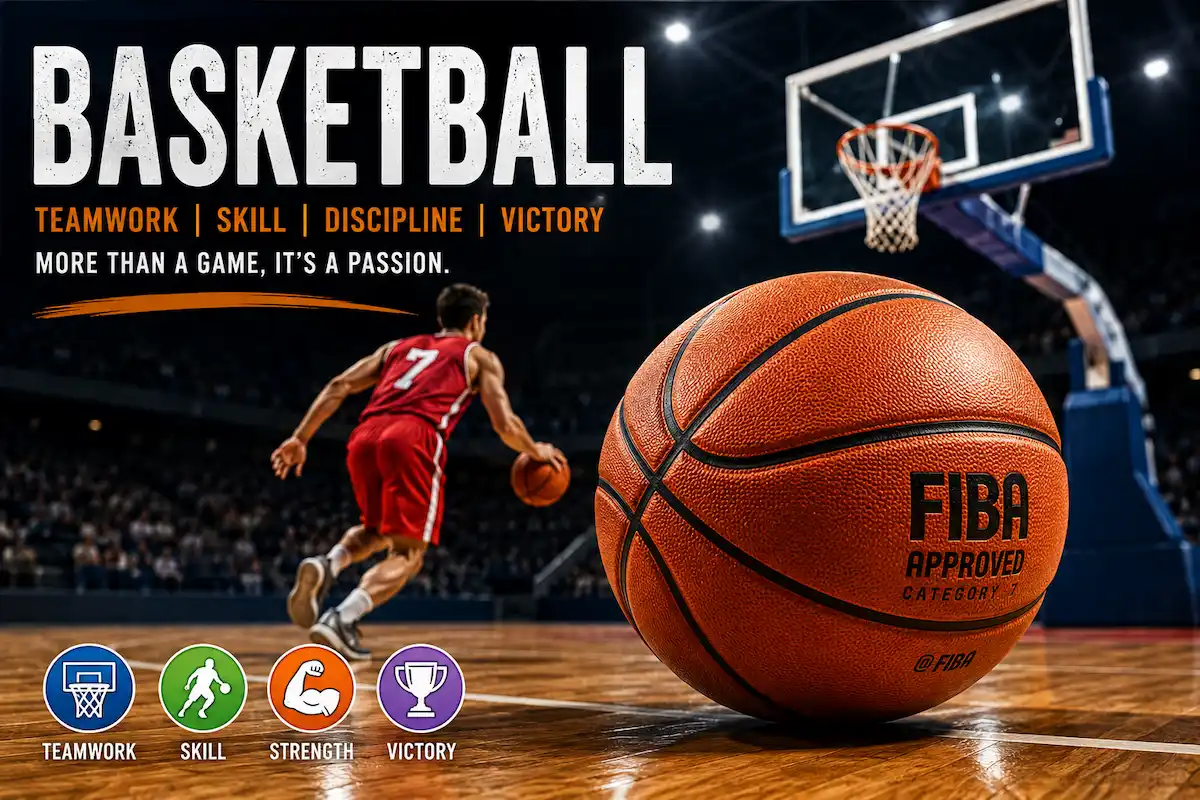
Basketball is a high-octane, incredibly dynamic, and globally beloved team sport that demands a perfect combination of supreme physical athleticism, mental sharpness, and cohesive teamwork. Played by two teams of five players each on a rectangular indoor court, the primary objective is to shoot a ball through a hoop elevated 10 feet above the ground. It is a game defined by rapid transitions, explosive jumps, tactical ball movement, and precise shooting.
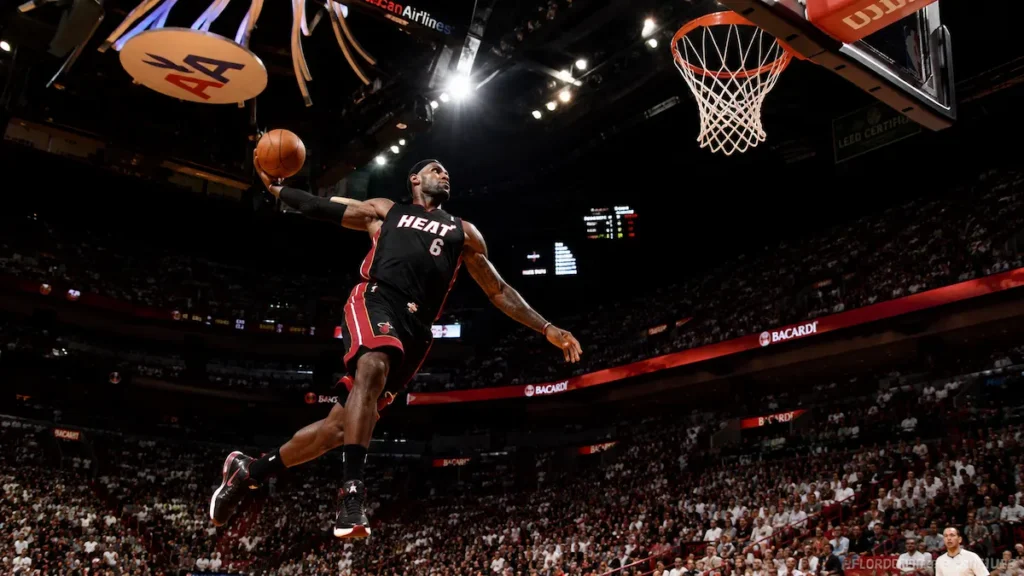
What makes basketball truly unique is its continuous flow. Unlike many other sports that stop and reset frequently, basketball is a game of constant motion. Players must seamlessly switch between aggressive offense and rigid defense within the blink of an eye. From neighborhood streetball courts to massive multi-million-dollar indoor arenas in the NBA, basketball has grown from a simple physical education activity into a global cultural phenomenon.
History of Basketball
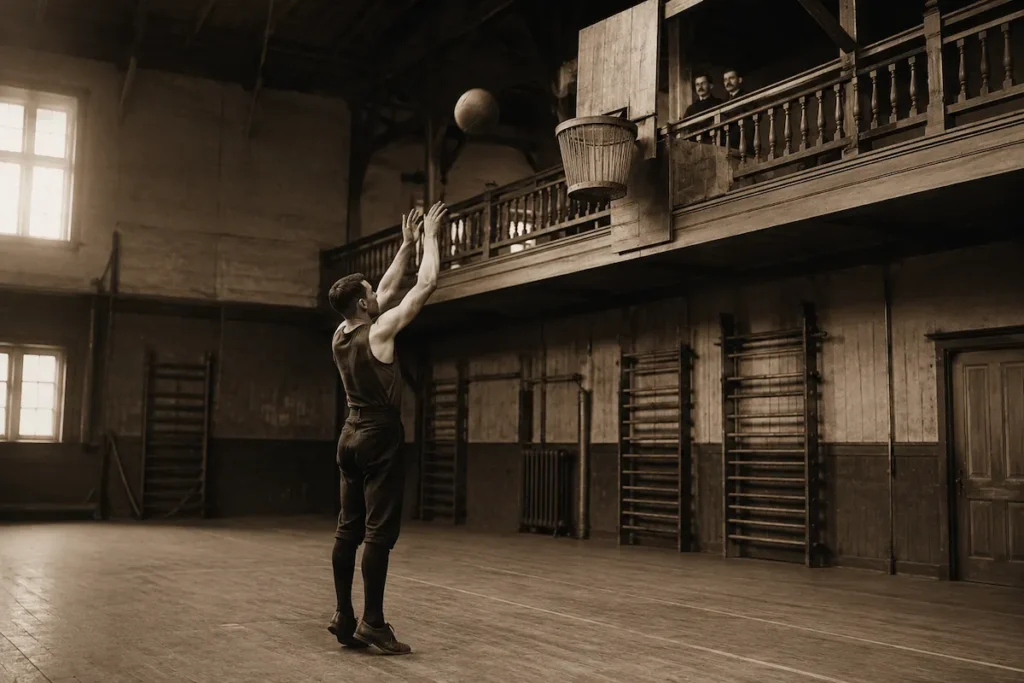
The origins of basketball are uniquely documented, unlike many ancient sports. It was invented in December 1891 by Dr. James Naismith, a Canadian physical education instructor at the YMCA International Training School (now Springfield College) in Springfield, Massachusetts, USA.
Dr. Naismith was tasked with creating an indoor game to keep young athletes active during the harsh New England winters. He wanted a game that relied on skill and accuracy rather than pure physical force to minimize injuries. Using a soccer ball and two peach baskets nailed to the lower balcony of the gymnasium, the game of “Basket Ball” was born. Every time a point was scored, the game had to pause so the janitor could climb a ladder and retrieve the ball from the basket, as the bottoms were not yet cut out!
Evolution of the Game
Basketball has undergone massive transformations over the last century to become the fast-paced spectacle we watch today:
- The Introduction of Dribbling: Originally, players were not allowed to run with or bounce the ball; they could only pass it from the spot they caught it. Dribbling was gradually introduced in the early 1900s, completely revolutionizing individual offensive play.
- The Shot Clock Era (1954): Before the shot clock, teams would take a lead and simply hold the ball to stall the game, leading to boring, low-scoring matches (like a notorious 19-18 game). The introduction of the 24-second shot clock forced teams to shoot quickly, saving the sport and skyrocketing its entertainment value.
- The 3-Point Line (1979 in the NBA): Borrowed from the rival ABA league, the 3-point line was introduced to spread the floor and reward long-distance shooting accuracy. Today, the 3-point shot dominates modern basketball analytics.
- Modern Positionless Basketball: Traditionally, players had strict roles based on height (big men stayed near the hoop, guards stayed outside). Today, the game has evolved into “positionless basketball,” where 7-foot tall centers are expected to shoot 3-pointers and handle the ball like point guards.
Governing Bodies
The systematic organization of basketball is handled by global and national bodies:
- FIBA (International Basketball Federation): Founded in 1932 and headquartered in Switzerland, FIBA governs international basketball. They determine the official international rules, specify equipment standards, and organize global tournaments like the FIBA World Cup and the Olympic basketball events.
- NBA (National Basketball Association): Although it is a private professional league in North America, the NBA is the premier basketball organization in the world. It operates under slightly different, entertainment-focused rules compared to FIBA.
- BFI (Basketball Federation of India): Established in 1950, the BFI is the governing body for basketball in India. It oversees the national teams, organizes the National Basketball Championships, and works to promote grassroots basketball across Indian schools and colleges.
Court Dimensions & Specifications
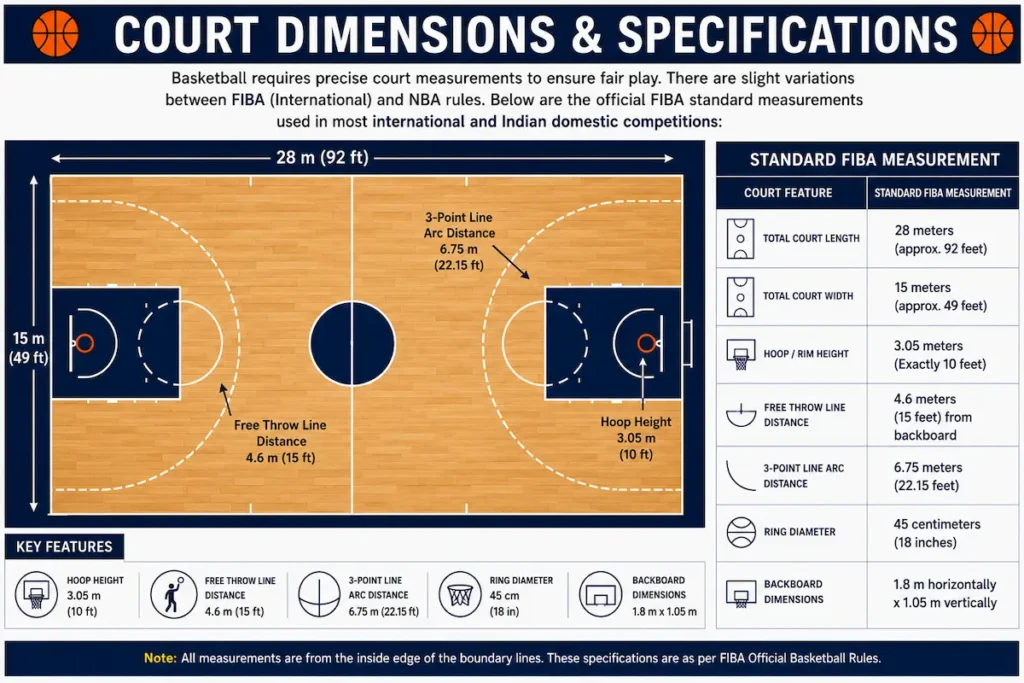
Basketball requires precise court measurements to ensure fair play. There are slight variations between FIBA (International) and NBA rules. Below are the official FIBA standard measurements used in most international and Indian domestic competitions:
| Court Feature | Standard FIBA Measurement |
| Total Court Length | 28 meters (approx. 92 feet) |
| Total Court Width | 15 meters (approx. 49 feet) |
| Hoop / Rim Height | 3.05 meters (Exactly 10 feet) |
| Free Throw Line Distance | 4.6 meters (15 feet) from backboard |
| 3-Point Line Arc Distance | 6.75 meters (22.15 feet) |
| Ring Diameter | 45 centimeters (18 inches) |
| Backboard Dimensions | 1.8m horizontally x 1.05m vertically |
The Hoop System: Detailed Specifications
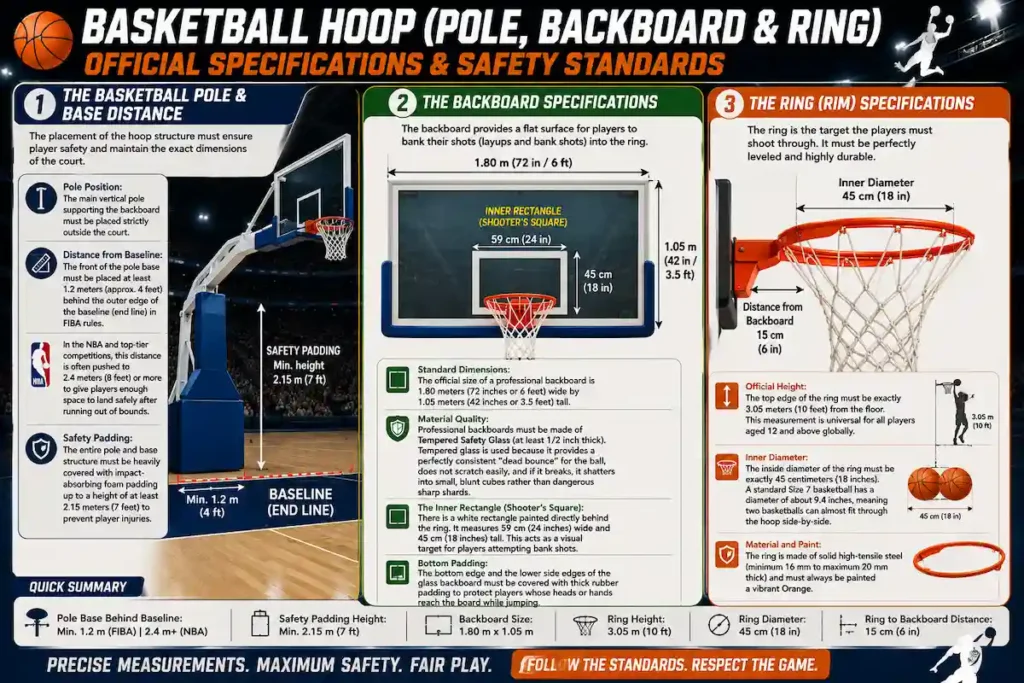
A basketball hoop is not just a ring and a net; it is a precisely engineered piece of equipment designed to withstand massive physical impact while adhering to strict global standards. The entire setup is known as the “Backstop Unit” or “Hoop System.”
Here are the detailed, official specifications for the hoop, ring, and backboard according to standard FIBA (International) and NBA rules:
1. The Basketball Pole & Base Distance
The placement of the hoop structure must ensure player safety and maintain the exact dimensions of the court.
- Pole Position: The main vertical pole supporting the backboard must be placed strictly outside the court.
- Distance from Baseline: The front of the pole base must be placed at least 1.2 meters (approx. 4 feet) behind the outer edge of the baseline (end line) in FIBA rules. In the NBA and top-tier competitions, this distance is often pushed to 2.4 meters (8 feet) or more to give players enough space to land safely after running out of bounds.
- Safety Padding: The entire pole and base structure must be heavily covered with impact-absorbing foam padding up to a height of at least 2.15 meters (7 feet) to prevent player injuries.
2. The Backboard Specifications
The backboard provides a flat surface for players to bank their shots (layups and bank shots) into the ring.
- Standard Dimensions: The official size of a professional backboard is 1.8 meters (72 inches or 6 feet) wide by 1.05 meters (42 inches or 3.5 feet) tall.
- Material Quality: Professional backboards must be made of Tempered Safety Glass (at least 1/2 inch thick). Tempered glass is used because it provides a perfectly consistent “dead bounce” for the ball, does not scratch easily, and if it breaks, it shatters into small, blunt cubes rather than dangerous sharp shards.
- The Inner Rectangle (Shooter’s Square): There is a white rectangle painted directly behind the ring. It measures 59 cm (24 inches) wide and 45 cm (18 inches) tall. This acts as a visual target for players attempting bank shots.
- Bottom Padding: The bottom edge and the lower side edges of the glass backboard must be covered with thick rubber padding to protect players whose heads or hands reach the board while jumping.
3. The Ring (Rim) Specifications
The ring is the target the players must shoot through. It must be perfectly leveled and highly durable.
- Official Height: The top edge of the ring must be exactly 3.05 meters (10 feet) from the floor. This measurement is universal for all players aged 12 and above globally.
- Inner Diameter: The inside diameter of the ring must be exactly 45 centimeters (18 inches). A standard Size 7 basketball has a diameter of about 9.4 inches, meaning two basketballs can almost fit through the hoop side-by-side.
- Material and Paint: The ring is made of solid high-tensile steel (minimum 16 mm to maximum 20 mm thick) and must always be painted a vibrant Orange.
- Distance from Backboard: The inner edge of the ring must be exactly 15 centimeters (6 inches) away from the face of the glass backboard.
Types of Basketball Rings
Not all rings are built the same. There are two primary types used in the sport:
- The Breakaway Rim (Standard Professional Ring):
- This is the standard ring used in every professional arena, college, and high-level school court.
- It contains a hidden hinge and heavy-duty springs inside the mounting box. When a player grabs the rim during a slam dunk, the springs allow the rim to bend downward slightly (up to 30 degrees) to absorb the massive shock. As soon as the player lets go, the rim instantly “snaps” back to its perfect horizontal position.
- Purpose: It prevents the glass backboard from shattering and protects the player’s wrists and hands from injury.
- The Static (Fixed) Rim:
- This is a traditional ring that is bolted directly and rigidly to the backboard or pole without any springs.
- Purpose: These are usually found on outdoor street courts or very low-budget setups. They are highly durable against weather but are very dangerous for dunking, as all the force is transferred directly to the backboard or the player’s joints.
4. The Net
Design: It must be designed to temporarily slow down the ball as it passes through. This slight delay allows the referee to clearly see that a point has been scored and allows the ball to drop predictably for the players below.
Material: Must be made of white nylon cord.
Length: Must be between 40 cm to 45 cm (15 to 18 inches) in length when attached to the ring.
Equipment Required
Basketball requires minimal but highly specific gear for competitive play:
Official Basketball Equipment & Their Practical Usage
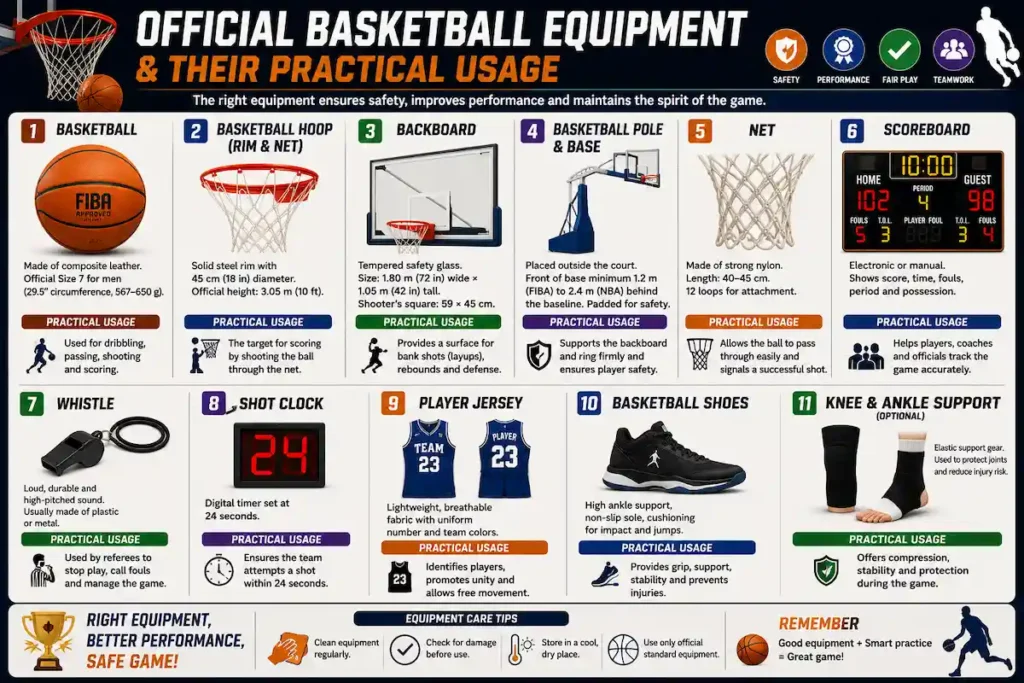
To play a professional or highly competitive game of basketball, both the court setup and the players must be equipped with specific, standardized gear. The official equipment is strictly regulated by governing bodies like FIBA and the NBA to ensure player safety and fair competition.
Here is a detailed breakdown of the official basketball equipment, how it is used, and practical examples:
1. The Official Basketball (The Ball)
The basketball itself is the most critical piece of equipment. It is engineered for maximum grip, perfect spherical balance, and a predictable bounce.
- What it is made of: Professional game balls are made of genuine leather (which takes time to “break in” and absorb sweat). Indoor/Outdoor balls are made of synthetic composite leather, while cheap street balls are made of rubber.
- How it is used: Used for all offensive and defensive plays (dribbling, passing, shooting).
- Practical Example: In an official NBA or FIBA Men’s match, a Size 7 ball is used. It has a circumference of 29.5 inches. However, in a Women’s official match (WNBA), a slightly smaller and lighter Size 6 ball is used so players can grip and shoot it comfortably according to their average hand size.
2. Player Uniforms (Jerseys & Shorts)
Basketball is a high-intensity, sweaty sport. The uniform is strictly regulated to ensure referees and fans can easily identify players.
- What it is made of: Lightweight, breathable, moisture-wicking synthetic fabrics (like polyester mesh) that do not restrict movement.
- How it is used: The jersey must have clearly visible numbers on both the front and the back. An official rule states that the jersey must be tucked into the shorts during professional play to prevent fingers from getting caught in loose fabric.
- Practical Example: In an official tournament, the Home team usually wears a light-colored uniform (e.g., White), and the Away team wears a dark-colored uniform (e.g., Black or Blue). This visual contrast stops players from accidentally passing the ball to the opponent during high-speed fast breaks.
3. Performance Footwear (Basketball Shoes)
You cannot play official basketball in running shoes or casual sneakers; doing so is highly dangerous for the ankles and damaging to the court.
- What it is: Specialized shoes featuring flat, non-marking rubber outsoles with herringbone traction patterns. They come in High-tops, Mid-tops, and Low-tops.
- How it is used: They provide extreme grip on polished wooden floors, allowing players to stop instantly, change direction, and jump. The thick heel cushioning absorbs the massive shock of landing after a rebound.
- Practical Example: A heavy, 7-foot-tall Center (like Shaquille O’Neal) uses heavy-duty High-top shoes for maximum ankle support and landing cushions. In contrast, a quick Point Guard (like Stephen Curry) uses lighter Low-top shoes for maximum speed and lateral (side-to-side) ankle mobility.
4. Court & Officiating Equipment
The game cannot run officially without the technological equipment used by the referees and the scoring table.
- The Shot Clock: A digital clock usually mounted directly above the basketball hoop.
- Usage & Example: It counts down from 24 seconds. If Team A gets the ball, they must shoot before the clock hits zero. If they don’t, a loud buzzer sounds, and the ball is given to Team B. This forces the game to be fast-paced.
- The Electronic Scoreboard: Displays the current score, the time remaining in the quarter, the number of team fouls, and the shot clock.
- The Fox 40 Whistle: Official referees use pealess whistles (which don’t have a small ball inside).
- Usage & Example: It produces a high-pitch, piercing sound that can be heard over a screaming crowd of 20,000 fans to instantly stop play for a foul or violation.
5. Protective & Support Accessories (Player Gear)
While not mandatory to play, FIBA and the NBA officially allow players to wear specific medical and protective accessories.
Usage & Example: If a player has recently broken their nose but still wants to play, the medical staff will fit them with a clear, official face mask (made famous by LeBron James and Kobe Bryant) to protect their facial bones while playing.
Shooting Sleeves & Compression Gear: Tight, elastic bands worn on the arms or legs.
Usage & Example: A player wears an arm sleeve on their shooting arm. It keeps the muscles warm to prevent cramping and protects the skin from being scratched by defenders’ fingernails during a shot.
Mouthguards: A custom-molded plastic shield worn over the upper teeth.
Usage & Example: When a player drives to the basket for a layup, they often face heavy physical contact. A mouthguard prevents teeth from being chipped by a stray elbow and reduces the risk of concussions if the player falls hard on the floor.
Protective Face Masks: Made of clear polycarbonate.
The Scorer’s Table: Official Table Equipment
While the players battle on the court, the true nerve center of a basketball game is the Scorer’s Table. Located just outside the sideline at the half-court mark, this is where the official scorer, timer, and shot-clock operator sit. They use highly specific table equipment to track every statistic, foul, and second of the game.
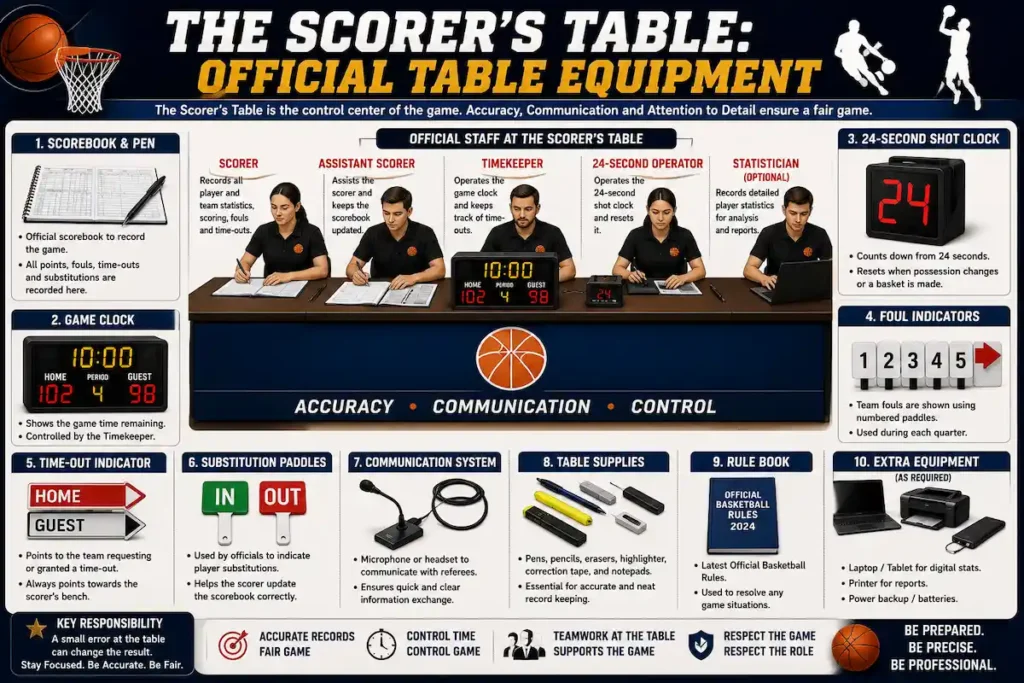
Here is the official equipment found at the Scorer’s Table and how it is practically used:
1. The Official Scoresheet (Scorebook)
Even in the era of advanced digital technology, the official physical (or approved digital) scoresheet is the ultimate legal document of the game.
- How it is used: The Official Scorer uses it to record the starting lineups, all points scored (and who scored them), timeouts taken, and every personal and technical foul committed.
- Practical Example: If the electronic scoreboard malfunctions or there is a dispute between the two teams about the score, the referee will stop the game and check the Official Scoresheet. Whatever is written on this sheet is considered the final and absolute truth of the game.
2. Game Clock & Scoreboard Control Console
This is the electronic panel used by the Timekeeper to manage the massive scoreboard hanging above the arena.
- How it is used: The timekeeper uses this console to start and stop the main game clock. In basketball, the clock must stop the exact millisecond a referee blows their whistle (for a foul, out-of-bounds, or timeout) and starts again exactly when the ball is touched in-bounds.
- Practical Example: During a fast-paced final quarter, a player steps out of bounds. The timekeeper instantly hits the “Stop” button on the console to pause the clock, ensuring no precious game time is wasted.
3. The 24-Second Shot Clock Operator Panel
Because the shot clock is so crucial to the pace of basketball, it requires its own dedicated operator and control panel, completely separate from the main game clock.
- How it is used: The operator must instantly reset the shot clock back to 24 seconds when the ball hits the rim on a shot, or reset it to 14 seconds if the offensive team secures a rebound.
- Practical Example: If Team A attempts a shot, the ball hits the ring, and Team A catches the rebound, the operator quickly presses the “14-Second Reset” button on the panel to give them a fresh, but shorter, attacking window.
4. The Alternating Possession Arrow
This is a physical plastic arrow or an illuminated electronic arrow placed directly on the scorer’s table, pointing either left or right.
- How it is used: After the initial jump ball at the start of the game, basketball avoids doing more jump balls. Instead, if two players grab the ball at the exact same time (a “Tie-up” or “Held Ball”), the referee looks at the table. The team that the arrow is pointing toward gets the ball.
- Practical Example: If two players wrestle for the ball and the arrow points to the Home team’s attacking side, the Home team gets to throw the ball in. The table official then instantly flips the arrow to point the other way for the next held-ball situation.
5. Player Foul Markers (Numbered Paddles)
These are physical plastic paddles, usually numbered from 1 to 5 (or 1 to 6 in the NBA). The numbers 1 to 4 are printed in black, while the final number (5 or 6) is printed in red.
- How it is used: Every time a referee calls a foul on a player, the scorer updates the sheet and then raises the corresponding numbered paddle high in the air.
- Practical Example: If Player No. 10 commits their 3rd foul of the game, the table official raises the paddle with the number “3”. This allows the coach, the fans, and the player to visually know exactly how much “foul trouble” they are in. If the red paddle goes up, the player is disqualified (fouled out).
6. Team Foul Markers (The Bonus Flags)
These are usually large red cylinders, cones, or bright red electronic lights placed on the extreme ends of the scorer’s table.
- How it is used: According to FIBA rules, a team is only allowed 4 team fouls per quarter. Once a team commits their 5th foul, they are in the “Penalty” or “Bonus” situation. The table official places the red marker on the edge of the table facing the court.
- Practical Example: When players see the red marker on the table, they know that any defensive foul they commit (even a normal, non-shooting foul) will automatically result in two free throws for the opposing team.
7. The Substitution Horn / Buzzer
A loud, electronic horn button located on the table.
Practical Example: The referee blows the whistle because the ball went out of bounds. Instantly, the table official hits the loud horn. The referee looks at the table, sees a new player waiting, and waves them onto the court to substitute.
How it is used: The table officials are not allowed to shout at the referee. Instead, if a coach requests a timeout, or a player is sitting at the table waiting to substitute into the game, the table official waits for a “dead ball” (when play has naturally stopped) and presses the horn.
Rules & Regulations
To keep the game fair and continuously moving, strict regulations are enforced by referees on the court:
Time Violations
- 24-Second Shot Clock: A team must attempt a shot that touches the rim within 24 seconds of gaining possession. Failure to do so results in a turnover.
- 8-Second Rule: The offensive team has 8 seconds to advance the ball past the half-court line.
- 3-Second Rule: An offensive player cannot stand inside the painted area (the key) near the basket for more than 3 consecutive seconds without attempting a shot or actively guarding someone.
Ball Handling Violations
- Traveling: Taking more than two steps without dribbling the ball, or moving the pivot foot illegally.
- Double Dribble: Dribbling the ball with two hands simultaneously, or stopping your dribble, holding the ball, and then starting to dribble again.
- Backcourt Violation (Over and Back): Once the offensive team brings the ball across the half-court line, they cannot pass or dribble it back into their defensive half.
Fouls
Physical contact is inevitable, but illegal contact is penalized. A Personal Foul is called for illegal physical contact (pushing, blocking, hitting the arm). A player fouls out of the game after committing 5 fouls (FIBA) or 6 fouls (NBA). A Technical Foul is given for unsportsmanlike conduct (arguing with refs), and a Flagrant Foul is issued for excessive, dangerous, or violent contact.
Scoring System & Match Formats
Scoring in basketball is simple but highly tactical. The team with the most points at the end of the game wins.
- 3 Points: Awarded for any field goal scored from outside the three-point arc.
- 2 Points: Awarded for any field goal scored from inside the three-point line, including layups, dunks, and mid-range jump shots.
- 1 Point: Awarded for a successful Free Throw. Free throws are uncontested shots taken from the free-throw line, usually awarded after a player is fouled in the act of shooting.
Game Duration: Under FIBA rules, a game consists of four quarters of 10 minutes each (40 minutes total). In the NBA, quarters are 12 minutes long (48 minutes total). If the score is tied at the end of regulation time, the game goes into a 5-minute Overtime (OT) period. Overtime continues until a winner is decided; there are no draws in basketball.
Player Positions & Roles
A standard lineup consists of five players, each with a traditional role, though modern basketball blends these heavily:
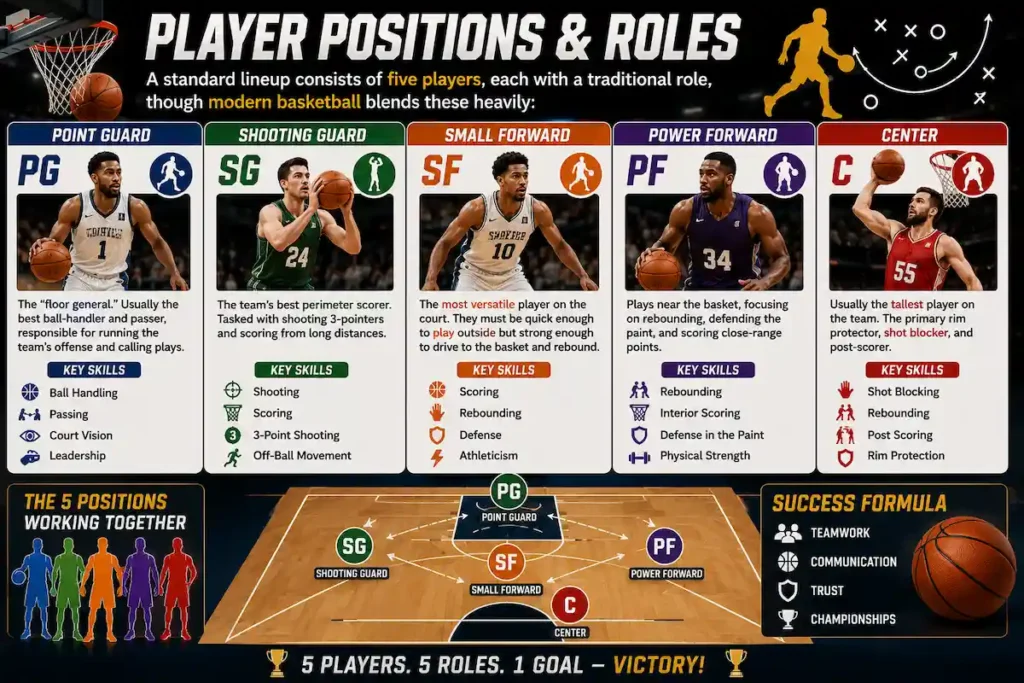
- Point Guard (PG): The “floor general.” Usually the best ball-handler and passer, responsible for running the team’s offense and calling plays.
- Shooting Guard (SG): The team’s best perimeter scorer. Tasked with shooting 3-pointers and scoring from long distances.
- Small Forward (SF): The most versatile player on the court. They must be quick enough to play outside but strong enough to drive to the basket and rebound.
- Power Forward (PF): Plays near the basket, focusing on rebounding, defending the paint, and scoring close-range points.
- Center (C): Usually the tallest player on the team. The primary rim protector, shot blocker, and post-scorer.
The Masterclass: Deep Dive into Fundamental Skills
Mastering basketball is not about learning complex trick plays; it is about executing the basic fundamentals flawlessly under pressure. To truly understand how the game is played, we must break down the four main pillars of basketball skills, how they are executed mechanically, and how players practice them.
1. Dribbling (Ball Handling)
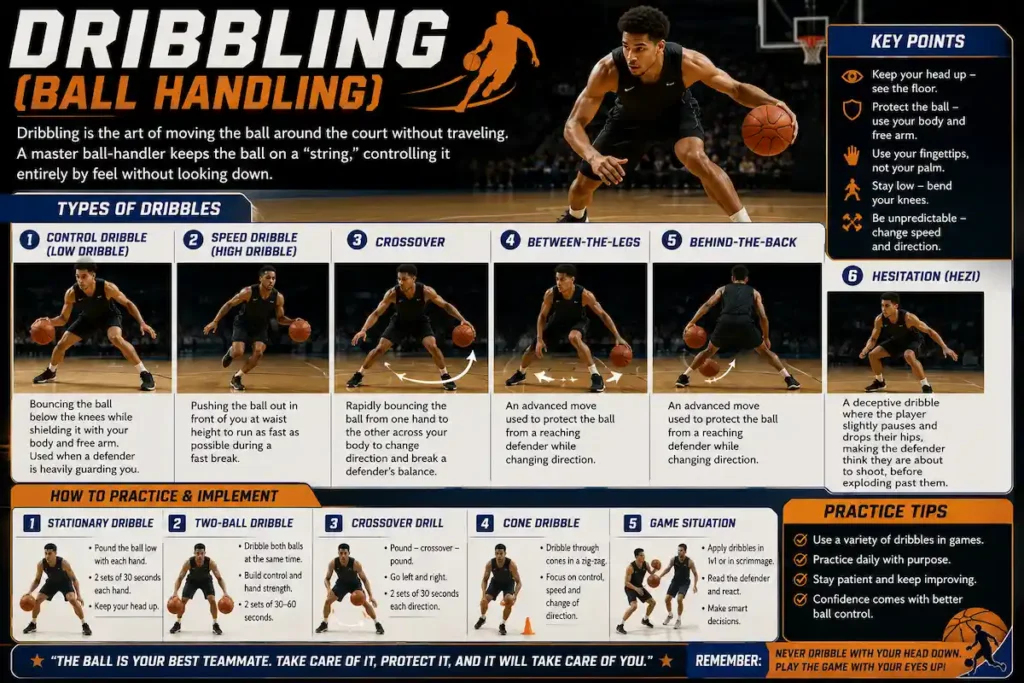
Dribbling is the art of moving the ball around the court without traveling. A master ball-handler keeps the ball on a “string,” controlling it entirely by feel without looking down.
Types of Dribbles:
- Control Dribble (Low Dribble): Bouncing the ball below the knees while shielding it with your body and free arm. Used when a defender is heavily guarding you.
- Speed Dribble (High Dribble): Pushing the ball out in front of you at waist height to run as fast as possible during a fast break.
- Crossover: Rapidly bouncing the ball from one hand to the other across your body to change direction and break a defender’s balance.
- Between-the-Legs & Behind-the-Back: Advanced moves used to protect the ball from a reaching defender while simultaneously changing direction.
- Hesitation (Hezi): A deceptive dribble where the player slightly pauses and drops their hips, making the defender think they are about to shoot, before exploding past them.
How to Practice & Implement: Never dribble with the palms of your hands; control the ball with the pads of your fingertips. The most effective way to develop handles is through Stationary Two-Ball Dribbling (dribbling two balls simultaneously to build weak-hand coordination) and Zig-Zag Cone Drills (practicing crossovers at game speed).
2. Shooting (The Most Crucial Skill)
Scoring is the ultimate goal, and shooting requires immense muscle memory, perfect body alignment, and mental focus.
Types of Shots:
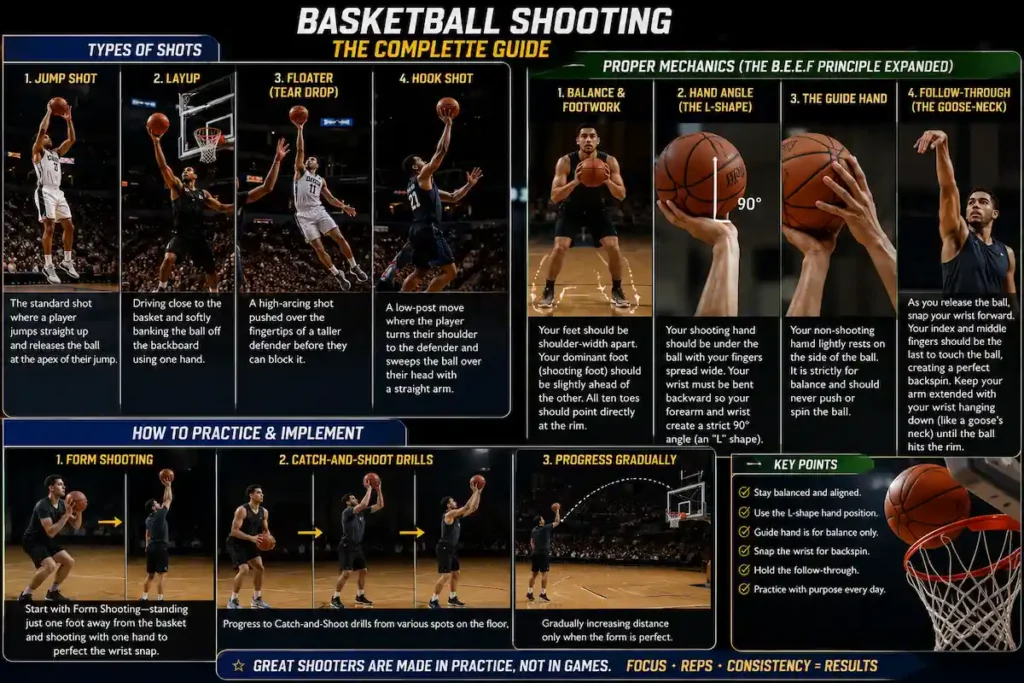
- Jump Shot: The standard shot where a player jumps straight up and releases the ball at the apex of their jump.
- Layup: Driving close to the basket and softly banking the ball off the backboard using one hand.
- Floater (Tear Drop): A high-arcing shot pushed over the fingertips of a taller defender before they can block it.
- Hook Shot: A low-post move where the player turns their shoulder to the defender and sweeps the ball over their head with a straight arm.
Proper Mechanics (The B.E.E.F Principle Expanded):
- Balance & Footwork: Your feet should be shoulder-width apart. Your dominant foot (shooting foot) should be slightly ahead of the other. All ten toes should point directly at the rim.
- Hand Angle (The L-Shape): Your shooting hand should be under the ball with your fingers spread wide. Your wrist must be bent backward so your forearm and wrist create a strict 90-degree angle (an “L” shape).
- The Guide Hand: Your non-shooting hand lightly rests on the side of the ball. It is strictly for balance and should never push or spin the ball.
- Follow-Through (The Goose-Neck): As you release the ball, snap your wrist forward. Your index and middle fingers should be the last to touch the ball, creating a perfect backspin. Keep your arm extended with your wrist hanging down (like a goose’s neck) until the ball hits the rim.
How to Practice & Implement: Start with Form Shooting—standing just one foot away from the basket and shooting with one hand to perfect the wrist snap. Progress to Catch-and-Shoot drills from various spots on the floor, gradually increasing distance only when the form is perfect.
3. Passing
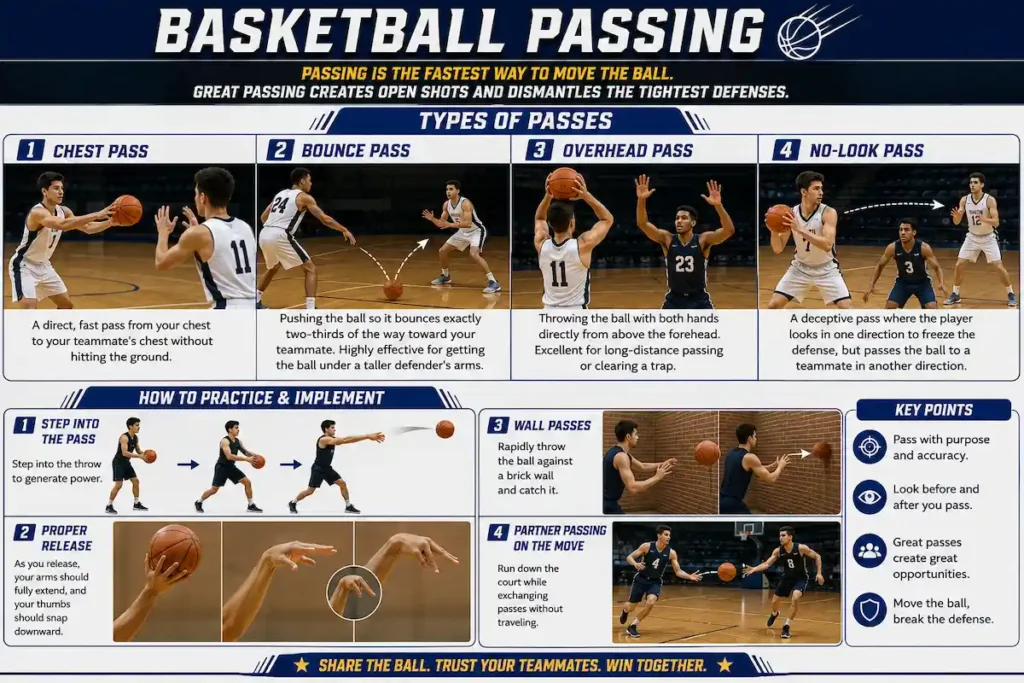
Passing is the fastest way to move the ball. Great passing creates open shots and dismantles the tightest defenses.
Types of Passes:
- Chest Pass: A direct, fast pass from your chest to your teammate’s chest without hitting the ground.
- Bounce Pass: Pushing the ball so it bounces exactly two-thirds of the way toward your teammate. Highly effective for getting the ball under a taller defender’s arms.
- Overhead Pass: Throwing the ball with both hands directly from above the forehead. Excellent for long-distance passing or clearing a trap.
- No-Look Pass: A deceptive pass where the player looks in one direction to freeze the defense, but passes the ball to a teammate in another direction.
How to Practice & Implement: When executing a pass, step into the throw to generate power. As you release, your arms should fully extend, and your thumbs should snap downward. Practice using Wall Passes (rapidly throwing the ball against a brick wall and catching it) and Partner Passing on the Move (running down the court while exchanging passes without traveling).
4. Rebounding
Rebounding is securing the ball after a missed shot. It is less about height and almost entirely about positioning, timing, and effort.
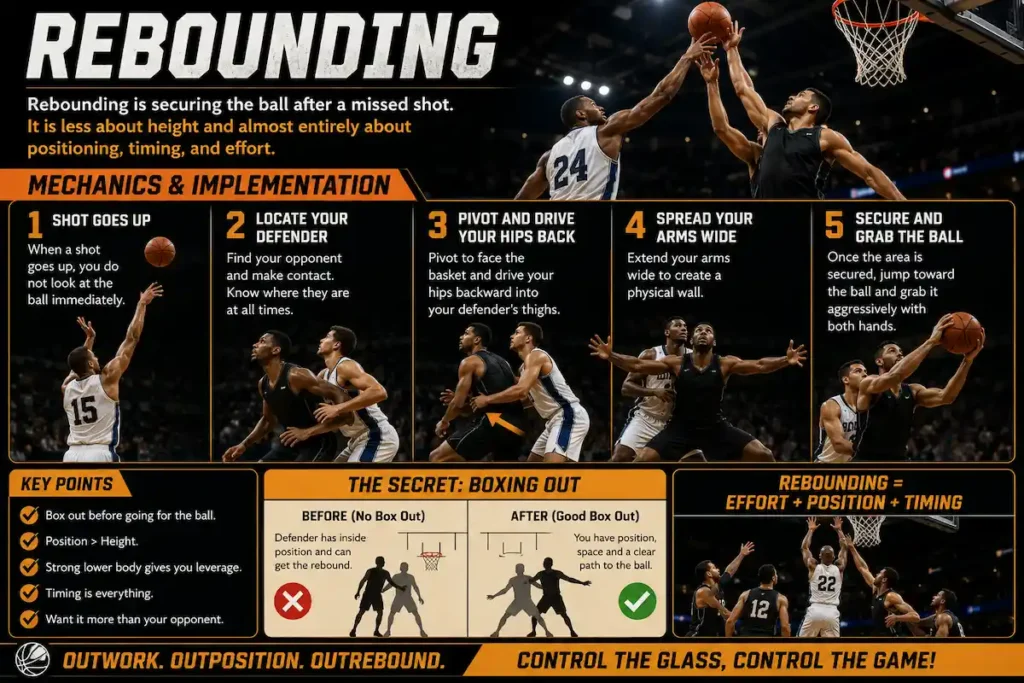
Mechanics & Implementation: The secret to rebounding is “Boxing Out.” When a shot goes up, you do not look at the ball immediately. First, you locate your defender, pivot, and drive your hips backward into their thighs while spreading your arms wide. This creates a physical wall, keeping the defender away from the basket. Once the area is secured, you jump toward the ball and grab it aggressively with both hands.
The Blueprint: Skill Development According to Age Groups
A common mistake is forcing young players to shoot three-pointers before they have the strength, ruining their mechanical form. Basketball development must be structured strictly according to a child’s physical and cognitive maturity.
Ages 5 to 8 Years (Beginners & Fundamentals)
- Equipment: Size 5 basketball, 8-foot (or lower) hoop.
- Focus Areas: At this age, basketball should be pure fun. The focus is entirely on basic motor skills—running without falling, catching a bouncing ball, and learning to dribble with both the left and right hand.
- Implementation: Avoid structured game rules. Play fun games like “Red Light, Green Light” while dribbling, or seeing how many times they can pass the ball against a wall.
Ages 9 to 12 Years (Form & Mechanics)
- Equipment: Size 6 basketball, 9-foot to standard 10-foot hoop.
- Focus Areas: This is the golden window for muscle memory. Players must learn the strict B.E.E.F shooting mechanics from close range. It is crucial to develop the “weak hand” (left hand for right-handed players) for layups and dribbling.
- Implementation: Introduce basic tactical concepts like spacing the floor, moving without the ball, and basic man-to-man defense. Stop players from shooting from far away if they are altering their form (e.g., throwing the ball from their chest) just to reach the hoop.
Ages 13 to 15 Years (Pace, Power & Tactics)
- Equipment: Size 7 basketball (for boys), Size 6 (for girls), standard 10-foot hoop.
- Focus Areas: Physical strength increases rapidly here. Players can now start extending their shooting range toward the 3-point line using proper form. Focus shifts to game-speed execution: shooting off the dribble, finishing layups through physical contact, and reading the defense.
- Implementation: Practice complex combinations (e.g., crossover into a jump shot). Introduce team plays, such as the Pick-and-Roll and zone defenses.
Ages 16 & Above (Elite Competition & Specialization)
Implementation: Drills must simulate intense game pressure. Focus heavily on “Basketball IQ”—learning to read how the opponent is defending and instantly making the right tactical decision to counter it.
Focus Areas: By this age, the core fundamentals should be automatic. Training shifts to high-level athleticism (vertical jump training, lateral speed) and positional specialization (e.g., a Point Guard mastering court vision, or a Center mastering post-footwork).
The Basketball Glossary: Essential Terminology
To truly master basketball, you have to speak its language. The sport has developed a rich, unique vocabulary over the decades. Whether you are watching an NBA game or stepping onto the court for the first time, understanding these technical terms and cultural slang is essential.
1. Court & Scoring Terminology
- The Paint (The Key): The rectangular painted area on the court located directly under the basket and extending to the free-throw line. Most close-range scoring and heavy physical contact happen here.
- The Perimeter: The area outside the free-throw lane but inside the 3-point line. Players who operate here are usually guards or “perimeter shooters.”
- Double-Double: When a player accumulates a double-digit number total (10 or more) in two of the five major statistical categories (points, rebounds, assists, steals, or blocks) in a single game. (e.g., 15 points and 10 rebounds).
- Triple-Double: An exceptional individual performance where a player hits double digits in three statistical categories in a single game (e.g., 20 points, 10 assists, and 11 rebounds).
- Turnover: When the offensive team loses possession of the ball to the defensive team before attempting a shot (due to a bad pass, stepping out of bounds, or a rule violation).
2. Offensive Play Terminology
- Alley-Oop: One of the most spectacular plays in basketball. A player throws the ball high into the air near the basket, and a jumping teammate catches it in mid-air and instantly dunks or lays it in before landing.
- And-One: When an offensive player is fouled while shooting but still manages to make the basket. They are awarded the points for the shot, plus “and one” additional free throw.
- Assist: A pass directly leading to a scored basket. The player who made the pass is credited with an assist in the stat sheet.
- Buzzer Beater: A shot taken just fractions of a second before the quarter or game clock expires. If the ball leaves the player’s hand before the buzzer sounds, the points count even if the ball goes in after the buzzer.
- Fadeaway: A difficult jump shot where the shooter jumps backward, leaning away from the defender to create space so the shot cannot be blocked.
- Post-Up: An offensive move where a player positions themselves close to the basket, turning their back to the defender to use their physical size and footwork to score.
3. Defensive & Rule Terminology
- Block (Rejection): When a defender legally deflects or alters a shot while the ball is on its upward trajectory.
- Charge (Offensive Foul): When an offensive player with the ball aggressively crashes into a stationary defender who has established a legal guarding position. The ball is awarded to the defense.
- Goaltending: An illegal violation where a player blocks or touches the ball while it is on its downward flight toward the basket, or while it is directly above the rim. If committed by the defense, the shot counts automatically.
- Steal (Pickpocket): Taking the ball away from the offensive player cleanly during a dribble or intercepting a pass.
- Trap: A highly aggressive defensive strategy where two defenders quickly trap the ball-handler in a corner or on the sideline, forcing them to make a panicked pass or turn the ball over.
4. Basketball Slang & Cultural Terms
Basketball has heavily influenced global streetwear and hip-hop culture. Here are terms born on the streetball courts:
Clutch: Performing exceptionally well under extreme pressure, usually in the final minutes of a close, high-stakes game.
Ankle Breaker: A highly evasive, rapid crossover dribble that makes the defender lose their balance, stumble, or even fall to the floor.
Posterize: To execute a fierce, high-flying slam dunk directly over a defender. The term implies the play was so visually spectacular that it deserves to be printed on a poster.
Brick: A very poor shot that heavily hits the rim or backboard and bounces off without going in.
Airball: A terrible shot that completely misses everything—the rim, the net, and the backboard.
Swish (Nothin’ but Net): A perfectly accurate shot that goes through the hoop without touching the rim or the backboard, making a highly satisfying “swish” sound through the nylon net.
Team Strategy: Offense vs. Defense
In basketball, Offense and Defense are the two primary pillars of the game. A famous basketball adage states: “Offense wins games, but Defense wins championships.” To build a successful team, there must be a perfect balance between scoring effectively and preventing the opponent from doing the same.
1. Understanding Offense
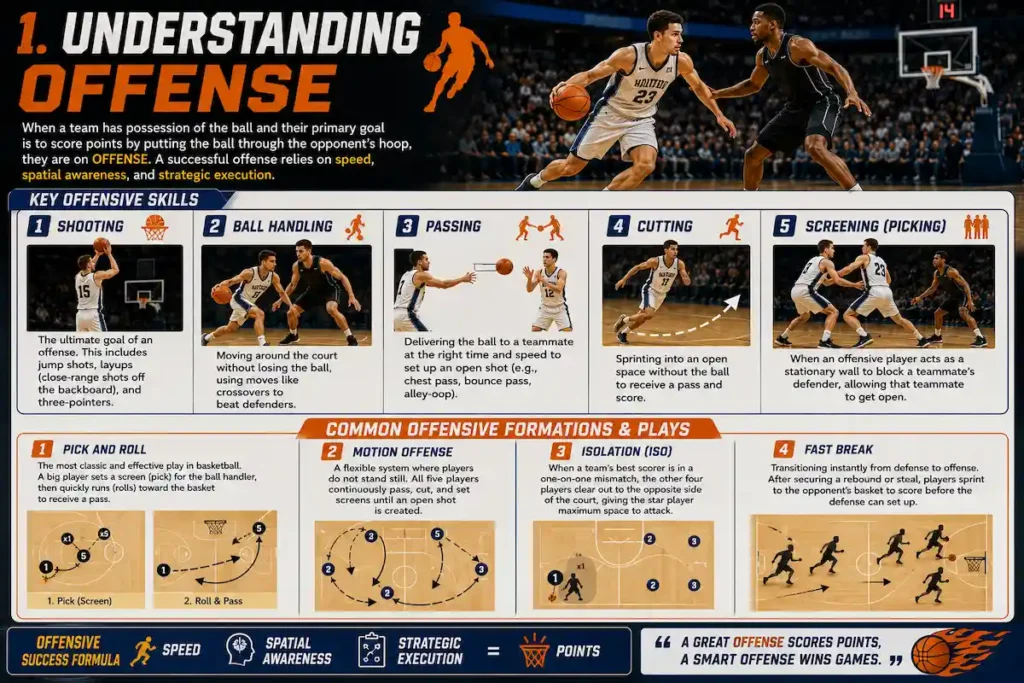
When a team has possession of the ball and their primary goal is to score points by putting the ball through the opponent’s hoop, they are on Offense. A successful offense relies on speed, spatial awareness, and strategic execution.
Key Offensive Skills
- Shooting: The ultimate goal of an offense. This includes jump shots, layups (close-range shots off the backboard), and three-pointers.
- Ball Handling: Moving around the court without losing the ball, using moves like crossovers to beat defenders.
- Passing: Delivering the ball to a teammate at the right time and speed to set up an open shot (e.g., chest pass, bounce pass, alley-oop).
- Cutting: Sprinting into an open space without the ball to receive a pass and score.
- Screening (Picking): When an offensive player acts as a stationary wall to block a teammate’s defender, allowing that teammate to get open.
Common Offensive Formations & Plays
- Pick and Roll: The most classic and effective play in basketball. A big player sets a screen (pick) for the ball handler, then quickly runs (rolls) toward the basket to receive a pass.
- Motion Offense: A flexible system where players do not stand still. All five players continuously pass, cut, and set screens until an open shot is created.
- Isolation (Iso): When a team’s best scorer is in a one-on-one mismatch, the other four players clear out to the opposite side of the court, giving the star player maximum space to attack.
- Fast Break: Transitioning instantly from defense to offense. After securing a rebound or steal, players sprint to the opponent’s basket to score before the defense can set up.
How to Implement a Good Offense Good spacing is crucial; players should stay 15-20 feet apart to prevent one defender from guarding two people. Furthermore, the ball should be moved rapidly through passing, as a pass will always travel faster than a dribbling player.
2. Understanding Defense
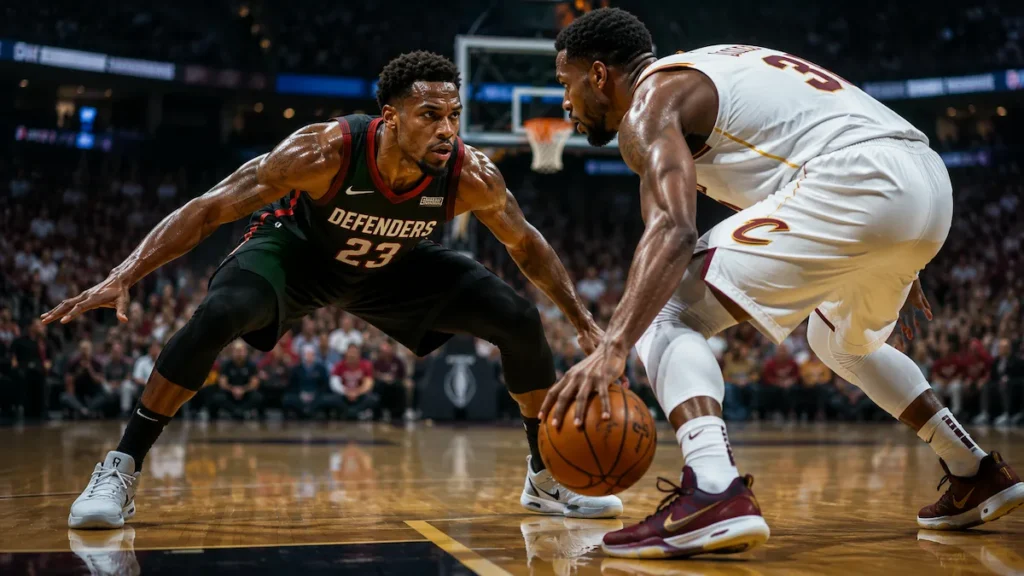
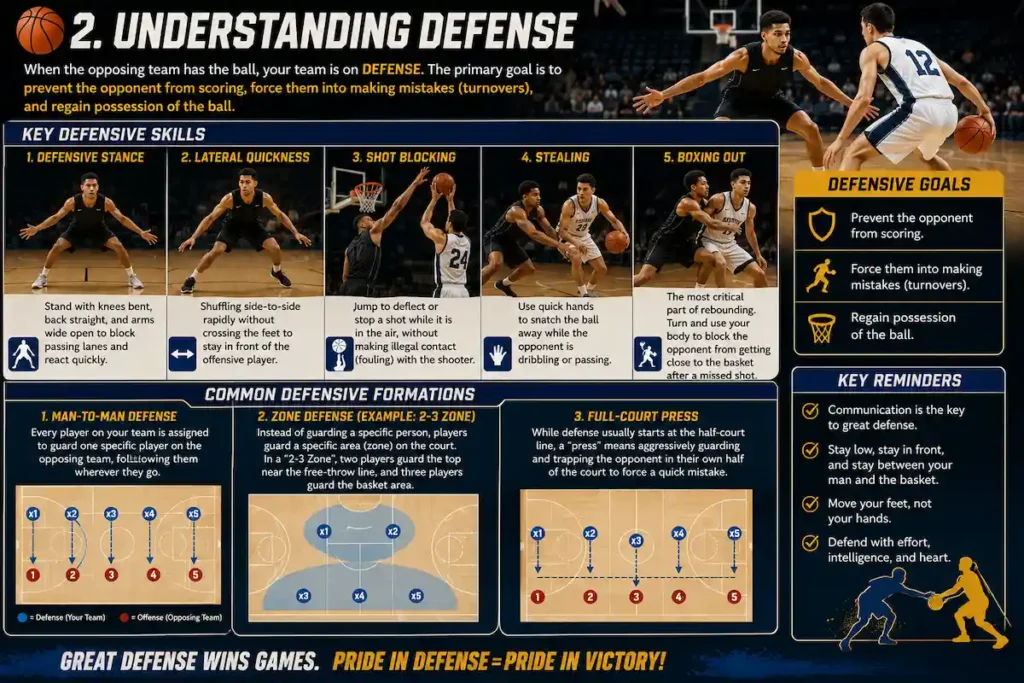
When the opposing team has the ball, your team is on Defense. The primary goal is to prevent the opponent from scoring, force them into making mistakes (turnovers), and regain possession of the ball.
Key Defensive Skills
- Defensive Stance: Standing with knees bent, back straight, and arms wide open to block passing lanes and react quickly.
- Lateral Quickness: Shuffling side-to-side rapidly without crossing the feet to stay in front of the offensive player.
- Shot Blocking: Jumping to deflect or stop a shot while it is in the air, without making illegal contact (fouling) with the shooter.
- Stealing: Quick hands to snatch the ball away while the opponent is dribbling or passing.
- Boxing Out: The most critical part of rebounding. Turning and using your body to block the opponent from getting close to the basket after a missed shot.
Common Defensive Formations
- Man-to-Man Defense: Every player on your team is assigned to guard one specific player on the opposing team, following them wherever they go.
- Zone Defense: Instead of guarding a specific person, players guard a specific area (zone) on the court. For example, in a ‘2-3 Zone’, two players guard the top near the free-throw line, and three players guard the basket area.
- Full-Court Press: While defense usually starts at the half-court line, a ‘press’ means aggressively guarding and trapping the opponent in their own half of the court to force a quick mistake.
How to Implement a Good Defense Communication is the heart of team defense. Players must constantly talk (e.g., calling out screens or asking for help). A defender must also always abide by the golden rule: stay directly between your assigned man and the basket. Finally, if a teammate gets beaten, another defender must step up to provide “help defense.”
Health & Physiology Benefits
Basketball is a strenuous, full-body workout that provides immense physiological benefits:
- Cardiovascular Health: The continuous sprinting, jogging, and jumping significantly elevate the heart rate, building deep aerobic and anaerobic endurance.
- Bone Density & Muscle Strength: The impact of jumping and landing increases bone mineral density. The sport heavily develops the core, calves, glutes, and shoulders.
- Agility and Coordination: The need to dribble a ball while running and tracking other players dramatically improves hand-eye coordination, spatial awareness, and lateral agility.
Indian Basketball Icons
Basketball is rapidly growing in India, and several stars have made history on the international stage:
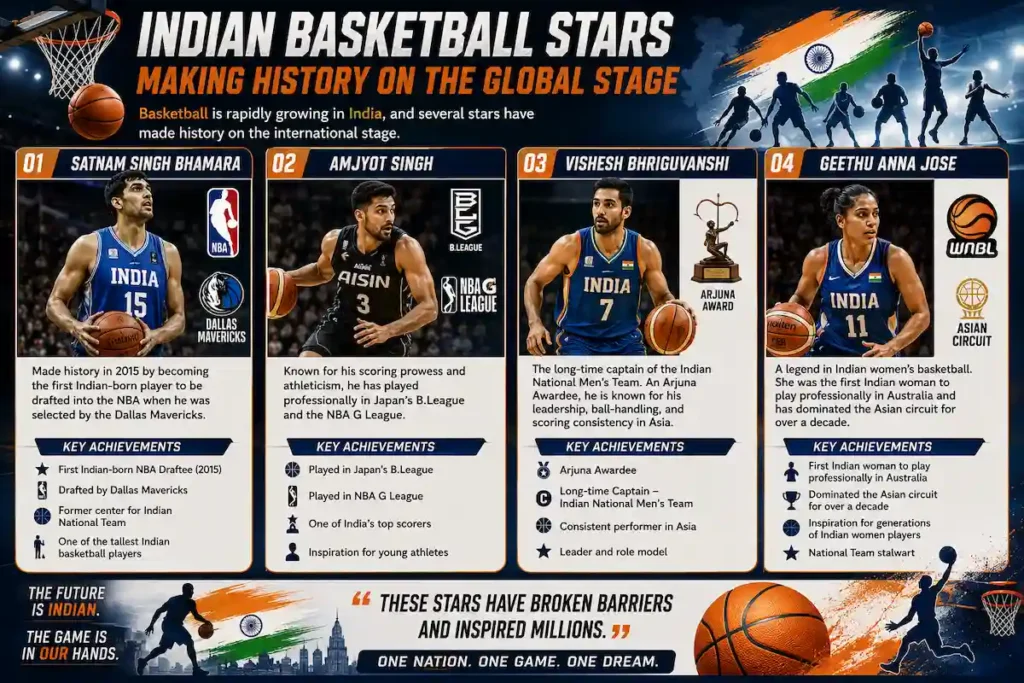
- Satnam Singh Bhamara: Made history in 2015 by becoming the first Indian-born player to be drafted into the NBA when he was selected by the Dallas Mavericks.
- Amjyot Singh: Known for his scoring prowess and athleticism, he has played professionally in Japan’s B.League and the NBA G League.
- Vishesh Bhriguvanshi: The long-time captain of the Indian National Men’s Team. An Arjuna Awardee, he is known for his leadership, ball-handling, and scoring consistency in Asia.
- Geethu Anna Jose: A legeA comprehensive basketball offense infographic illustrating essential offensive skills, including shooting, ball handling, passing, cutting, screening, and common offensive formations such as Pick and Roll, Motion Offense, Isolation (Iso), and Fast Break.nd in Indian women’s basketball. She was the first Indian woman to play professionally in Australia and has dominated the Asian circuit for over a decade.
International Legends
These players have transcended the sport to become global cultural icons:
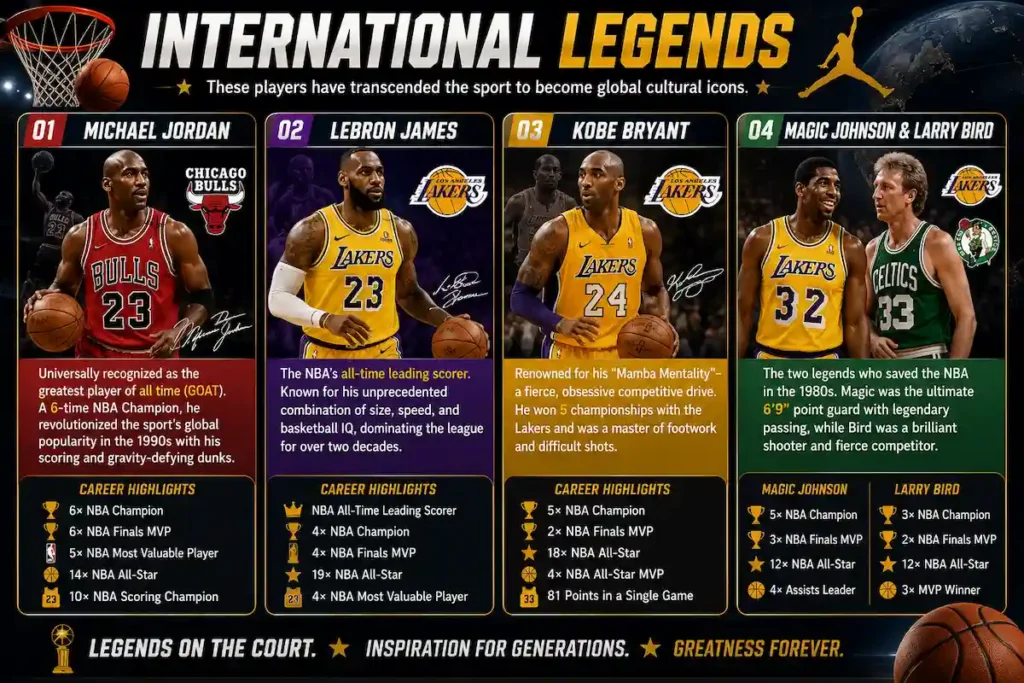
- Michael Jordan: Universally recognized as the greatest player of all time (GOAT). A 6-time NBA Champion, he revolutionized the sport’s global popularity in the 1990s with his scoring and gravity-defying dunks.
- LeBron James: The NBA’s all-time leading scorer. Known for his unprecedented combination of size, speed, and basketball IQ, dominating the league for over two decades.
- Kobe Bryant: Renowned for his “Mamba Mentality”—a fierce, obsessive competitive drive. He won 5 championships with the Lakers and was a master of footwork and difficult shots.
- Magic Johnson & Larry Bird: The two legends who saved the NBA in the 1980s. Magic was the ultimate 6’9″ point guard with legendary passing, while Bird was a brilliant shooter and fierce competitor.
Major Championships
The pinnacle of basketball competition happens on these major stages:
- The NBA Finals: The culmination of the North American professional season, where the Eastern and Western Conference champions clash. It is the most watched basketball event globally.
- FIBA Basketball World Cup: An international tournament contested by the men’s national teams, held every four years.
- The Olympic Games: Basketball has been an official Olympic medal sport since 1936. Winning Olympic Gold is considered the highest honor for a national team.
- EuroLeague: The highest level of professional club basketball in Europe, known for its passionate fans and highly tactical style of play.
Career Opportunities in Basketball
The basketball industry offers diverse professional pathways beyond just playing:
- Professional Player: Competing in domestic leagues, foreign professional leagues, or aiming for the NBA/WNBA.
- Coaching & Development: Working as a head coach, assistant coach, or skills trainer for schools, academies, or professional clubs.
- Sports Analytics & Management: Modern basketball relies heavily on data. Video coordinators, statisticians, and sports managers are in high demand globally.
- Officiating: Becoming a certified FIBA referee allows you to travel the world and officiate international tournaments.
Conclusion
Basketball is much more than putting a ball through a hoop; it is a symphony of athleticism, strategy, and teamwork. It teaches discipline, resilience, and the importance of working together toward a common goal. The sheer thrill of a fast break, the tension of a buzzer-beating shot, and the explosive energy of a slam dunk make it one of the most entertaining sports in human history. Whether you are aiming to play competitively or just looking for a fantastic way to stay fit, stepping onto the hardwood court is an experience unlike any other.