
Introduction
Badminton is one of the fastest and most exciting racket sports in the world. It is played by millions of people for recreation, fitness, and professional competition. The game requires speed, agility, balance, endurance, coordination, and quick decision-making. Unlike many other racket sports, badminton uses a shuttlecock instead of a ball, making it unique and highly challenging.
Badminton is played both indoors and outdoors, although professional matches are always held indoors to avoid the effects of wind. It is an Olympic sport governed by the Badminton World Federation (BWF), which organizes international tournaments and establishes the official rules of the game.
In India, badminton has become one of the most popular sports after cricket. Indian players have achieved remarkable success in international competitions, inspiring millions of young athletes. Today, badminton is played in schools, colleges, clubs, academies, and professional leagues across the country.
History of Badminton
The origins of badminton can be traced back more than 2,000 years. Ancient civilizations in China, Greece, Egypt, and India played games similar to badminton using a shuttle-like object and simple rackets or paddles.
One of the earliest games resembling badminton was known as Battledore and Shuttlecock, which became popular in Europe during the 17th and 18th centuries. In this game, players tried to keep the shuttlecock in the air for as long as possible without letting it touch the ground.
The modern version of badminton developed in India during the British colonial period. British army officers stationed in Pune (formerly Poona), Maharashtra, played a local game that later evolved into modern badminton. Because of its popularity in Pune, the game was initially known as the “Poona Game.”
In 1873, officers returning to England introduced the game at Badminton House, the residence of the Duke of Beaufort in Gloucestershire. The game quickly gained popularity among British society and became known as Badminton.
The first official rules of badminton were established in 1887 by the Bath Badminton Club in England. Later, the Badminton Association of England standardized the rules in 1893.
The first major international competition, the All England Open Badminton Championships, was held in 1899. It remains one of the oldest and most prestigious badminton tournaments in the world.
The International Badminton Federation (IBF) was founded in 1934 with nine member countries. In 2006, the organization was renamed the Badminton World Federation (BWF).
Badminton became an official medal sport in the 1992 Barcelona Olympic Games, marking a significant milestone in its global recognition.
Evolution of Badminton
Badminton has transformed from a recreational pastime into one of the fastest racket sports globally. Advances in sports science, coaching, equipment technology, and fitness training have significantly improved the speed and competitiveness of the game.
Modern badminton players rely on:
- Scientific training methods
- Video performance analysis
- Sports nutrition
- Psychological preparation
- Advanced racket technology
- Lightweight shuttlecocks
- High-performance footwear
Today, badminton is especially popular in countries such as:
- China
- India
- Indonesia
- Malaysia
- Japan
- Denmark
- South Korea
- Thailand
- Chinese Taipei
- Singapore
Court Dimensions
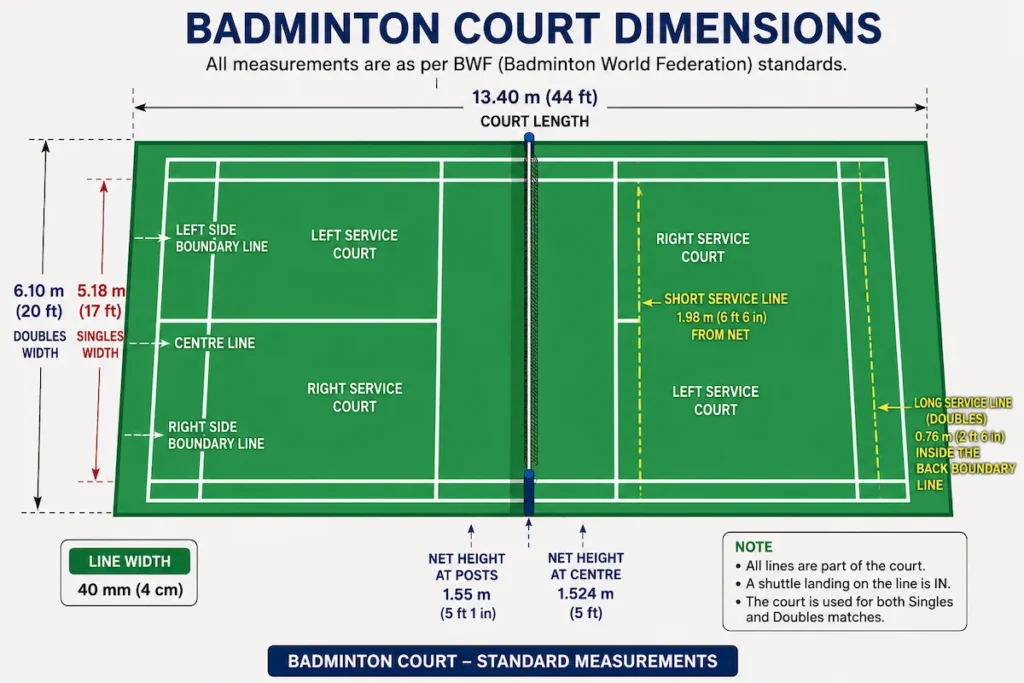
Badminton is played on a rectangular court divided into two equal halves by a net.
Standard Court Measurements
| Measurement | Size |
|---|---|
| Court Length | 13.40 m |
| Singles Width | 5.18 m |
| Doubles Width | 6.10 m |
| Net Height at Posts | 1.55 m |
| Net Height at Centre | 1.524 m |
| Short Service Line | 1.98 m from net |
| Long Service Line (Doubles) | 0.76 m from back boundary |
| Centre Line | Divides service courts |
Equipment Used in Badminton
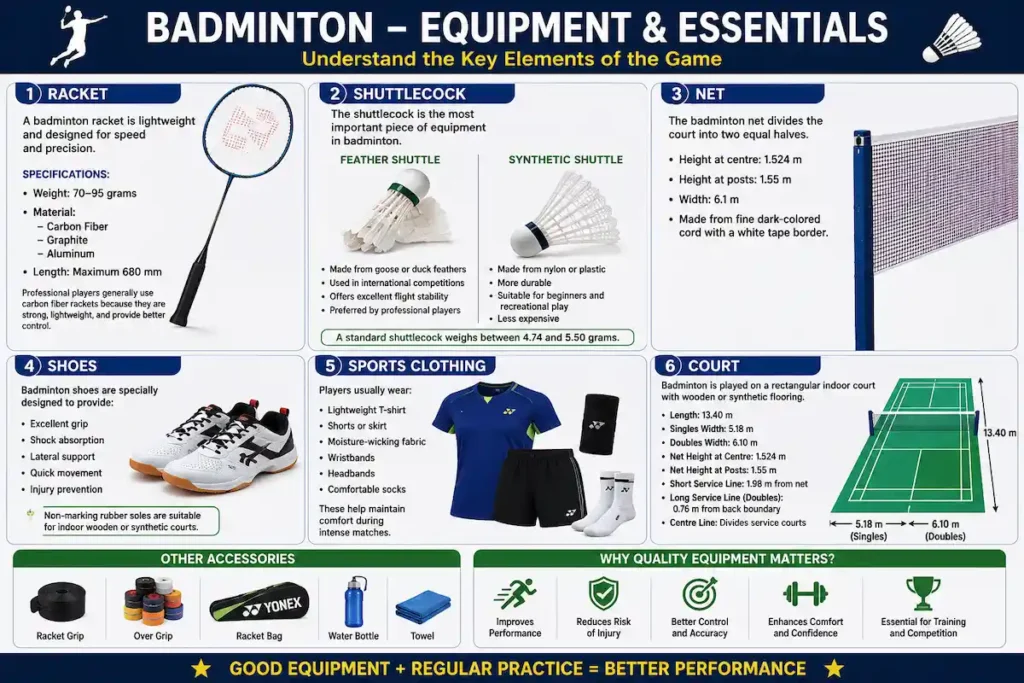
1. Racket
A badminton racket is lightweight and designed for speed and precision.
Specifications:
- Weight: 70–95 grams
- Material:
- Carbon Fiber
- Graphite
- Aluminum
- Length: Maximum 680 mm
Professional players generally use carbon fiber rackets because they are strong, lightweight, and provide better control.
2. Shuttlecock
The shuttlecock is the most distinctive piece of equipment in badminton.
Types of Shuttlecocks
Feather Shuttle
- Made from goose or duck feathers
- Used in international competitions
- Offers excellent flight stability
- Preferred by professional players
Synthetic Shuttle
- Made from nylon or plastic
- More durable
- Suitable for beginners and recreational play
- Less expensive than feather shuttles
A standard shuttlecock weighs between 4.74 and 5.50 grams.
3. Net
The badminton net divides the court into two equal halves.
Specifications:
- Height at centre: 1.524 m
- Height at posts: 1.55 m
- Width: 6.1 m
- Made from fine dark-colored cord with a white tape border.
4. Shoes
Badminton shoes are specially designed to provide:
- Excellent grip
- Shock absorption
- Lateral support
- Quick movement
- Injury prevention
Professional players use non-marking rubber soles suitable for indoor wooden or synthetic courts.
5. Sports Clothing
Players usually wear:
- Lightweight T-shirt
- Shorts or skirt
- Moisture-wicking fabric
- Wristbands
- Headbands
- Comfortable socks
These help maintain comfort during intense matches.
Rules of Badminton
Badminton follows the official rules established by the Badminton World Federation (BWF).
Basic Rules
- A match begins with a serve.
- The shuttle must pass over the net into the opponent’s service court.
- A rally coGENERAL RULES
1. Team Composition
Singles: Played with one player per side.
Doubles: Played with two players per side.
Mixed Doubles: Played with one male and one female player per side.
2. Match Duration
A standard badminton match is played in the best-of-three games format.
Each game is played to 21 points.
Players must win by at least 2 points.
If the score reaches 20–20, a player must win by 2 points.
If the score reaches 29–29, the next point wins the game.
3. Serving
The serve must be delivered diagonally into the opponent’s service court.
The server must strike the shuttlecock below the waist and keep their feet behind the service line.
In singles, players serve from the right side of the court when their score is even and from the left side when their score is odd.
In doubles, the serving side alternates service between its players, starting from the right side of the court.
4. Scoring System
Points are scored on every serve (rally scoring system).
The player or team who wins a rally scores a point and serves next.
5. Faults
Service Faults
Errors in serving, such as:
Serving above the waist.
Serving into the wrong court.
Striking the shuttlecock with a part of the body.
Play Faults
Includes:
Hitting the shuttlecock out of bounds.
Not clearing the net.
Striking the shuttlecock more than once before it crosses the net.
Shuttlecock Faults
The shuttlecock must land within the boundaries of the opponent’s court.
If it lands outside, hits the ceiling, or the net, it is a fault.
6. Net Play
Players must not touch the net with their body or racket during play.
Players cannot reach over the net to strike the shuttlecock. However, they can follow through over the net after hitting it.
7. Rally Play
Each player or team must hit the shuttlecock over the net and into the opponent’s court.
The shuttlecock must be hit once by each side before crossing the net.
8. Let Serve
If the shuttlecock hits the top of the net and lands in the correct service court, the serve is considered a “let serve,” and it is replayed.ntinues until the shuttle lands outside the court, hits the net, or a fault occurs. - Players alternate serves according to the scoring rules.
- The shuttle may only be struck once before crossing the net.
- Touching the net with the racket or body during play is considered a fault.
- If the shuttle lands on the boundary line, it is considered in.
9. Substitutions
- There are no formal substitutions in badminton matches, but players can request breaks periodically.
10. Referees and Officials
- Referee is responsible for a match.
- A service judge watches the server.
- Line judges call whether the shuttle lands in or out.
11. Toss
- Before the beginning of a game, there will be a toss. The winner of the toss decides to choose an end of the court or to serve first.
12. Scoring
- A game consists of 21 points.
- Best of three games.
- If the score becomes 20–20, the game continues until one side leads by 2 points.
- If the score reaches 29–29, the side scoring the 30th point wins the game.
13. Match
A match consists of the best of three games.
Fundamental Skills of Badminton
Badminton is a fast-paced racket sport that requires a combination of technical skills, physical fitness, and tactical awareness. To become a successful player, every beginner should master the fundamental skills of badminton. These skills form the foundation for advanced techniques and competitive performance.
1. Grip
The grip is the way a player holds the badminton racket. A correct grip provides better control, accuracy, power, and flexibility while playing different strokes.
Types of Grip
A. Forehand Grip
- Used for forehand shots.
- Also called the Handshake Grip.
- Provides maximum power for clears, smashes, and drives.
B. Backhand Grip
- Used for backhand shots.
- The thumb rests against the wider bevel of the racket handle.
- Helps generate better control and power on the backhand side.
Importance
- Improves racket control.
- Prevents wrist injuries.
- Enables quick grip changes during rallies.
2. Ready Stance
The ready stance is the basic position from which a player prepares to receive the shuttle and move in any direction.
Key Points
- Feet shoulder-width apart.
- Knees slightly bent.
- Weight on the balls of the feet.
- Racket held in front of the body.
- Eyes focused on the opponent.
Importance
- Faster reaction time.
- Better balance.
- Quicker movement around the court.
3. Footwork
Footwork refers to the movement of the feet that allows players to reach the shuttle quickly and maintain balance.
Types of Footwork
- Forward movement
- Backward movement
- Sideways movement
- Diagonal movement
- Split step
- Lunge
- Chasse step
- Cross-over step
Importance
- Covers the court efficiently.
- Saves energy.
- Improves speed and balance.
- Reduces injury risk.
4. Serving
The serve starts every rally and is one of the most important technical skills in badminton.
Types of Serves
Short Serve
- Lands close to the opponent’s front service line.
- Commonly used in doubles.
High Serve
- Travels high and deep into the opponent’s backcourt.
- Mainly used in singles.
Flick Serve
- Looks like a short serve but travels quickly to the backcourt.
Drive Serve
- A fast, flat serve aimed at surprising the opponent.
Importance
- Begins the rally.
- Creates attacking opportunities.
- Puts pressure on the receiver.
5. Clear Shot
A clear is a high shot that sends the shuttle to the opponent’s backcourt.
Types
- Attacking Clear
- Defensive Clear
Importance
- Creates space.
- Pushes the opponent backward.
- Gives the player time to recover.
6. Drop Shot
A drop shot is played softly so that the shuttle lands just over the net in the opponent’s frontcourt.
Types
- Slow Drop
- Fast Drop
Importance
- Forces the opponent to move forward.
- Creates opportunities for attack.
- Breaks the opponent’s rhythm.
7. Smash
The smash is the most powerful attacking shot in badminton. The shuttle is hit steeply downward at high speed.
Types
- Forehand Smash
- Backhand Smash
- Jump Smash
Importance
- Wins points directly.
- Puts pressure on the opponent.
- Most effective offensive stroke.
8. Drive Shot
A drive is a fast, flat shot that travels horizontally over the net.
Importance
- Increases rally speed.
- Used in doubles.
- Keeps opponents under pressure.
9. Net Shot
A net shot is played softly near the net so that the shuttle tumbles just over the tape.
Types
- Forehand Net Shot
- Backhand Net Shot
Importance
- Forces the opponent to lift the shuttle.
- Creates attacking chances.
- Improves net control.
10. Lift
A lift is a defensive shot played from the frontcourt to the opponent’s backcourt.
Importance
- Escapes pressure.
- Allows recovery time.
- Resets the rally.
11. Return of Serve
The return of serve is the first shot played after receiving the opponent’s serve.
Common Returns
- Net Return
- Drive Return
- Push Return
- Lift Return
Importance
- Starts offensive or defensive play.
- Helps gain early control of the rally.
12. Coordination and Timing
Successful badminton players must coordinate their body movements with the shuttle’s speed and direction.
Importance
- Better shot accuracy.
- More powerful strokes.
- Improved consistency.
13. Balance
Balance helps players remain stable before, during, and after every shot.
Importance
- Prevents falls.
- Improves recovery.
- Enables quick movement.
14. Recovery Position
After every shot, players should quickly return to the base position (center of the court) to prepare for the next stroke.
Importance
- Better court coverage.
- Faster response.
- Improved defense.
Summary of Fundamental Skills
| Fundamental Skill | Purpose |
|---|---|
| Grip | Hold the racket correctly |
| Ready Stance | Prepare for movement |
| Footwork | Move efficiently around the court |
| Serving | Start the rally |
| Clear | Push opponent to the backcourt |
| Drop Shot | Place the shuttle near the net |
| Smash | Powerful attacking shot |
| Drive | Fast flat attacking shot |
| Net Shot | Control play near the net |
| Lift | Defensive shot to the backcourt |
| Return of Serve | Begin the rally after receiving |
| Coordination | Improve timing and control |
| Balance | Maintain stability |
| Recovery Position | Return to the base position after each sho |
Mastering the fundamental skills of badminton is essential for every player, from beginners to professionals. Correct grip, efficient footwork, accurate serving, powerful smashes, precise net shots, and good balance work together to improve overall performance. Regular practice of these basic skills builds confidence, enhances fitness, and prepares players for competitive badminton. These fundamentals serve as the foundation for advanced techniques and long-term success in the sport.
Types of Badminton Events
International badminton competitions feature five official events:
1. Men’s Singles
One male player competes against another male player.
2. Women’s Singles
One female player competes against another female player.
3. Men’s Doubles
Two male players compete against another pair of male players.
4. Women’s Doubles
Two female players compete against another pair of female players.
5. Mixed Doubles
A team consisting of one male and one female player competes against another mixed pair.
Mixed doubles is one of the most strategic events, requiring excellent coordination, communication, and tactical play between partners.
Importance of Learning Badminton
Badminton is much more than a competitive sport. It promotes a healthy lifestyle and develops essential physical and mental qualities.
Physical Benefits
- Improves cardiovascular fitness
- Increases stamina and endurance
- Enhances speed and agility
- Builds muscular strength
- Improves flexibility and coordination
- Helps maintain healthy body weight
Mental Benefits
- Improves concentration
- Develops quick decision-making
- Enhances confidence
- Reduces stress
- Encourages discipline and sportsmanship
Conclusion
Badminton has evolved from a simple recreational game into one of the world’s most exciting Olympic sports. With its rich history, well-defined rules, standardized court dimensions, specialized equipment, and thrilling gameplay, badminton continues to attract players of all ages. Understanding its origins, rules, scoring system, and equipment provides a strong foundation for appreciating the sport. In the next part, we will explore the techniques, skills, fitness requirements, major international tournaments, Olympic badminton, and the greatest international legends who have shaped the game.