When a gymnast lands a perfect backflip, a cricket fast bowler delivers a 150 km/h yorker, or a weightlifter cleans 200kg off the floor, they are not just relying on raw muscle power—they are mastering the laws of physics. Sports Biomechanics is the scientific analysis of human movement and the internal and external forces that act upon the body during physical activity.
For physical education professionals, coaches, and sports science enthusiasts, biomechanics provides the exact blueprint for efficiency. By understanding how joints act as levers, how torque generates rotational power, and how the center of gravity dictates stability, we can optimize athletic performance, correct faulty techniques, and significantly reduce the risk of injury. In this comprehensive guide, we will break down the foundational principles of sports biomechanics and how they apply to real-world athletic movements.
1. Planes & Axes: The 3D Map of Human Movement
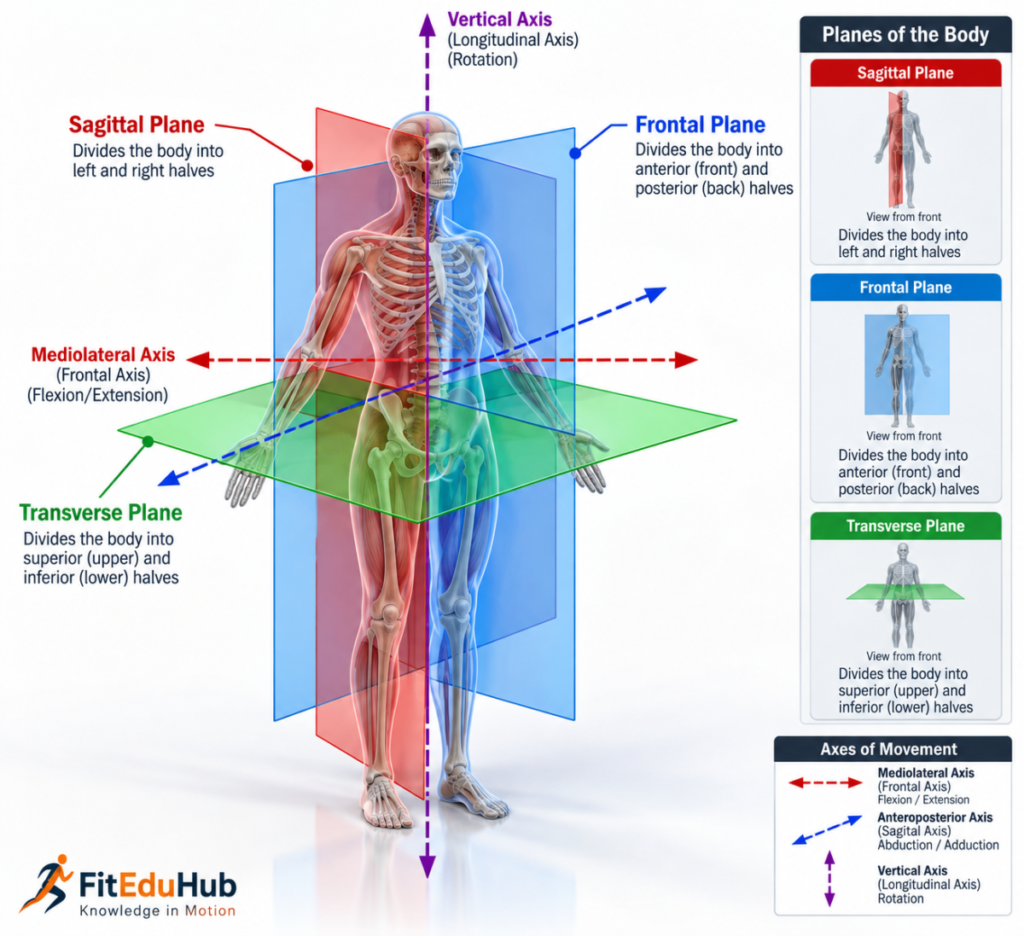
To scientifically analyze human movement, sports scientists use an imaginary 3D mapping system consisting of planes (flat surfaces dividing the body) and axes (imaginary lines around which rotation occurs). Every athletic movement, no matter how complex, happens within these dimensions.
The Three Anatomical Planes
Sagittal Plane: This vertical plane divides the body into left and right halves. Movements in this plane go directly forward and backward.
Practical Scientific Example: Sprinting, cycling, performing a Bicep Curl, or kicking a football.
Frontal (Coronal) Plane: This vertical plane divides the body into front and back halves. Movements here are side-to-side (lateral).
Practical Scientific Example: Performing jumping jacks, lateral shoulder raises, or a basketball player side-stepping on defense.
Transverse (Horizontal) Plane: This plane divides the body into upper and lower halves. Movements in this plane primarily involve rotation.
Practical Scientific Example: A golf swing, a discus throw, or twisting the torso to throw a punch in boxing.
The Corresponding Axes of Rotation
Movement in a plane always occurs around an axis that runs exactly 90 degrees (perpendicular) to that plane.
Frontal Axis: Runs side-to-side (pairs with the Sagittal Plane). Think of a gymnast performing a forward somersault around a horizontal bar.
Sagittal Axis: Runs front-to-back (pairs with the Frontal Plane). Think of a gymnast doing a lateral cartwheel.
Vertical (Longitudinal) Axis: Runs top-to-bottom (pairs with the Transverse Plane). Think of a figure skater performing a rapid upright spin.
👉 Pro Tip: Anatomy & KinesiologyExplore the skeletal and muscular structures that allow movement across these planes in our complete Anatomy guide.
Body planes and axes of movement: sagittal, frontal, and transverse planes illustrated with a 3D anatomical figure.
2. Force & Torque: The Engines of Action
In the realm of biomechanics, nothing moves without force, and nothing rotates without torque. Understanding how to manipulate these two elements is the secret to athletic dominance.
Understanding Force in Sports
Force is a push or pull that alters the state of motion of a body. It is measured in Newtons (N).
Internal Forces: These are generated inside the body by muscle contractions pulling on bones via tendons.
External Forces: These are environmental factors acting on the athlete, such as gravity, air resistance (drag), friction from the ground, or a physical tackle from an opponent.
Practical Scientific Example: When a sprinter pushes off the starting blocks, their leg muscles generate immense internal force. This transfers into the block, and the block pushes back with an external force (Ground Reaction Force), propelling the athlete forward down the track.
Torque: The Rotational Force
While force moves things in a straight line, torque is the rotational equivalent of linear force. Since human joints are hinges or pivots, almost all human movement is rotational in nature.
Torque = Force × Moment Arm (Distance from the joint to the line of force).
The longer the moment arm, the greater the torque produced. This is why tall tennis players or volleyball attackers with long arms can strike the ball with such devastating power—their long limbs act as massive force multipliers.
👉 Pro Tip: Strength & ConditioningLearn how to maximize your internal force production and explosive torque in our Power Development section.
3. Levers: The Body’s Mechanical Advantage
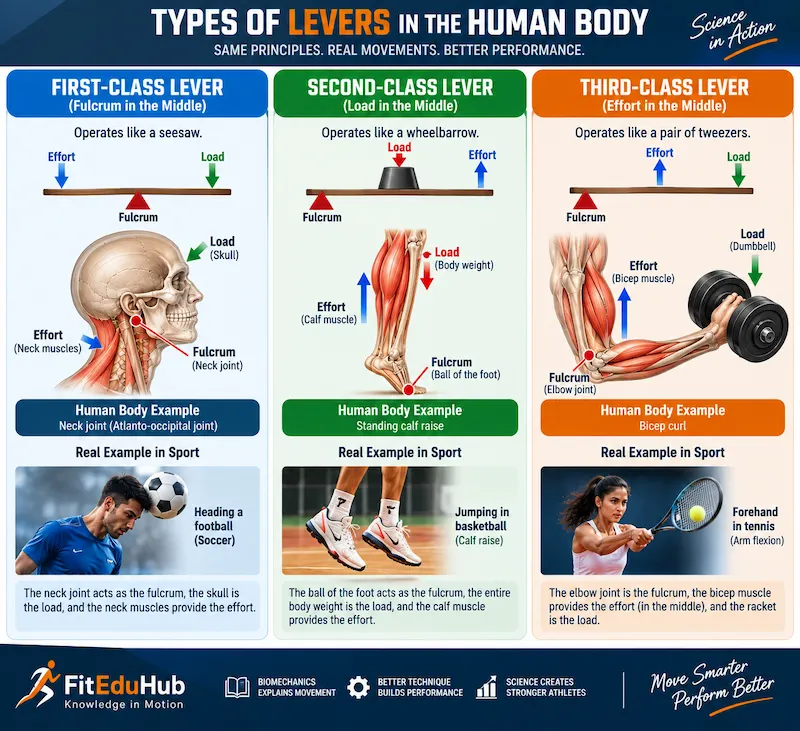
The human musculoskeletal system is essentially a complex series of biological levers. A lever system consists of a rigid bar (the bone), a fulcrum or pivot point (the joint), an effort or applied force (the muscle contraction), and a load or resistance (the weight of the body part or an external object like a dumbbell).
The Three Classes of Levers
Understanding which lever you are using helps determine whether a movement is designed for heavy strength or high speed.
First-Class Levers (Fulcrum in the middle): Operates like a seesaw.
Human Body Example: The neck joint (Atlanto-occipital joint). The skull is the load, the neck joint is the fulcrum, and the trapezius/neck muscles provide the effort to keep the head up.
Second-Class Levers (Load in the middle): Operates like a wheelbarrow. These provide a massive mechanical advantage for strength, meaning a small effort can move a heavy load.
Human Body Example: Performing a standing calf raise. The ball of the foot acts as the fulcrum, the entire body weight is the load in the middle, and the calf muscle (gastrocnemius) pulls up on the heel (effort).
Third-Class Levers (Effort in the middle): Operates like a pair of tweezers or a fishing rod. These are the most common levers in the human body. They sacrifice strength but provide a huge advantage for speed and range of motion.
Human Body Example: A bicep curl. The elbow joint is the fulcrum, the dumbbell in the hand is the load, and the bicep muscle attaches just past the elbow (effort in the middle) to lift the weight.
Three classes of human body levers explained through anatomy and real sports movements.
👉 Pro Tip: EXERCISE LIBRARY / Bicep CurlSee third-class levers in action in our detailed Bicep Curl execution guide.
4. Centre of Gravity (CoG): The Core of Control
The Centre of Gravity (CoG), also known as the center of mass, is the exact theoretical point around which the body’s entire mass is equally balanced in all directions.
The Dynamic Nature of CoG
In a rigid, symmetrical object like a perfectly round basketball, the CoG is always exactly in the center and never changes. However, because the human body is flexible and constantly moving, the CoG shifts depending on your posture and limb position.
In a normal, upright standing position with arms by the sides, an adult’s CoG is typically located just behind the belly button (slightly higher in males due to broader shoulders, and slightly lower in females due to wider hips).
If you raise both arms above your head, your CoG moves upward into your chest.
If you bend over to touch your toes, your CoG actually leaves your physical body and hangs in the empty space below your stomach.
Biomechanical Hacks Using CoG
Elite athletes manipulate their CoG to achieve impossible feats.
Practical Scientific Example: During a high jump event (using the Fosbury Flop technique), the athlete arches their back so severely over the bar that their actual Centre of Gravity passes underneath the bar while their physical body passes over it. This is a brilliant biomechanical hack that allows the jumper to clear higher heights while expending less total force.
5. Balance & Stability: Defying Gravity
Stability is the ability of a body to resist being moved, overthrown, or having its equilibrium disrupted. In sports, maximizing stability is crucial for defensive positions, while intentionally minimizing stability is the secret to explosive acceleration.
The Rules of Maximum Stability
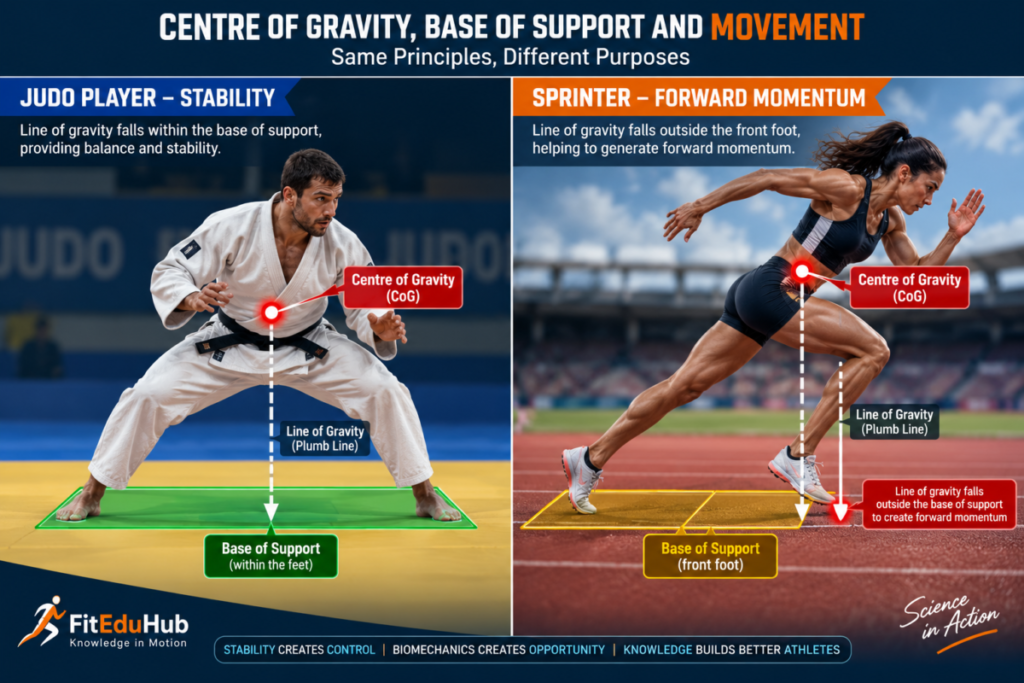
An athlete’s stability is dictated by the relationship between their Centre of Gravity (CoG), their Base of Support (BoS), and the Line of Gravity.
Widen the Base of Support: The Base of Support is the area beneath an object or person that includes every point of contact with the ground. Placing your feet shoulder-width apart makes you significantly more stable than standing with your feet together.
Lower the Centre of Gravity: By bending the knees and dropping the hips, you bring your CoG closer to the ground. A lower CoG means a larger force is required to tip you over.
Keep the Line of Gravity Inside the Base: The Line of Gravity is an imaginary vertical line dropping straight down from the CoG to the floor. If this line falls outside your Base of Support, you will lose balance and fall.
Practical Scientific Example: Consider a judo athlete or a football lineman in a defensive stance. They bend their knees deep (lowering CoG) and spread their legs wide (widening BoS). Because their Line of Gravity is dead-center in a massive base, they become incredibly difficult to push over. Conversely, a sprinter on the starting blocks intentionally leans far forward so their Line of Gravity falls outside their hands. They are completely unstable, which allows gravity to assist their explosive forward acceleration the moment the gun goes off.
👉 Pro Tip:Fitness Testing & AssessmentDiscover specific balance and stability assessments, such as the Stork Stand Test, in our Assessment category.
Centre of gravity and base of support explained through a judo stance and sprinting movement.
6. Joint Movements and Kinematics
Kinematics is the branch of biomechanics that describes the exact motion of a body (angles, speed, and displacement) without considering the forces causing it. To understand sports biomechanics, you must master the scientific terminology of joint movements.
Flexion & Extension (Sagittal Plane): Flexion decreases the angle of a joint (e.g., bending the elbow during a bicep curl, or bending the knee). Extension increases the joint angle (e.g., straightening the arm, or kicking a football).
Abduction & Adduction (Frontal Plane): Abduction moves a limb away from the imaginary midline of the body (e.g., raising your arms out to the sides). Adduction brings the limb back toward the midline.
Internal & External Rotation (Transverse Plane): Twisting a bone around its longitudinal axis. Turning your shoulder in toward your chest is internal rotation; opening it up backward is external rotation.
Plantarflexion & Dorsiflexion: Specific to the ankle joint. Plantarflexion is pointing the toes downward (like a ballerina on her toes). Dorsiflexion is pulling the toes upward toward the shin (crucial for proper squat depth).
👉 Pro Tip: Anatomy & KinesiologyExplore which specific muscle fibers drive these kinematic joint actions in our Major Muscle Groups guide.
7. Newton’s Laws of Motion in Sports
Sir Isaac Newton’s three laws of motion, formulated in 1687, remain the absolute, unbreakable foundation of sports biomechanics today.
First Law: The Law of Inertia
The Concept: A body at rest will stay at rest, and a body in motion will stay in motion with the same speed and in the same direction unless acted upon by an unbalanced external force.
Sports Application: A heavy 120kg rugby forward has a massive amount of inertia. When he is standing still, it takes immense force to move him. When he is sprinting at full speed, it takes an equally massive force to stop him. Mass is a direct measure of inertia.
Second Law: The Law of Acceleration (F = ma)
The Concept: Force equals Mass multiplied by Acceleration. Acceleration is directly proportional to the net force applied and inversely proportional to the mass of the object.
Sports Application: If a baseball batter wants to hit a home run, they must accelerate the bat as fast as possible. If they switch to a heavier bat (more mass), they must generate significantly more internal muscular force just to swing it at the same speed as the lighter bat.
Third Law: The Law of Action-Reaction (Ground Reaction Force)
The Concept: For every action, there is an equal and opposite reaction.
Sports Application: When a basketball player jumps for a dunk, they don’t just “float” up. They actively push down hard into the hardwood floor (the action). The rigid floor pushes back up against the soles of their shoes with the exact same amount of force (the reaction). In sports science, this upward thrust is called Ground Reaction Force (GRF). The harder you push the ground, the higher you jump.
👉 Pro Tip: Sports Research & TechnologyLearn how sports scientists use modern force plates to measure Ground Reaction Force down to the millisecond.
8. Applied Exercise Biomechanics: Analyzing the Big Three
How do we translate all these theoretical physics concepts to the gym floor? Let’s analyze the biomechanics of the three foundational strength training movements.
The Barbell Squat
Planes & Axes: Operates primarily in the Sagittal plane around a frontal axis.
Levers & Joints: The hips and knees act as intersecting fulcrums. A biomechanically perfect squat distributes the torque evenly between the knee joint (quadriceps effort) and the hip joint (glutes and hamstrings effort).
Biomechanics Flaw (Knee Valgus): When a lifter’s knees cave inward during the upward phase, they are introducing an unwanted frontal plane movement. This shifts the heavy load away from the muscles and places dangerous shear force directly on the ACL and MCL ligaments. 🔗 [INTERNAL LINK: EXERCISE LIBRARY / Squat]Master the perfect mechanical execution in our detailed Squat technique guide.
The Deadlift
Stability & CoG: In a deadlift, the lifter must keep the barbell vertically aligned exactly over the mid-foot (their Base of Support). If the bar drifts even one inch forward away from the shins, the combined Centre of Gravity shifts forward.
The Danger of Torque: When the bar drifts away from the body, it massively increases the moment arm between the weight and the lower back. This multiplies the torque on the lumbar spine, changing safe compressive force into highly dangerous shear force, risking a herniated disc. 🔗 [INTERNAL LINK: EXERCISE LIBRARY / Deadlift]Learn the exact setup cues to keep the barbell over your mid-foot in our Deadlift guide.
The Bench Press
Base of Support: While it looks like an upper-body isolation movement, a biomechanically sound bench press relies on multiple points of contact: the head, upper back, glutes on the bench, and feet driven hard into the floor.
Force Transfer: Using Newton’s Third Law, driving the feet into the floor (leg drive) creates a chain of kinetic action-reaction force that travels up through the rigid torso and into the arms, maximizing the total pressing power. 🔗 [INTERNAL LINK: EXERCISE LIBRARY / Bench Press]See how to optimize your pressing path and grip width in our Bench Press tutorial.
Conclusion: Bridging Physics and Athletics
Sports Biomechanics removes the guesswork from physical training. By applying the absolute laws of planes, axes, levers, and Newtonian physics, we can dissect any athletic movement—from a golf swing to a heavy deadlift—to find mechanical inefficiencies.
Whether you are a physical education teacher analyzing a student’s running form, or an elite strength coach programming for Olympic weightlifters, biomechanics is the definitive tool for engineering athletic supremacy. By consistently applying these scientific analyses, athletes not only achieve greater speed, force, and balance, but they also build a robust, injury-resistant musculoskeletal system.
📚 Evidence-Based References
To keep this guide highly actionable, we recommend exploring these two core foundational texts that dominate the field of sports biomechanics:
Basic Biomechanics by Susan J. Hall. (The gold standard textbook for understanding kinematics, kinetics, and lever systems in human movement).
Biomechanics of Sport and Exerciseby Peter M. McGinnis. (Highly recommended for its practical examples integrating Newton’s laws directly into real-world athletic performance).
Frequently Asked Questions: Sports Biomechanics
1. What is Sports Biomechanics?
Sports biomechanics is the scientific study and analysis of human movement, focusing on the internal muscular forces and external environmental forces that affect the body during athletic activities.
2. What are the three anatomical planes of movement?
The three planes are the Sagittal plane (forward and backward movements), the Frontal plane (side-to-side movements), and the Transverse plane (rotational or twisting movements).
3. How does torque affect athletic performance?
Torque is rotational force. It is determined by the force applied multiplied by the distance from the joint (moment arm). Greater torque allows athletes to generate more power in swinging, throwing, and kicking motions.
4. What is the most common type of lever in the human body?
Third-class levers are the most common in the human body. In these levers, the effort (muscle attachment) is located between the fulcrum (joint) and the load. This setup sacrifices absolute strength but allows for high speed and a large range of motion.
5. Why does the Centre of Gravity (CoG) change during movement?
Unlike a solid object, the human body is flexible. As you move your limbs, bend, or change posture, the distribution of your body mass changes, causing your Centre of Gravity to constantly shift to reflect your new shape.
6. How can an athlete safely increase their stability?
An athlete can maximize stability by widening their base of support (spreading their feet apart), lowering their centre of gravity (bending their knees), and ensuring their line of gravity falls perfectly in the middle of their base.
7. What is Ground Reaction Force (GRF)?
Based on Newton’s Third Law (Action-Reaction), GRF is the force exerted by the ground on a body in contact with it. When a runner pushes into the track, the track pushes back with equal force, propelling them forward.
8. What is the main difference between kinematics and kinetics?
Kinematics is the study of motion itself (speed, joint angles, velocity, and displacement) without worrying about what caused it. Kinetics is the study of the actual forces (friction, gravity, muscle tension) that produce or change that motion.
9. How does Newton’s Law of Inertia apply to heavy athletes?
The Law of Inertia states that objects resist changes to their state of motion. A heavier athlete (greater mass) has higher inertia, meaning they require significantly more force to start moving quickly, and once moving, significantly more force to stop.
10. Why is keeping the barbell over the mid-foot critical in a deadlift?
Keeping the barbell over the mid-foot aligns the weight directly with the athlete’s center of gravity and base of support. If the bar drifts forward, it creates a longer moment arm on the lower back, resulting in dangerous torque and a high risk of spinal injury.