

Introduction: Engineering the Ultimate Athlete
Talent and skill can win games, but superior physical conditioning wins championships. Strength and Conditioning (S&C) is the highly systematic, science-backed process of developing an athlete’s physical qualities—such as strength, speed, power, and endurance—while bulletproofing their body against injuries.
Unlike traditional bodybuilding, which focuses purely on muscle size and aesthetics, S&C focuses strictly on performance output. Whether you are a combat sports athlete needing explosive knockout power, a soccer player requiring 90 minutes of relentless stamina, or an average gym-goer wanting to move better and pain-free, the principles of strength and conditioning remain the same. In this comprehensive master guide, we will break down the precise methodologies used by elite sports scientists to build robust, high-performing human machines.
1. Strength: The Foundation of Athletic Performance
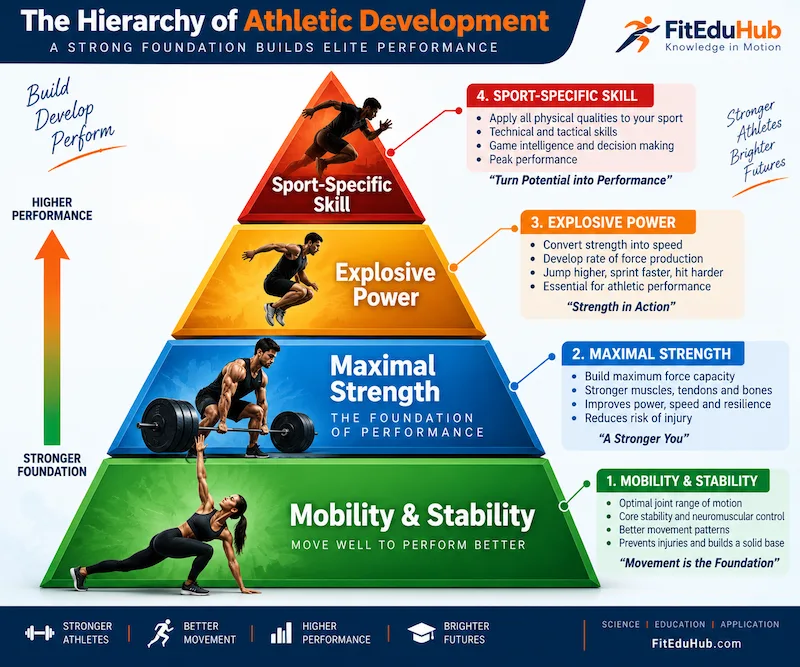
In the realm of sports science, strength is the foundational physical quality upon which all other athletic traits (like power and speed) are built. If your muscles cannot produce sufficient raw force, you cannot run fast, jump high, or tackle hard.
Types of Strength
Not all strength is the same. S&C coaches categorize strength into three main domains:
- Absolute (Maximal) Strength: The maximum amount of force a muscle group can generate in a single, all-out effort, regardless of the athlete’s body weight. Measured by a 1-Rep Max (1RM) in exercises like the Squat or Deadlift. Essential for powerlifters and American football linemen.
- Relative Strength: The amount of force generated relative to the athlete’s body weight. A 70kg gymnast who can deadlift 140kg (2x body weight) has superior relative strength compared to a 100kg athlete who can deadlift 150kg (1.5x body weight). Relative strength is the ultimate predictor of sprinting speed and body control.
- Strength Endurance: The ability to sustain sub-maximal muscular force over an extended period. Think of a wrestler grappling for 15 minutes or a rower constantly pulling against water resistance.
👉 Pro Tip: Anatomy & Kinesiology Understand how the nervous system recruits specific Type II muscle fibers for maximal strength in our Anatomy module.
2. Power: The Physics of Force × Velocity
Many beginners confuse strength with power. While strength is simply the ability to move a heavy load, Power is the ability to move a load fast.
In biomechanical terms, Power = Force × Velocity. You can be incredibly strong, but if you cannot apply that strength in a fraction of a second, you will not be powerful on the field.
Rate of Force Development (RFD)
The single most important metric in elite sports is the Rate of Force Development (RFD). It measures how fast an athlete can develop muscular force.
- In sports like sprinting or basketball, an athlete’s foot is on the ground for less than 0.2 seconds. A powerlifter might take 3 full seconds to grind out a heavy squat.
- Therefore, the athlete doesn’t just need absolute strength; their nervous system must be trained to fire all motor units in a fraction of a millisecond.
- Practical Scientific Example: An Olympic Weightlifter performing a Power Clean. They must generate immense upward force (strength) so rapidly (velocity) that the heavy barbell becomes weightless long enough for them to drop under it.
👉 Pro Tip: Sports Biomechanics Dive deeper into the physics of Force, Torque, and Acceleration in our Biomechanics section.
3. Speed: The Ultimate Weapon
Speed kills the competition. In S&C, speed training is a highly technical discipline focused on the biomechanics of movement and neural firing rates, not just “running hard until you’re tired.”
The Two Phases of Sprinting Speed
- Acceleration Phase (0 to 20 meters): This is all about pushing force. The athlete’s body is leaning heavily forward, and they are using their glutes and quads to drive violently into the ground (like pistons) to overcome inertia.
- Maximum Velocity Phase (20+ meters): Once top speed is reached, the mechanics completely change. The athlete is standing upright, and the focus shifts to the stretch-shortening cycle (elasticity) of the Achilles tendon. The foot acts like a stiff spring, spending minimum time on the ground (Ground Contact Time).
How to Train Speed
You cannot get faster by jogging long distances. True speed is developed through:
- Short Sprints (10-30m): With complete rest (2-3 minutes) between reps to ensure the central nervous system is 100% recovered.
- Resisted Sprints: Using sleds or parachutes to improve acceleration force.
- Overspeed Training: Running downhill (a very slight 2-degree decline) to force the nervous system to adapt to faster leg turnover rates.
4. Agility: Change of Direction and Cognitive Reaction
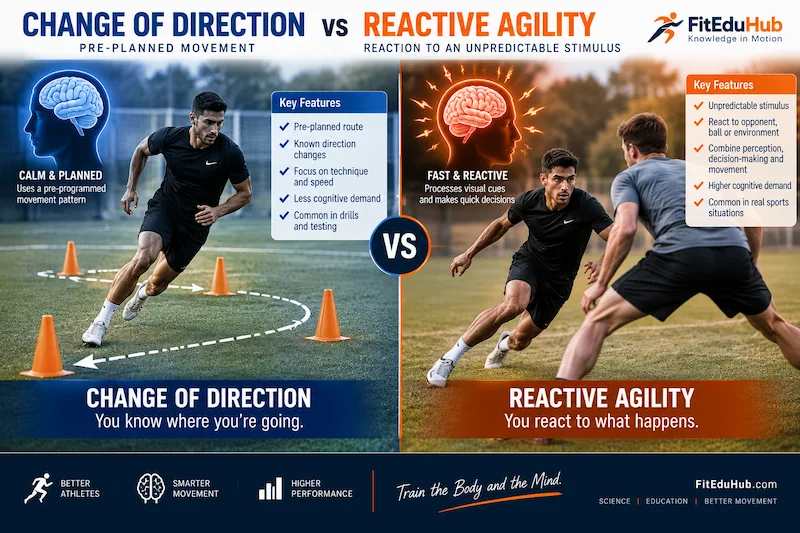
If speed is running fast in a straight line, agility is the ability to rapidly change direction in response to a stimulus.
Change of Direction (CoD) vs. True Agility
Sports scientists make a strict distinction between these two:
- Change of Direction (CoD): A pre-planned movement. Running a zig-zag drill through cones is CoD because the athlete already knows where they are going. It relies heavily on eccentric strength (the ability to brake and decelerate) and lateral stability.
- True Agility (Reactive Agility): Changing direction in response to an unpredictable external stimulus, like a defender moving or a ball being deflected. This involves the Perception-Action Coupling process.
The Cognitive Element
True agility requires a lightning-fast brain. The athlete must:
- Scan the environment (Visual scanning).
- Anticipate the opponent’s move.
- React and send the signal to the muscles.
- Execute the biomechanical change of direction.
👉 Pro Tip: Sports Psychology Enhance your reaction time, focus, and cognitive anticipation skills in our Sports Psychology category.
5. Endurance: The Engine That Never Quits
Endurance is the ability to resist fatigue and maintain a specific power output over time. Depending on the sport, conditioning programs target entirely different energy systems.
Aerobic Endurance (Stamina)
Aerobic means “with oxygen.” This is the foundational cardiovascular fitness required for long-duration events like long-distance running, cycling, or the continuous 90-minute jog of a midfielder in soccer.
- Training Method: Long Slow Distance (LSD) running, Zone 2 cardio, or high-volume circuit training. It builds a massive network of capillaries and increases the size of mitochondria in the muscles.
Anaerobic Endurance (Power Endurance)
Anaerobic means “without oxygen.” This is the ability to perform repeated bouts of high-intensity, explosive work with incomplete rest. Think of a boxer throwing heavy combinations round after round, or a hockey player doing a 45-second all-out shift on the ice.
- The Goal: To increase the body’s Lactate Buffering Capacity. The athlete is trained to clear metabolic waste (hydrogen ions) rapidly so their muscles don’t freeze up and burn out.
- Training Method: High-Intensity Interval Training (HIIT) or repeated sprint ability (RSA) drills.
6. Flexibility & Mobility: The Armor Against Injury
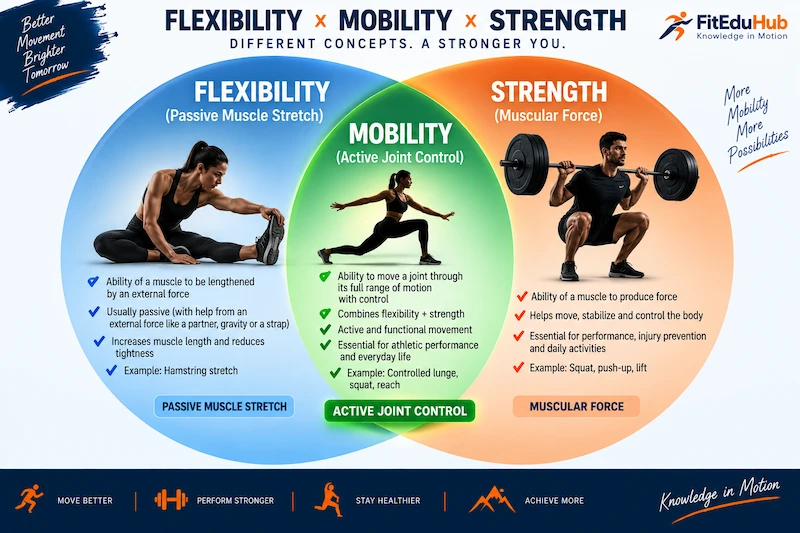
Strength without mobility is a recipe for disaster. Many athletes and coaches use the terms “flexibility” and “mobility” interchangeably, but in S&C, they mean very different things.
Flexibility vs. Mobility
- Flexibility: This is the passive range of motion of a joint. It dictates how far a muscle can stretch. For example, lying on your back and having a partner push your leg up to stretch your hamstring.
- Mobility: This is the active, controllable range of motion. It is the ability of your nervous system and muscles to move a joint through its full range without external help. For example, standing on one leg and raising your other knee to your chest using only your hip flexors.
Why Mobility Trumps Flexibility in Sports
Sports are active, dynamic environments. Having passive flexibility is useless if you don’t have the strength (mobility) to control that extreme range of motion. When an athlete moves into a range of motion they cannot control (e.g., a deep squat or an awkward tackle), injuries like muscle tears and ligament ruptures occur.
👉 Pro Tip: Anatomy & Kinesiology Explore the specific joints, like the ball-and-socket, that require the most mobility in our Kinesiology guide.
7. Resistance Training: Building the Engine
Resistance training is the practical application of building muscular strength and hypertrophy. It involves forcing the muscles to contract against an external load (weights, bands, or body weight).
The Principle of Progressive Overload
This is the absolute golden rule of resistance training. For a muscle to grow stronger, it must be forced to adapt to a tension that is greater than what it has previously experienced. If you lift 50kg for 10 reps today, you must eventually lift 55kg, or do 12 reps, to continue improving.
Core Lifts (Compound Movements)
S&C programs do not rely on bodybuilding isolation machines (like a bicep curl machine). Instead, they focus on compound, multi-joint movements that teach the body to fire as one synchronized unit:
- The Squat (Knee Dominant): Builds maximal strength in the quads, glutes, and core.
- The Deadlift (Hip Hinge): The ultimate builder of the posterior chain (hamstrings, glutes, lower back).
- The Press (Pushing Mechanics): Bench press and overhead press build the chest, shoulders, and triceps.
- The Pull (Pulling Mechanics): Pull-ups and heavy barbell rows build the lats, biceps, and grip strength.
👉 Pro Tip: EXERCISE LIBRARY / Squat Master the perfect biomechanical execution in our detailed Squat technique tutorial.
8. Plyometrics: The Science of Explosiveness
Plyometric training bridges the gap between raw strength and athletic power. It is designed to train the central nervous system to contract muscles with maximal speed.
The Stretch-Shortening Cycle (SSC)
Plyometrics rely entirely on the Stretch-Shortening Cycle. This is a highly specialized mechanical and neurological process:
- Eccentric Phase (Stretch): The muscle rapidly lengthens, storing elastic energy in the tendon (like pulling back a rubber band).
- Amortization Phase (Transition): The split-second pause before changing direction. In elite plyometrics, this phase must be as short as possible.
- Concentric Phase (Contraction): The muscle powerfully shortens, releasing both the stored elastic energy and the active muscle contraction simultaneously.
Practical Scientific Examples of Plyometrics
- Box Jumps: To develop raw vertical power.
- Depth Jumps (Shock Method): The athlete drops from a box, hits the floor, and immediately rebounds as high as possible. This forces the nervous system to absorb massive eccentric force and rapidly reverse it.
- Medicine Ball Throws: For explosive upper-body and rotational power (crucial for boxing and throwing sports).
👉 Pro Tip: Sports Biomechanic Understand the physics of Ground Reaction Force (GRF) used in depth jumps in our Biomechanics section.
9. Periodization: The Master Plan
You cannot train hard every day. If an athlete tries to maximize their strength, speed, and endurance all at the same time, they will inevitably suffer from overtraining syndrome.
What is Periodization?
Periodization is the systematic, logical planning of athletic training over the course of a year. It manipulates training volume (how much you do) and intensity (how heavy/hard it is) to ensure the athlete hits their absolute physical “peak” exactly when the most important competition occurs.
The Three Cycles of Periodization
- Macrocycle (The Year Plan): Typically an entire year or an Olympic 4-year cycle.
- Mesocycle (The Training Phase): Typically 4 to 6 weeks focusing on one specific physical trait (e.g., a “Hypertrophy Phase” or a “Max Strength Phase”).
- Microcycle (The Weekly Plan): A 1-week block detailing the exact daily workouts and recovery days.
Traditional Linear vs. Undulating Periodization
- Linear Periodization: The athlete starts in the off-season with high volume and low intensity (building muscle size and endurance). As the competition nears, the volume drops and the intensity peaks (focusing entirely on explosive power and speed).
- Undulating (Non-Linear) Periodization: Volume and intensity fluctuate heavily within the same week. For example, Monday is heavy strength (low reps), Wednesday is speed/power, and Friday is hypertrophy (high volume).
👉 Pro Tip: Recovery & Performance Learn how to program mandatory deload weeks to prevent overtraining in our Recovery module.
Conclusion: The Architecture of Supremacy
Strength and Conditioning is not about randomly making athletes tired; it is the precise, scientific application of physics, anatomy, and exercise physiology.
By strategically developing maximal strength, converting it into explosive power, mastering the Stretch-Shortening Cycle through plyometrics, and meticulously periodizing the training year, coaches can engineer athletes who run faster, jump higher, and dominate their sport while staying injury-free.
📚 Evidence-Based References
To continue your deep dive into elite programming and performance, we highly recommend these two foundational texts:
- Essentials of Strength Training and Conditioning by the NSCA (National Strength and Conditioning Association). (The definitive global standard for S&C professionals covering physiology, biomechanics, and program design)