

Cardiovascular fitness is an important part of overall physical fitness. It helps the body perform sustained physical activity by challenging the heart, lungs, blood vessels, and active muscles.
Walking, running, cycling, swimming, rowing, dancing, and many sports can contribute to cardiovascular fitness when performed at an appropriate intensity and duration.
However, effective cardio training is not simply about exercising until you are exhausted. A well-designed fitness training program considers frequency, intensity, duration, exercise type, progression, recovery, and the individual’s current fitness level and goals.
This guide explains cardiovascular endurance, the difference between cardio and endurance training, major cardio training methods, exercise intensity, FITT principles, beginner programming, safe progression, common training mistakes, recovery, and safety considerations.
Quick Answer
Cardio training refers to aerobic or cardiovascular exercise that increases the demands placed on the heart and respiratory system, either continuously or through repeated bouts of activity.
Endurance is the ability to sustain physical activity or repeatedly perform work while resisting fatigue over time.
In simple terms, cardio is a type of exercise or training, while endurance is a physical capacity that training can help develop. Cardio exercise is therefore one important way to improve cardiorespiratory endurance.
For general health, adults are generally advised to accumulate 150–300 minutes of moderate-intensity aerobic physical activity per week, 75–150 minutes of vigorous-intensity activity, or an equivalent combination of both. Adults should also perform muscle-strengthening activities on at least two days per week.
What Is Cardiovascular Endurance?
Cardiovascular endurance, also called cardiorespiratory endurance, is the body’s ability to sustain physical activity involving large muscle groups by efficiently delivering and using oxygen.
During aerobic exercise, the cardiovascular and respiratory systems work together to deliver oxygen to active tissues and support the energy demands of working muscles.
Activities commonly used to develop cardiovascular endurance include:
- Brisk walking
- Jogging and running
- Cycling
- Swimming
- Rowing
- Dancing
- Hiking
- Continuous or intermittent sports
A person with better cardiovascular endurance can generally sustain an appropriate workload for longer before fatigue significantly reduces performance.
Cardiovascular endurance is not only important for athletes. It also supports everyday activities such as walking longer distances, climbing stairs, participating in recreational activities, and maintaining an active lifestyle.
Cardio vs Endurance: What Is the Difference?
The terms cardio and endurance are often used interchangeably, but they describe different concepts.
What Is Cardio?
Cardio is a common term for aerobic or cardiovascular exercise. These activities increase the demands placed on the heart, lungs, and circulatory system.
Examples include brisk walking, cycling, jogging, swimming, rowing, and aerobic exercise classes.
What Is Endurance?
Endurance is a physical capacity—the ability to continue an activity, sustain an appropriate workload, or repeatedly perform physical work while resisting fatigue.
Endurance is not limited to cardiovascular fitness. Different forms include cardiorespiratory endurance and muscular endurance, depending on the activity and the physical demands involved.
For example, a distance runner relies heavily on cardiorespiratory endurance, while a sport such as rowing, climbing, or repeated bodyweight exercise may also place substantial demands on muscular endurance.
How Are Cardio and Endurance Connected?
Cardio exercise can be used to improve cardiorespiratory endurance.
A simple way to remember the difference is:
Cardio is a form of training; endurance is a physical capacity that training can improve.
| Cardio | Endurance |
|---|---|
| Refers mainly to aerobic or cardiovascular exercise | Refers to the ability to sustain or repeat physical effort |
| Includes activities such as walking, cycling, swimming, and running | Includes cardiorespiratory and muscular endurance |
| Describes a training or exercise method | Describes a physical capacity |
| Can range from light to vigorous intensity | Develops progressively through appropriate training |
| Can be used to improve aerobic fitness | Supports daily activity, exercise, and sports performance |
In short, cardio provides one of the main ways to train the body’s aerobic system, while endurance describes how effectively the body can sustain physical effort and resist fatigue.
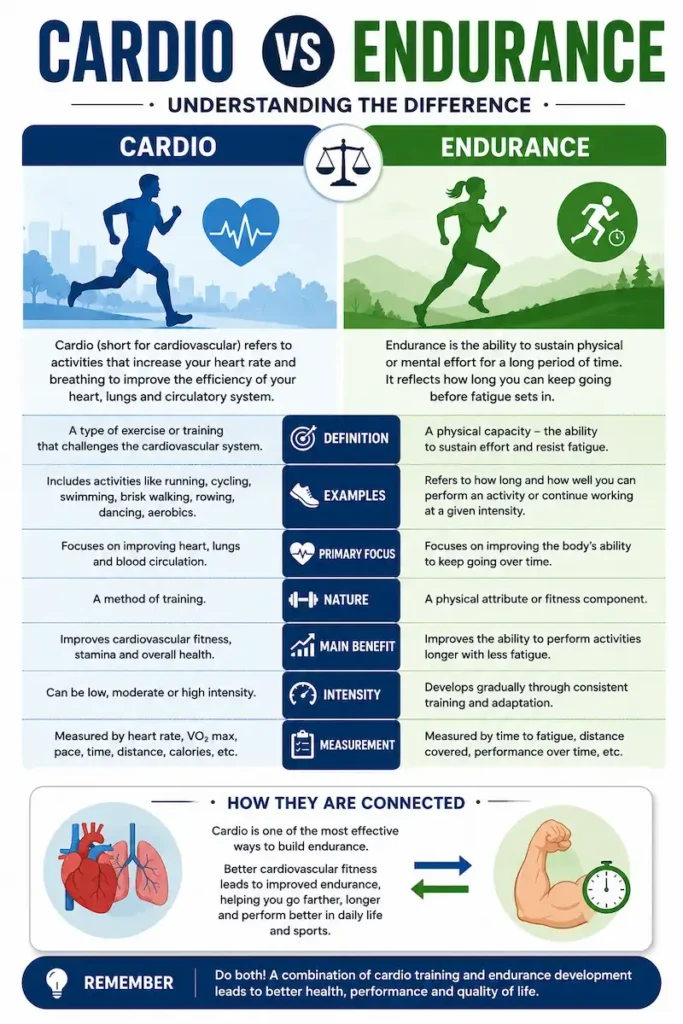
Cardio is a form of cardiovascular training, while endurance describes the ability to sustain physical effort and resist fatigue over time.How Does Cardio Training Affect the Body?
Cardio exercise increases the body’s demand for oxygen and energy. In response, heart rate and breathing generally increase so the cardiovascular and respiratory systems can support the working muscles.
With regular and appropriately structured training, the body can adapt to repeated aerobic demands. These adaptations may include improvements in the body’s ability to deliver and use oxygen, sustain physical activity, and tolerate exercise with less fatigue at a given workload.
The exact response to cardio training varies from person to person. Factors such as training intensity, duration, frequency, exercise type, current fitness level, age, genetics, health status, recovery, and consistency can all influence how an individual adapts.
For this reason, two people following a similar cardio program may not improve at exactly the same rate. A well-designed fitness training program should therefore be adjusted to the individual’s needs, goals, and current level of fitness.
Benefits of Regular Cardio and Endurance Training
Regular physical activity can provide important benefits for physical health, mental well-being, and overall quality of life. The World Health Organization recommends regular physical activity for adults and notes that it is associated with benefits for cardiovascular health, mental health, cognitive health, sleep, and several other health outcomes.
Appropriately planned cardio and endurance training may support the following areas:
Cardiorespiratory Fitness
Regular aerobic activity challenges the heart, lungs, blood vessels, and working muscles.
Over time, appropriate training can improve the body’s ability to deliver and use oxygen during sustained physical activity. This can make everyday activities and exercise feel more manageable at an appropriate workload.
Exercise Capacity
Improved endurance can help a person sustain activities such as walking, running, cycling, swimming, hiking, and recreational sports for longer periods.
Exercise capacity is influenced not only by cardiovascular fitness but also by muscular endurance, training experience, recovery, and the demands of the activity.
General Health
Aerobic physical activity is a major part of international physical-activity recommendations because regular movement is associated with important health benefits.
For adults, WHO recommends at least 150–300 minutes of moderate-intensity aerobic physical activity or 75–150 minutes of vigorous-intensity aerobic physical activity per week, or an equivalent combination, together with muscle-strengthening activity on at least two days per week.
Sport Performance
Many sports require athletes to sustain activity, recover between repeated efforts, or maintain technical and physical performance as fatigue develops.
The type of endurance required can vary considerably between sports. A distance runner, football player, swimmer, badminton player, and combat-sport athlete may therefore require different conditioning approaches.
For athletes who need to combine endurance with strength, power, and other physical qualities, [Strength & Conditioning] provides a broader framework for developing physical performance.
Mental Well-Being
Regular physical activity is also associated with benefits for mental health and overall well-being. WHO guidance notes associations with reduced symptoms of anxiety and depression, as well as benefits for cognitive health and sleep.
However, cardio training should not be viewed as punishment for eating or as a way to create maximum exhaustion. It is a form of physical training that can be used to support health, fitness, daily function, and sports performance.
Major Types of Cardio Training
There is no single best type of cardio for everyone.
Different training methods create different demands on the cardiovascular system, muscles, energy systems, and recovery capacity. The most appropriate method depends on the individual’s goal, fitness level, sport, available equipment, preferences, and ability to recover.
1. Low-to-Moderate Intensity Continuous Training
This method involves performing an aerobic activity continuously at a manageable intensity.
Examples include:
- Brisk walking
- Comfortable cycling
- Easy jogging
- Steady swimming
- Moderate rowing
This approach can be practical for developing an aerobic fitness base and increasing regular physical activity, particularly for beginners and people returning to exercise.
2. Vigorous Continuous Training
Continuous exercise can also be performed at a higher intensity.
Because the effort is greater, the duration that can be comfortably sustained is generally shorter than during easier aerobic exercise.
Vigorous continuous training may be useful for appropriately trained individuals, but beginners do not need to start with high-intensity continuous exercise.
3. Interval Training
Interval training alternates periods of relatively higher effort with periods of easier activity or recovery.
For example:
1 minute faster + 2 minutes easy
This pattern can be repeated several times according to the individual’s fitness level and training goal.
Intervals can range from relatively moderate to highly demanding. Therefore, interval training does not automatically mean an all-out workout.
4. High-Intensity Interval Training
High-Intensity Interval Training (HIIT) uses relatively high-intensity work intervals separated by recovery periods.
HIIT can provide a time-efficient and challenging form of training, but it is not necessary for every cardio session and may not be appropriate for every individual.
The appropriate intensity, work duration, recovery period, and total volume should depend on the individual’s experience, fitness level, goals, and ability to recover.
5. Fartlek Training
Fartlek training is a flexible form of variable-speed endurance training.
For example, a runner may alternate between comfortable running, faster sections, and easier recovery based on time, terrain, landmarks, or perceived effort.
Unlike highly structured interval training, Fartlek sessions can allow more freedom to adjust the pace according to the environment and how the athlete feels.
6. Circuit-Based Conditioning
Circuit training combines multiple exercises performed sequentially with planned work and recovery periods.
Depending on exercise selection, resistance, work duration, and rest intervals, circuits can challenge both the muscular and cardiovascular systems.
Circuit training should not automatically be classified as pure aerobic endurance training because its physical demands depend heavily on how the circuit is designed.
For readers interested in combining cardiovascular work with strength, resistance, and conditioning methods, see the [Strength & Conditioning] section of FitEduHub.
7. Sport-Specific Conditioning
Athletes may need conditioning that reflects the work demands, movement patterns, intensity changes, and recovery periods of their sport.
A marathon runner, football player, tennis player, swimmer, and sprinter should not necessarily follow the same endurance program.
Effective sport-specific conditioning should therefore consider the actual demands of competition rather than simply adding more cardio.

Major types of cardio training include continuous exercise, interval training, HIIT, fartlek, circuit-based conditioning and sport-specific conditioning.Understanding Cardio Exercise Intensity
Exercise intensity describes how hard your body is working during physical activity. It is one of the most important variables in cardio training because the same activity can feel easy for one person and challenging for another.
A common mistake is assuming that every workout needs to be extremely hard. In reality, different intensities serve different purposes, and a sustainable fitness training program usually combines easier, moderate, and sometimes vigorous sessions rather than relying on maximum effort every day.
Intensity can be estimated in several practical ways, including the Talk Test, Rating of Perceived Exertion (RPE), and heart rate.
The Talk Test
The Talk Test is one of the simplest ways to estimate aerobic exercise intensity because it does not require a heart-rate monitor or other specialized equipment.
As a general guide, during moderate-intensity activity, a person should be able to talk but not sing comfortably. During vigorous-intensity activity, a person will usually be able to say only a few words before needing to pause for a breath.
For beginners, the Talk Test can be particularly useful because it helps them understand intensity through breathing and speaking ability rather than focusing only on numbers.
Simple guide:
- Easy: You can talk comfortably in full sentences.
- Moderate: You can talk, but singing would be difficult.
- Vigorous: You can say only a few words before pausing for breath.
Keep in mind that these are practical guidelines rather than exact measurements. Your individual response can vary with fitness level, health status, environment, and the type of activity.
Rating of Perceived Exertion (RPE)
Rating of Perceived Exertion (RPE) refers to how hard an exercise feels to you.
It takes into account the overall effort you experience from breathing, heart rate, muscular work, and fatigue.
A simple 0–10 scale can make this easier to understand:
| RPE | Perceived Effort | General Description |
|---|---|---|
| 0–2 | Very easy | Little or no effort |
| 3–4 | Easy to light | Comfortable effort |
| 5–6 | Moderate | Challenging but sustainable |
| 7–8 | Vigorous | Hard effort with noticeably heavier breathing |
| 9 | Very hard | Near-maximal effort |
| 10 | Maximal | Maximum effort |
The CDC describes relative moderate-intensity activity as roughly 5–6 on a 0–10 scale, while vigorous intensity generally begins around 7–8.
RPE is particularly useful when heart-rate data are unavailable or when factors such as heat, stress, or medication may make heart-rate-based estimates less straightforward.
Heart Rate
Heart rate can provide another useful way to monitor exercise intensity.
Heart-rate targets are often expressed as a percentage of an estimated maximum heart rate or as a training zone. However, these estimates are not equally accurate for everyone, and individual heart-rate responses can vary.
Factors that can influence heart rate during exercise include:
- Age
- Fitness level
- Temperature
- Hydration
- Stress
- Caffeine
- Medications
- Health conditions
- Exercise type
The American Heart Association notes that age-based target heart-rate ranges are general guides, and some medications or medical conditions can affect heart-rate responses during exercise.
For this reason, heart-rate formulas should be treated as estimates rather than precise individualized prescriptions.
For beginners, combining heart rate with the Talk Test and perceived exertion can provide a more practical picture of exercise intensity than relying on a single number.

Cardio intensity can be monitored using practical measures such as the talk test, perceived exertion and estimated heart-rate response.Moderate vs Vigorous Cardio
Public-health guidelines commonly distinguish between moderate- and vigorous-intensity aerobic activity, but the intensity of an activity is relative to the individual performing it.
Examples of moderate-intensity activity may include brisk walking, recreational cycling, or other activities that noticeably increase breathing and heart rate without making conversation impossible.
Examples of vigorous-intensity activity may include running, fast cycling, or other activities that cause substantially heavier breathing and make sustained conversation difficult.
The same activity can fall into different intensity categories for different people. For example, brisk walking may feel moderate to one person but vigorous to someone who is new to exercise.
This is why individual effort, fitness level, and exercise response matter when determining cardio intensity.
Moderate vs Vigorous: At a Glance
| Moderate Intensity | Vigorous Intensity |
|---|---|
| Noticeably increases breathing and heart rate | Produces a substantial increase in breathing and heart rate |
| Conversation is generally possible | Conversation becomes difficult |
| Can often be sustained for longer periods | Usually requires shorter periods or more recovery |
| Examples may include brisk walking and recreational cycling | Examples may include running and fast cycling |
| Useful for building regular aerobic activity | Useful when higher-intensity training is appropriate |
These categories are practical guidelines rather than rigid labels. The Talk Test and perceived exertion can help individuals judge how hard an activity feels.
How Much Cardio Do Adults Need?
For general health, current U.S. physical-activity guidance recommends that adults accumulate at least:
- 150–300 minutes of moderate-intensity aerobic activity per week, or
- 75–150 minutes of vigorous-intensity aerobic activity per week, or
- an equivalent combination of moderate- and vigorous-intensity activity.
Adults should also perform muscle-strengthening activities on at least two days per week. (health.gov)
The World Health Organization provides similar recommendations, advising adults to complete at least 150–300 minutes of moderate-intensity aerobic physical activity or 75–150 minutes of vigorous-intensity aerobic physical activity per week, or an equivalent combination. (who.int)
These recommendations are population-level guidelines for general health, not individualized endurance-training prescriptions.
A person who currently performs very little physical activity may need to build toward these amounts gradually. Training volume should take into account current fitness, goals, recovery, health status, and the demands of other physical activities.
Applying the FITT Principle to Cardio Training
The FITT Principle provides a simple framework for organizing and adjusting cardio and endurance training.
FITT stands for Frequency, Intensity, Time, and Type.
Frequency
How often will you perform cardio?
Cardio sessions can be distributed across several days rather than concentrated into one large session.
The appropriate frequency depends on training goals, current fitness, recovery, and the amount of other physical activity being performed.
Intensity
How hard will you exercise?
Intensity can be monitored using the Talk Test, Rating of Perceived Exertion (RPE), heart rate, pace, power, or other appropriate measures.
Not every session needs to be performed at a high intensity.
Time
How long will each session or activity period last?
Beginners can start with manageable durations and gradually increase their total activity as their fitness and tolerance improve.
Time can refer to the duration of an individual session as well as the overall weekly training volume.
Type
What type of cardio activity will you perform?
Examples include:
- Walking
- Cycling
- Running
- Swimming
- Rowing
- Dancing
- Hiking
- Other appropriate aerobic activities
The most suitable activity depends on the individual’s goal, ability, environment, available equipment, preferences, and recovery capacity.
For a broader explanation of physical fitness components, training principles, and the FITT framework, explore our Fitness Fundamentals guide.
How Beginners Should Start Cardio Training
Beginners do not need complicated endurance programs. The first goal should be to establish a manageable, consistent, and sustainable routine.
A sensible beginner approach generally includes the following steps.
Start With an Appropriate Activity
Walking is accessible for many people, but cycling, swimming, elliptical training, or other low-impact activities may be preferable depending on individual ability, preferences, and physical needs.
Choosing an activity that is enjoyable and practical can make it easier to maintain a regular routine.
Begin at a Manageable Intensity
A beginner does not need to finish every session completely exhausted.
Moderate-intensity activity can provide important health benefits, while starting at a manageable intensity can make it easier to recover and remain consistent.
Increase Gradually
Beginners can generally focus first on establishing consistency and gradually increasing duration or total activity before adding substantial intensity.
Increasing several training variables aggressively at the same time can increase fatigue and make recovery more difficult.
Pay Attention to Recovery
Some fatigue is a normal part of training, but persistent or excessive fatigue may indicate that training demands need to be adjusted.
Adequate sleep, nutrition, hydration, easier training days, and rest all contribute to effective recovery.
Choose Activities You Can Sustain
An exercise method that looks ideal on paper has limited value if a person strongly dislikes it and eventually stops doing it.
Consistency is one of the foundations of long-term fitness.
Example Beginner Endurance & Cardio Week
The following schedule is an educational example, not an individualized exercise prescription.
| Day | Example Activity |
|---|---|
| Monday | 20–30 minutes of brisk walking |
| Tuesday | Strength training or normal daily activity |
| Wednesday | 20–30 minutes of moderate cycling or walking |
| Thursday | Recovery or light physical activity |
| Friday | 20–30 minutes of moderate cardio |
| Saturday | Longer, easy recreational activity |
| Sunday | Rest or gentle mobility |
The exact duration and intensity should be adapted to the individual’s current ability and circumstances.
Someone who currently performs very little physical activity may begin with shorter sessions and gradually build up.
A more experienced exerciser may require a substantially different training structure based on their goals, sport, training history, and recovery capacity.

Example beginner weekly endurance and cardio plan combining aerobic exercise, active recovery and gradual progression.How to Progress Cardio Safely
Cardio training can progress in several ways. Depending on the activity and training goal, a person may gradually increase:
- frequency;
- session duration;
- distance;
- pace;
- resistance;
- number of intervals; or
- exercise intensity.
However, these variables do not need to increase at the same time.
For example, a beginner who can comfortably walk for 15 minutes might first increase walking duration before introducing faster walking, jogging, or more demanding intervals.
A useful principle is to progress according to adaptation rather than impatience. If a particular workload feels manageable and recovery is good, a gradual increase may be appropriate. If fatigue continues to accumulate, reducing the workload or allowing more recovery may be more appropriate.
Progression should also consider the type of activity. Increasing running distance, cycling resistance, swimming volume, and interval intensity are not interchangeable forms of training stress.
Should You Do Cardio Every Day?
Not necessarily.
Light physical activity may be appropriate on many days, but structured cardio does not need to be hard every day.
The appropriate amount and intensity depend on factors such as:
- exercise intensity;
- session duration;
- current fitness level;
- training history;
- other workouts;
- sport participation;
- health status; and
- recovery.
A gentle walk and a demanding interval session are both forms of physical activity, but they can place very different demands on the body.
Therefore, the better question is not simply:
“Can I do cardio every day?”
Instead, consider:
“What type and amount of activity can I recover from while progressing toward my goal?”
A well-designed program usually includes an appropriate balance of training, easier activity, and recovery rather than making every session equally demanding.
Cardio and Strength Training: Can You Do Both?
Yes. In fact, combining aerobic activity with muscle-strengthening exercise is an important part of a balanced physical-activity program.
For general health, physical-activity guidelines recommend both aerobic activity and muscle-strengthening activities.
People who want to develop both strength and endurance should organize their training so that the total workload remains manageable.
For example, repeatedly performing exhausting cardio immediately before demanding strength training may reduce the quality of the strength session. In other situations, separating demanding cardio and strength sessions may make it easier to manage fatigue and training quality.
The appropriate balance depends on the person’s primary goal, training experience, schedule, and recovery capacity.
If strength development is the main priority, resistance training may receive greater emphasis. If endurance performance is the primary goal, endurance training may receive greater emphasis.
Learn how resistance training, sets, repetitions, exercise selection, and recovery contribute to strength and physical performance in our Strength & Conditioning guide.
Endurance Training for Sports
Different sports place different demands on the body’s energy systems, muscles, movement patterns, and ability to recover between efforts.
For this reason, endurance training should become increasingly specific to the sport and performance goal as training progresses.
Distance Running
Distance runners rely heavily on aerobic endurance and sport-specific running capacity.
Training may include continuous running, easier aerobic sessions, longer endurance sessions, and appropriately planned faster work depending on the event and athlete’s level.
Football and Field Sports
Field sports such as football combine lower-intensity movement with repeated higher-intensity efforts.
Players therefore need aerobic fitness as well as the ability to accelerate, perform repeated efforts, and recover between demanding actions.
Racquet Sports
Sports such as tennis and badminton involve repeated movements, changes of direction, and intermittent high-intensity efforts separated by recovery periods.
Training should therefore reflect the movement and work-to-recovery demands of the sport.
Combat Sports
Combat sports can involve repeated high-intensity exchanges within rounds, with recovery periods between efforts and rounds.
Conditioning should reflect the specific sport, competition format, duration, and technical demands rather than relying only on general running or cardio sessions.
Swimming and Cycling
Swimming and cycling can involve everything from short, high-intensity events to long-duration endurance competitions.
Training therefore varies considerably according to the event and performance objective.
These examples demonstrate the principle of specificity:
Training adaptations are influenced by the type of activity performed, so endurance training should increasingly reflect the physical demands of the sport or activity being prepared for.
Cardio for Fat Loss: What Should You Know?
Cardio exercise increases energy expenditure, but changes in body weight and body fat are influenced by overall energy balance over time.
Cardio can therefore be useful as part of a broader approach to body-composition goals, but it should not be viewed as a way to “punish” the body after eating.
A sustainable approach may combine:
- regular physical activity;
- appropriate nutrition;
- resistance training;
- adequate sleep; and
- habits that can be maintained over time.
More cardio is not automatically better.
Very large increases in exercise volume can increase fatigue and may make a program difficult to maintain. For people pursuing body-composition goals, a sustainable combination of physical activity, nutrition, recovery, and resistance training is generally more practical than repeatedly relying on exhausting workouts.
Low-Impact Cardio Options
Running is not required to develop cardiovascular fitness.
Lower-impact options can include:
- walking;
- cycling;
- swimming;
- elliptical training;
- rowing, when appropriate; and
- water-based exercise.
The most suitable activity depends on factors such as fitness level, preferences, training goals, movement tolerance, and available equipment.
For people with pain, injury, disability, or certain medical conditions, exercise may need to be modified. Professional guidance can help determine appropriate activities and progression when necessary.
Common Cardio Training Mistakes
1. Going Too Hard Every Session
Hard workouts can have an appropriate place in a training program, but attempting maximum effort every day can create unnecessary fatigue and reduce recovery.
2. Progressing Too Quickly
Increasing duration, distance, and intensity simultaneously can create more training stress than the body is prepared to handle.
Gradual progression is generally more sustainable.
3. Ignoring Strength Training
Cardio is an important component of fitness, but a balanced general-fitness program should also include muscle-strengthening activity.
Strength training can support muscular fitness, physical function, and sport performance.
4. Doing Only High-Intensity Intervals
HIIT is one method of cardiovascular training—it is not the definition of cardio.
Lower- and moderate-intensity activities can also provide valuable aerobic training and may be easier to perform consistently.
5. Copying an Athlete’s Program
A competitive endurance athlete may train for many hours each week because their program is designed around a specific sport, performance level, training history, and recovery capacity.
That workload is not automatically appropriate for a beginner or recreational exerciser.
6. Ignoring Recovery
Increasing training while consistently sleeping poorly or accumulating fatigue can reduce training quality and make progression more difficult.
Recovery should be considered part of the training process rather than something separate from it.
7. Believing Sweat Measures Workout Quality
Sweating is influenced by exercise intensity, environmental temperature, humidity, clothing, genetics, acclimatization, and other factors.
Therefore, more sweat does not automatically mean a better workout.
8. Ignoring Pain or Concerning Symptoms
Normal exercise effort and fatigue are different from unusual, severe, or concerning symptoms.
Significant or unexplained symptoms should not simply be pushed through. Appropriate medical evaluation may be necessary depending on the symptom.
Recovery for Endurance Training
Recovery allows the body to respond and adapt to training.
Important recovery factors include:
Sleep
Adequate sleep supports overall health, recovery, and readiness for physical activity.
Nutrition
Endurance activity requires energy and nutrients. Individual nutritional needs vary according to factors such as body size, training volume, exercise intensity, goals, and overall health.
Hydration
Fluid requirements vary according to exercise duration, environmental conditions, sweat losses, activity type, and individual needs.
Longer or more demanding sessions may require greater attention to hydration than short, easy activities.
Easier Training Days
Not every workout needs to be demanding.
Easier sessions can allow a person to remain active while reducing overall training stress.
Rest
Planned rest can be useful, particularly when training volume or intensity increases.
Recovery needs also vary between individuals and can change as training demands change.
For a deeper look at nutrition, hydration, sleep, and recovery strategies, see our Recovery & Nutrition guide.
Cardio Training Across Different Age Groups
Cardio and aerobic activity should be appropriate for a person’s age, health, fitness level, physical ability, and developmental stage.
Children and Adolescents
Children and adolescents generally benefit from regular physical activity that includes aerobic activity as part of an active lifestyle.
Age-specific physical-activity recommendations should be used rather than simply applying adult exercise prescriptions to younger people.
Adults
Adults can use a combination of moderate- and vigorous-intensity aerobic activity according to their abilities, preferences, health status, and goals.
Regular muscle-strengthening activity should also be included as part of a balanced physical-activity routine.
Older Adults
Older adults can benefit from regular aerobic activity, muscle-strengthening exercise, and activities that support balance and physical function.
Training should account for individual health conditions, functional ability, previous exercise experience, and recovery needs.
Safety and When to Seek Professional Guidance
Most people can benefit from appropriate physical activity, but exercise should be matched to the individual’s health, fitness, ability, and circumstances.
Consider seeking professional guidance before beginning or substantially increasing exercise if you have significant health concerns, medical restrictions, a recent injury, or uncertainty about which activities are appropriate for you.
During exercise, stop and seek appropriate medical evaluation if you experience concerning symptoms such as:
- chest pain or pressure;
- fainting or loss of consciousness;
- severe or unusual shortness of breath;
- sudden severe dizziness; or
- other significant or unexplained symptoms.
People returning to exercise after an injury or living with a chronic health condition may require individualized exercise modifications.
This article provides general educational information and is not a substitute for individualized medical, exercise, or nutritional advice.termine whether a particular exercise program is medically appropriate for an individual reader.
Frequently Asked Questions About Endurance & Cardio
Find clear answers to common questions about cardio exercise, endurance training, intensity, progression, and recovery.
Cardiovascular or cardiorespiratory endurance is the ability to sustain physical activity while the cardiovascular and respiratory systems support the working muscles.
Not exactly. Cardio generally refers to cardiovascular exercise, while endurance describes the ability to sustain physical effort. Cardio training can help improve cardiorespiratory endurance.
There is no universal best cardio exercise. Walking, running, cycling, swimming, rowing, dancing, and other activities can all be useful depending on a person’s goals, abilities, preferences, and health considerations.
Yes. Walking can be cardiovascular exercise. A brisk walking pace may qualify as moderate-intensity physical activity depending on the individual.
For general health, adults should aim for at least 150 minutes of moderate-intensity aerobic activity per week, 75 minutes of vigorous-intensity activity, or an equivalent combination. Additional activity may provide further health benefits when appropriate.
Neither method is universally better. HIIT and steady-state cardio create different training demands. The appropriate method depends on goals, fitness level, preferences, health status, and the overall training program.
Yes. Intervals can be designed at different intensity levels. Beginners do not need to start with all-out HIIT and may begin with gentle changes in walking or cycling pace when appropriate.
Yes. General physical-activity guidelines include both aerobic activity and muscle-strengthening activity. Combining them can provide a more balanced approach to overall physical fitness.
No. A heart-rate monitor can provide useful training data, but simple tools such as the talk test and perceived exertion can also help estimate exercise intensity.
There is no universal timeline. Improvements depend on starting fitness, training frequency, intensity, duration, recovery, health, consistency, and individual response to training.
Key Takeaways
Endurance and cardio training are important components of physical fitness and can support health, daily function, and sports performance when appropriately planned.
- Cardio is a training method, while endurance is a physical capacity. Cardio exercise is one of the main ways to develop cardiorespiratory endurance.
- Cardio training can include continuous exercise, interval training, HIIT, fartlek, circuit-based conditioning, and sport-specific training.
- Exercise intensity can be monitored using practical methods such as the talk test, perceived exertion, and, when useful, heart-rate data.
- Beginners should focus on consistency, manageable intensity, gradual progression, and adequate recovery rather than immediately attempting demanding workouts.
- For general health, adults should work toward established aerobic physical-activity recommendations while also including muscle-strengthening activity.
- Endurance training should become increasingly specific to the activity or sport as performance goals become more specific.
- Recovery factors such as sleep, nutrition, hydration, easier training days, and rest are important parts of a sustainable training program.
- The most effective approach is not necessarily the hardest one. Training should be appropriate, progressive, sustainable, and matched to individual goals and abilities.
Continue Learning on FitEduHub
Endurance and cardio training are closely connected with other areas of physical fitness. Explore these related FitEduHub guides to build a broader understanding of fitness training, performance, movement, and recovery.
References & Further Reading
The following authoritative resources were consulted for physical activity recommendations, exercise intensity, and general cardiovascular fitness guidance.
- World Health Organization (WHO). WHO Guidelines on Physical Activity and Sedentary Behaviour. Evidence-based recommendations for physical activity across different age groups. Read the WHO guidelines
- Centers for Disease Control and Prevention (CDC). How to Measure Physical Activity Intensity. Guidance on moderate and vigorous activity, including the Talk Test and other ways to understand exercise intensity. Read the CDC guidance
- U.S. Department of Health and Human Services (HHS). Physical Activity Guidelines for Americans. National guidelines covering aerobic activity, muscle strengthening, and physical activity recommendations for different populations. Read the Physical Activity Guidelines
- American Heart Association (AHA). Physical Activity and Exercise Guidance. Practical information on aerobic activity, exercise intensity, strength training, and cardiovascular health. Explore AHA exercise guidance
About This Article
Editorial Purpose
This article is designed to provide clear, practical, and evidence-informed information about endurance and cardio training. It explains the difference between cardio and endurance, common training methods, exercise intensity, progression, recovery, sport-specific endurance, and practical considerations for beginners.
The content is intended for educational purposes and is written to help readers develop a better understanding of cardiovascular fitness and endurance training. Training recommendations should always be adapted to an individual’s goals, experience, abilities, and circumstances.
Health & Safety Note
This article provides general educational information and is not a substitute for individualized medical, exercise, or nutritional advice. People with health conditions, injuries, medical restrictions, or concerns about beginning or increasing exercise should seek appropriate professional guidance.
Exercise should be progressed gradually and performed at an intensity appropriate to the individual’s current fitness level and abilities. If unusual or significant symptoms occur during exercise, stop the activity and seek appropriate medical evaluation.