

Introduction: The Foundation of Human Performance
In the world of athletic performance, a hard training session does not actually make you stronger, faster, or fitter. Training is the stimulus that breaks the body down. It is the food you eat and the recovery you prioritize that builds the body back up. Sports Nutrition is the precise, scientific application of dietary strategies designed to optimize the performance, recovery, and overall health of athletes and highly active individuals.
Whether you are a marathon runner requiring sustained energy, a bodybuilder looking to maximize muscle hypertrophy, or a physical education student trying to understand human metabolism, grasping the science of macronutrients and micronutrients is non-negotiable. You cannot out-train a poor diet. In this comprehensive guide, we will break down the biological role of every nutrient and how to strategically utilize them to engineer peak physical performance.
1. Carbohydrates: The Premium Fuel Source
Carbohydrates are the undisputed king of high-intensity athletic performance. Despite modern diet trends demonizing carbs, sports science unequivocally proves that they are the body’s preferred and most efficient source of energy.
Glycogen: The Muscle’s Battery Pack
When you consume carbohydrates (like rice, oats, or potatoes), your digestive system breaks them down into glucose. This glucose enters the bloodstream to be used for immediate energy. However, the excess glucose is converted into a substance called glycogen and stored primarily directly inside the skeletal muscles and the liver.
- During high-intensity exercise (like sprinting, heavy weightlifting, or a soccer match), the body rapidly depletes these muscle glycogen stores to produce ATP (cellular energy).
- If an athlete starts a match with low glycogen levels, they will experience a severe drop in performance—a phenomenon commonly referred to as “hitting the wall” or “bonking.”
Simple vs. Complex Carbohydrates
To fuel effectively, athletes must understand the Glycemic Index (GI), which measures how quickly a carbohydrate raises blood sugar.
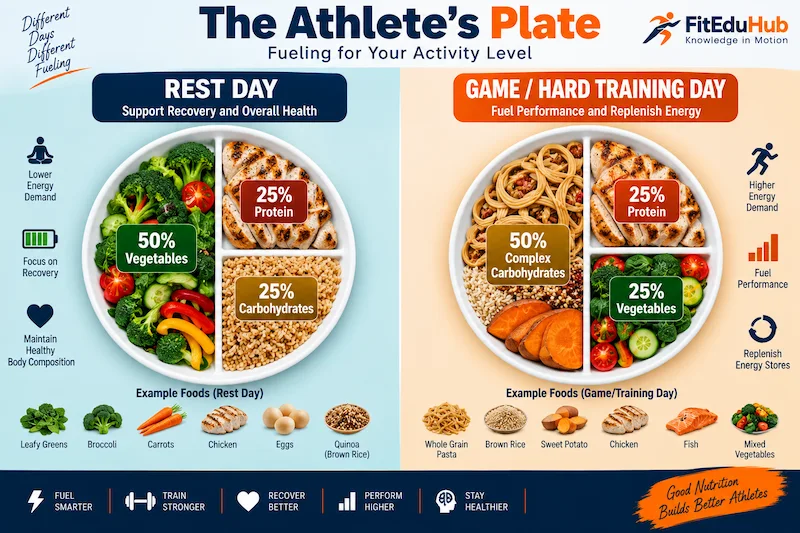
- Complex Carbohydrates (Low GI): Foods like sweet potatoes, brown rice, and whole-wheat pasta. These digest slowly, providing a steady, sustained release of energy. They should make up the bulk of an athlete’s daily diet.
- Simple Carbohydrates (High GI): Foods like sports drinks, gummy bears, and white bread. These digest almost instantly, causing a rapid spike in blood sugar. While generally avoided for daily health, they are highly strategic during or immediately after an intense training session to rapidly replenish depleted glycogen.
👉 Pro Tip: Exercise Physiology Learn exactly how carbohydrates are metabolized in the Glycolytic Energy System in our Exercise Physiology guide.
2. Protein: The Building Blocks of Recovery
If carbohydrates are the fuel for the engine, protein is the steel used to build and repair the engine itself. Every time an athlete trains, they create microscopic tears in their muscle fibers (microtrauma). Dietary protein provides the raw materials necessary to repair this damage.
Amino Acids and Muscle Protein Synthesis (MPS)
When ingested, protein is broken down into its fundamental building blocks: Amino Acids. There are 20 amino acids, 9 of which are “essential” (meaning the body cannot produce them and they must come from food).
- Branched-Chain Amino Acids (BCAAs): Leucine, Isoleucine, and Valine. Among these, Leucine is the most critical. Leucine acts as a biological trigger that activates a pathway called mTOR, which effectively turns on the muscle-building process known as Muscle Protein Synthesis (MPS).
How Much Protein Do Athletes Actually Need?
The general population can survive on 0.8 grams of protein per kilogram of body weight. However, active individuals and athletes require significantly more to recover from tissue breakdown:
- Endurance Athletes (Runners, Cyclists): Require approximately 1.2 to 1.4 grams per kilogram of body weight (to repair muscle damage and maintain immune function).
- Strength & Power Athletes (Weightlifters, Sprinters): Require 1.6 to 2.2 grams per kilogram of body weight (to maximize muscle hypertrophy and absolute strength).
👉 Pro Tip: Anatomy & Kinesiology Discover how muscle fibers physically repair and grow thicker (hypertrophy) in our Muscular System module.
3. Fats: The Essential Engine for Hormones and Endurance
For decades, dietary fat was mistakenly blamed for weight gain. In modern sports nutrition, healthy fats are recognized as highly essential. They are the most calorie-dense macronutrient (yielding 9 calories per gram compared to 4 calories for carbs/protein).
The Role of Dietary Fat in Sports
- Endurance Energy: While carbs fuel high-intensity work, fats are the primary fuel source for low-intensity, long-duration activities (like a slow 10km jog or a 4-hour cycling stage). The body stores vast amounts of energy in adipose (fat) tissue, which is metabolized via the Oxidative energy system.
- Hormone Production: Dietary fat is the foundational building block for synthesizing vital anabolic hormones, including testosterone. If an athlete’s fat intake drops too low, their hormone levels will crash, leading to a massive loss of strength and a severe drop in recovery capacity.
- Vitamin Absorption: Vitamins A, D, E, and K are fat-soluble. Without adequate dietary fat, the body cannot absorb these critical micronutrients.
Omega-3 Fatty Acids and Inflammation
Not all fats are equal. Athletes must prioritize unsaturated fats (olive oil, avocados, nuts) and pay special attention to Omega-3 fatty acids (found heavily in fatty fish like salmon). Hard training causes systemic inflammation. Omega-3s act as powerful natural anti-inflammatories, reducing joint pain, accelerating recovery, and even improving cognitive function and reaction time.
👉 Pro Tip: Strength & Conditioning Understand how aerobic endurance training relies heavily on fat oxidation in our Conditioning guide.
4. Vitamins & Minerals: The Micro-Managers of Metabolism
Macronutrients (Carbs, Protein, Fats) provide the raw energy and structure, but Micronutrients (Vitamins and Minerals) act as the spark plugs. Without them, the body cannot effectively convert food into usable energy or repair bone tissue.
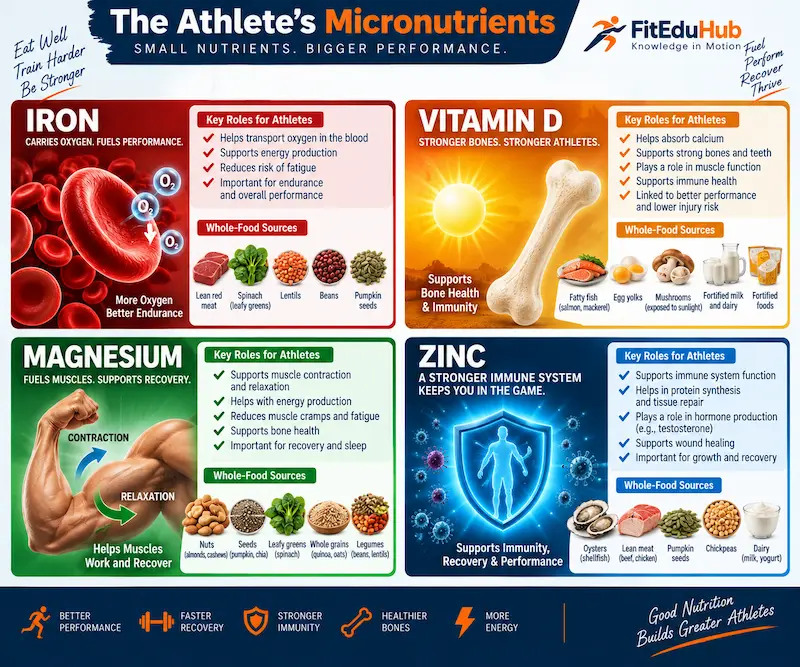
Iron: The Oxygen Transporter
Iron is a critical component of hemoglobin (in red blood cells) and myoglobin (in muscle cells). Its primary job is to bind to oxygen in the lungs and transport it to the working muscles.
- Sports Consequence: Female athletes and endurance runners are at a high risk of iron depletion. Low iron leads to “Sports Anemia,” characterized by severe fatigue, elevated heart rate, and an inability to sustain aerobic exercise.
Calcium and Vitamin D: The Structural Pillars
Calcium is the primary mineral responsible for bone density and muscle contraction (calcium ions trigger the sliding filament theory in muscles). Vitamin D acts as the “key” that allows the intestines to actually absorb that calcium.
- Sports Consequence: A deficiency in Calcium or Vitamin D massively increases the risk of stress fractures, especially in high-impact sports like basketball or gymnastics.
Magnesium: The Relaxation Mineral
While calcium tells a muscle to contract, magnesium tells it to relax. It is involved in over 300 metabolic reactions in the body.
- Sports Consequence: Athletes who sweat heavily lose large amounts of magnesium. A deficiency often presents itself as severe muscle cramps, spasms, and poor sleep quality.
5. Hydration: The Liquid Lifeline of Performance
The human body is approximately 60% water, but muscle tissue is composed of nearly 75% water. Hydration is not just about quenching thirst; it is a critical physiological necessity for maintaining blood volume, regulating core body temperature (thermoregulation), and lubricating joints.
The Dangers of Dehydration
Athletic performance plummets dramatically with even minor dehydration.
- The 2% Rule: In sports science, losing just 2% of your total body weight through sweat (e.g., a 70kg athlete losing 1.4kg of sweat) results in a measurable decline in cognitive function, reaction time, and muscular endurance.
- At 4-5% dehydration, aerobic capacity drops by up to 30%, and the risk of heat exhaustion or heat stroke becomes critically high. As blood volume decreases due to water loss, the heart has to beat significantly faster (cardiac drift) just to pump the same amount of oxygen to the muscles.
👉 Pro Tip: Sports Psychology Understand how severe dehydration negatively impacts cognitive decision-making and focus in our Sports Psychology guide.
6. Electrolytes: The Conductors of Muscle Function
When an athlete sweats, they do not just lose water; they lose vital minerals known as electrolytes. Electrolytes carry an electrical charge and are responsible for conducting the nerve signals that tell muscles to contract and relax.
The Big Four Electrolytes
- Sodium: The most critical electrolyte lost in sweat. It regulates total body fluid balance. If an athlete drinks gallons of plain water during a marathon without replacing sodium, they risk a deadly condition called Hyponatremia (water intoxication).
- Potassium: Works closely with sodium to regulate fluid inside the cells and helps prevent muscle cramping.
- Calcium: Triggers the physical sliding mechanism of muscle contractions.
- Magnesium: Signals the muscle to relax after a contraction.
- Practical Scientific Example: During a 90-minute tennis match in extreme heat, an athlete should not drink just plain water. They must consume an isotonic sports drink that contains a precise ratio of water, carbohydrates (for glycogen), and sodium (to retain the fluid and maintain electrical signaling).
7. Nutrient Timing: Pre, During, and Post-Exercise Nutrition
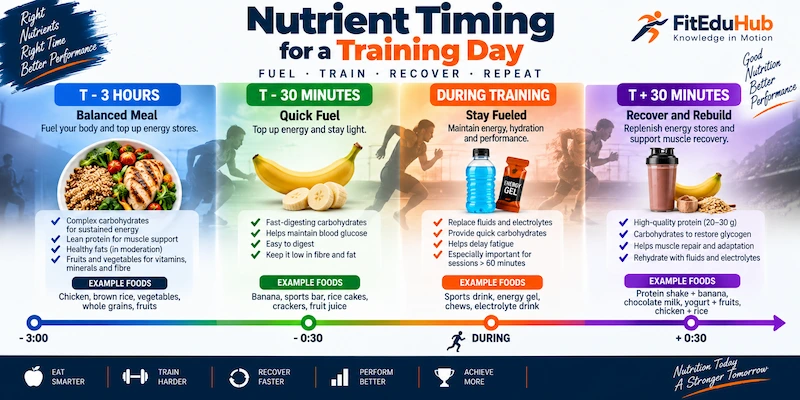
What you eat is important, but when you eat it (Nutrient Timing) dictates how your body utilizes that fuel. Elite athletes periodize their nutrition around their training schedule.
Pre-Exercise Nutrition (The Primer)
The goal is to top off glycogen stores and prime the body without causing gastrointestinal (GI) distress.
- 3-4 Hours Before: A complete, balanced meal. (Example: Grilled chicken, brown rice, and roasted vegetables).
- 30-60 Minutes Before: A small, highly digestible, high-GI carbohydrate snack for immediate blood sugar. Keep fiber and fat extremely low to prevent stomach cramps. (Example: A ripe banana or a handful of pretzels).
During-Exercise Nutrition (The Sustainer)
This is only necessary for high-intensity training lasting longer than 60-90 minutes.
- The Goal: To spare muscle glycogen and maintain blood glucose levels.
- The Strategy: Consume 30 to 60 grams of easily digestible carbohydrates per hour, along with fluids and electrolytes. (Example: Carbohydrate gels, isotonic sports drinks, or chewable energy blocks).
Post-Exercise Nutrition (The Rebuilder)
The post-workout window is focused on the “3 R’s of Recovery”: Replenish, Repair, and Rehydrate.
- Replenish (Carbs): Consume complex and simple carbohydrates to refill the depleted glycogen stores in the muscles and liver.
- Repair (Protein): Consume 25-40 grams of fast-digesting, high-quality protein (like Whey Protein) to spike Leucine levels and activate Muscle Protein Synthesis.
- Rehydrate (Fluids): Drink 1.5 liters of fluid for every 1 kilogram of body weight lost during the session.
👉 Pro Tip: Recovery & Performance] Discover additional recovery modalities like cold water immersion and sleep hygiene in our Athletic Recovery section.
8. Supplements & Evidence: Separating Fact from Fiction
The sports supplement industry is a multi-billion-dollar machine filled with marketing hype. However, sports scientists rely on the AIS (Australian Institute of Sport) Framework, which strictly categorizes supplements based on verified scientific evidence.
Group A Supplements (Strong Scientific Evidence)
These supplements have been rigorously tested and proven to safely enhance performance when used correctly:
- Creatine Monohydrate: The most researched sports supplement in history. It rapidly replenishes the ATP-PC energy system, allowing athletes to lift heavier, sprint faster, and recover quicker between explosive bouts.
- Caffeine: A powerful central nervous system stimulant. It lowers the athlete’s perception of effort and pain, making hard endurance work feel significantly easier.
- Whey Protein: A fast-digesting, highly bioavailable protein source packed with essential amino acids, perfect for post-workout muscle repair.
- Beta-Alanine: Acts as an intracellular buffer. It helps clear out the acidic hydrogen ions that cause the “burn” during high-intensity 1-to-4 minute efforts (like a 400m sprint).
The Danger of Banned Substances
Athletes must be incredibly careful when selecting supplements. Cross-contamination with banned substances (like anabolic steroids or unapproved stimulants) is common in cheap, unregulated brands. Athletes competing in tested federations (like WADA) must only use supplements bearing third-party certifications like Informed-Sport or NSF Certified for Sport.
Conclusion: Fueling the Human Machine
Sports Nutrition is the ultimate multiplier of athletic talent and hard training. By manipulating macronutrient ratios to fuel the specific demands of the sport, prioritizing hydration and electrolytes, and strategically timing nutrient intake around workouts, an athlete can push their physiological boundaries.
Remember, supplements are designed to supplement a good diet, not replace it. The foundation of a champion is built on a consistent intake of whole foods, adequate protein, complex carbohydrates, and proper hydration.
📚 Evidence-Based References
To continue mastering the science of fueling athletic performance, we highly recommend these two globally recognized texts:
- Sport Nutrition by Asker Jeukendrup and Michael Gleeson. (The definitive academic textbook covering everything from energy metabolism to advanced nutrient timing).
- Advanced Sports Nutrition by Dan Benardot. (A highly practical guide used by Olympic dietitians to engineer meal plans for elite athletes).