

Exercise creates a challenge for the body. Recovery is the process that allows a person to adapt to that challenge and prepare for future physical activity. Training, nutrition, hydration, sleep, and appropriate rest therefore work together rather than functioning as completely separate parts of fitness.
Nutrition is especially important because exercise increases the body’s need for energy and nutrients. Carbohydrates can support training and replenish glycogen, dietary protein supplies amino acids used in tissue repair and remodeling, dietary fats contribute energy and essential nutrients, and fluids help maintain hydration.
But recovery is not simply about drinking a protein shake after a workout.
A well-designed recovery approach considers overall food intake, training demands, sleep, hydration, rest, stress, individual goals, and consistency over time.
This guide explains the fundamentals of exercise recovery, nutrition, protein, carbohydrates, fats, hydration, pre- and post-workout nutrition, sleep, rest days, supplements, common mistakes, and practical recovery strategies.
Quick Answer
Exercise recovery is the period and process through which the body responds to training and prepares for subsequent activity.
Effective recovery generally depends on several interconnected factors:
- adequate overall nutrition;
- sufficient energy intake;
- appropriate protein and carbohydrate intake;
- hydration;
- adequate sleep;
- sensible training load;
- rest and lower-intensity periods; and
- consistency.
A nutritionally adequate diet and sufficient hydration form the foundation of athletic nutrition; supplements should not be viewed as substitutes for that foundation.
What Is Exercise Recovery?
Recovery is sometimes treated as simply “taking a day off,” but the concept is broader.
Training temporarily challenges the body’s systems. Depending on the exercise, a workout can influence:
- energy stores;
- muscles and connective tissues;
- fluid balance;
- nervous-system demands;
- perceived fatigue; and
- readiness for another training session.
Recovery provides an opportunity for the body to respond and adapt.
The exact recovery needs of a recreational exerciser performing three moderate workouts per week can be very different from those of an athlete training multiple times per day.
Therefore, recovery should be matched to the type, duration, intensity, and frequency of training.
Why Is Recovery Important?
Exercise is only one part of the training process.
A useful way to think about fitness development is:
Training Stimulus → Recovery → Adaptation → Future Training
Training provides the stimulus.
Recovery supports the processes occurring between training sessions.
Future training then provides another stimulus.
Problems can arise when training demands repeatedly exceed a person’s ability to recover.
This does not mean athletes should avoid difficult training. Challenging training is often necessary for improvement.
The objective is to balance training stress and recovery appropriately.
Major Components of Exercise Recovery
Recovery involves more than one behavior.
1. Nutrition
Food provides energy, macronutrients, micronutrients, and other dietary components needed for normal physiological function and training.
2. Hydration
Exercise can increase fluid loss, particularly through sweating.
Replacing fluid appropriately is part of recovery.
3. Sleep
Sleep is an important part of overall health and recovery.
Training programs should not treat chronic sleep restriction as something that can simply be compensated for with supplements.
4. Rest
Periods of reduced physical demand can help manage accumulated fatigue.
5. Training-Load Management
Recovery cannot be considered separately from the amount of training being performed.
6. Active Recovery
Low-intensity activity may sometimes be incorporated between harder training sessions.
It should remain genuinely easy rather than becoming another demanding workout.
7. Psychological Recovery
Training, competition, work, study, travel, and everyday responsibilities can all contribute to overall stress.
A recovery strategy should therefore consider the person, not just the muscles used in the previous workout.

Effective exercise recovery combines nutrition, hydration, sleep, appropriate rest, training-load management, active recovery and psychological recovery.Nutrition and Exercise Recovery
Sports nutrition can become unnecessarily complicated.
At its foundation, recovery nutrition starts with an adequate overall diet.
NIH’s Office of Dietary Supplements notes that athletes perform and recover best when they have a nutritionally adequate diet, sufficient fluids, appropriate physical conditioning, and proper training.
That means recovery should not revolve around one “superfood,” one supplement, or one post-workout meal.
Instead, consider the complete dietary pattern.
Important factors include:
- total energy intake;
- carbohydrate intake;
- protein intake;
- dietary fats;
- vitamins and minerals;
- fluids; and
- meal timing when relevant.
Individual requirements can vary considerably according to body size, training volume, goals, sport, environment, dietary pattern, and other factors.
Macronutrients for Training and Recovery
The three major macronutrients are:
Carbohydrates, proteins, and fats.
All three can contribute to a balanced diet for physically active people, although their roles differ.
Carbohydrates
Carbohydrates are an important fuel source for many forms of exercise.
They can be particularly relevant during moderate- to high-intensity activity and repeated training.
Carbohydrate-containing foods include:
- rice;
- oats;
- potatoes;
- whole grains;
- bread;
- pasta;
- fruit;
- legumes;
- milk and yogurt; and
- other grain or starchy foods.
After exercise, carbohydrate intake can contribute to replenishing muscle glycogen.
How important rapid carbohydrate replacement is depends heavily on the training schedule.
An athlete who must train again within several hours has different recovery priorities from someone whose next workout is two days later.
Protein
Dietary protein provides amino acids used throughout the body and is important for muscle protein remodeling following exercise.
Protein-rich foods may include:
- eggs;
- milk;
- yogurt;
- paneer or other cheeses;
- fish;
- poultry;
- lean meats;
- soy foods;
- lentils;
- beans;
- chickpeas; and
- other protein-rich foods.
Protein needs can be higher for athletes than for less active adults. NIH’s sports-performance fact sheet cites a broad athlete range of approximately 1.2–2.0 g/kg/day, while emphasizing that requirements depend on training and the individual.
That range is educational rather than an individualized prescription.
Dietary Fats
Fat is an important nutrient and energy source.
Dietary fats also contribute essential fatty acids and assist with the absorption of fat-soluble vitamins.
Sources can include:
- nuts;
- seeds;
- nut butters;
- avocado;
- olive and other plant oils;
- fish; and
- other foods containing dietary fats.
Extremely restricting dietary fat is not a general requirement for fitness.
The overall dietary pattern and energy needs matter more than labeling all fat as either “good” or “bad.”
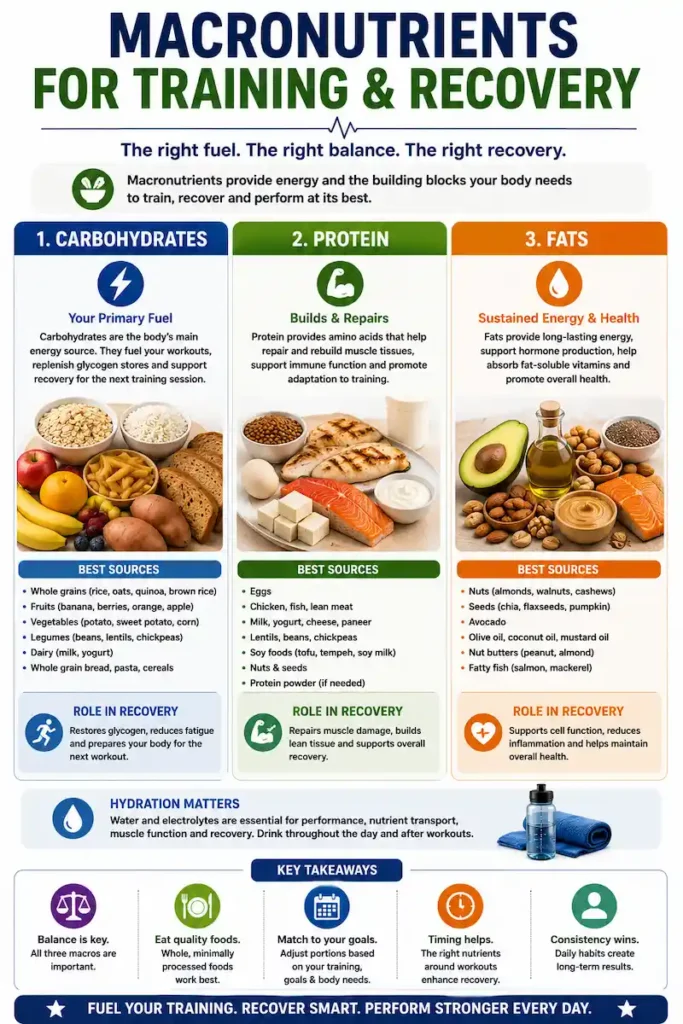
Carbohydrates, protein and dietary fats provide energy and nutrients that support training, recovery and overall physical performance.Protein and Muscle Recovery
Protein receives substantial attention in fitness, sometimes to the point that other aspects of nutrition are overlooked.
Resistance exercise and protein intake both influence muscle protein metabolism.
For people participating in strength training, adequate daily protein intake is therefore important.
However:
More protein is not automatically better indefinitely.
A person’s total diet, training program, energy intake, food preferences, and individual requirements should all be considered.
Protein also does not need to come exclusively from supplements.
A varied diet can provide protein through both animal and plant sources.
Learn how strength training, sets, reps, resistance, and recovery can help develop strength and physical performance in our Strength & Conditioning guide.
Carbohydrates and Recovery
Muscle glycogen is an important stored carbohydrate source used during exercise.
Training can reduce glycogen stores, particularly when exercise is prolonged or demanding.
Carbohydrate intake after exercise can contribute to glycogen restoration.
The urgency depends on the situation.
When Rapid Recovery Matters
Carbohydrate timing becomes more important when an athlete has:
- multiple training sessions in one day;
- closely scheduled competitions;
- prolonged endurance training; or
- high training volume.
When There Is More Recovery Time
For many recreational exercisers, the next workout may not occur until the following day or later.
In that situation, adequate total daily nutrition may be more practical to focus on than obsessing over a tiny post-workout timing window.
ILearn how cardiovascular training can improve aerobic fitness, stamina, and exercise capacity in our Endurance & Cardio guide.
Pre-Workout Nutrition
There is no single ideal pre-workout meal for everyone.
The appropriate choice depends on:
- time before exercise;
- workout duration;
- workout intensity;
- individual tolerance;
- dietary preferences; and
- the person’s overall nutrition.
A pre-exercise meal may contain carbohydrates together with some protein and other foods according to individual needs.
Examples might include:
Oats + yogurt + fruit
Rice + vegetables + a protein source
Toast + eggs + fruit
Banana + yogurt
These are examples, not mandatory combinations.
Large meals immediately before intense exercise may cause discomfort for some people, while others tolerate food differently.
Experiment during normal training rather than testing unfamiliar foods immediately before an important competition.
Post-Workout Nutrition
Post-workout nutrition can support recovery by providing nutrients and fluids after exercise.
Depending on the training session, priorities may include:
- protein;
- carbohydrates;
- fluids;
- electrolytes where relevant; and
- adequate overall energy.
A practical post-workout meal might combine:
Protein source + carbohydrate source + vegetables/fruit + fluids
Examples include:
Rice + dal + vegetables + yogurt
Potatoes + eggs + vegetables
Oats + milk/yogurt + fruit
Rice + chicken/fish/tofu + vegetables
Again, these are examples rather than universal prescriptions.

Pre-workout nutrition helps provide fuel for exercise, while post-workout nutrition supports energy replenishment, muscle recovery and rehydration.Is There a 30-Minute Anabolic Window?
Fitness advice sometimes claims that protein must be consumed within exactly 30 minutes after training or the workout will be “wasted.”
That is an oversimplification.
Post-exercise nutrition can certainly be useful, particularly when training sessions are closely spaced, but overall daily protein and energy intake also matter substantially.
Rather than becoming anxious about an exact minute on the clock, most recreational exercisers can focus on:
- eating adequately throughout the day;
- consuming appropriate protein;
- including carbohydrate according to training demands; and
- having a practical meal or snack around training.
Athletes with demanding schedules may require more precise nutrition planning.
Hydration and Exercise Recovery
Water is essential for normal physiological function.
Exercise can increase fluid loss through sweat, and the amount lost can vary substantially between individuals.
Sweat rate is influenced by factors such as:
- exercise intensity;
- exercise duration;
- temperature;
- humidity;
- clothing;
- body size;
- acclimatization; and
- individual physiology.
This is why a single fixed water target is not appropriate for every athlete in every environment.
Practical Hydration Approach
A sensible approach includes:
- beginning exercise reasonably hydrated;
- drinking according to the demands of the activity and environment;
- replacing fluids after meaningful losses; and
- paying greater attention during prolonged exercise or hot conditions.
NIH notes that athletes participating in endurance activities lasting over an hour or exercising in extreme environments may need additional fluid, electrolytes, and carbohydrates.
Excessive water consumption can also be dangerous, so “drink as much as possible” is poor advice.
What Are Electrolytes?
Electrolytes include minerals such as:
- sodium;
- potassium;
- chloride;
- magnesium; and
- calcium.
They perform important physiological functions.
Sweat contains water and electrolytes, particularly sodium.
For short, ordinary workouts, many people can meet hydration and electrolyte needs through normal food and fluids.
Long-duration exercise, heavy sweating, hot environments, or repeated sessions may require more individualized attention.
Sports drinks are therefore tools for particular situations, not mandatory beverages after every workout.
Sleep and Recovery
Sleep should be treated as a major part of recovery rather than an optional extra.
Poor sleep can affect how a person feels and performs, while physical activity itself can support sleep quality as part of broader health.
Practical sleep habits may include:
- maintaining a reasonably consistent sleep schedule;
- creating a dark and comfortable sleep environment;
- limiting behaviors that repeatedly disrupt sleep;
- allowing adequate opportunity for sleep; and
- adjusting training when severe fatigue accumulates.
No supplement can reliably compensate for chronically inadequate sleep.
Rest Days: Do You Need Them?
Rest does not always mean lying completely still for 24 hours.
A rest or recovery day may include:
- normal daily activities;
- easy walking;
- gentle mobility;
- recreational movement; or
- complete rest when needed.
The appropriate approach depends on the person’s training program and fatigue.
Someone training twice per week may naturally have several days between sessions.
A competitive athlete training almost daily may need planned lower-load sessions instead.
Therefore, the important question is not simply:
“How many rest days should everyone take?”
It is:
“Does this training schedule provide enough recovery for this individual?”
Active Recovery
Active recovery refers to relatively easy physical activity performed during recovery periods.
Examples might include:
- walking;
- easy cycling;
- gentle swimming;
- light mobility work; or
- other low-intensity activity.
Active recovery should remain low enough in intensity that it does not become another difficult workout.
It can be useful for movement and enjoyment, but it is not a magical method that eliminates all soreness or accelerates every recovery process.
Learn the difference between flexibility and mobility and how stretching and mobility exercises can improve range of motion and movement control in our Flexibility & Mobility guide.
Muscle Soreness After Exercise
Delayed-onset muscle soreness, commonly called DOMS, can occur after unfamiliar or demanding exercise.
Soreness often becomes noticeable after the workout rather than during it.
Importantly:
Soreness is not a reliable measurement of workout quality.
A workout does not need to cause severe soreness to produce useful training adaptations.
Likewise, deliberately trying to become extremely sore after every workout can interfere with subsequent training.
Persistent, severe, unusual, or concerning pain should not simply be assumed to be normal DOMS.
Recovery Between Strength Sessions
Strength training creates demands that should be considered when scheduling subsequent sessions.
Recovery requirements depend on:
- training volume;
- intensity;
- exercise selection;
- muscle groups trained;
- training experience;
- nutrition;
- sleep; and
- the rest of the person’s activity.
This is why a beginner should not simply copy the schedule of an advanced bodybuilder or professional athlete.
Programming should match training capacity.
Recovery From Endurance Training
Long endurance sessions can create different nutritional and recovery demands from short resistance workouts.
Depending on duration and intensity, endurance exercise may increase the importance of:
- carbohydrate availability;
- glycogen replacement;
- hydration;
- electrolyte replacement;
- overall energy intake; and
- sleep.
The more frequent the training sessions, the more important deliberate recovery planning can become.
Recovery From Speed & Agility Training
Sprint and agility sessions can be demanding even when the workout itself is relatively short.
High-quality speed work requires substantial neuromuscular effort.
Excessive fatigue can reduce sprint speed, coordination, and movement quality.
Therefore, recovery between high-intensity speed sessions should be considered alongside strength training, sport practice, and conditioning.
Learn how acceleration, reaction, deceleration, and change-of-direction training can develop faster and more controlled movement in our Speed & Agility guide.
Nutrition for Different Fitness Goals
Nutrition should reflect the person’s actual goal.
General Fitness
Focus on a balanced dietary pattern, sufficient energy, appropriate portions, hydration, and consistency.
Strength and Muscle Development
Adequate energy and protein become particularly relevant alongside progressive resistance training.
Endurance Training
Carbohydrate availability and hydration may become increasingly important as training duration and volume increase.
Weight Management
Long-term energy balance matters, but aggressive restriction can interfere with training, recovery, nutrient intake, and adherence.
Competitive Sport
Athletes may benefit from individualized planning from a qualified sports dietitian because training volume, competition schedules, travel, body-composition demands, and sport rules can make nutrition more complex.
Do You Need Supplements for Recovery?
For most people, supplements should not be the starting point.
NIH emphasizes that performance supplements cannot substitute for a healthy diet, and only a limited number of ingredients have sufficient evidence for particular performance applications.
Some supplements can also:
- cause side effects;
- interact with medications;
- contain multiple poorly studied ingredients; or
- contain undeclared or prohibited substances.
Therefore:
Food, hydration, sleep, and appropriate training should form the foundation.
Competitive athletes also need to consider anti-doping regulations and contamination risk.
Supplement decisions are best made with an appropriately qualified healthcare or sports-nutrition professional when individual circumstances warrant it.
What About Protein Powder?
Protein powder is a convenient source of dietary protein.
It is not inherently required for muscle development or recovery.
A person who can obtain adequate protein through their normal diet may not need it.
For someone who finds it difficult to meet protein requirements through food alone, a suitable protein product may offer convenience.
The important distinction is:
Protein is a nutrient. Protein powder is simply one way of obtaining it.
What About Creatine?
Creatine is one of the better-studied sports supplements and can improve certain types of high-intensity exercise performance and training adaptations in appropriate contexts.
However, that does not mean everyone needs creatine.
Supplement choice depends on age, health, goals, sport, diet, medications, and other individual factors.
NIH advises people considering performance supplements to discuss them with a healthcare provider, particularly when medical conditions or medications are involved.
This article does not provide an individualized creatine prescription.
Vitamins and Minerals
Vitamins and minerals are essential nutrients, but taking large doses does not automatically improve recovery or performance.
Deficiencies can matter.
However, supplementation should ideally address an actual nutritional need rather than the assumption that “more is better.”
For example, NIH notes that treating diagnosed iron-deficiency anemia can improve exercise capacity, whereas extra iron does not improve performance when iron intake/status is already adequate.
Unnecessary high-dose supplementation can also create health risks.
Example Daily Recovery & Nutrition Routine
The following is an educational example, not a personalized meal plan.
| Time | Example Recovery Focus |
|---|---|
| Morning | Balanced breakfast + fluids |
| Before Training | Appropriate meal/snack depending on timing |
| During Training | Fluids according to workout/environment |
| After Training | Protein + carbohydrate + fluids |
| Later Meals | Balanced meals supporting total daily needs |
| Evening | Light recovery activities if desired |
| Night | Consistent sleep routine |
The important message is that recovery occurs throughout the day, not only during the hour immediately after exercise.

A balanced daily recovery routine combines appropriate nutrition, hydration, training, rest and consistent sleep habits.Example Recovery Meal Structure
Instead of prescribing one exact meal, a simple structure can help explain the concept:
Protein source + carbohydrate source + vegetables/fruit + appropriate dietary fat + fluids
For example:
Dal + rice + vegetables + yogurt
or
Eggs + whole-grain toast + fruit + milk
or
Tofu + rice + vegetables + nuts/seeds
or
Fish/chicken + potatoes + vegetables + water
Food choices can be adapted for culture, dietary preferences, allergies, availability, and individual requirements.
Common Recovery and Nutrition Mistakes
1. Focusing Only on Protein
Protein matters, but recovery also involves carbohydrates, total energy, hydration, micronutrients, sleep, and training load.
2. Ignoring Sleep
A perfect-looking meal plan cannot make chronic sleep restriction irrelevant.
3. Treating Soreness as Success
Extreme soreness is not required for effective training.
4. Training Hard Every Day
More training is not automatically more productive.
5. Under-Eating While Training Heavily
Insufficient energy intake can interfere with training and recovery.
6. Avoiding All Carbohydrates
Carbohydrates can be particularly important fuel for demanding exercise.
7. Assuming Supplements Are Necessary
Most recovery fundamentals come before supplements.
8. Drinking Excessive Water
Hydration is important, but excessive fluid intake can also be unsafe.
9. Copying an Elite Athlete’s Diet
An elite athlete’s energy expenditure and training schedule may be completely different from yours.
10. Obsessing Over Exact Meal Timing
Timing can matter in some situations, particularly with closely spaced sessions, but total daily intake remains fundamental.
11. Ignoring Persistent Fatigue
Continually declining performance, persistent fatigue, unusual symptoms, or recurring pain should not simply be solved by adding another supplement.
12. Using Food as a Substitute for Medical Care
Nutrition supports health and training, but it does not replace appropriate diagnosis or treatment.
Signs That Your Recovery Strategy May Need Attention
Individual symptoms can have many causes, so they should not be self-diagnosed from a checklist.
However, it may be worth reviewing training and seeking appropriate professional advice if someone experiences persistent:
- fatigue;
- declining training performance;
- unusual sleep problems;
- recurring injury or pain;
- prolonged loss of motivation;
- difficulty completing normal workouts;
- major appetite changes; or
- other concerning symptoms.
Medical conditions, nutrient deficiencies, psychological factors, illness, and training-related issues can overlap.
Professional assessment is more appropriate than guessing.
How Beginners Should Approach Recovery
Beginners do not need an elaborate recovery system.
Start with the fundamentals:
Train appropriately.
Eat a balanced diet.
Consume adequate protein and carbohydrate for your needs.
Stay appropriately hydrated.
Sleep consistently.
Allow recovery between demanding sessions.
Progress training gradually.
Once these foundations are established, more advanced recovery strategies can be considered if they actually solve a specific problem.
Frequently Asked Questions About Recovery & Nutrition
What is exercise recovery?
Exercise recovery is the process between training sessions through which the body responds to exercise and prepares for future activity.
What should I eat after a workout?
A practical post-workout meal can include a protein source, carbohydrate source, other nutrient-rich foods, and fluids. Exact requirements depend on the workout and individual.
Is protein necessary after exercise?
Protein is important for muscle protein remodeling, but overall daily protein intake also matters. You do not need to panic if protein is not consumed immediately after the final repetition.
Do I need protein powder?
No. Protein powder is a convenient protein source, not a requirement.
Are carbohydrates important for recovery?
Yes, particularly when training depletes glycogen or when another demanding session follows relatively soon.
Should I drink electrolytes after every workout?
Not necessarily. The need depends on exercise duration, sweat losses, environment, diet, and individual factors.
How much water should I drink?
There is no single amount suitable for every workout and person. Fluid needs vary with body size, sweat rate, exercise, weather, diet, and other factors.
Is sleep important for muscle recovery?
Yes. Sleep is an important component of overall recovery and health.
Should I take a complete rest day?
That depends on your training schedule and recovery needs. Some people use complete rest, while others use easy active recovery.
Does stretching improve recovery?
Gentle stretching may feel useful for some people, but it should not be presented as a guaranteed way to eliminate soreness or accelerate every recovery process.
Do supplements improve recovery?
Some supplements have evidence for specific uses, but many do not. Supplements cannot compensate for poor nutrition, inadequate sleep, or inappropriate training.
What is the most important recovery strategy?
There is no single magic strategy. Effective recovery generally comes from consistently combining appropriate training, nutrition, hydration, sleep, and rest.
Key Takeaways
Recovery is part of training, not something separate from it.
Nutrition, hydration, sleep, rest, and sensible training-load management work together to support recovery.
Carbohydrates can support exercise and glycogen replenishment.
Protein provides amino acids needed for muscle protein remodeling.
Dietary fats remain an important part of an adequate diet.
Hydration needs vary according to the individual, environment, and exercise demands.
Post-workout nutrition can be useful, but recovery does not depend on hitting an imaginary 30-minute deadline.
Supplements are secondary to the fundamentals and cannot replace a nutritionally adequate diet.
For most fitness learners, the strongest foundation remains straightforward:
Train appropriately + eat adequately + hydrate appropriately + sleep consistently + recover before repeating demanding training.
Continue Learning on FitEduHub
After understanding fitness fundamentals, continue your learning with these topics:
Understand cardiorespiratory fitness, aerobic exercise, and endurance-training methods. Endurance & Cardio
Learn how resistance and conditioning methods can develop muscular strength, endurance, and physical performance. Strength & Conditioning
Explore acceleration, speed, reaction ability, agility, and athletic movement. Speed & Agility
Learn about flexibility, joint mobility, range of motion, and movement quality. Flexibility & Mobility
Understand the role of recovery, sleep, hydration, and nutrition in supporting exercise and physical performance. Recovery & Nutrition
References & Further Reading
- NIH Office of Dietary Supplements — Exercise & Athletic Performance
- NIH ODS — Consumer Guide to Exercise & Athletic Performance Supplements
- CDC — Health Benefits of Physical Activity for Adults
- NIH Office of Dietary Supplements — Supplement Fact Sheets
About This Article
Editorial Purpose
This FitEduHub educational resource is designed to help students, teachers, coaches, fitness learners, athletes, and general readers understand the fundamental relationship between exercise recovery and nutrition.
The article focuses on practical, evidence-informed foundations rather than promoting restrictive diets, miracle recovery methods, or unnecessary supplements.
Health & Nutrition Note
This article provides general educational information and is not individualized medical or dietetic advice.
Nutrition requirements can vary substantially with age, health status, medications, pregnancy, body size, training load, dietary restrictions, medical conditions, and athletic goals.
People with medical conditions, suspected nutrient deficiencies, eating disorders or disordered eating concerns, persistent unexplained fatigue, significant gastrointestinal problems, or specialized athletic requirements should seek individualized guidance from an appropriately qualified healthcare professional or registered dietitian.