

Introduction: The Engine of Human Performance
Have you ever wondered why your muscles burn during a heavy sprint, or how a marathon runner sustains energy for hours? The answer lies in Exercise Physiology. It is the scientific study of how the human body functions during physical exertion and how it adapts to consistent training over time.
For athletes, coaches, and sports science enthusiasts, understanding the physiological mechanisms of the body is the key to unlocking peak performance. Whether you are lifting weights, running a 5K, or recovering from an intense match, your body is constantly making complex physiological adjustments. In this comprehensive guide, we will break down the practical science behind energy systems, cardiovascular responses, and VO₂ Max.
1. Energy Systems: The Fuel for Movement
The human body does not use the food you eat directly for energy. Instead, it converts carbohydrates, fats, and proteins into a high-energy molecule called ATP (Adenosine Triphosphate). Depending on the intensity and duration of your exercise, your body relies on three distinct energy systems to produce ATP.
A. The ATP-PC (Phosphagen) System
- Intensity: Maximum (95-100% effort)
- Duration: 0 to 10 seconds
- How it works: This system uses stored ATP and Phosphocreatine (PC) in the muscles to deliver immediate, explosive energy. It does not require oxygen (anaerobic).
- Practical Scientific Example: Think of a 100-meter sprinter launching off the starting blocks, or a weightlifter performing a 1-Rep Max (1RM) Deadlift. The action is over before the body has time to process oxygen, relying purely on the Phosphagen system.
- 👉 Pro Tip: Discover how to build explosive power using the ATP-PC system in our upcoming Strength & Conditioning guide.
B. The Glycolytic (Lactic Acid) System
- Intensity: High (80-95% effort)
- Duration: 10 seconds to 2 minutes
- How it works: Once PC stores deplete, the body breaks down muscle glycogen (stored carbohydrates) to create ATP. This process produces hydrogen ions and lactate, leading to the familiar “muscle burn” and eventual fatigue.
- Practical Scientific Example: A 400-meter track sprint or a 50-meter freestyle swim. Athletes in these events feel a heavy burning sensation in their legs and arms because the glycolytic system is working in overdrive, accumulating metabolites faster than they can be cleared.
C. The Oxidative (Aerobic) System
- Intensity: Low to Moderate (Under 80% effort)
- Duration: 2 minutes to several hours
- How it works: This system uses oxygen to break down carbohydrates and fats (and sometimes proteins) into large amounts of ATP. While it produces energy slowly, its capacity is virtually limitless as long as fuel is provided.
- Practical Scientific Example: A marathon runner pacing themselves for 42 kilometers, or a cyclist on a long-distance tour.
- 👉 Pro Tip: To optimize your aerobic energy output, proper fueling is required. Read our upcoming complete guide to carbohydrates and fats in the Sports Nutrition category.
2. Cardiovascular & Respiratory Responses to Exercise
The moment you start exercising, your body’s demand for oxygen and nutrient delivery skyrockets. The cardiovascular (heart and blood vessels) and respiratory (lungs) systems work in synergy to meet this demand.
The Cardiovascular Response
- Heart Rate (HR): Your resting heart rate might be 60-70 beats per minute (bpm). During intense exercise, the sympathetic nervous system kicks in, raising your heart rate up to your maximum (roughly 220 minus your age).
- Stroke Volume (SV): This is the amount of blood pumped out of the heart with each beat. Exercise forces the heart to pump more forcefully, increasing SV.
- Cardiac Output (Q): Cardiac Output = Heart Rate × Stroke Volume. During exercise, cardiac output can increase from 5 liters per minute at rest to up to 20-30 liters per minute in elite athletes, rushing oxygen-rich blood to working muscles.
- Blood Shunting (Vasodilation & Vasoconstriction): Blood is directed away from non-essential organs (like the stomach) and shunted toward active skeletal muscles.
- 👉 Pro Tip: Understand the structural mechanics of the heart and blood vessels in our Anatomy & Kinesiology module.
The Respiratory Response
- Tidal Volume & Breathing Rate: Tidal volume (the depth of each breath) and respiratory rate (breaths per minute) both increase. This allows more oxygen to enter the lungs and more carbon dioxide (a waste product) to be exhaled.
- Practical Scientific Example: When doing heavy Barbell Squats, a lifter takes a deep breath and holds it (the Valsalva maneuver) to stabilize the core. However, during a 5K run, the runner relies on rhythmic, deep breathing to maintain a steady supply of oxygen to the working leg muscles.
3. VO₂ Max: The Ultimate Metric of Aerobic Fitness
VO₂ Max (Maximum Volume of Oxygen) is the maximum amount of oxygen your body can take in, transport, and utilize in one minute during intense, maximal exercise. It is widely considered the gold standard indicator of cardiovascular fitness and aerobic endurance.
Why Does VO₂ Max Matter?
The higher your VO₂ Max, the more oxygen your body can deliver to your muscles. This means your muscles can produce more energy aerobically, delaying the point at which they must rely on the fatiguing glycolytic (anaerobic) system.
- Average vs. Elite: An average untrained male might have a VO₂ Max of 35-40 ml/kg/min. In contrast, elite endurance athletes (like Tour de France cyclists or Olympic marathon runners) often record VO₂ Max scores of 70 to 85+ ml/kg/min.
- How is it Tested? The most accurate way to measure VO₂ Max is in a sports science laboratory. The athlete runs on a treadmill or rides a stationary bike while wearing a mask that measures the volume and concentration of inhaled and exhaled gases.
- 👉 Pro Tip: Want to test your aerobic capacity without a lab? Check out field tests like the Beep Test and Cooper Run in our Fitness Testing & Assessment category.
How to Improve VO₂ Max
- HIIT (High-Intensity Interval Training): Short bursts of near-maximal effort (e.g., 4 x 4-minute runs at 90-95% Max HR) have been proven to significantly boost VO₂ Max.
- Long Slow Distance (LSD) Training: Consistent, low-intensity cardio builds the foundational capillary density needed to transport oxygen effectively.
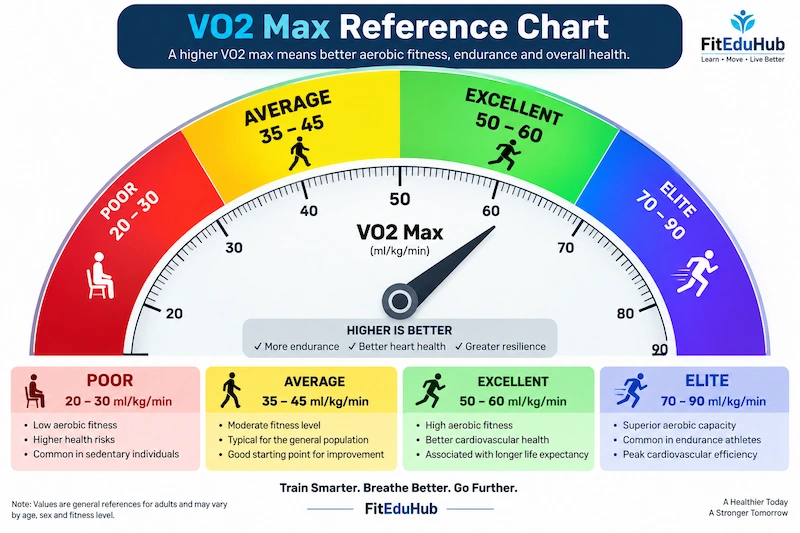
VO2 Max Reference Chart — General reference ranges for aerobic fitness from poor to elite levels.4. Exercise Physiology – Understanding Lactate, Fatigue, and Long-Term Training Adaptations
Lactate: The Misunderstood Metabolite
For decades, athletes and coaches blamed “lactic acid” for muscle soreness and fatigue. However, modern sports science has completely debunked this myth. Lactate is not a waste product; it is actually a highly efficient energy source.
The Truth About Lactate and Hydrogen Ions (H+)
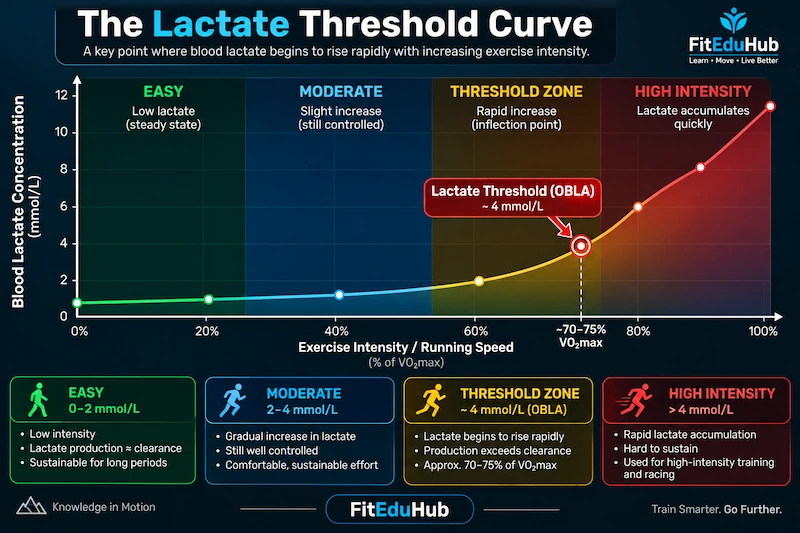
When your body relies on the Glycolytic system (breaking down carbohydrates without oxygen), it produces a substance called pyruvate. At high exercise intensities, pyruvate is converted into lactate and hydrogen ions (H+). It is the accumulation of hydrogen ions that increases the acidity (lowers the pH) in your muscles, causing the burning sensation and interfering with muscle contractions. Lactate, on the other hand, is a buffer. It is transported out of the muscle, sent to the liver, and converted back into glucose (energy) through a process called the Cori Cycle.
The Lactate Threshold (LT)
The Lactate Threshold is the specific exercise intensity at which lactate begins to accumulate in the blood faster than the body can clear it.
- Practical Scientific Example: Imagine two runners completing a 10K race. Runner A has a low lactate threshold and hits “the burn” at a pace of 6:00 min/km. Runner B has trained their lactate threshold to occur at a much higher intensity, allowing them to run at a 4:30 min/km pace before accumulating H+ ions and fatiguing.
- 👉 Pro Tip: Learn how to measure your exact Lactate Threshold using lab protocols and field tests in our Fitness Testing & Assessment guide.
5. Fatigue: Why We Slow Down and Stop
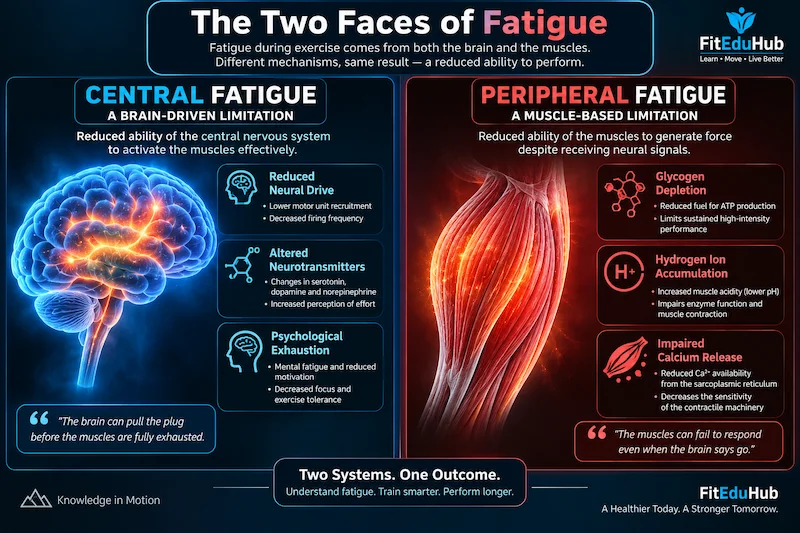
Fatigue is defined as the inability to maintain a desired power output or force generation. In exercise physiology, fatigue is a protective mechanism that stops you from pushing your body to the point of permanent damage. It is generally divided into two categories: Central and Peripheral.
Peripheral Fatigue (Muscle Level)
This type of fatigue occurs directly within the muscle tissue.
- Substrate Depletion: Running out of fuel. For example, hitting “The Wall” in a marathon happens when your muscles completely deplete their glycogen (stored carbohydrate) reserves.
- Metabolic Accumulation: As mentioned earlier, the build-up of hydrogen ions, inorganic phosphate, and ammonia disrupts the muscle fibers’ ability to slide and contract forcefully.
- Practical Scientific Example: During a heavy set of 12-rep bicep curls, the final two reps feel impossible. Your brain is sending the signal, but the local muscle environment is too acidic (peripheral fatigue) to contract further.
- 👉 Pro Tip: Did you know that what you eat before a game directly delays substrate depletion? Read our definitive guide to Pre/During/Post Exercise Fueling in the Sports Nutrition section.
Central Fatigue (Brain and Nervous System Level)
Central fatigue originates in the Central Nervous System (CNS) — your brain and spinal cord.
- Neural Drive & Neurotransmitters: Prolonged exercise increases core body temperature and alters neurotransmitters like serotonin and dopamine in the brain. The brain perceives this physiological stress and consciously or subconsciously reduces the neural drive (the signal) sent to the muscles to force you to slow down.
- 👉 Pro Tip: Your mindset can actually override central fatigue. Discover the Central Governor Model and mental resilience techniques in our Sports Psychology module.
6. Training Adaptations: How the Body Evolves
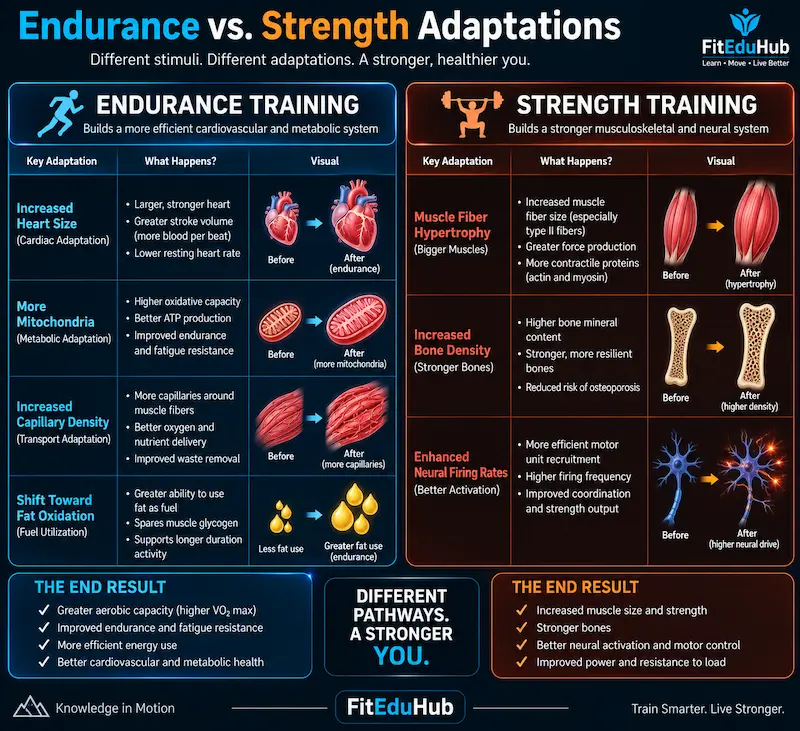
The most beautiful aspect of human physiology is its ability to adapt to stress. According to the SAID principle (Specific Adaptation to Imposed Demands), your body changes specifically in response to the type of training you do.
A. Aerobic (Endurance) Adaptations
When you consistently perform cardiovascular exercise, the body becomes a highly efficient oxygen-processing machine:
- Cardiac Hypertrophy (Athlete’s Heart): The left ventricle of the heart grows larger and stronger, allowing it to pump more blood per beat (increased Stroke Volume).
- Increased Capillary Density: The body builds microscopic new blood vessels around the muscle fibers to deliver oxygen faster.
- Mitochondrial Biogenesis: Mitochondria are the “powerhouses” of the cell. Endurance training increases both the size and number of mitochondria in your muscles, enhancing your capacity to burn fat for fuel.
- 👉 Pro Tip: To maximize muscle recovery and allow these endurance adaptations to take place, follow our proven protocols in the Recovery & Performance section.
B. Anaerobic (Strength & Power) Adaptations
Lifting heavy weights or performing explosive plyometrics triggers entirely different physiological changes:
- Neural Adaptations: Within the first few weeks of strength training, you get stronger without getting bigger. This is because your brain becomes better at recruiting more motor units and firing them synchronously.
- Muscular Hypertrophy: Over time, mechanical tension and metabolic stress cause muscle fibers (specifically Type II fast-twitch fibers) to increase in cross-sectional area (size).
- Bone Density: Heavy resistance training places mechanical stress on the skeletal system, stimulating osteoblasts to build denser, stronger bones—crucial for injury prevention.
- Practical Scientific Example: A beginner doing the Barbell Squat will see their weight jump from 40kg to 60kg in a month, not because their muscles grew massively, but because their nervous system learned how to coordinate the movement efficiently.
- Dive deeper into hypertrophy, power development, and periodization structures in our comprehensive Strength & Conditioning category.
Conclusion: Bridging Theory and Practice
Exercise physiology is not just textbook science; it is the blueprint of athletic success. By understanding how your energy systems fire, how oxygen is transported, why fatigue sets in, and how your body rebuilds itself, you transition from simply “working out” to truly training.
Whether you are designing a program for an elite athlete or trying to optimize your own fitness journey, applying these physiological principles ensures that every drop of sweat serves a specific, scientific purpose.
📚 Resources & Evidence-Based References
To maintain evidence-based practice and allow our readers to explore these concepts further, we recommend the following academic resources and textbooks:
- Textbook: Exercise Physiology: Nutrition, Energy, and Human Performance by William D. McArdle, Frank I. Katch, and Victor L. Katch. (Considered the gold standard text for energy systems and cardiovascular responses).
- Textbook: Physiology of Sport and Exercise by W. Larry Kenney, Jack Wilmore, and David Costill. (Excellent for understanding environmental stressors and training adaptations).
- Research Journal: The Journal of Applied Physiology – A peer-reviewed journal publishing original papers on human adaptation to physical exercise.
- Research Journal: Sports Medicine (Auckland, N.Z.) – Highly recommended for deep dives into lactate metabolism and central fatigue models.
- 👉 Pro Tip: For more on how to read, interpret, and apply scientific sports data, visit our Sports Research & Technology section.