
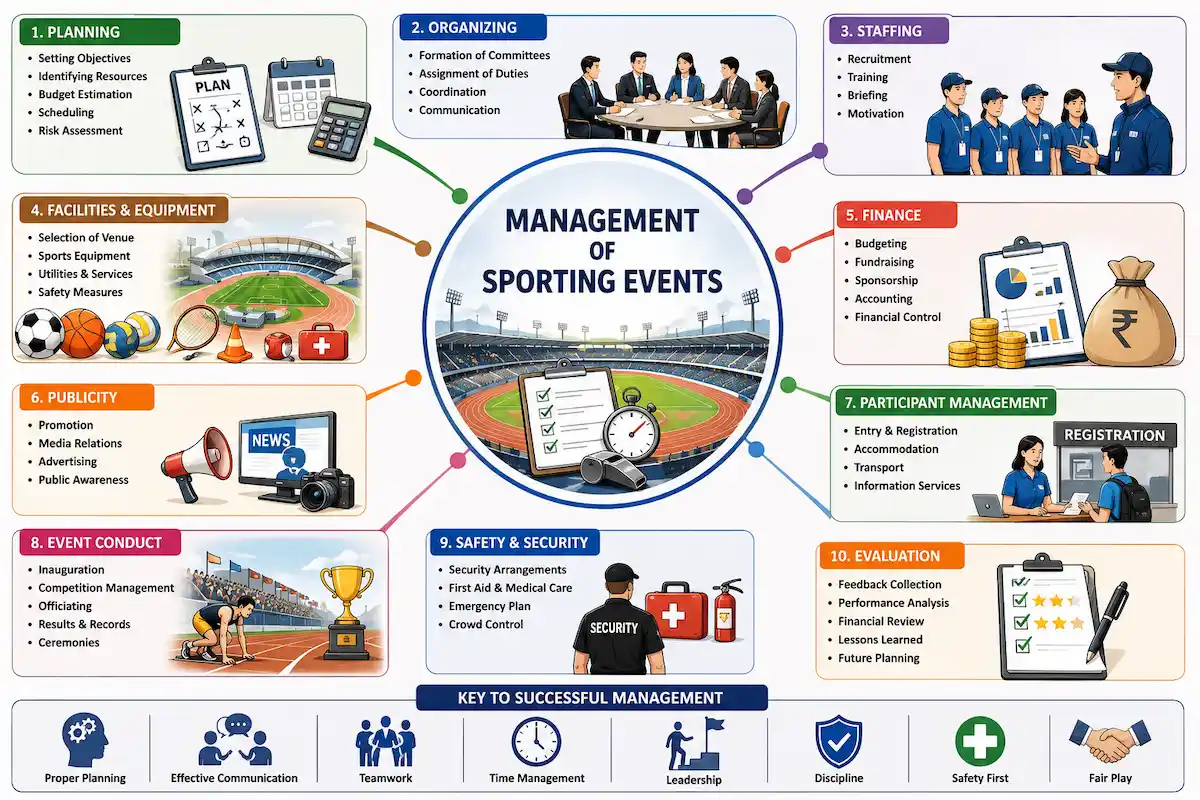
Topic 1: Functions of Sports Events Management
Organizing a sports event (whether it is an Inter-House school competition or a National Level Championship) requires immense planning and execution. No event can be successful without proper management.
There are primarily 5 key functions of management in sports events, which can be easily remembered with the acronym POSDC (Planning, Organising, Staffing, Directing, Controlling). Let us understand each in detail:
1. Planning
Planning is the first and most crucial step of management. It is the process of thinking in advance about “what is to be done”, “how it is to be done”, “when it is to be done”, and “who is going to do it”. It sets the foundation for the entire event.
- Role in Sports Events: Deciding the dates, finalizing the venue, preparing the budget, and choosing the type of tournament (Knockout or League).
- Example: If a school is hosting a District Level Basketball Tournament next month, the management must first “plan” the exact dates, estimate the total cost, and decide which schools will be invited.
2. Organising
Once the planning is done, the next step is bringing that plan to reality. Organising means arranging all the necessary resources (physical, financial, and human) and distributing the workload among different people to achieve the goal smoothly.
- Role in Sports Events: Forming various committees, allocating duties, and arranging required sports equipment and infrastructure.
- Example: Dividing the school staff into different teams. Giving the Physical Education teachers the duty to arrange basketballs and mark the courts, while assigning the art department to decorate the venue.
3. Staffing
An event cannot run automatically; it needs qualified people. Staffing refers to recruiting, selecting, and placing the right person for the right job.
- Role in Sports Events: Appointing technical officials (referees, umpires, judges), medical staff, and volunteers who have the proper knowledge and experience.
- Example: Hiring professional, certified referees for the basketball matches so that all rule violations (like fouls or traveling) are judged accurately and fairly, rather than asking a random teacher to umpire.
4. Directing
Directing is the active phase of management. It involves instructing, guiding, inspiring, and leading the staff and volunteers to perform their duties efficiently. Communication is the key here.
- Role in Sports Events: Providing on-the-spot instructions, resolving conflicts between teams, and motivating the organizing crew during stressful situations.
- Example: If heavy rain suddenly disrupts an outdoor volleyball match, the Event Director must immediately instruct the ground committee to shift the match to the indoor sports hall without creating panic.
5. Controlling
Controlling is the final step. It means evaluating the actual performance and comparing it with the original “Plan”. If things are going off-track, immediate corrective actions are taken.
Example: If two opposing teams get into a physical fight on the field, the management steps in to “control” the situation, disciplines the players, and restores order so the tournament can continue peacefully.
Role in Sports Events: Ensuring matches start strictly on time, checking if the budget is not being overspent, and maintaining strict discipline.
Topic 2: Various Committees and their Responsibilities
A large-scale sports tournament cannot be managed by a single person. To ensure smooth conduct, the workload is divided, and various Committees are formed under the leadership of an Administrative Director or a General Committee.
The responsibilities of these committees are divided into three distinct phases:
A. Pre-Tournament Responsibilities (Before the Event)
These committees start their work weeks or even months before the actual event begins:
- Publicity Committee:
- Responsibility: To advertise the sports event and spread awareness.
- Example: Designing posters, managing social media announcements, and sending official invitation letters to various schools regarding the upcoming sports meet.
- Finance / Budget Committee:
- Responsibility: To manage all the money matters. They prepare the budget, estimate income and expenditure, and seek sponsorships.
- Example: Approaching a local sports brand to sponsor the tournament in exchange for putting up their banners on the ground.
- Purchase Committee:
- Responsibility: To buy all the required items for the tournament well in advance.
- Example: Purchasing gold/silver medals, trophies, certificates, new basketballs, and first-aid kits.
B. During-Tournament Responsibilities (While the Event is Happening)
These committees are highly active on the days of the tournament:
- Reception Committee:
- Responsibility: To welcome the Chief Guest at the opening and closing ceremonies, as well as greeting the participating teams.
- Transport Committee:
- Responsibility: To manage the travel logistics of players and officials.
- Example: Arranging school buses to pick up outstation teams from the railway station and drop them at their accommodation.
- Boarding and Lodging Committee:
- Responsibility: To provide comfortable stay (accommodation) and hygienic meals for outstation players and officials.
- Ground and Equipment Committee:
- Responsibility: To ensure the playing arena is ready and safe.
- Example: Drawing the boundary lines with lime powder, setting up the goalposts, and keeping spare balls ready near the referee’s desk.
- Technical / Officiating Committee:
- Responsibility: To conduct the matches strictly according to the official rules. This committee includes referees, umpires, time-keepers, and score-keepers.
- First-Aid / Medical Committee:
- Responsibility: To provide immediate medical assistance in case of an injury on the field.
- Example: Keeping a doctor, an ambulance, and ice packs ready beside the court in case a player twists their ankle.
- Discipline Committee:
- Responsibility: To maintain peace and order among the spectators, students, and participating athletes.
C. Post-Tournament Responsibilities (After the Event)
The work is not over when the final whistle blows. These committees wrap up the event:
Responsibility: To check all the financial records, clear all pending bills, and calculate the exact amount of money spent versus the allocated budget.
Awards and Prizes Committee:
Responsibility: To organize the prize distribution ceremony and hand out medals, trophies, and certificates to the winning teams and standout performers.
Record and Report Committee:
Responsibility: To prepare a detailed final report of the entire tournament, including all match scores and statistics, and preserve it for future reference.
Finance / Audit Committee:
Responsibility: To check all the financial records, clear all pending bills, and calculate the exact amount of money spent versus the allocated budget.
Topic 3: Tournaments and Their Types
1. Meaning of a Tournament
A tournament is a well-planned series of sports competitions organized among various teams or individual players. It is played under a specific set of rules and a fixed schedule, eventually leading to the declaration of a single winning team or a champion.
Real-World Example: The ICC T20 World Cup, where cricket teams from different countries compete through various stages until one final champion lifts the trophy.
2. Importance of Tournaments in Sports
Why do we even organize tournaments? From an educational and sports perspective, tournaments are highly important because of the following reasons:
- Development of Sports Skills: Competing against strong opponents helps players push their limits and improve their technical and tactical skills.
- Selection of Good Players: Tournaments act as a testing ground. Selectors use these events to spot hidden talents and pick the best players for state or national teams.
- National and International Integration: When teams from different states or countries play together, it promotes unity, brotherhood, and peace.
- Development of Social Qualities: Players learn valuable life skills like discipline, teamwork, fair play, and respect for others.
3. Different Types of Tournaments
Depending on the time available, budget, and the number of participating teams, tournaments are broadly divided into three major categories in the CBSE physical education syllabus:
A. Knockout Tournament (Elimination Tournament)
This is the fastest and most thrilling type of tournament. In a knockout tournament, a team stays in the competition only as long as it keeps winning its matches. If a team loses even a single match, it gets completely eliminated and sent home.
- Advantages:
- Saves Time & Money: Since losing teams are immediately eliminated, fewer matches are played, making it cost-effective and quick to finish.
- High Competition Level: Players give their 100% in every single match because they know there is no second chance.
- Disadvantages:
- Unfair Eliminations: A very strong team might have one bad day or face another strong team in the first round and get eliminated early.
- Less Opportunity: Weak teams get to play only one match, which limits their learning and exposure.
- Example: In an Inter-School Badminton Knockout Tournament of 16 players, whoever loses the Round 1 match is instantly out of the competition.
B. League Tournament (Round Robin Tournament)
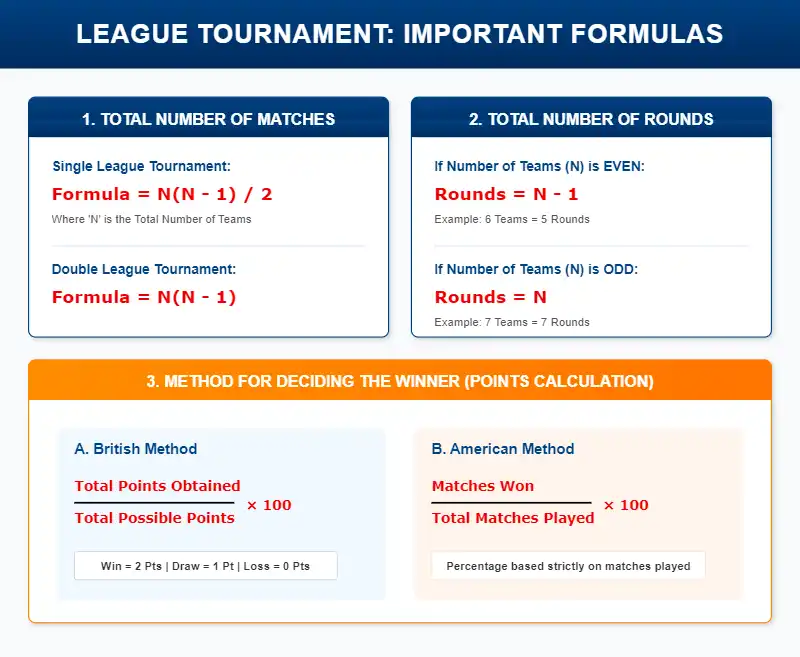
This is considered the fairest and most logical format of a tournament. In a league tournament, every participating team plays a match against every other team in the group, regardless of whether they win or lose their previous matches. The final winner is decided by calculating the maximum points earned.
- Types of League Tournaments:
- Single League: Every team plays with every other team exactly once. (Formula for total matches:
N(N-1) / 2). - Double League: Every team plays with every other team twice. (Formula for total matches:
N(N-1)).
- Single League: Every team plays with every other team exactly once. (Formula for total matches:
- Advantages:
- True Champion: The most consistent and deserving team wins the tournament because one bad match does not ruin their chances.
- Maximum Opportunities: Players get plenty of matches to showcase and improve their skills.
- Disadvantages:
- Expensive & Time-Consuming: It requires a huge budget, more grounds, and a lot of days to complete.
- Example: The group stage of the Indian Premier League (IPL) is a Double League system, where Royal Challengers Bangalore plays against Chennai Super Kings twice, regardless of the match results.
C. Combination Tournament
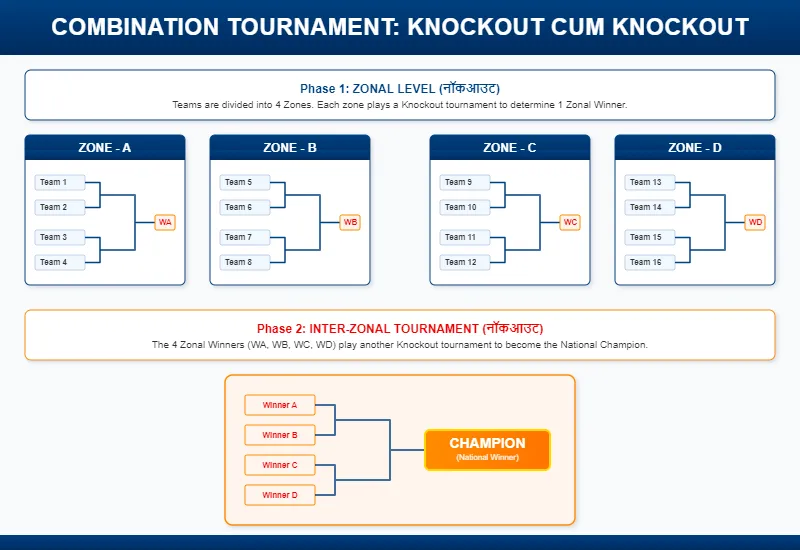
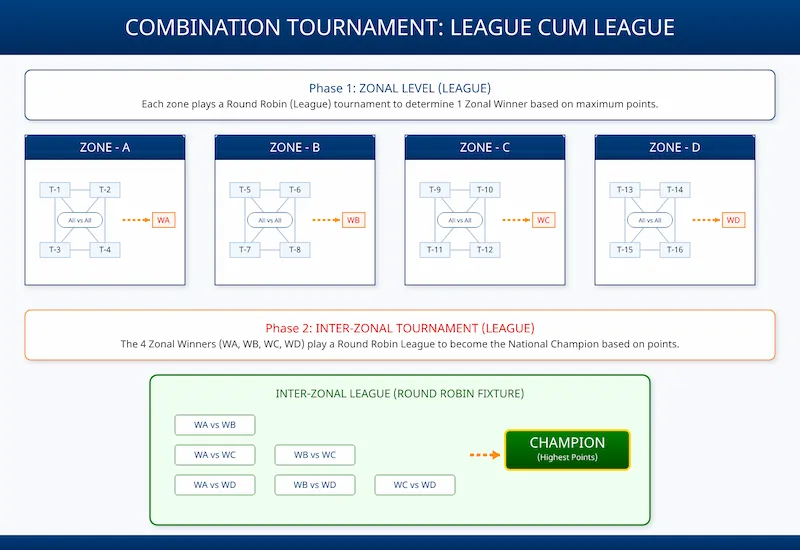
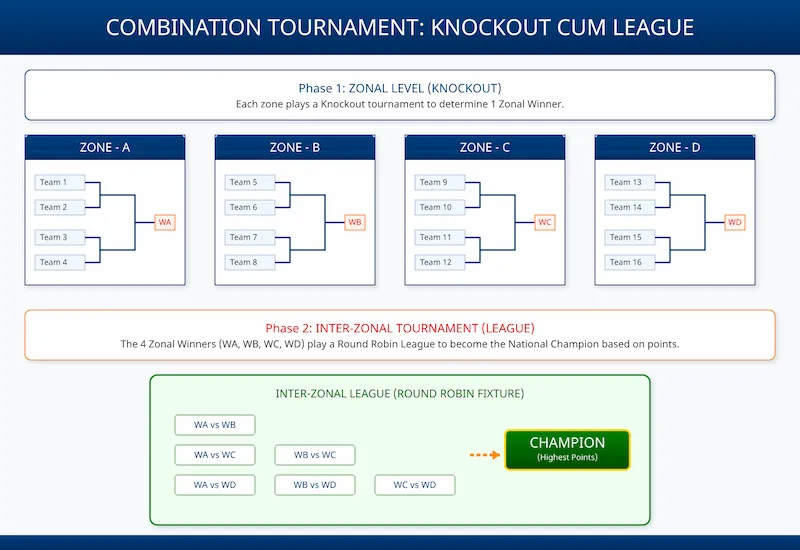
When a tournament is hosted on a grand scale (like National or Zonal level) with a massive number of participating teams, it is practically impossible to organize it using only a Knockout or only a League format. To solve this, teams are divided into different “Zones” or “Pools”, and a combination of both formats is used.
Phase 2: The 4 winning teams from the 4 zones then play a Knockout tournament among themselves (Semi-Finals and Finals) to decide the ultimate National Champion.
The 4 Types of Combination Tournaments are:
Knockout cum Knockout
League cum League
Knockout cum League
League cum Knockout
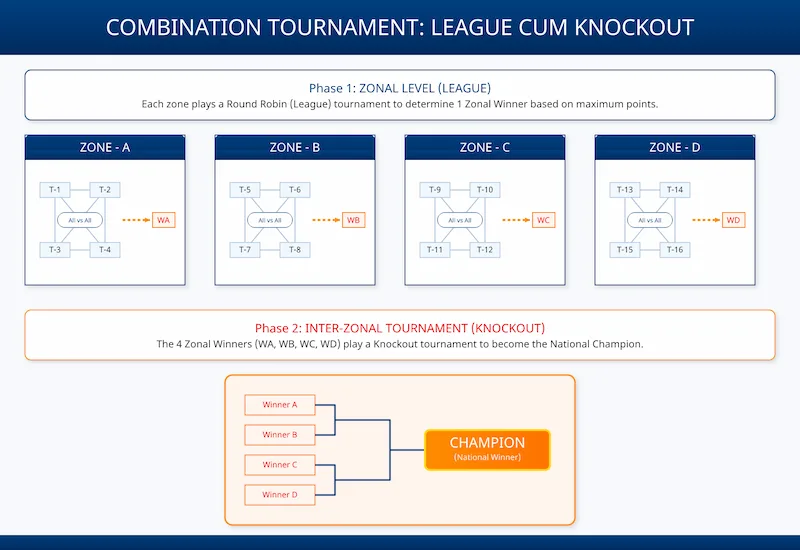
Example (League cum Knockout): Suppose 32 teams are participating in a National Football Championship. They are divided into 4 zones (8 teams each).
Phase 1: Teams within each zone play a League tournament to find the top team of that zone.
Phase 2: The 4 winning teams from the 4 zones then play a Knockout tournament among themselves (Semi-Finals and Finals) to decide the ultimate National Champion.
Topic 4: Fixtures and Their Procedures (Knockout & League)
1. What is a Fixture?
A fixture is a systematic and pre-planned schedule of matches. It clearly outlines which team will play against which opponent, at what exact time, and on which date or court during a tournament. A well-drawn fixture ensures that the tournament runs smoothly without any confusion or bias.
2. Important Terminologies in Fixtures
Before drawing a fixture, it is crucial to understand these three important terms:
- Bye: A “Bye” is a special privilege or dummy advantage given to a team in the very first round. A team receiving a bye does not play in the first round; it directly advances to the second round. Byes are only given when the total number of participating teams is not a power of 2 (like 2, 4, 8, 16, 32, etc.).
- Seeding: This is a ranking procedure used to separate strong teams (such as last year’s winners and runners-up). Strong teams are “seeded” and placed far apart in the fixture so they do not face and eliminate each other in the early rounds.
- Special Seeding: In this method, the highly ranked teams are given a massive advantage. They do not just skip the first round; they directly play in the Quarter-Finals or Semi-Finals.
3. Procedure and Calculations for Knockout Fixtures
To draw a flawless knockout fixture in your exam, you must first show the correct mathematical calculations. Here are the standard formulas:
- Total Matches:
N - 1(Where N is the total number of teams). - Upper Half Teams (Odd N):
(N + 1) / 2 - Lower Half Teams (Odd N):
(N - 1) / 2 - Total Byes:
Next highest power of 2 - Total Teams (N)
Here are the step-by-step calculations for various team numbers:
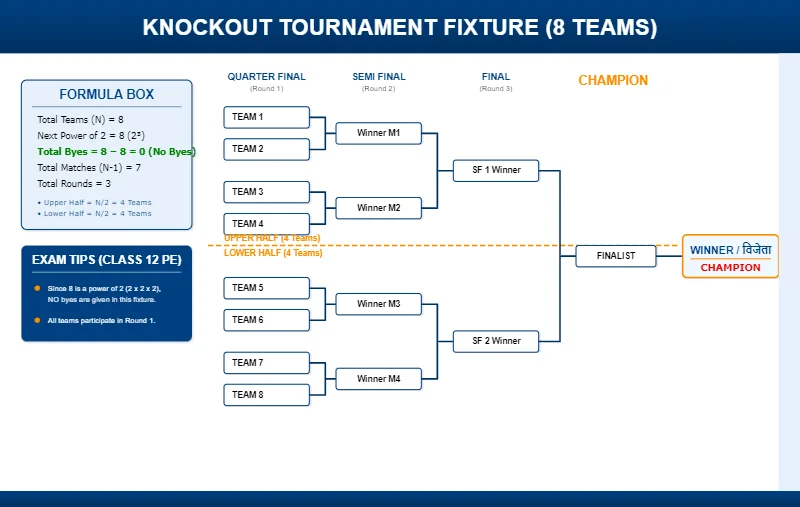
A. Knockout Fixture for 8 Teams (Even Number)
- Total Teams (N): 8
- Total Matches: 8 – 1 = 7 Matches
- Upper Half: 8 / 2 = 4 Teams | Lower Half: 8 / 2 = 4 Teams
- Total Byes: 8 – 8 = 0 Byes (Since 8 is exactly a power of 2, no byes are required).
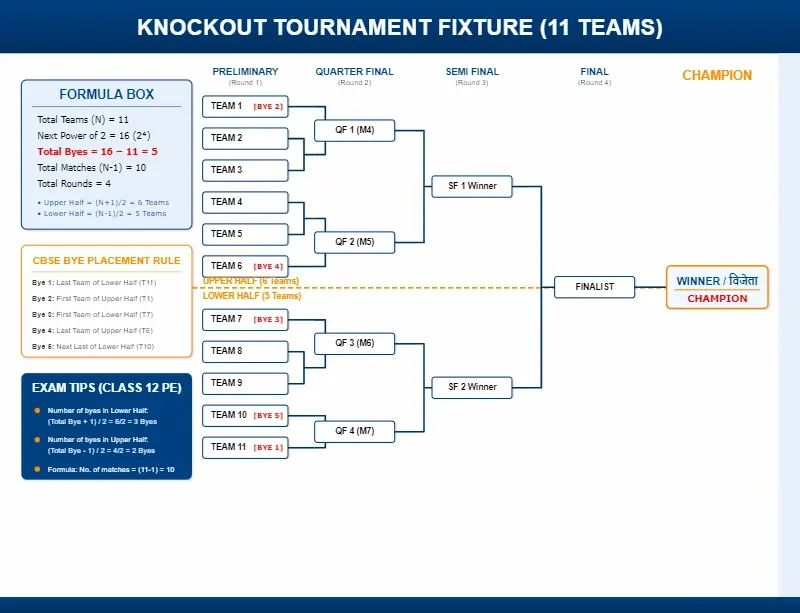
B. Knockout Fixture for 11 Teams (Odd Number)
- Total Teams (N): 11
- Total Matches: 11 – 1 = 10 Matches
- Upper Half: (11 + 1) / 2 = 6 Teams | Lower Half: (11 – 1) / 2 = 5 Teams
- Total Byes: Next power of 2 (16) – 11 = 5 Byes
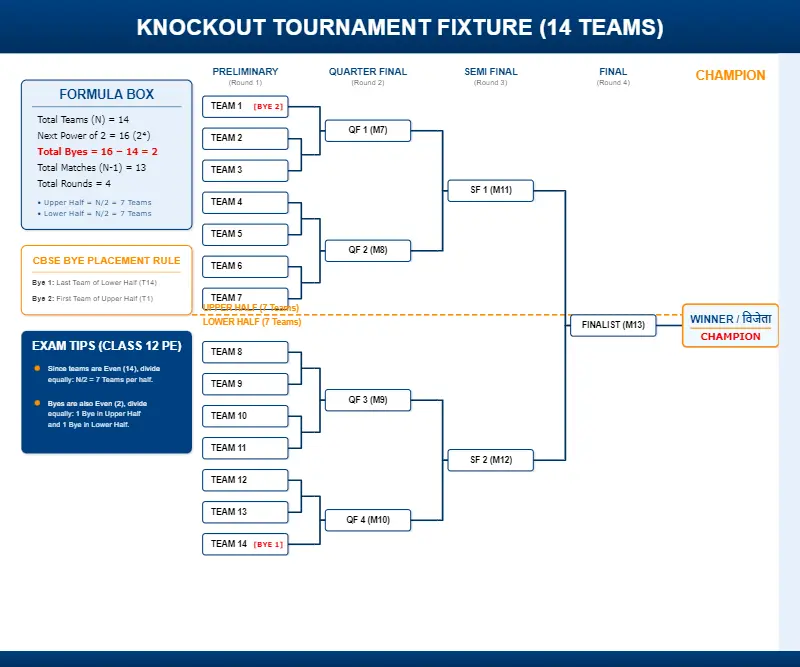
C. Knockout Fixture for 14 Teams (Even Number)
- Total Teams (N): 14
- Total Matches: 14 – 1 = 13 Matches
- Upper Half: 14 / 2 = 7 Teams | Lower Half: 14 / 2 = 7 Teams
- Total Byes: Next power of 2 (16) – 14 = 2 Byes
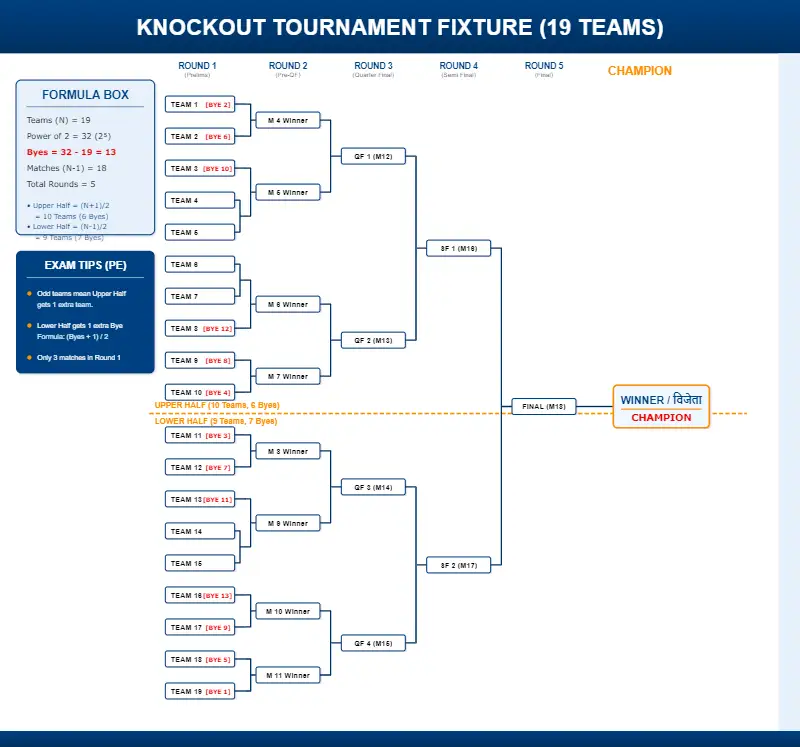
D. Knockout Fixture for 19 Teams (Odd Number)
- Total Teams (N): 19
- Total Matches: 19 – 1 = 18 Matches
- Upper Half: (19 + 1) / 2 = 10 Teams | Lower Half: (19 – 1) / 2 = 9 Teams
- Total Byes: Next power of 2 (32) – 19 = 13 Byes
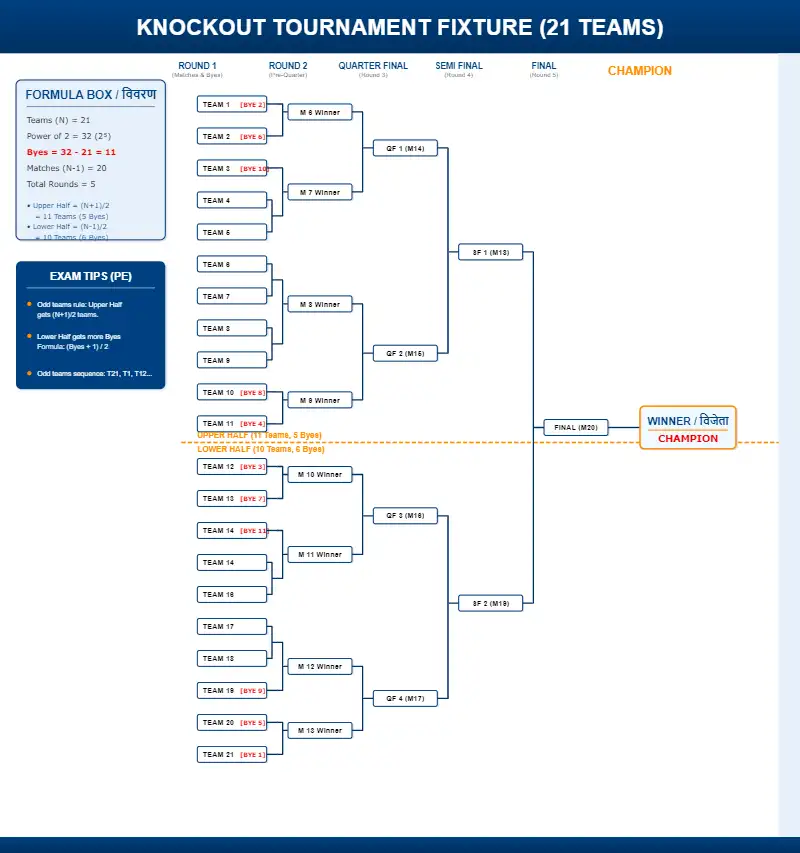
E. Knockout Fixture for 21 Teams (Odd Number)
- Total Teams (N): 21
- Total Matches: 21 – 1 = 20 Matches
- Upper Half: (21 + 1) / 2 = 11 Teams | Lower Half: (21 – 1) / 2 = 10 Teams
- Total Byes: 32 – 21 = 11 Byes
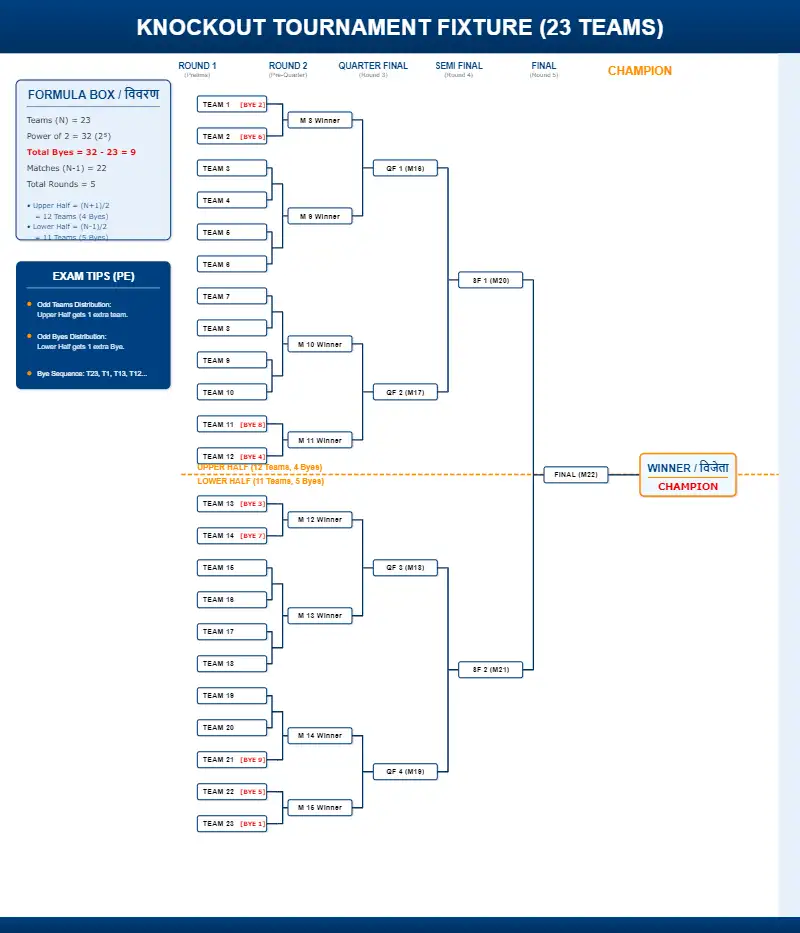
F. Knockout Fixture for 23 Teams (Odd Number)
- Total Teams (N): 23
- Total Matches: 23 – 1 = 22 Matches
- Upper Half: (23 + 1) / 2 = 12 Teams | Lower Half: (23 – 1) / 2 = 11 Teams
- Total Byes: 32 – 23 = 9 Byes
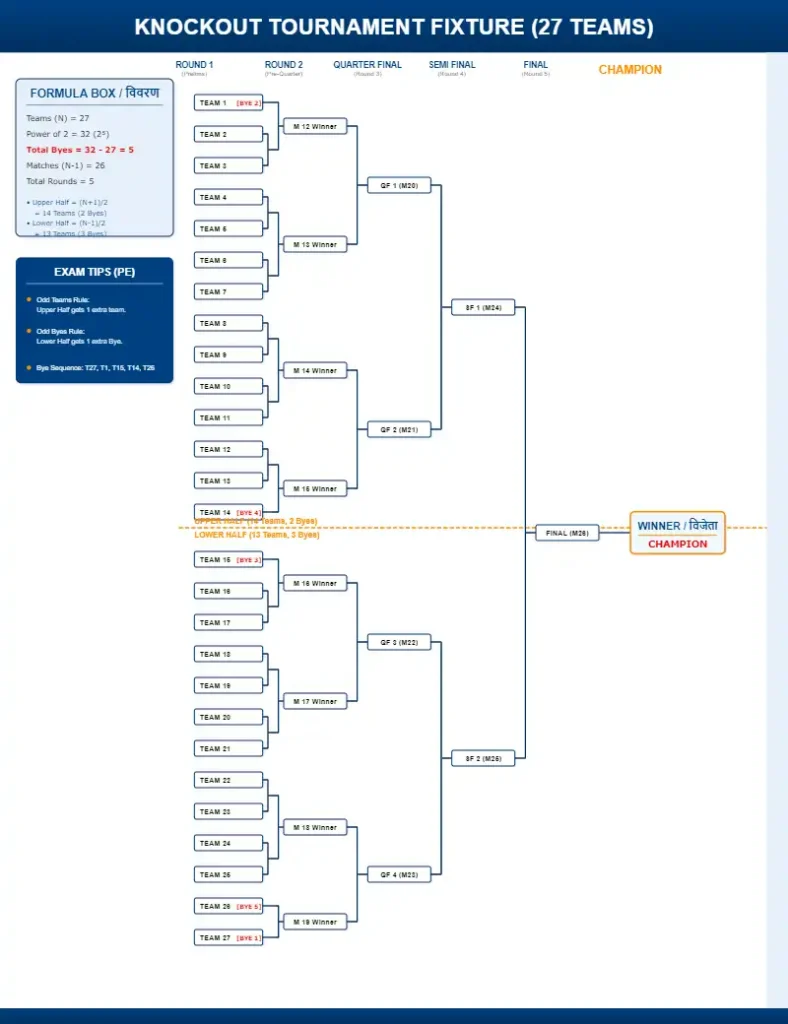
G. Knockout Fixture for 27 Teams (Odd Number)
- Total Teams (N): 27
- Total Matches: 27 – 1 = 26 Matches
- Upper Half: (27 + 1) / 2 = 14 Teams | Lower Half: (27 – 1) / 2 = 13 Teams
- Total Byes: 32 – 27 = 5 Byes
4. Knockout Fixtures with Seeding
Seeding ensures fair competition by protecting top teams in the initial rounds.
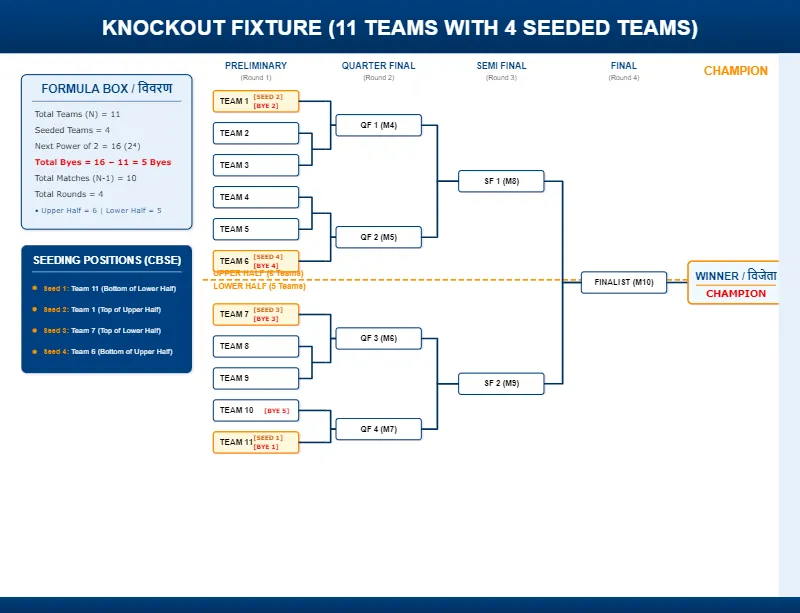
Example 1: Fixture of 11 Teams with 4 Teams Seeded
- Total Byes Needed: 16 – 11 = 5 Byes.
- Distribution Rule: The 4 seeded teams automatically receive 4 out of the 5 byes. They are placed at the absolute top and bottom of the halves. The remaining 1 bye is given to a non-seeded team according to the standard bye sequence.
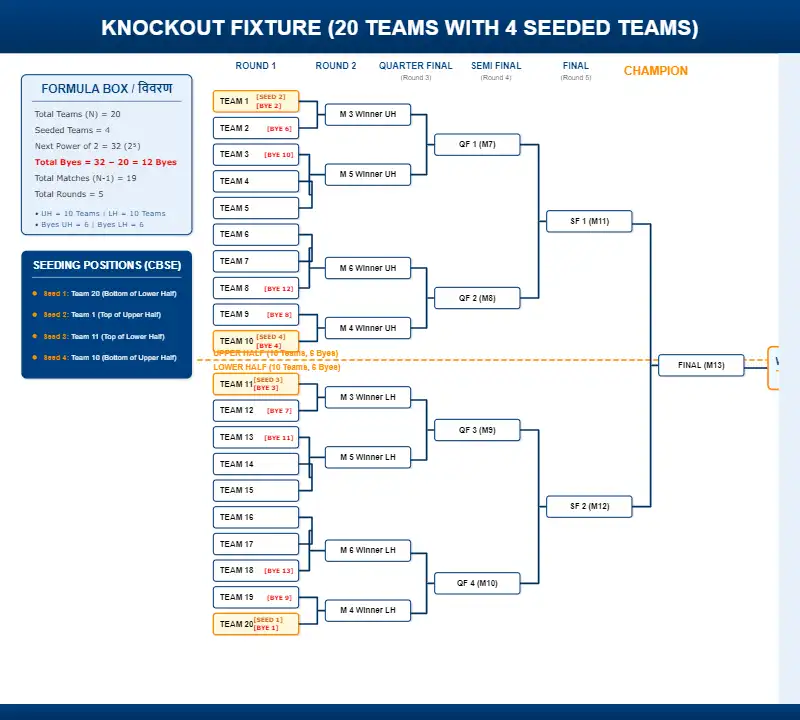
Example 2: Fixture of 20 Teams with 4 Teams Seeded
- Halves: Upper Half = 10 Teams | Lower Half = 10 Teams
- Total Byes Needed: 32 – 20 = 12 Byes.
- Distribution Rule: Out of 12 byes, 4 are assigned to the seeded teams at the extreme corners. The remaining 8 byes are distributed normally among the unseeded teams.
5. Procedure for Drawing a League Fixture
Unlike Knockout tournaments, League fixtures are generally mapped out using three graphical methods to ensure every team plays against every other team:
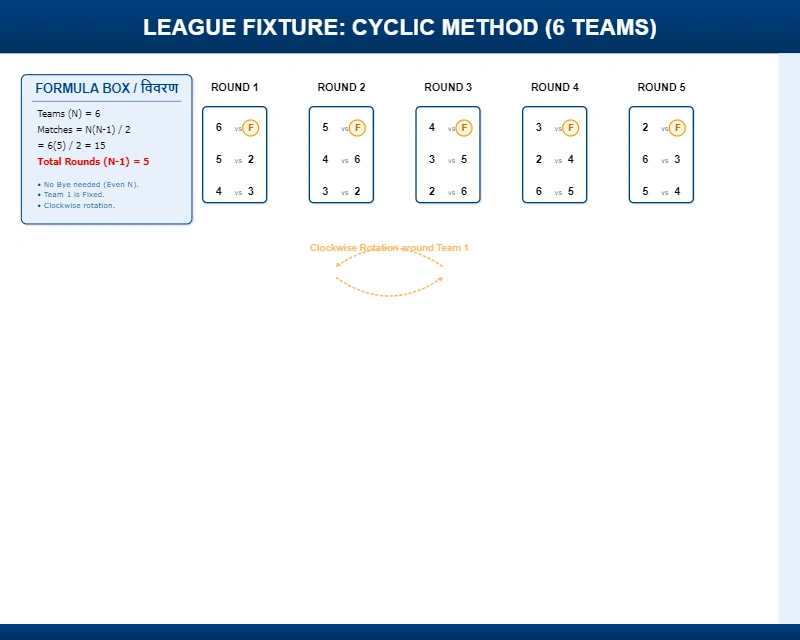
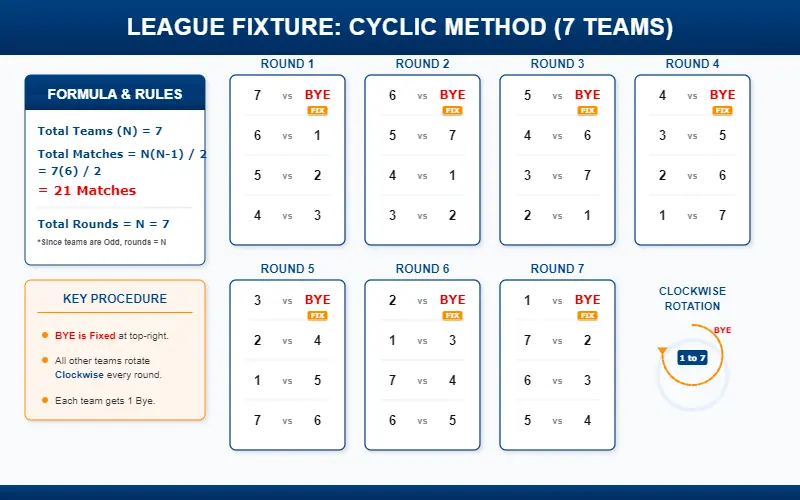
A. Cyclic Method
In this method, the teams rotate in a continuous cycle (clockwise direction) for every round.
- For Even Teams (e.g., 6 Teams): Team number 1 is kept permanently fixed at the top right corner. The remaining teams (2, 3, 4, 5, 6) rotate clockwise around it in each new round.
- For Odd Teams (e.g., 7 Teams): The word “Bye” is kept permanently fixed at the top right corner. A7teams take turns rotating clockwise. The team that aligns with “Bye” gets a rest in that round.
B. Staircase Method
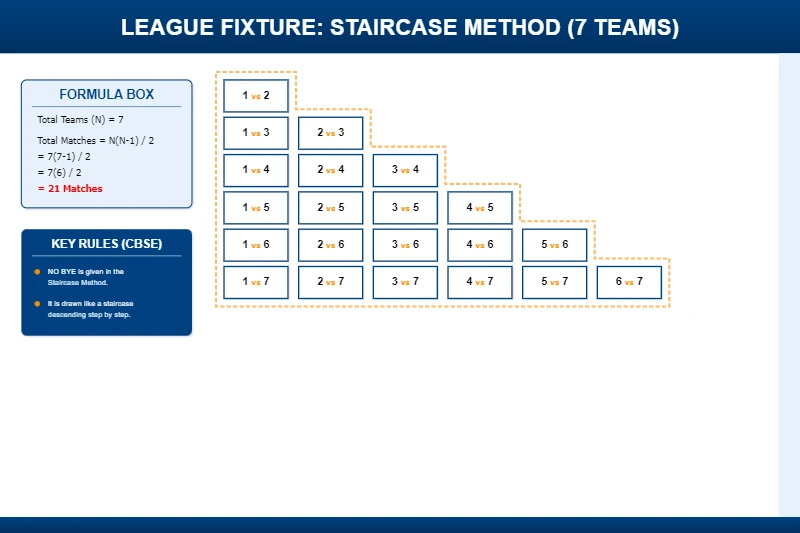
This method is universally simple and gets its name because the drawn fixture looks exactly like a set of stairs.
- Rule: There is absolutely no concept of Byes in the Staircase method, whether the number of participating teams is odd or even.
- Process: Team 1 plays all its matches on the first step, Team 2 plays its remaining matches on the step below, and so on, until the last two teams meet on the final bottom step.
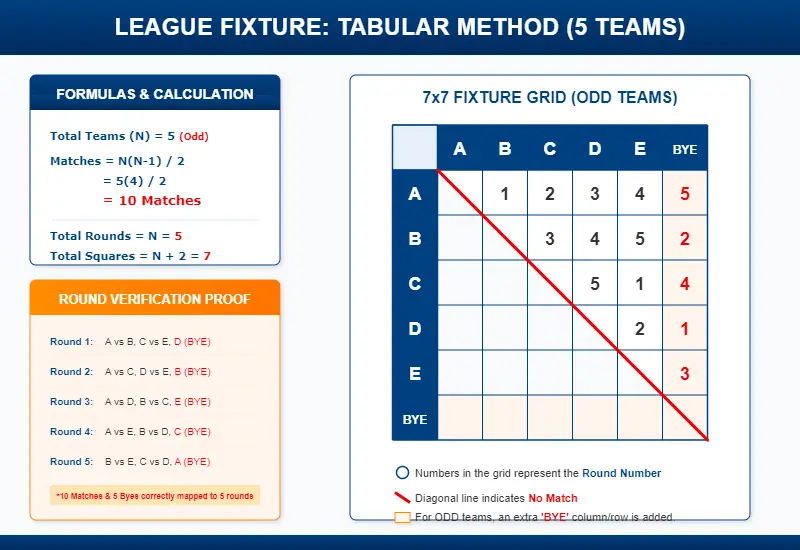
C. Tabular Method
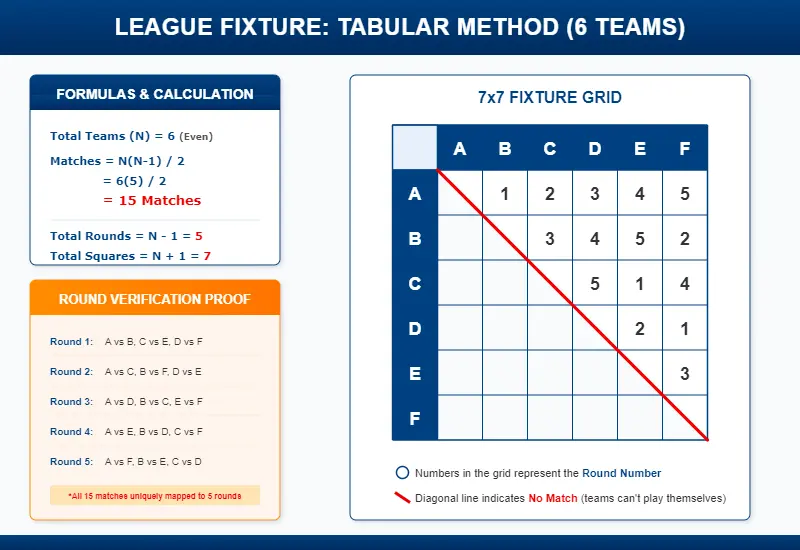
This method uses a square grid or table to schedule matches. A diagonal line is drawn across the squares from the top-left corner to the bottom-right corner, dividing the table.
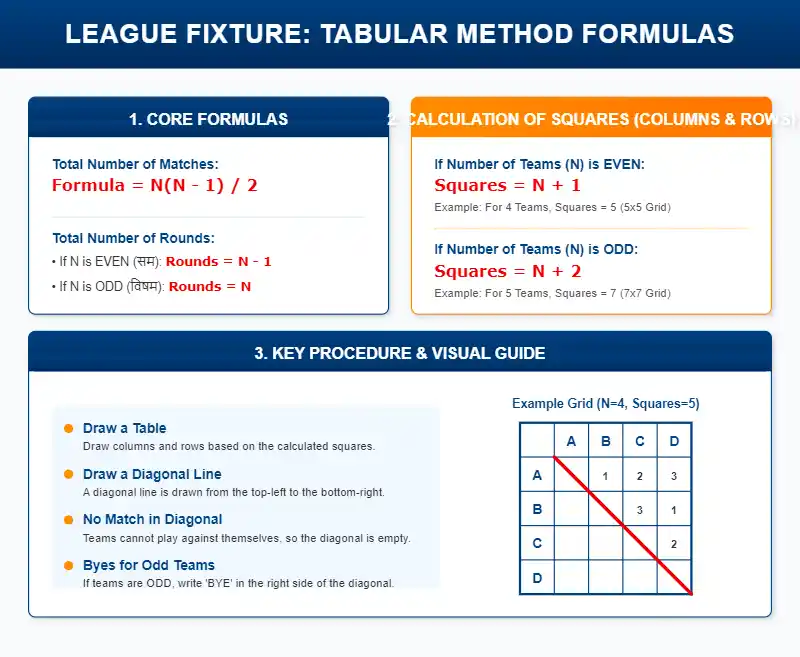
- For Even Teams (e.g., 6 Teams): You must draw a grid of
N + 1rows and columns. So, for 6 teams, a 7×7 box grid is drawn.
- For Odd Teams (e.g., 5 Teams): You must draw a grid of
N + 2rows and columns. So, for 5 teams, a 7×7 box grid is drawn, and one entire column/row is assigned specifically for “Byes”.
Topic 5: Intramural and Extramural Tournaments
To develop the physical and social skills of students, schools and institutions organize sports at two different levels: Intramurals and Extramurals.
1. Intramural Tournaments (Within the Walls)
The word “Intramural” is derived from the Latin words ‘Intra’ (meaning “inside” or “within”) and ‘Mural’ (meaning “wall”). Therefore, Intramural tournaments are the sports competitions organized strictly within the boundary walls of a single institution or school.
- Rule: No student or team from any outside school is allowed to participate in these events.
- Real-World Example: An Inter-House Basketball Competition organized between Jyoti House and Pragati House within the campus of Modern School.
Objectives of Intramurals:
- Mass Participation: To provide an opportunity for every single student in the school to play and participate, not just the top athletes.
- Identifying Talent: It acts as a base to spot hidden sporting talent among students who can later be selected for the school team.
- Developing Leadership and Cooperation: Students learn how to organize, officiate, and work together as a team within their houses or classes.
- Recreation: To provide students a healthy break from their regular academic routine.
2. Extramural Tournaments (Outside the Walls)
The word “Extramural” is derived from the Latin words ‘Extra’ (meaning “outside”) and ‘Mural’ (meaning “wall”). Thus, Extramural tournaments are sports competitions organized outside the boundary walls of an institution, where teams from two or more different schools/institutions compete against each other.
- Rule: Only the selected best players (the official School Team) participate to represent their institution.
- Real-World Example: A school’s Under-14 Girls Basketball team traveling to participate in a District-level Tournament hosted at Ramagya School.
Objectives of Extramurals:
Enhancing the School’s Image: Winning extramural medals brings fame, pride, and a strong reputation to the school in the district or state.
High Standard of Competition: To provide advanced players with tough competition so they can test and improve their skills.
Exposure and Experience: Players learn to handle pressure, play in new environments, and observe the techniques of different teams.
Promoting Brotherhood: To build friendly relationships, unity, and sportsmanship among different schools and institutions.
Topic 6: Specific Sports Programmes
Specific Sports Programmes are not regular tournaments like the Olympics or World Cups. They are special sports events organized not for the sake of competition or winning a trophy, but to create awareness, raise funds, or promote a specific social cause (like health, unity, or charity).
Here are the most common types of specific sports programmes:
1. Sports Day
- What is it? An annual mega-event organized by schools or colleges to promote all-round development.
- Purpose: It gives every student a chance to participate in various athletic events (sprints, relays, long jump) and fun races. It is celebrated like a festival and focuses on mass participation rather than strict professional competition.
2. Health Run
- What is it? A run organized by health departments, sports NGOs, or hospitals to promote the importance of physical fitness among the general public.
- Purpose: To make people aware of diseases like obesity, diabetes, and heart problems. There is no prize money or official timing recorded—the only goal is to complete the run and stay healthy.
3. Run for Fun
- What is it? A purely recreational event organized for enjoyment and community bonding.
- Purpose: The main objective is to release stress and spread happiness. People of all ages—kids, parents, and senior citizens—participate together. It often includes fun elements like color runs or costume runs.
4. Run for a Specific Cause
- What is it? A marathon or run organized specifically to raise funds for a charity or to draw public attention to a serious social or medical issue.
- Purpose: The money collected from the registration fees of the runners is donated to NGOs.
- Example: Running to raise funds for cancer patients, AIDS awareness, or “Save the Environment” campaigns.
5. Run for Unity
- What is it? A massive run organized to promote a feeling of oneness, peace, and national integration among citizens of different religions, states, and backgrounds.
- Purpose: To make people realize that despite their differences, they stand united as one nation. A famous example in India is the marathon organized on National Unity Day.
Chapter Conclusion: Management of Sporting Events
This chapter lays the foundation for organizing successful sports events. It highlights that effective Planning is essential to avoid last-minute confusion, manage resources, and ensure smooth execution through various dedicated committees (Pre, During, and Post-tournament). The chapter thoroughly explains tournament structures, distinguishing between Knockout (elimination) and League (Round-Robin) tournaments, alongside providing mathematical formulas for calculating fixtures, byes, and matches. Additionally, it clarifies the concepts of Intramurals (sports within the school) and Extramurals (competitions between different schools), and sheds light on Specific Sports Programs designed to create health awareness in society.
Frequently Asked Questions (FAQs)
Objective Type Questions (1 Mark)
Q1. What is the primary objective of planning in sports? +
Ans. C) To reduce unnecessary pressure and avoid confusion
Q2. Which of the following is another name for a League Tournament? +
Ans. B) Round-Robin Tournament
Q3. If 11 teams are participating in a knockout tournament, how many byes will be given? +
Ans. C) 5 (Formula: Next highest power of 2 minus N -> 16 – 11 = 5 byes)
Q4. The activities or sports competitions organized within the walls of an institution are called: +
Ans. B) Intramural
Q5. What is the formula to calculate the total number of matches in a Single League Tournament? +
Ans. C) N(N-1)/2
Very Short Answer Type Questions (2 Marks)
Q6. Define the meaning of ‘Planning’ in physical education and sports. +
Ans. Planning is a predefined process of setting goals and deciding the best course of action to achieve them efficiently. In sports, it involves organizing resources, time, and personnel systematically to ensure a tournament is conducted smoothly without any last-minute hurdles.
Q7. What is a ‘Bye’ in a knockout tournament? +
Ans. A ‘Bye’ is a dummy team or a privilege given to a team in a knockout tournament, usually determined by drawing lots, exempting them from playing in the first round. A team receiving a bye directly advances to the second round.
Q8. Briefly differentiate between Intramural and Extramural competitions. +
Ans. Intramural (Intra = within, Muros = wall) means sports activities conducted strictly within the boundary walls of an institution where only the students of that school can participate. Extramural refers to competitions held outside the walls of an institution, involving participation from students of two or more different schools.
Q9. What do you mean by ‘Seeding’ in fixtures? +
Ans. Seeding is a procedure by which strong and reputed teams are deliberately placed in fixtures in such a way that they do not meet each other in the early rounds. This ensures that the tournament remains exciting and good teams don’t get eliminated right at the beginning.
Short Answer Type Questions (3 Marks)
Q10. Explain any three objectives of Intramural tournaments. +
Ans. The main objectives of intramurals are:
- Mass Participation: To provide every student of the school, regardless of their skill level, an equal opportunity to participate in sports.
- Development of Sportsmanship: To teach students qualities like fair play, teamwork, discipline, and respect for rules and opponents.
- Talent Identification: To help physical education teachers spot hidden sports talent among students, who can then be trained for school teams (extramurals).
Q11. Calculate the fixtures details for 11 teams in a knockout tournament. +
Ans. Calculations for 11 teams (N = 11):
- Total number of matches: N – 1 = 11 – 1 = 10 matches.
- Number of Byes: Next power of two (16) – N = 16 – 11 = 5 Byes.
- Teams in Upper Half: (N + 1) / 2 = (11 + 1) / 2 = 6 teams.
- Teams in Lower Half: (N – 1) / 2 = (11 – 1) / 2 = 5 teams.
- Byes in Lower Half: (NB + 1) / 2 = (5 + 1) / 2 = 3 Byes.
- Byes in Upper Half: (NB – 1) / 2 = (5 – 1) / 2 = 2 Byes.
Q12. What are Specific Sports Programs? Give any two examples. +
Ans. Specific Sports Programs are events that are not organized primarily for competition but to create awareness regarding health, unity, and social causes among the masses. They encourage general physical fitness and raise funds for charities.
Examples:
- Health Run: Organized by health departments or NGOs to make people aware of the importance of maintaining a healthy lifestyle.
- Run for a Cause: Organized to raise funds or awareness for specific issues like cancer, girl child education, or environmental protection.
Q13. Mention the responsibilities of the organizing committee During the tournament. +
Ans. The responsibilities during the tournament include:
- Ensuring all events, matches, and opening/closing ceremonies are starting precisely according to the scheduled time.
- Making sure that officials, referees, and umpires are performing their duties impartially.
- Providing immediate first aid and medical assistance to any injured player on the spot.
- Maintaining score sheets, results, and keeping the public/media updated.
Long Answer Type Questions (5 Marks)
Q14. Explain the various committees and their responsibilities required to organize a large-scale sports tournament. +
Ans. To organize a successful tournament, a General Committee is formed, which further delegates work to various sub-committees:
- Organizing Committee: Headed by the Principal or Chairman. Responsible for overall supervision and smooth conduct of the event.
- Publicity Committee: Pre-tournament task. Responsible for advertising the event, sending press releases, and managing media coverage.
- Boarding and Lodging Committee: Makes necessary arrangements for the accommodation (stay) and meals of athletes and officials coming from outside.
- Grounds and Equipment Committee: Prepares the playing fields, marks the tracks, and ensures all necessary sports equipment (like balls, nets, stopwatches) is available and in good condition.
- First Aid Committee: Comprises doctors or trained personnel. Provides immediate medical assistance during injuries on the field.
- Finance Committee: Prepares the budget, manages funds, handles ticket sales, and keeps track of all expenses and income.
- Refreshment Committee: Responsible for supplying water, energy drinks, and snacks to players, officials, and VIP guests during the event.
Q15. Write the differences between Knockout and League tournaments. Discuss their respective advantages. +
Ans. Difference: In a Knockout (Elimination) tournament, a team that gets defeated is immediately eliminated from the competition, and only the winning teams continue. In a League (Round-Robin) tournament, every team gets a chance to play against every other participating team, irrespective of victory or defeat.
Advantages of Knockout Tournament:
- Time-saving: It takes fewer days to complete since defeated teams are quickly eliminated.
- Cost-effective: Requires less budget for organizing, boarding, and officiating as the number of matches is less.
- High Excitement: Every match is a do-or-die situation, keeping spectators thrilled.
Advantages of League Tournament:
- True Winner: The most deserving and capable team wins, as a single bad day doesn’t eliminate a good team.
- Maximum Opportunities: Players get ample opportunities to showcase their talent and improve their performance throughout the tournament.
- Popularity: Sports receive maximum promotion and visibility over a longer period (e.g., IPL).
Q16. Explain the procedure of drawing a fixture for a League Tournament using the Cyclic Method for 6 teams. +
Ans. Cyclic Method: In this method, if the number of teams is even (like 6), team number 1 is fixed at the top right position, and the other teams rotate cyclically (clockwise) around it.
Calculations for 6 Teams (N=6):
- Total Matches: N(N-1) / 2 = 6(5) / 2 = 15 Matches.
- Total Rounds: N – 1 = 6 – 1 = 5 Rounds.
Fixtures: (Team 1 is fixed)
- Round 1: 6 vs 1, 5 vs 2, 4 vs 3
- Round 2: 5 vs 1, 4 vs 6, 3 vs 2
- Round 3: 4 vs 1, 3 vs 5, 2 vs 6
- Round 4: 3 vs 1, 2 vs 4, 6 vs 5
- Round 5: 2 vs 1, 6 vs 3, 5 vs 4
Note: If the number of teams was odd (e.g., 5), a ‘Bye’ would be fixed at the top right, and the teams would rotate around the Bye. The total rounds would be N (i.e., 5).
Q17. What is Extramural? Explain the objectives and importance of Extramural competitions in schools. +
Ans. Extramural: The word extramural is derived from Latin words ‘Extra’ meaning outside, and ‘Muros’ meaning walls. Thus, extramural sports are competitions held outside the boundary walls of an institution, played against teams from different schools or colleges (e.g., Zonal, District, or CBSE National tournaments).
Objectives and Importance:
- Enhancing Standards of Sports: Playing against highly competitive teams from other schools forces players to improve their techniques, strategies, and overall standard of performance.
- Broadening Base of Sports: Extramurals allow students to experience professional environments, officiation, and large-scale crowds, preparing them for state or national-level events.
- Socialization and Unity: It provides opportunities for students of different schools, cultures, and backgrounds to meet, interact, and develop mutual respect and friendship.
- Knowledge of New Rules and Techniques: Students and coaches learn new strategies, advanced training methods, and updated rules by observing other successful teams.
- Institutional Prestige: Winning extramural tournaments brings name, fame, and glory to the participating school in the community.