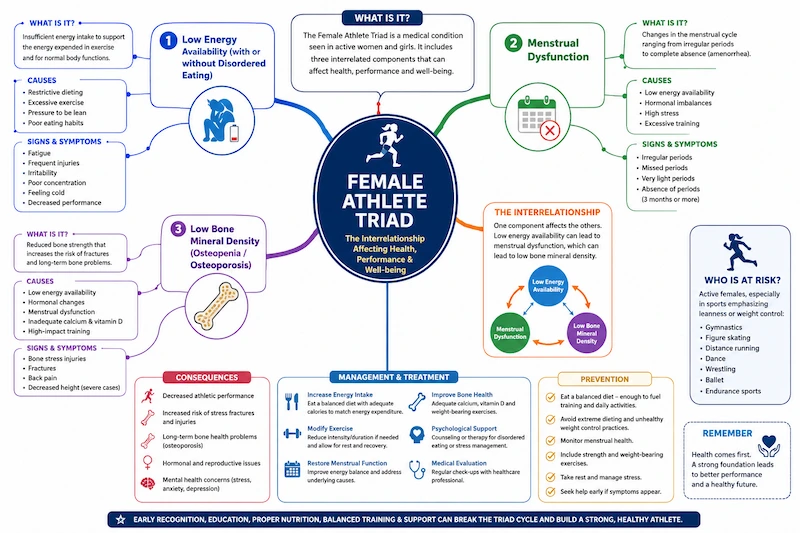
A comprehensive mind map explaining the Female Athlete Triad, including low energy availability, menstrual dysfunction, low bone mineral density, their interrelationship, health effects, prevention strategies, and treatment for athletes.
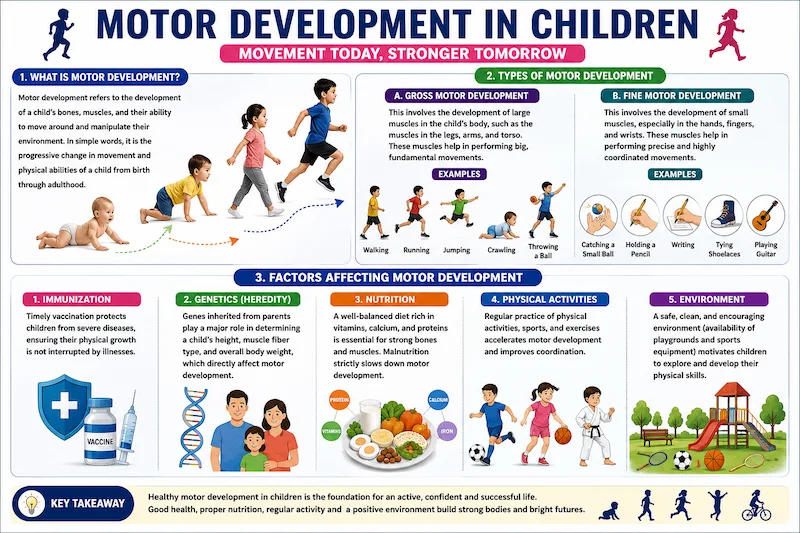
Motor development refers to the development of a child’s bones, muscles, and their ability to move around and manipulate their environment. In simple words, it is the progressive change in movement and physical abilities of a child from birth through adulthood.
2. Types of Motor Development
Motor development is classified into two main categories:
Gross Motor Development: This involves the development of large muscles in the child’s body, such as the muscles in the legs, arms, and torso. These muscles help in performing big, fundamental movements.
Examples: Walking, running, jumping, crawling, and throwing a ball.
Fine Motor Development: This involves the development of small muscles, especially in the hands, fingers, and wrists. These muscles help in performing precise and highly coordinated movements.
Examples: Catching a small ball, holding a pencil, writing, tying shoelaces, and playing a guitar.
3. Factors Affecting Motor Development
Several factors can positively or negatively influence how quickly and effectively a child’s motor skills develop:
Immunization: Timely vaccination protects children from severe diseases, ensuring their physical growth is not interrupted by illnesses.
Genetics (Heredity): Genes inherited from parents play a major role in determining a child’s height, muscle fiber type, and overall body weight, which directly affect motor development.
Nutrition: A well-balanced diet rich in vitamins, calcium, and proteins is essential for strong bones and muscles. Malnutrition strictly slows down motor development.
Physical Activities: Regular practice of physical activities, sports, and exercises accelerates motor development and improves coordination.
Environment: A safe, clean, and encouraging environment (availability of playgrounds and sports equipment) motivates children to explore and develop their physical skills.
Motor Development in Children: This educational infographic explains the meaning of motor development, the difference between gross and fine motor skills, and the key factors influencing a child’s physical development, including nutrition, genetics, immunization, regular physical activity, and a supportive environment. It serves as a visual study guide for CBSE Class 12 Physical Education.
Topic 2: Common Postural Deformities and Corrective Measures
What is a Postural Deformity?
A postural deformity is an unnatural change or defect in the normal alignment of the body’s bones and spine. It prevents a person from performing movements efficiently and can cause pain or discomfort.
1. Spinal Deformities
The human spine has natural curves, but bad posture or weak muscles can cause the following deformities:
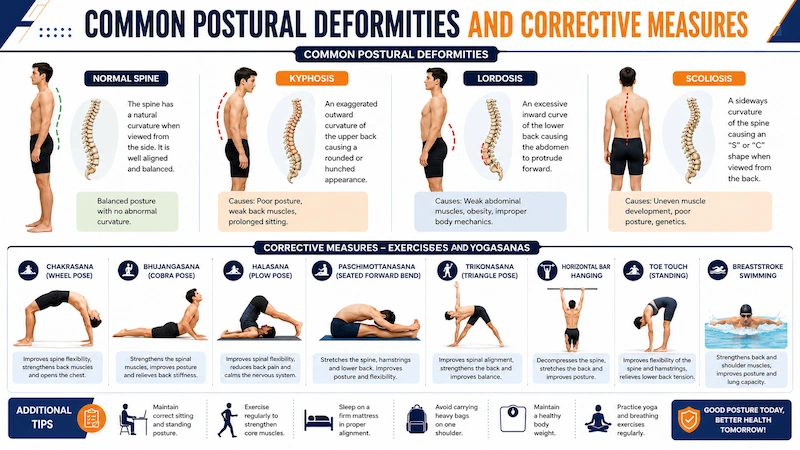
Kyphosis (Round Upper Back): It is an exaggerated outward curve of the upper spine (thoracic region), causing a “hunchback” appearance.
Scoliosis (C-Curve or S-Curve): It is a sideways curvature of the spine. The spine bends either to the left or the right side, causing uneven shoulder heights.
Corrective Measures: Hanging on a horizontal bar, performing Trikonasana (Triangle pose), and swimming using the breaststroke technique.
Educational infographic explaining common postural deformities and effective corrective exercises to improve spinal alignment, posture, and flexibility.
2. Leg and Foot Deformities
These deformities affect a person’s walking and running efficiency:
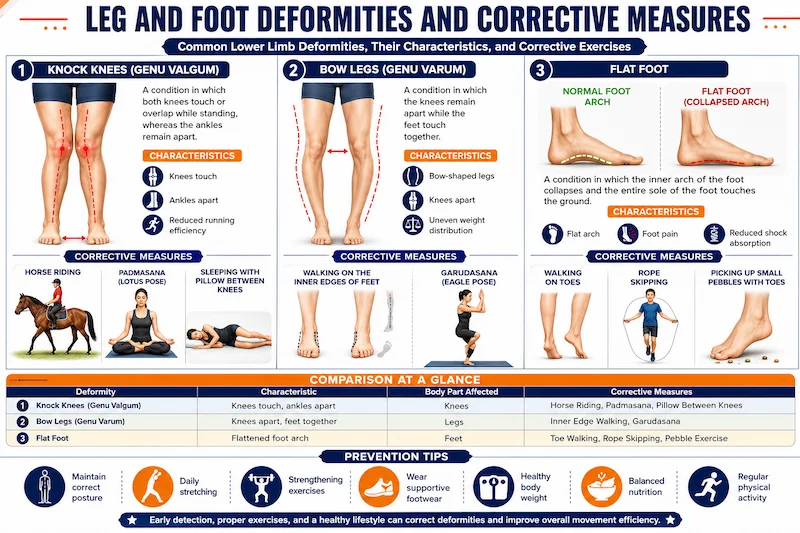
Knock Knees (Genu Valgum): A condition where both knees touch or overlap each other in a normal standing position, while there is a wide gap between the ankles.
Corrective Measures: Horse riding, performing Padmasana (Lotus pose), and keeping a pillow between the knees while sleeping.
Bow Legs (Genu Varum): The exact opposite of Knock Knees. There is a wide gap between the knees when standing with the feet together. The legs curve outward like a bow.
Corrective Measures: Walking on the inner edges of the feet and performing Garudasana (Eagle pose).
Flat Foot: A condition where the inner arch of the foot is completely flattened, and the entire sole touches the ground.
Corrective Measures: Walking on toes, skipping with a rope, and picking up small pebbles using the toes.
Premium infographic explaining common leg and foot deformities and effective corrective exercises for better posture, balance, and movement.
3. Round Shoulders
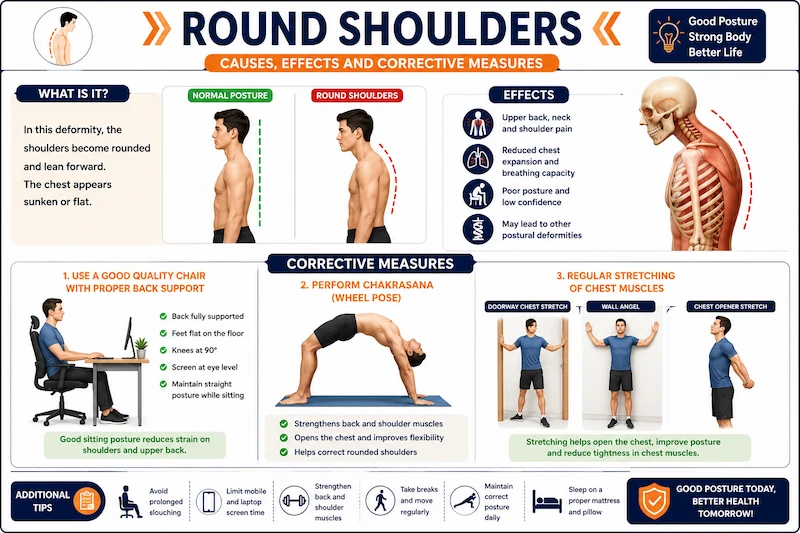
What is it? In this deformity, the shoulders become rounded and lean forward. The chest appears sunken or flat.
Corrective Measures: Using a good quality chair with proper back support, performing Chakrasana, and regular stretching of the chest muscles.
Premium infographic explaining Round Shoulders, its causes, posture changes, and effective corrective exercises to improve shoulder alignment and upper body posture.
Topic 3: Special Considerations for Women in Sports
Participation of women in sports has increased globally, but female athletes go through certain physiological changes that require special care and understanding. The two main considerations according to the syllabus are:
1. Menarche
Meaning: Menarche is the very first menstrual cycle (or first period) a young female experiences during puberty. It marks the beginning of her reproductive years.
Normal Age: It generally occurs between the ages of 11 to 14 years.
Sports Consideration: During this phase, girls might experience physical discomfort, mood swings, or fatigue. Coaches and parents must provide a supportive environment, ensure a nutrient-rich diet, and adjust training loads if necessary, without completely stopping physical activity.
2. Menstrual Dysfunction
Corrective Measures: Reducing training intensity, taking proper rest, eating a balanced diet, and consulting a sports physician.Meaning: Menstrual dysfunction refers to an irregular, abnormal, or completely absent menstrual cycle in females of reproductive age.
Common Symptoms: Unusually long cycles (more than 35 days), missed periods, or unusually heavy/painful bleeding.
Causes in Female Athletes:
Intense and excessive physical training (overtraining).
Extreme psychological stress or performance pressure.
Poor nutrition and extreme weight loss.
Topic 4: Female Athlete Triad
What is the Female Athlete Triad?
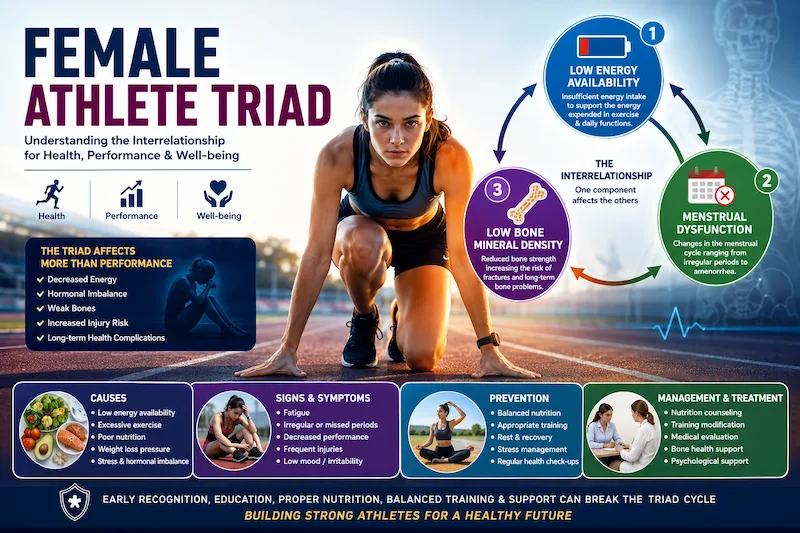
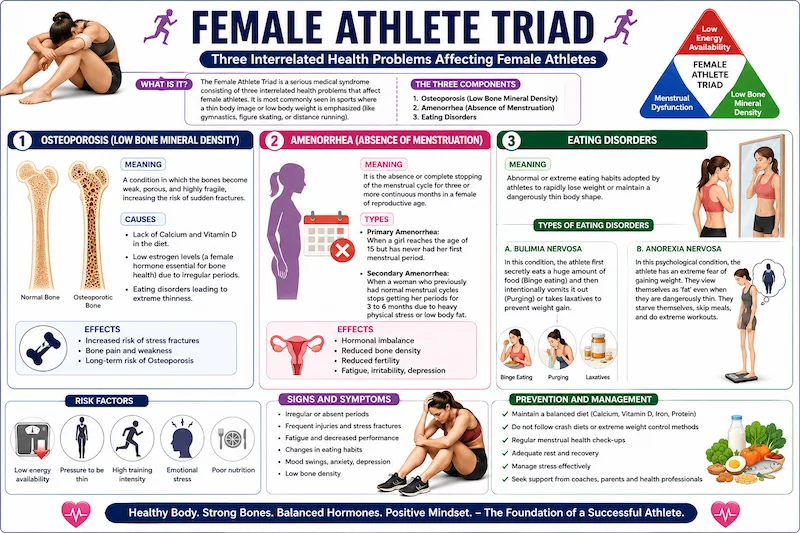
The Female Athlete Triad is a serious medical syndrome consisting of three interrelated health problems that affect female athletes. It is most commonly seen in sports where a thin body image or low body weight is emphasized (like gymnastics, figure skating, or distance running).
The three components of the Female Athlete Triad are:
1. Osteoporosis (Low Bone Mineral Density)
Meaning: A condition in which the bones become weak, porous, and highly fragile, increasing the risk of sudden fractures.
Causes:
Lack of Calcium and Vitamin D in the diet.
Low estrogen levels (a female hormone essential for bone health) due to irregular periods.
Eating disorders leading to extreme thinness.
2. Amenorrhea (Absence of Menstruation)
Meaning: It is the absence or complete stopping of the menstrual cycle for three or more continuous months in a female of reproductive age.
Types:
Primary Amenorrhea: When a girl reaches the age of 15 but has never had her first menstrual period.
Secondary Amenorrhea: When a woman who previously had normal menstrual cycles stops getting her periods for 3 to 6 months due to heavy physical stress or low body fat.
3. Eating Disorders
Bulimia Nervosa: In this condition, the athlete first secretly eats a huge amount of food (Binge eating) and then intentionally vomits it out (Purging) or takes laxatives to prevent weight gain.
Meaning: Abnormal or extreme eating habits adopted by athletes to rapidly lose weight or maintain a dangerously thin body shape.
Types of Eating Disorders:
Anorexia Nervosa: In this psychological condition, the athlete has an extreme fear of gaining weight. They view themselves as ‘fat’ even when they are dangerously thin. They starve themselves, skip meals, and do extreme workouts.
Premium medical infographic illustrating the Female Athlete Triad and its three components—osteoporosis, amenorrhea, and eating disorders—with causes, effects, and prevention strategies.
Chapter Conclusion: Children and Women in Sports
This chapter explores the foundational stages of human growth and the specific challenges faced by women in the sporting arena. It begins by explaining Motor Development (Gross and Fine) in children and the various factors influencing it, such as genetics and environment. A major portion is dedicated to identifying common Postural Deformities like Kyphosis, Lordosis, Scoliosis, Knock Knees, and Flat Foot, along with their corrective Yoga and physical measures. Furthermore, the chapter critically addresses women’s participation in sports, shedding light on physiological issues such as Menarche, Menstrual Dysfunction, and the severe health risks associated with the Female Athlete Triad (Osteoporosis, Amenorrhea, and Eating Disorders).
Frequently Asked Questions (FAQs)
Objective Type Questions (1 Mark)
Q1. Which postural deformity is characterized by an increased backward curve (hunchback) in the thoracic region of the spine? +
A) Lordosis
B) Scoliosis
C) Kyphosis
D) Flat foot
Ans. C) Kyphosis
Q2. The first menstrual bleeding in young girls during puberty is medically termed as: +
A) Menopause
B) Amenorrhea
C) Menarche
D) Dysmenorrhea
Ans. C) Menarche
Q3. Which of the following is NOT a component of the Female Athlete Triad? +
A) Osteoporosis
B) Amenorrhea
C) Eating Disorders
D) Lordosis
Ans. D) Lordosis
Q4. A postural deformity where both knees touch or overlap each other while standing normally is called: +
A) Bow Legs (Genu Varum)
B) Knock Knees (Genu Valgum)
C) Flat Foot
D) Round Shoulders
Ans. B) Knock Knees (Genu Valgum)
Q5. Catching a ball, writing, and painting are examples of which type of motor development? +
A) Gross Motor Development
B) Fine Motor Development
C) Sensory Development
D) Cognitive Development
Ans. B) Fine Motor Development
Very Short Answer Type Questions (2 Marks)
Q6. Define Motor Development. Differentiate between Gross and Fine motor development. +
Ans. Motor development refers to the development of a child’s bones, muscles, and ability to move around and manipulate their environment. Gross Motor Development involves the coordination of large muscles (e.g., running, jumping). Fine Motor Development involves the coordination of small muscles, specifically in the hands and fingers (e.g., writing, holding a spoon).
Q7. What do you understand by the term ‘Menarche’? +
Ans. Menarche is the first occurrence of menstruation in a female, marking the onset of puberty and the beginning of her reproductive years. It typically happens between the ages of 11 and 15.
Q8. What are Bow Legs (Genu Varum)? +
Ans. Bow Legs is a postural deformity of the lower limbs where the knees stay wide apart even when the ankles are joined together. The legs curve outward like a bow. It is often caused by a deficiency of Vitamin D, calcium, or rickets.
Q9. List any two common causes of bad posture. +
Ans. Two common causes are:
Poor Habits: Continuously sitting, standing, or walking in incorrect postures (like slouching while using a phone).
Muscular Weakness or Imbalance: Weak muscles cannot hold the spine and joints in proper alignment against gravity.
Short Answer Type Questions (3 Marks)
Q10. Differentiate between Kyphosis and Lordosis. +
Ans.
Kyphosis (Hunchback): It is an exaggerated backward or convex curve in the thoracic region (upper back) of the spine, causing the shoulders to round forward and the chest to cave in.
Lordosis (Hollow Back): It is an exaggerated inward or concave curve in the lumbar region (lower back) of the spine, causing the abdomen to push forward and the buttocks to stick out backward.
Q11. Explain the ‘Female Athlete Triad’ briefly. +
Ans. The Female Athlete Triad is a syndrome combining three interrelated health conditions commonly seen in female athletes who train intensely and restrict calories. The components are:
Osteoporosis: Weak and brittle bones due to low calcium and estrogen levels.
Amenorrhea: The absence of menstrual periods for more than three months.
Eating Disorders: Unhealthy eating habits like anorexia or bulimia to maintain low body weight.
Q12. Discuss any three factors affecting motor development in children. +
Ans. Factors affecting motor development:
Genetics/Heredity: The rate of physical growth and muscle fiber type is heavily influenced by genes inherited from parents.
Nutrition: A well-balanced diet rich in proteins, calcium, and vitamins is critical. Malnutrition severely delays motor development and weakens bones/muscles.
Environment and Opportunities: Children who have safe spaces to play, proper coaching, and encouragement develop motor skills much faster than those who lead sedentary lifestyles.
Q13. What is Flat Foot? Suggest two corrective measures. +
Ans. Flat Foot (Pes Planus) is a deformity where the longitudinal arch of the foot is completely absent, causing the entire sole to touch the ground. It causes pain during walking and running.
Corrective Measures:
Walking on heels or walking barefoot on sand.
Picking up marbles or a towel with the toes to strengthen the foot muscles.
Long Answer Type Questions (5 Marks)
Q14. Detail the common postural deformities of the spine (Kyphosis, Lordosis, Scoliosis) and their corrective measures. +
Ans. Spinal Deformities:
Kyphosis: An abnormal increase in the backward curvature of the upper back (thoracic spine), resulting in a hunchback. Corrective Measures: Practice Chakrasana, Dhanurasana, and Bhujangasana. Sit upright and avoid carrying heavy backpacks on one shoulder.
Lordosis: An abnormal increase in the forward curvature of the lower back (lumbar spine), pushing the stomach outward. Corrective Measures: Practice Paschimottanasana and Halasana. Perform sit-ups to strengthen abdominal muscles.
Scoliosis: A lateral (sideways) curvature of the spine. The spine bends either to the left or right, creating an ‘S’ or ‘C’ shape. One shoulder often appears higher than the other. Corrective Measures: Practice Trikonasana, Ardh-Chakrasana, and hanging exercises on a horizontal bar. Swimming (especially breaststroke) is highly effective.
Q15. Elaborate on the ‘Female Athlete Triad’ (Osteoporosis, Amenorrhea, Eating Disorders) in detail. +
Ans. The Female Athlete Triad is a severe medical condition characterized by three interconnected health issues in female athletes, usually triggered by an imbalance between energy intake (food) and energy expenditure (exercise).
Eating Disorders: The root cause of the triad. Athletes, under pressure to maintain a low body weight for aesthetics or performance (e.g., gymnastics, distance running), develop psychological conditions like Anorexia Nervosa (starving oneself) or Bulimia Nervosa (binge eating followed by vomiting). This leads to severe energy deficiency.
Amenorrhea: The intense stress of training coupled with dangerously low body fat and poor nutrition disrupts the endocrine system. The hypothalamus stops producing normal hormones, leading to the cessation of menstrual periods for three months or more.
Osteoporosis: The drop in estrogen levels (caused by amenorrhea) combined with poor calcium/vitamin D intake causes bones to lose density, becoming weak, porous, and highly susceptible to stress fractures.
Prevention: Educating athletes on healthy nutrition, reducing extreme pressure for weight loss, and ensuring a balanced diet that matches training demands.
Q16. Discuss the various postural deformities of the lower extremities (Knock Knees, Bow Legs, Flat Foot) and their remedies. +
Ans. Deformities of Lower Extremities:
Knock Knees (Genu Valgum): The knees knock or touch each other in a normal standing position, while there is a wide gap between the ankles. It makes walking and running difficult. Remedies: Practice Padmasana and Gomukhasana. Keep a pillow between the knees and stand for some time. Horse riding is also beneficial.
Bow Legs (Genu Varum): The opposite of knock knees. The knees stay wide apart even when the ankles are touching. The legs bow outward. Commonly caused by Rickets or early walking in childhood. Remedies: Practice Garudasana (Eagle Pose) and Ardh-Matsyendrasana. Walk on the inner edges of the feet. Ensure an adequate intake of calcium and Vitamin D.
Flat Foot: The arch of the foot collapses, and the entire sole touches the ground, acting as poor shock absorbers. Remedies: Walk on the toes, walk barefoot on sand, and skip rope. Perform Tadasana regularly.
Q17. Explain Menstrual Dysfunction and its impact on female athletes’ participation in sports. +
Ans. Menstrual Dysfunction: It refers to any abnormality in a female’s normal menstrual cycle. A normal cycle is typically 28 days, but dysfunctions can alter its frequency, duration, or cause immense pain.
Types of Dysfunction:
Amenorrhea: Absence of menstruation. Primary (never started by age 15) or Secondary (stops for 3+ months after starting).
Dysmenorrhea: Extremely painful menstrual cramps that can be debilitating.
Oligomenorrhea: Infrequent or highly irregular menstrual periods (cycle length longer than 35 days).
Impact on Sports Participation:
Physical Weakness: Heavy bleeding (Menorrhagia) can cause iron-deficiency anemia, leading to extreme fatigue, shortness of breath, and a drop in stamina, which directly degrades performance.
Psychological Stress: The pain from dysmenorrhea and the stress of irregular cycles can cause anxiety, mood swings, and a lack of concentration during high-pressure competitions.
Bone Health: As seen in the Triad, amenorrhea lowers estrogen, directly increasing the risk of stress fractures and career-threatening bone injuries.
Conclusion: With proper medical guidance, nutrition, and tailored training loads, female athletes can successfully manage these dysfunctions and compete at the highest levels.