
Introduction: The Science of Sports Training
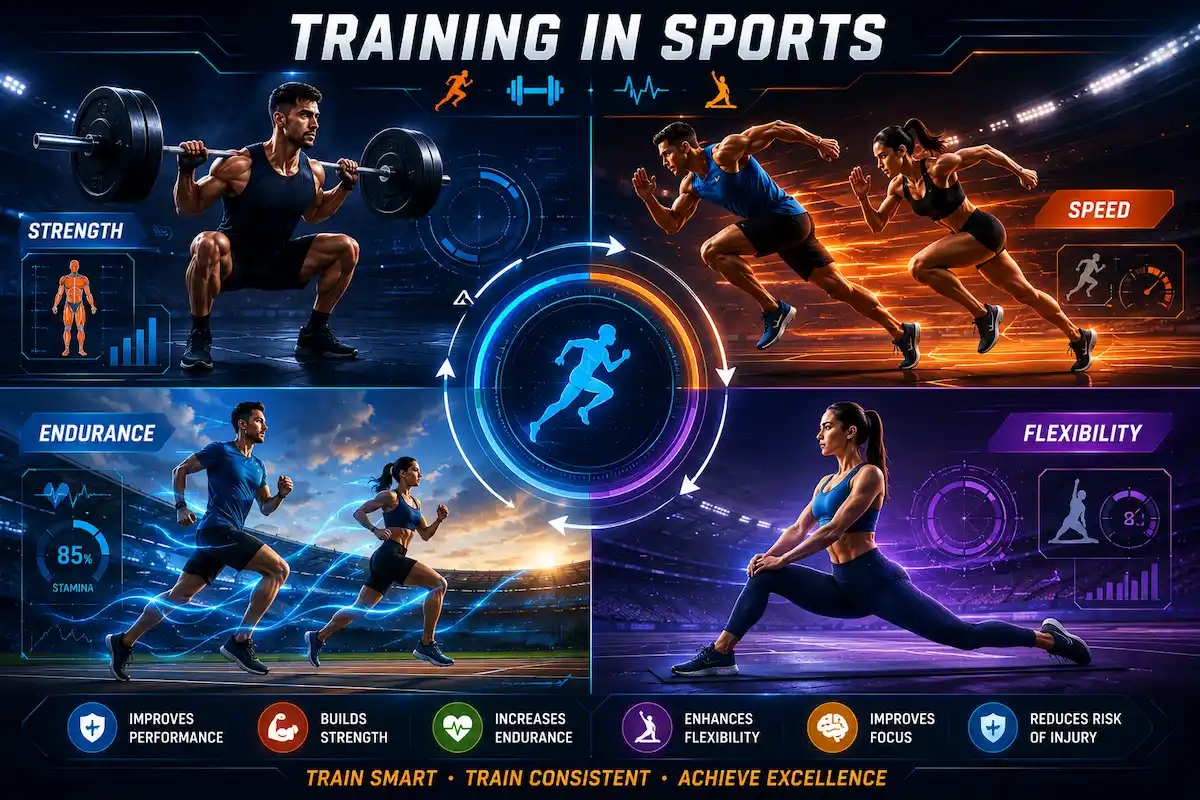
Sports training is not merely about physical exertion or lifting heavy weights; it is a highly systematic, scientifically planned, and long-term pedagogical process aimed at maximizing an athlete’s performance. In the modern era, achieving Olympic-level excellence requires a perfect blend of physiological conditioning, biomechanical correction, and psychological preparation. Sports training focuses on gradually inducing positive physiological adaptations in the body through the principle of “Progressive Overload.” This chapter breaks down the exact methodologies, structural training cycles, and scientific techniques used by elite coaches worldwide to develop extreme strength, unbreakable endurance, explosive speed, and flawless physical coordination.
Topic 1: Concept of Talent Identification and Talent Development in Sports
Understanding Talent Identification (TID)
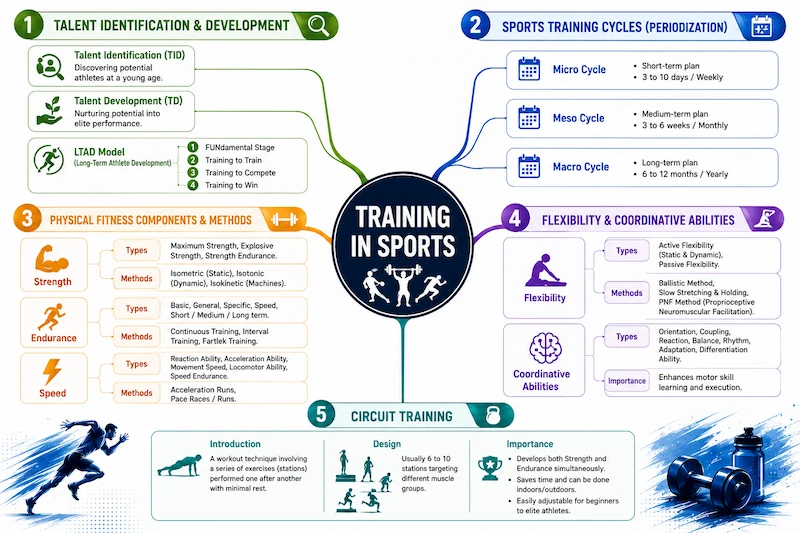
Talent Identification in sports is the systematic and scientific process of recognizing current participants with the highest potential to excel in a particular sport in the future. Instead of relying on random selection or a coach’s “gut feeling,” modern TID uses objective physiological, psychological, and biomechanical parameters. For instance, measuring a 10-year-old’s arm span, muscle fiber type, and natural aerobic capacity can help identify if they are genetically predisposed to become an elite swimmer or a marathon runner. The goal is to discover hidden athletic gems at a grassroots level before they are filtered out by lack of opportunity.
The Process of Talent Development (TD)
Identifying a talented child is only 10% of the journey; the remaining 90% relies entirely on Talent Development. Talent Development is the continuous, structured, and long-term nurturing of the identified athlete to transform their raw potential into world-class performance. This involves providing the athlete with elite coaching, top-tier sports infrastructure, scientific nutritional guidance, and psychological support.
The LTAD Model (Long-Term Athlete Development)
Talent development generally follows the Long-Term Athlete Development (LTAD) model, which emphasizes that it takes approximately 10 years (or 10,000 hours) of dedicated practice for a talented child to reach elite athletic status. The stages of development include:
- FUNdamental Stage: Focusing on basic human movements like running, jumping, and throwing in a fun environment without intense competition.
- Training to Train: Building strong aerobic bases, introducing sports-specific skills, and teaching discipline.
- Training to Compete: High-intensity training focused on winning, tactical awareness, and handling pressure.
- Training to Win: The final stage for elite athletes where every microscopic detail (diet, biomechanics, recovery) is optimized for international dominance.
Topic 2: Introduction to Sports Training Cycles – Micro, Meso, and Macro Cycle
The Concept of Periodization
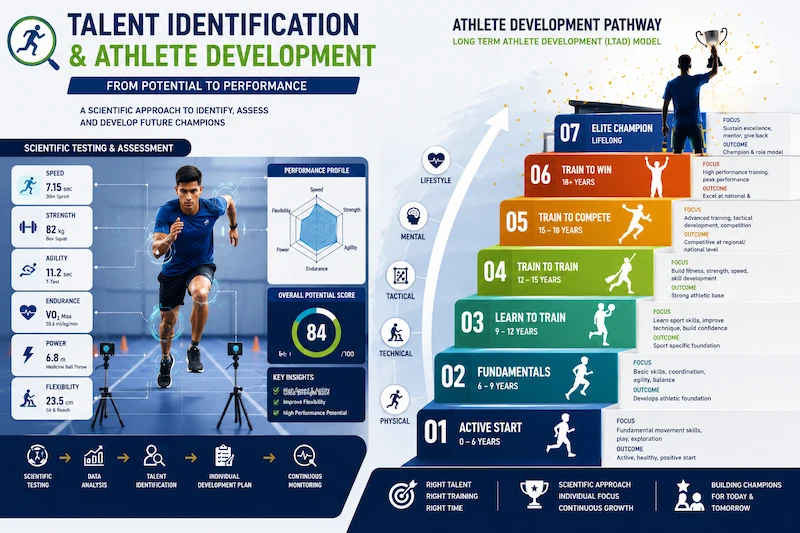
To achieve peak performance exactly on the day of a major competition (like the Olympic Finals), sports scientists use a concept called Periodization. Periodization is the logical division of an athlete’s yearly training program into smaller, manageable, and highly specific phases (cycles). This prevents overtraining, reduces injury risks, and ensures the athlete’s body peaks at the exact right moment. These training cycles are divided into three specific categories based on their duration.
1. Macro Cycle (Long-Term Plan)
The Macro Cycle is the longest phase of training, typically lasting anywhere from 6 months to 12 months (often referred to as an Annual Plan). In some cases, like Olympic preparation, a macro cycle can last up to 4 years. The entire macro cycle focuses on a singular, ultimate goal—winning the championship. It is broadly divided into three periods:
- Preparatory Period: Building general fitness, base endurance, and extreme strength.
- Competition Period: Reducing volume, increasing intensity, and focusing purely on sports-specific tactics and speed.
- Transition Period (Off-season): Active rest and psychological recovery to prevent burnout.
2. Meso Cycle (Medium-Term Plan)
A Meso Cycle is a medium-duration block of training that fits inside a Macro cycle. It typically lasts from 3 weeks to 6 weeks. Each meso cycle has a highly specific physiological objective. For example, a weightlifter might have a 4-week meso cycle dedicated entirely to “Muscle Hypertrophy” (building muscle size), followed by another 4-week meso cycle dedicated strictly to “Explosive Power.”
3. Micro Cycle (Short-Term Plan)
The Micro Cycle is the shortest and most detailed training block, usually lasting 3 to 10 days (most commonly a single week). It consists of daily training sessions and dictates exactly what the athlete will do on Monday, Tuesday, etc. A micro cycle carefully balances high-intensity workdays with active recovery days. For example, a sprinter’s micro cycle might include heavy weightlifting on Monday, sprint mechanics on Tuesday, complete rest on Wednesday, and active recovery swimming on Sunday.
Topic 3: Types and Methods to Develop Strength, Endurance, and Speed
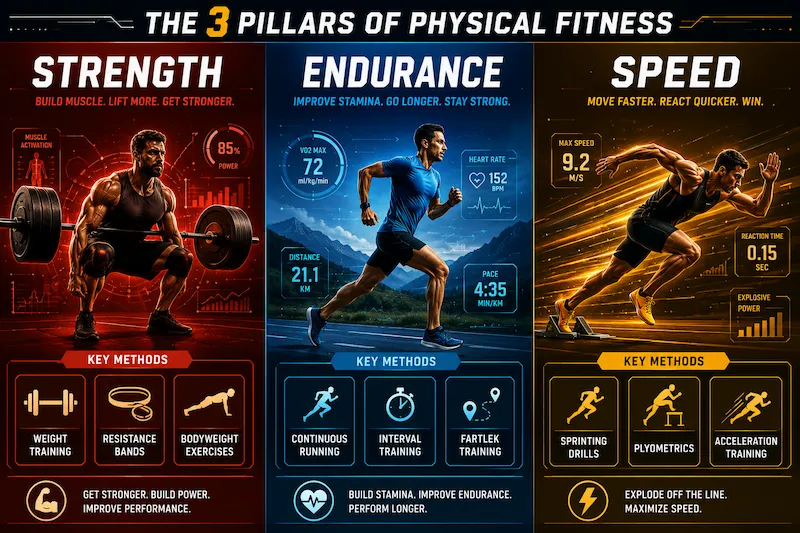
1. Developing Strength
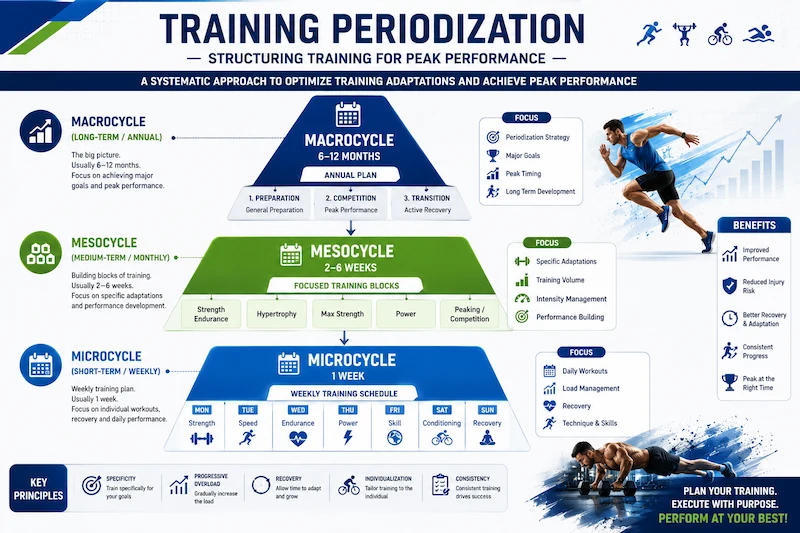
Strength is the ability of muscles to overcome resistance. It is categorized into Maximum Strength (lifting heaviest weight), Explosive Strength (power + speed, like a high jump), and Strength Endurance (swimming).
Methods of Development:
- Isometric Exercises: Exercises where the muscle creates tension, but there is zero visible movement in the joint, and the length of the muscle does not change. Example: Pushing against a solid wall or holding a static plank position.
- Isotonic Exercises: Exercises where the muscle actively shortens and lengthens under tension, creating visible joint movement. This is the most common form of training. Example: Bicep curls, squats, and bench presses.
- Isokinetic Exercises: Highly advanced exercises performed on specially designed computerized machines that keep the speed of the movement exactly the same throughout the entire range of motion, regardless of how much force the athlete applies.
2. Developing Endurance
Endurance is the ability to sustain intense physical activity for long periods without fatigue.
Methods of Development:
- Continuous Training Method: The athlete performs an activity (like running or cycling) continuously for a long duration (at least 30 minutes to over 2 hours) without any rest periods. The heart rate is kept steady at around 140-160 beats per minute. This builds massive aerobic capacity.
- Interval Training Method: Based on the principle of “work and recovery.” The athlete sprints at high intensity for a short duration, followed by an incomplete rest period (like slow jogging), and then sprints again. It trains the heart to recover rapidly and drastically improves VO₂ max. This type of training also connects closely with cardiorespiratory adaptations that occur through regular exercise.
- Fartlek Training Method: A Swedish term meaning “Speed Play.” It is an unstructured combination of continuous and interval training done on natural terrain (hills, forests, sand). The athlete naturally changes their speed (sprinting, jogging, walking) depending on the surroundings and how they feel.
3. Developing Speed
Speed is the capacity of an individual to perform successive movements of the same pattern at the fastest possible rate.
Methods of Development:
- Acceleration Runs: The athlete starts from a stationary position and tries to reach their absolute maximum speed as quickly as possible. These are usually short sprints of 30 to 50 meters, focusing purely on explosive power and technique.
- Pace Runs: In pace runs, the athlete covers a specific long distance at a perfectly maintained, constant high speed. This is crucial for 400m or 800m runners who need to distribute their energy evenly without slowing down before the finish line.
Topic 4: Types and Methods to Develop Flexibility and Coordinative Ability
1. Developing Flexibility
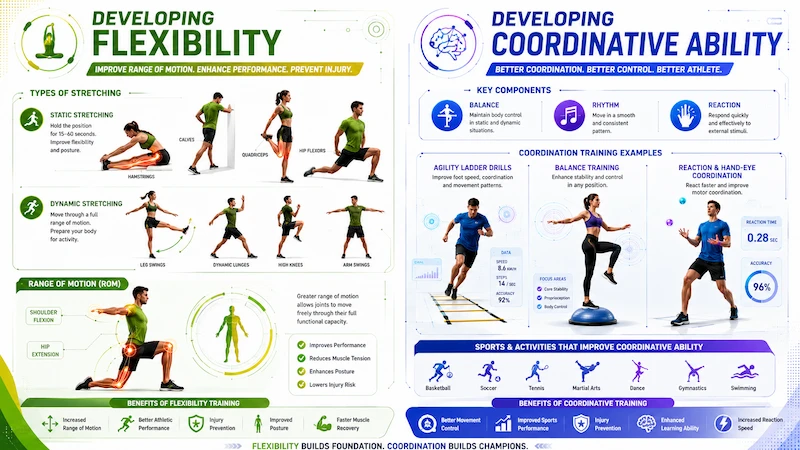
Flexibility is the maximum range of motion possible at a given joint. It prevents severe muscle tears and allows for graceful, energy-efficient movements. It is divided into Active Flexibility (stretching without external help) and Passive Flexibility (stretching with the help of a partner or equipment).
Methods of Development:
- Ballistic Method: This is an aggressive, dynamic method where the muscle is stretched using a bouncing or swinging motion. Example: Forcefully swinging the leg up and down. Due to the high risk of overstretching and injury, it is only recommended for advanced, fully warmed-up athletes.
- Slow Stretching and Holding Method: The athlete slowly stretches a muscle to its maximum limit (until a slight discomfort is felt) and holds that static position for 15 to 30 seconds. This is the safest and most common method for increasing muscle length.
- PNF Method (Proprioceptive Neuromuscular Facilitation): The most advanced and scientifically effective method, usually requiring a partner. It involves a process of “Contract-Relax-Stretch.” The athlete strongly contracts the target muscle against the partner’s resistance for a few seconds, completely relaxes, and then the partner stretches the muscle further than before. This bypasses the nervous system’s natural stretch reflex.
2. Developing Coordinative Abilities
Earlier referred to purely as “Agility,” coordinative abilities are deeply controlled by the Central Nervous System. They define an athlete’s ability to smoothly and accurately combine multiple body movements. There are seven specific types of coordinative abilities (such as Balance, Rhythm, Reaction Time, and Spatial Orientation).
Methods of Development:
To develop elite coordination, athletes must constantly challenge their nervous system rather than just their muscles:
- Practicing Complex Motor Skills: Performing diverse and unusual movements, such as running backward while dribbling a football or balancing on unstable surfaces (like a Bosu ball).
- Changing External Conditions: Practicing standard skills in completely unpredictable environments, such as playing tennis on a heavily wind-blown court or fielding a cricket ball on an uneven, bumpy surface.
- Rhythm and Reaction Drills: Using agility ladders, reacting to sudden visual or auditory signals (like a coach blowing a whistle randomly), or practicing jump rope routines to deeply wire the mind-muscle connection.
Topic 5: Circuit Training – Introduction and Importance
Introduction to Circuit Training
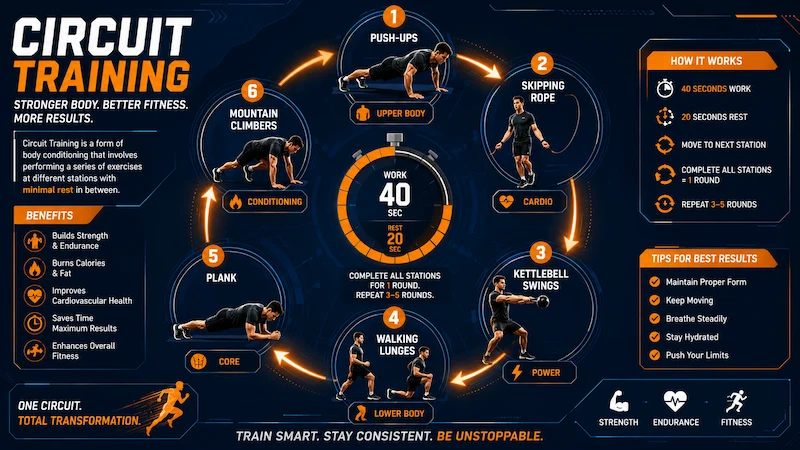
Circuit Training is one of the most famous, efficient, and versatile training methods in the world of sports conditioning. It was originally developed in 1953 by R.E. Morgan and G.T. Adamson at the University of Leeds in England. A “Circuit” is a scientifically designed sequence of several different exercises (usually 6 to 10 specific stations) performed one immediately after the other, targeting different muscle groups to prevent localized fatigue.
In a typical circuit, an athlete might perform push-ups at Station 1, immediately move to Station 2 for jump squats, proceed to Station 3 for core planks, and so on, until the entire loop is completed. Once the circuit is finished, the athlete takes a longer rest before repeating the entire loop 3 to 5 times.
Structuring a Circuit
A well-designed circuit strictly follows the principle of “Alternate Muscle Group Engagement.” This means if Station 1 severely exhausts the upper body, Station 2 must target the lower body, and Station 3 must target the core. This strategic arrangement allows the upper body to rest while the lower body works, keeping the heart rate extremely high throughout the entire session.
Importance and Advantages of Circuit Training
- Simultaneous Development: It is one of the very few training methods that simultaneously develops both muscular strength and cardiovascular endurance in a single session.
- Highly Time-Efficient: Because rest periods between stations are incredibly short (10-15 seconds) or non-existent, a massive amount of physical conditioning can be achieved in just 30 to 45 minutes.
- Maximum Utility of Space: It is a blessing for physical education teachers. An entire class of 30-40 students can be engaged continuously in a small indoor gymnasium by assigning a few students to each station simultaneously.
- Easily Adjustable (Individualized): The intensity of the circuit can be instantly modified to suit a beginner or an Olympian simply by changing the weight, increasing the duration at each station, or cutting down the rest intervals.
Chapter Conclusion: Training in Sports
This final chapter focuses on the scientific preparation of athletes to achieve peak performance. It introduces the concept of Talent Identification and breaks down the training process into specific cycles (Micro, Meso, Macro). The core of the chapter lies in understanding the five major physical fitness components: Strength, Endurance, Speed, Flexibility, and Coordinative Abilities. Students learn the distinct types of each component and the specific training methods used to develop them, such as Isometric/Isotonic exercises for strength, Fartlek and Interval training for endurance, and the PNF technique for flexibility.
Frequently Asked Questions (FAQs)
Objective Type Questions (1 Mark)
Q1. Which training method is also known as ‘Speed Play’? +
Ans. B) Fartlek Training
Q2. A training cycle that typically lasts for 3 to 10 days is called: +
Ans. C) Micro cycle
Q3. Exercises in which there is no visible movement of the body or joints, yet the muscles are contracting, are known as: +
Ans. B) Isometric exercises
Q4. Acceleration runs and Pace runs are methods specifically used to develop: +
Ans. D) Speed
Q5. What does ‘PNF’ stand for in flexibility training? +
Ans. A) Proprioceptive Neuromuscular Facilitation
Very Short Answer Type Questions (2 Marks)
Q6. Define Sports Training. +
Ans. Sports training is a scientifically based and pedagogically organized process through which athletes are prepared for higher performance in sports competitions by improving their physical, psychological, and tactical abilities.
Q7. What is Talent Identification in sports? +
Ans. Talent identification is the process of recognizing current participants with the potential to excel in a particular sport. It involves analyzing a child’s physical attributes, genetics, and motor skills to predict their future success in specific athletic events.
Q8. Differentiate between Meso cycle and Macro cycle. +
Ans. A Meso cycle is a medium-duration training cycle that typically lasts from 3 to 6 weeks, focusing on specific training goals. A Macro cycle is the longest training cycle, generally lasting from 6 months to a year (or up to 4 years for Olympic athletes), covering the entire preparation, competition, and transition phases.
Q9. Define Flexibility. +
Ans. Flexibility is the maximum range of motion possible at a joint. It is determined by the elasticity of muscles, tendons, and ligaments. It helps in preventing sports injuries and performing movements smoothly.
Short Answer Type Questions (3 Marks)
Q10. Explain the Interval Training Method. +
Ans. The Interval Training Method is highly effective for developing endurance. It involves alternating periods of high-intensity exercise (work) with periods of rest or low-intensity exercise (recovery). It is based on the principle of “effort and recovery.” By not allowing complete recovery between sets, it trains the heart and lungs to work efficiently under fatigue.
Q11. What are Coordinative Abilities? Mention any two types. +
Ans. Coordinative abilities (previously known as agility) are those abilities of an individual that enable them to perform a sequence of movements smoothly and accurately. They heavily depend on the central nervous system.
Types:
- Reaction Ability: The ability to react quickly and effectively to a signal (e.g., a sprinter responding to the starter’s gun).
- Balance Ability: The ability to maintain body equilibrium during stationary or moving positions (e.g., gymnastics).
Q12. Differentiate between Isometric and Isotonic exercises. +
Ans.
- Isometric Exercises: “Iso” means same, “metric” means length. The muscle contracts, but its length does not change. There is no visible movement at the joint (e.g., pushing a solid wall).
- Isotonic Exercises: “Iso” means same, “tonic” means tension. The muscle contracts, and its length changes (either shortens or lengthens), causing visible movement (e.g., lifting dumbbells, doing push-ups).
Q13. Explain Pace runs and Acceleration runs to develop speed. +
Ans.
- Acceleration Runs: Used to develop the ability to reach maximum speed from a stationary position in the shortest possible time. The athlete starts slowly and accelerates to top speed, usually over a distance of 30-50 meters.
- Pace Runs: Involves running a longer distance (e.g., 800m or 1500m) at a steady, uniform speed. The focus is on maintaining a specific pace evenly throughout the race without dropping speed due to fatigue.
Long Answer Type Questions (5 Marks)
Q14. What is Endurance? Detail the three main methods used to develop endurance in sports. +
Ans. Endurance: It is the ability of the body to resist fatigue and sustain an activity for a prolonged period.
Methods to Develop Endurance:
- Continuous Training Method: The exercise is performed for a long duration without any rest breaks. The intensity is kept relatively low, but the volume is high. The heart rate remains between 140-160 beats per minute. Examples include cross-country running, long-distance cycling, or swimming.
- Interval Training Method: Alternating periods of high-intensity work with periods of incomplete recovery (rest). For example, sprinting 400 meters, jogging for 200 meters to recover, and repeating. It trains both the aerobic and anaerobic systems.
- Fartlek Training Method: Developed in Sweden, it means ‘Speed Play’. It is a blend of continuous and interval training. The athlete changes the pace (speeding up and slowing down) according to the natural terrain (hills, sand, forests) and their own feeling of fatigue, without pre-planned rest intervals.
Q15. Explain the concept of Flexibility. Discuss the various methods used to develop flexibility. +
Ans. Flexibility: The range of motion around a joint. It can be Passive (with external help) or Active (without external help).
Methods to Develop Flexibility:
- Ballistic Method: The stretching is done with rhythmic bouncing or swinging movements. The joint is pushed to its maximum limit and then bounces back. It carries a higher risk of muscle tear.
- Static Stretching Method: A muscle is stretched to its farthest point and held in that position for 10 to 30 seconds without any movement. It is very safe and highly effective (e.g., Yoga asanas).
- Dynamic Stretching Method: Involves moving parts of the body and gradually increasing reach, speed of movement, or both. It consists of controlled leg and arm swings that gently take you to the limits of your range of motion (often used in warm-ups).
- PNF (Proprioceptive Neuromuscular Facilitation) Technique: The most advanced method. It involves an isometric contraction (pushing against resistance) followed by a static stretch. Usually, a partner is required to provide resistance and assist in the stretch.
Q16. What is Strength? Describe the different types of exercises used for strength development. +
Ans. Strength: It is the ability of the muscles to overcome resistance. Types include Maximum Strength, Explosive Strength, and Strength Endurance.
Methods/Exercises for Strength Development:
- Isometric Exercises: (Iso=Same, Metric=Length). Muscles contract, but length doesn’t change. No visible movement. Example: Pushing against a wall, holding a plank. Best for rehabilitation.
- Isotonic Exercises: (Iso=Same, Tonic=Tension). Muscle length changes (concentric-shortens, eccentric-lengthens) and movement is visible. Example: Bicep curls, squats. Excellent for building muscle mass and sports-specific strength.
- Isokinetic Exercises: (Iso=Same, Kinetic=Motion). These are performed on specially designed computerized machines that maintain a constant speed of movement regardless of how much force the athlete applies. Used highly by elite athletes for even strength development throughout the entire range of motion.
🏆 Take Your Sports Training Knowledge Further
Want to explore these training concepts in greater detail? Discover our focused guides on endurance, strength, speed, flexibility, recovery and nutrition.
❤️ Endurance & Cardio
Understand cardiorespiratory fitness, aerobic exercise and endurance-training methods.
💪 Strength & Conditioning
Learn how resistance and conditioning methods develop muscular strength, endurance and physical performance.
⚡ Speed & Agility
Explore acceleration, speed, reaction ability, agility and athletic movement.
🧘 Flexibility & Mobility
Learn about flexibility, joint mobility, range of motion and movement quality.
🥗 Recovery & Nutrition
Understand the role of recovery, sleep, hydration and nutrition in supporting exercise and physical performance.