
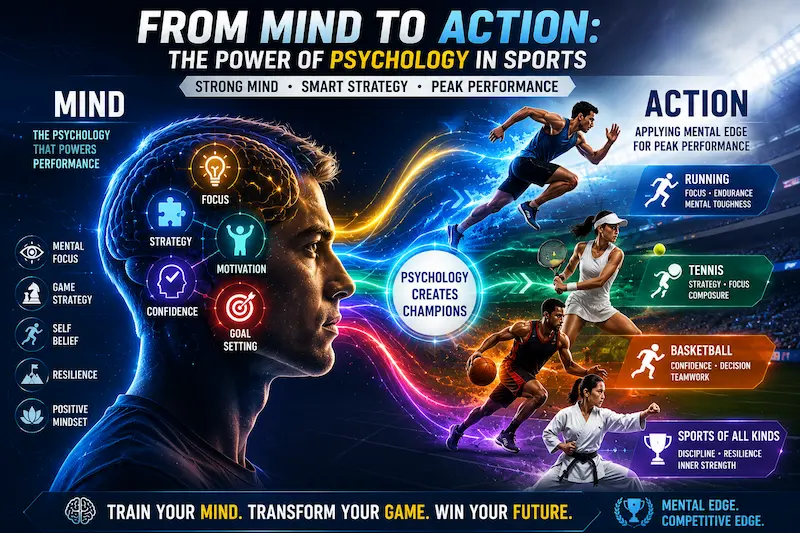
Introduction: The Role of Psychology in Sports
While physiology dictates the physical limits of an athlete’s body, sports psychology governs the boundless limits of their mind. Sports psychology is the scientific study of human behavior, emotions, and cognitive processes in the context of athletic performance and physical activity. In modern competitive sports, physical skills and tactical training are often equal among elite athletes; therefore, it is the psychological edge—mental toughness, focus, and emotional control—that determines the ultimate champion. This chapter explores how an athlete’s unique personality, their internal and external drive to succeed, and their management of aggressive instincts can make or break their sporting career.
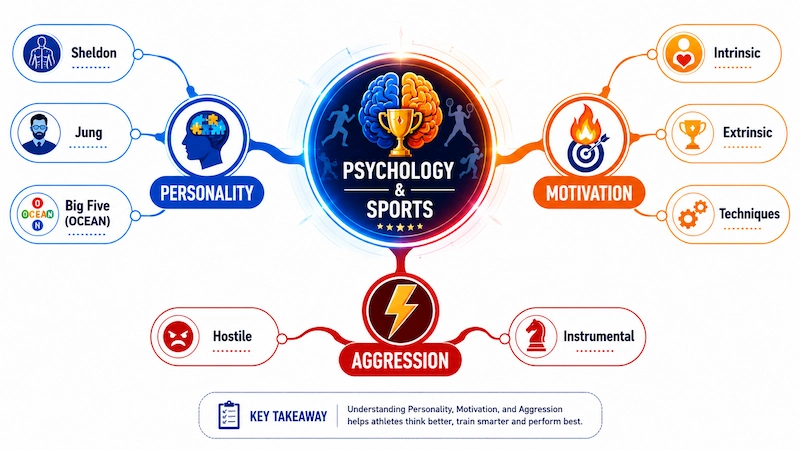
Topic 1: Personality – Meaning and Classifications (Sheldon and Jung)
A. Meaning and Concept of Personality
The word “Personality” is derived from the Latin word “Persona,” which originally meant the theatrical mask worn by ancient Roman actors to project a specific character to the audience. However, in modern psychology, personality is much more than outward appearance. It is defined as the dynamic organization of an individual’s physical, mental, emotional, social, and psychological characteristics that determine their unique adjustment to their environment. In sports, an athlete’s personality influences how they handle high-pressure situations, how they interact with teammates, and which sports they are naturally drawn toward.
B. Sheldon’s Classification (Somatotypes)
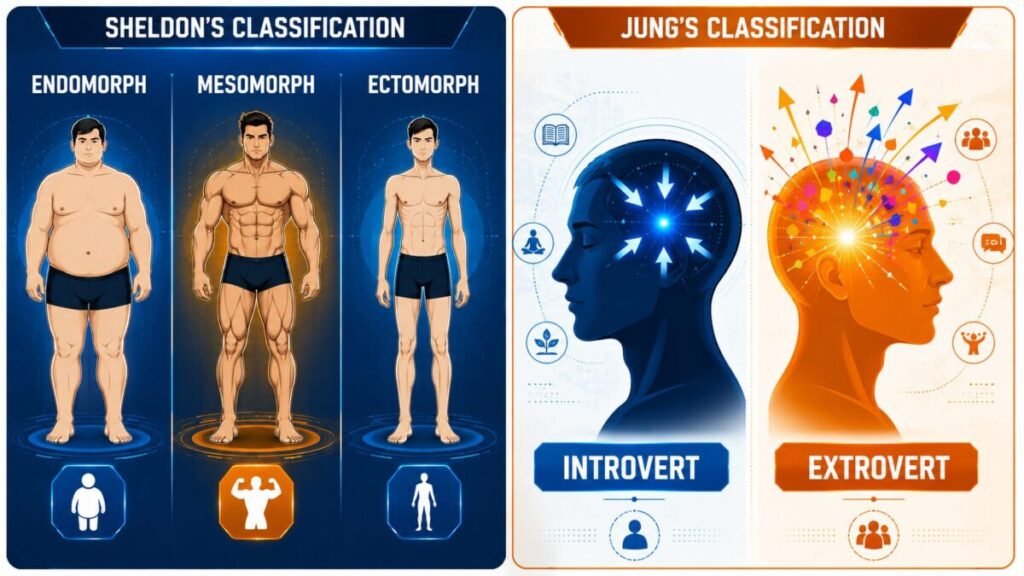
William Herbert Sheldon, an American psychologist, proposed that a person’s psychological characteristics are deeply linked to their physical body structure (Somatotypes). He classified human personalities into three distinct categories:
- Endomorphs: These individuals have a soft, round, and slightly heavier body structure with a high tendency to store body fat. They typically have short limbs and a wider waist. Psychologically, they are known to be highly sociable, relaxed, tolerant, and affectionate. Sports Suitability: Due to their bulk and center of gravity, they excel in power-based, static sports like weightlifting, sumo wrestling, and shot put.
- Mesomorphs: Characterized by a muscular, well-proportioned, athletic, and sturdy physique with broad shoulders and narrow hips. Psychologically, they are courageous, assertive, highly competitive, and adventurous. Sports Suitability: They are the ideal athletic type, naturally excelling in high-intensity, strength, and speed-based sports like sprinting, boxing, rugby, and gymnastics.
- Ectomorphs: These individuals have a tall, thin, and fragile body structure with long limbs and very little body fat or muscle mass. Psychologically, they tend to be introverted, self-conscious, highly sensitive, and intellectual. Sports Suitability: Their light body weight and efficient cooling systems make them perfect for endurance-based sports like marathon running, high jump, and long-distance cycling.
C. Jung’s Classification
Carl Jung, a famous Swiss psychiatrist, classified personalities based on social interaction, psychological energy, and how people engage with their surroundings:
- Introverts: These individuals are inward-looking, shy, reserved, and prefer solitude over large social gatherings. They think deeply before they act and are highly self-reliant. In sports, introverts often gravitate toward individual, precision-based sports like archery, shooting, or long-distance running where intense internal focus is required.
- Extroverts: These individuals are outward-looking, highly sociable, expressive, and draw their energy from being around other people. They are action-oriented and adapt quickly to new environments. Extroverts thrive in fast-paced team sports like football, basketball, and hockey, where communication and team dynamics are essential.
- Ambiverts: Very few people are purely introverted or extroverted. Ambiverts possess a balanced mixture of both traits. They can be outgoing in a team setting but also enjoy deep, solitary focus when training alone. Most successful modern athletes fall into this highly adaptable category.
Topic 2: The Big Five Theory of Personality (OCEAN)
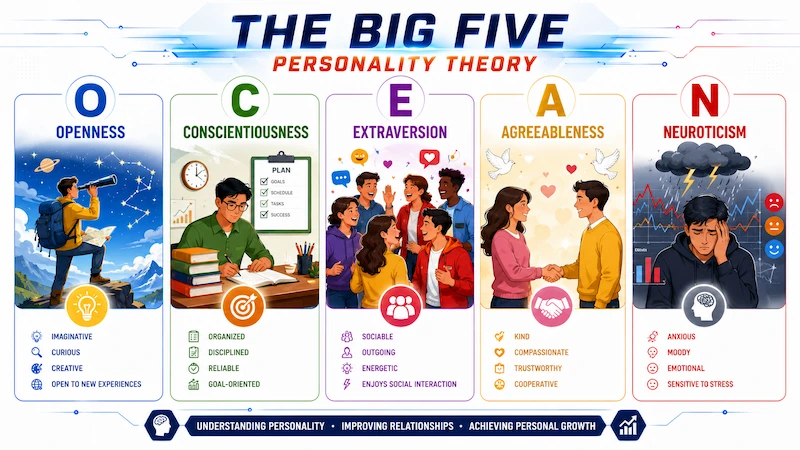
The Big Five Personality Theory, developed over decades by researchers like Paul Costa and Robert McCrae, is currently the most widely accepted and scientifically validated model in psychology. It suggests that human personality can be accurately measured across five broad, independent dimensions. An easy way to remember these five traits is the acronym OCEAN.
- O – Openness to Experience: This trait measures a person’s level of curiosity, creativity, and willingness to embrace new ideas. Athletes scoring high in openness are highly adaptable; they love learning new tactical strategies, are open to trying unorthodox training methods, and are highly imaginative. Those with low scores prefer strict routine, traditional coaching, and predictable environments.
- C – Conscientiousness: This trait reflects how organized, disciplined, and goal-oriented a person is. In the sports world, conscientiousness is highly correlated with success. Highly conscientious athletes never skip training, maintain strict diets, meticulously analyze their performance, and possess immense willpower. Low scorers tend to be easily distracted, careless, and lack long-term discipline. This discipline is especially important when following a systematic sports training program
- E – Extroversion (vs. Introversion): This measures an individual’s sociability, assertiveness, and emotional expressiveness. High extroverts are energetic, talkative, and thrive under the spotlight of a cheering crowd, making them excellent team captains. Low extroverts (introverts) prefer quiet environments and internal focus, making them highly effective in solo sports.
- A – Agreeableness: This dimension measures how cooperative, compassionate, and trusting an individual is toward others. A highly agreeable athlete is a perfect “team player” who follows the coach’s instructions flawlessly and resolves team conflicts peacefully. However, if an athlete is too agreeable, they might lack the aggressive “killer instinct” needed to defeat opponents. Low agreeableness leads to a highly competitive, suspicious, and sometimes stubborn nature.
- N – Neuroticism (Emotional Stability): Neuroticism measures a person’s tendency to experience negative emotions like anxiety, anger, fear, and depression. Elite athletes must aim for low neuroticism (high emotional stability). Emotionally stable athletes remain perfectly calm under immense pressure, such as taking a penalty kick in a World Cup final. Athletes with high neuroticism choke under pressure, experience severe pre-match anxiety, and lose focus easily when facing setbacks.
Topic 3: Motivation – Meaning, Types, and Techniques
A. Meaning of Motivation
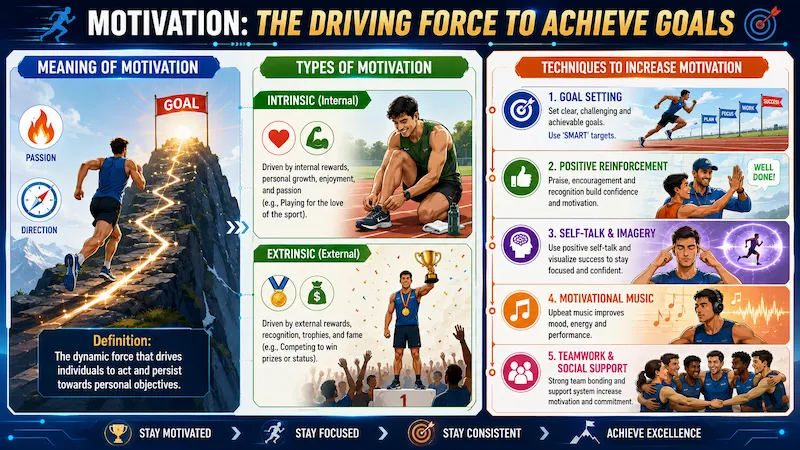
The word “Motivation” is derived from the Latin word “Movere,” which simply means “to move” or “to drive forward.” In sports psychology, motivation is the internal biological, emotional, or cognitive force that initiates, guides, and maintains goal-oriented behavior. It is the invisible energy that makes an athlete wake up at 4:00 AM for practice, push through grueling physical pain, and consistently strive for excellence despite repeated failures. Without high levels of motivation, even the most genetically gifted athlete will never reach their true potential.
B. Types of Motivation
Motivation is strictly categorized into two distinct types based on the source of the driving force:
- Intrinsic Motivation (Internal): This is the purest and most powerful form of motivation. It occurs when an athlete participates in a sport purely for the internal joy, personal satisfaction, and love of the game. The driving force comes from within—like a desire to master a new skill, the thrill of competition, or achieving a personal best. Intrinsic motivation is long-lasting and prevents athletes from burning out during tough times.
- Extrinsic Motivation (External): This occurs when an athlete is driven by external rewards or the avoidance of punishment. The motivating factors lie outside the individual. Examples include competing to win a gold medal, earning a massive cash prize, securing a government job, seeking public fame, or avoiding the wrath of an angry coach. While highly effective in the short term, relying solely on extrinsic motivation can cause an athlete to quit once the external rewards are removed.
C. Techniques of Motivation in Sports
Coaches and sports psychologists use various techniques to keep athletes highly motivated throughout a long, grueling season:
- Goal Setting: Setting SMART (Specific, Measurable, Achievable, Realistic, Time-bound) goals gives athletes a clear, tangible target to work toward. Breaking a massive goal (winning the Olympics) into smaller daily goals (improving sprint time by 0.1 seconds) keeps the athlete constantly motivated. This works particularly well when combined with structured training methods and progressive improvement
- Positive Self-Talk: Teaching athletes to replace negative internal thoughts (“I can’t beat this opponent”) with powerful positive affirmations (“I am trained, strong, and ready”). This drastically boosts self-confidence just before an event.
- Rewards and Reinforcement: Recognizing an athlete’s hard work through public praise, trophies, certificates, or financial incentives provides a massive temporary boost in motivation and validates their extreme effort.
- Motivational Music: Listening to high-tempo, energetic music before a match has been scientifically proven to increase heart rate, elevate mood, and mentally pump up an athlete for physical combat.
- Role of Spectators: A massive, cheering home crowd acts as a powerful psychological stimulant. The loud support forces athletes to push their bodies beyond normal physiological limits, often resulting in record-breaking performances.
Topic 4: Aggression in Sports – Meaning, Concept, and Types
A. Meaning and Concept of Aggression
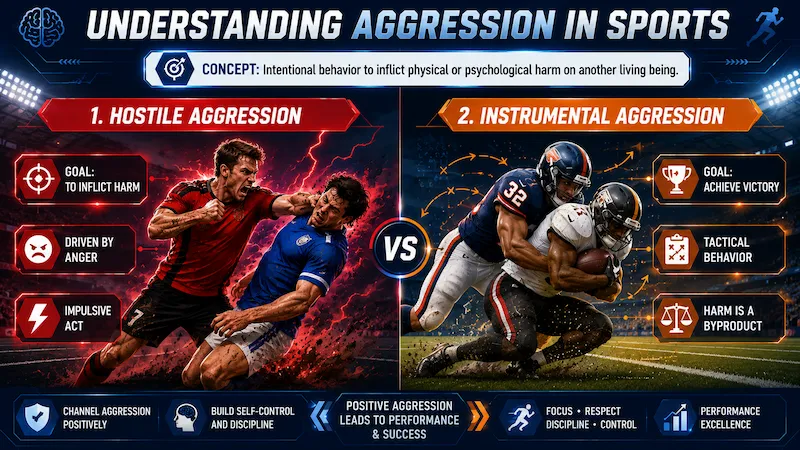
In everyday society, aggression is strictly viewed as a negative and destructive behavior. However, in the realm of competitive sports, the concept is far more complex. In sports psychology, aggression is defined as any physical or verbal behavior that is directed toward intentionally harming or injuring another living being (either physically or psychologically) who is motivated to avoid such treatment. It is crucial to understand that true aggression involves an intent to harm. Simply playing hard or being energetic is not aggression; the mindset behind the action defines it.
B. Types of Aggression in Sports
Psychologists classify aggressive behavior in sports into three distinct categories. Understanding the difference between these three is essential for maintaining fair play and athlete safety.
- Hostile Aggression (Reactive Aggression):
- Concept: This is the most toxic and illegal form of aggression. The primary, singular goal of hostile aggression is to inflict physical injury or psychological pain on the opponent out of pure anger, frustration, or personal hatred. The outcome of the game is secondary; hurting the opponent is the main objective.
- Example: A football player intentionally punching the referee in the face out of anger over a bad decision, or a bowler deliberately throwing a deadly bouncer straight at a batsman’s head to injure them. This behavior results in red cards, severe bans, and sometimes criminal charges.
- Instrumental Aggression:
- Concept: In this type, aggressive physical contact is used solely as a “tool” or “instrument” to achieve a non-aggressive, external goal—like winning the game, stopping a goal, or gaining a tactical advantage. While harm may be inflicted, hurting the opponent is not the primary emotional goal; it is merely a byproduct of a tactical decision.
- Example: A basketball player aggressively committing a hard, physical foul on an opponent driving to the basket to prevent a guaranteed score. The intent is to stop the two points and force a free throw, not to maliciously injure the player out of hatred.
- Assertive Behavior (Channelled Aggression):
- Concept: Also known as “playing hard,” this is the most desirable form of psychological intensity in sports. Assertive behavior involves playing with massive physical force, high energy, and extreme dominance, but strictly within the official rules of the game and with absolutely no intent to cause bodily harm.
- Example: A tennis player smashing the ball over the net with violent, explosive power to win a point, or a rugby player executing a perfectly timed, crushing—but entirely legal—tackle to stop the opposing runner. The athlete is incredibly forceful, but their intent is purely competitive, not malicious.
Chapter Conclusion: Psychology and Sports
This chapter explores the profound impact of human mind and behavior on athletic performance. It emphasizes that physical training alone is insufficient for peak performance; mental conditioning is equally vital. The chapter covers the classification of Personality (such as Carl Jung’s classification and the Big Five Theory) to understand how different athletes react to pressure. It highlights the critical role of Motivation (Intrinsic and Extrinsic) in keeping athletes driven, and examines the concept of Aggression in sports. Furthermore, it introduces essential psychological attributes like goal setting, mental imagery, and self-talk, which are powerful tools used by sports psychologists to enhance an athlete’s focus and confidence.
Frequently Asked Questions (FAQs)
Objective Type Questions (1 Mark)
Q1. Carl Jung classified personality into which of the following categories? +
Ans. B) Introvert, Extrovert, Ambivert
Q2. In the Big Five Theory of Personality (OCEAN), what does ‘O’ stand for? +
Ans. C) Openness
Q3. Which type of motivation comes from within the individual, such as the joy of playing a sport? +
Ans. B) Intrinsic Motivation
Q4. Aggression where the primary aim is to achieve a sports goal, without a primary intent to harm the opponent, is known as: +
Ans. B) Instrumental Aggression
Q5. Creating positive mental pictures of a successful performance before the actual event is called: +
Ans. C) Mental Imagery
Very Short Answer Type Questions (2 Marks)
Q6. Define Personality in the context of sports psychology. +
Ans. Personality is the dynamic organization of psychological and physical traits within an individual that determines their unique adjustment to their environment. In sports, it reflects how an athlete behaves, thinks, and feels under various competitive situations.
Q7. Differentiate between Intrinsic and Extrinsic Motivation. +
Ans. Intrinsic Motivation comes from within; the athlete participates for internal satisfaction, joy, or personal growth. Extrinsic Motivation comes from external sources; the athlete is driven by rewards such as trophies, money, praise, or avoiding punishment.
Q8. What is Assertive Behaviour in sports? +
Ans. Assertive behavior is playing with high energy and legitimate physical force strictly within the rules of the game. The athlete is highly competitive and forceful, but there is absolutely no intention to cause physical harm to the opponent.
Q9. What do you understand by ‘Self-Talk’? +
Ans. Self-talk is an inner dialogue or the act of talking to oneself either aloud or silently. In sports, positive self-talk (e.g., “I can do this,” “Stay focused”) is a psychological technique used to boost confidence, control emotions, and enhance concentration.
Short Answer Type Questions (3 Marks)
Q10. Explain Carl Jung’s classification of personality. +
Ans. Carl Jung classified individuals into three psychological types based on their social interaction:
- Introverts: Individuals who are shy, socially withdrawn, self-centered, and prefer being alone. They often excel in individual sports like archery or long-distance running.
- Extroverts: Individuals who are outgoing, talkative, friendly, and highly social. They usually thrive in team sports like football or basketball.
- Ambiverts: Individuals who possess a balance of both introvert and extrovert traits, adapting their behavior based on the situation.
Q11. Differentiate between Hostile and Instrumental Aggression with examples. +
Ans.
- Hostile Aggression: The primary intent is to inflict physical or psychological harm on the opponent out of anger or frustration. The goal is the injury itself. Example: A bowler intentionally throwing a bouncer directly at the batsman’s head to injure him.
- Instrumental Aggression: The primary intent is to achieve a non-aggressive goal (like winning the ball or stopping a goal), but harm is caused as a byproduct. Example: A football defender slide-tackling hard to get the ball, accidentally injuring the striker in the process.
Q12. Discuss any three techniques of motivation used by coaches in sports. +
Ans. Three effective techniques of motivation include:
- Goal Setting: Setting realistic, achievable, and specific goals gives athletes a clear target to work towards, keeping them focused and driven.
- Praise and Blame: Positive verbal reinforcement (praise) boosts an athlete’s morale, while constructive criticism (blame) can push them to correct mistakes and perform better.
- Cash Prizes, Certificates, and Trophies: Providing tangible rewards is a strong extrinsic motivator that encourages athletes to put in maximum effort to win.
Q13. Explain ‘Goal Setting’ and ‘Mental Imagery’ as psychological attributes. +
Ans.
- Goal Setting: It is a psychological strategy where an athlete sets specific, measurable, and time-bound targets (e.g., reducing a 100m sprint time by 0.5 seconds). It directs attention, mobilizes effort, and increases persistence.
- Mental Imagery: Also known as visualization, it involves the athlete mentally rehearsing a physical skill or performance in their mind without any physical movement. It programs the nervous system for success and reduces pre-match anxiety.
Long Answer Type Questions (5 Marks)
Q14. Discuss the ‘Big Five Theory of Personality’ (OCEAN) in detail. +
Ans. The Big Five Theory is the most widely accepted model of personality traits. It categorizes human personality into five broad dimensions, easily remembered by the acronym OCEAN:
- O – Openness (to experience): Refers to a person’s willingness to try new things and embrace new ideas. High scorers are creative, imaginative, and curious. Low scorers prefer routine and tradition.
- C – Conscientiousness: Refers to how organized, disciplined, and goal-oriented a person is. Highly conscientious athletes are punctual for practice, hardworking, and highly reliable.
- E – Extraversion: Refers to sociability, energy, and talkativeness. High scorers (extroverts) love social interaction and team environments, while low scorers (introverts) prefer solitude.
- A – Agreeableness: Refers to how cooperative, kind, and empathetic a person is. High scorers are excellent team players who avoid conflict, while low scorers can be highly competitive and manipulative.
- N – Neuroticism (Emotional Stability): Refers to a person’s tendency to experience negative emotions like anxiety, stress, or anger. Low scorers are emotionally stable, calm under pressure, and resilient, which is crucial for elite athletes.
Q15. Define Motivation. Elaborate on the various techniques of motivation in sports. +
Ans. Motivation: Motivation is an inner psychological drive that directs a person’s behavior toward fulfilling a specific goal. In sports, it is the desire and energy to train hard and win.
Techniques of Motivation:
- Goal Setting: Goals should be SMART (Specific, Measurable, Achievable, Realistic, Time-bound). Reaching milestones keeps the athlete motivated.
- Positive Sports Environment: A supportive coach, good infrastructure, clean grounds, and quality equipment naturally motivate athletes to practice.
- Rewards (Extrinsic): Offering scholarships, medals, trophies, cash prizes, or job security in sports quotas serves as a massive driving force.
- Spectators and Crowd Support: Playing in front of a cheering crowd dramatically boosts an athlete’s adrenaline and motivation to perform exceptionally.
- Praise and Constructive Criticism: A coach’s words matter. Praising good efforts builds confidence, while controlled, constructive criticism prevents complacency.
- Motivational Music and Speeches: Listening to upbeat music or inspiring speeches by coaches before a match hypes the athletes mentally.
Q16. What is Aggression in sports? Explain its different types with suitable examples. +
Ans. Aggression: In sports psychology, aggression refers to any physical or verbal behavior intended to harm or injure another individual (opponent) who is motivated to avoid such treatment.
Types of Aggression:
- Hostile Aggression: Also known as reactive aggression. The primary goal is to cause physical or psychological pain to the opponent. It usually stems from anger or frustration and violates the rules of the game.
Example: A football player deliberately punching an opponent after an argument. - Instrumental Aggression: The primary goal is to achieve an external reward (like winning a point, getting the ball, or stopping a goal). Harming the opponent is not the main intent, but it happens as a means to an end.
Example: A basketball player aggressively blocking an opponent from making a layup, resulting in the opponent falling and getting hurt. - Assertive Behavior (Often classified under aggressive actions): This is playing with high intensity, legitimate physical force, and strict adherence to the rules. There is absolutely zero intent to harm.
Example: A powerful, legal shoulder-charge in football or a hard, legal tackle in rugby.
Q17. Explain the meaning and importance of Psychological Attributes in sports (Self-esteem, Mental Imagery, Self-talk, Goal setting). +
Ans. Psychological attributes are mental skills that athletes develop to optimize their performance and handle the intense pressure of competition.
- Goal Setting: The process of identifying something that you want to accomplish and establishing measurable targets and timeframes. Importance: It provides direction, keeps the athlete focused, and helps in tracking progress, which builds confidence over time.
- Self-Talk: The continuous inner dialogue an athlete has with themselves. Importance: Positive self-talk (“I am prepared,” “Focus on the ball”) helps in managing pre-match anxiety, correcting bad habits, and maintaining high concentration levels during crucial moments of the game.
- Mental Imagery (Visualization): Creating or recreating an experience in the mind using all senses. Importance: When an athlete visualizes executing a perfect shot or winning a race, the brain sends the same signals to the muscles as if they were actually doing it. It improves muscle memory and builds immense self-belief.
- Self-Esteem: A person’s overall subjective sense of personal worth or value. Importance: Athletes with high self-esteem believe in their abilities and are more resilient. They don’t let a single failure or a bad match destroy their confidence, enabling them to bounce back stronger.
🧠 Continue Learning About Performance
Physical and mental preparation work together. Explore related fitness and recovery concepts that support athletic performance.