Topic 1: Meaning of Asana and its Benefits
1. What is an Asana?
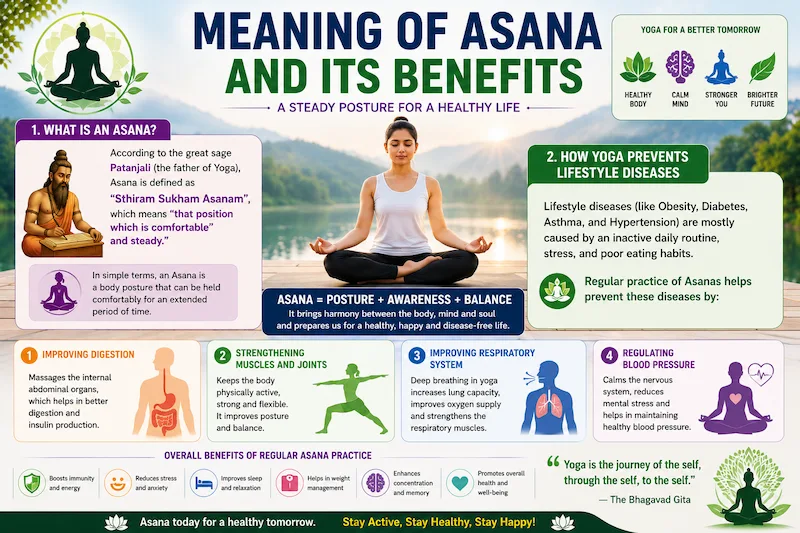
According to the great sage Patanjali (the father of Yoga), Asana is defined as “Sthiram Sukham Asanam”, which means “that position which is comfortable and steady.” In simple terms, an Asana is a body posture that can be held comfortably for an extended period of time.
2. How Yoga Prevents Lifestyle Diseases
Lifestyle diseases (like Obesity, Diabetes, Asthma, and Hypertension) are mostly caused by an inactive daily routine, stress, and poor eating habits. Regular practice of Asanas helps prevent these diseases by:
Improving Digestion: Massages the internal abdominal organs, which helps in better digestion and insulin production.
Strengthening Muscles and Joints: Keeps the body physically active and flexible.
Improving Respiratory System: Deep breathing in yoga increases lung capacity.
Regulating Blood Pressure: Calms the nervous system and reduces mental stress.
Topic 2: Obesity and its Preventive Asanas
1. What is Obesity?
Obesity is a medical and lifestyle condition in which excess body fat has accumulated to the extent that it may have a severe negative effect on health. A person is generally considered obese when their Body Mass Index (BMI) is 30 or higher.
Main Causes: The primary causes include a sedentary lifestyle, lack of physical activity, overconsumption of junk and high-calorie food, stress, hormonal imbalances (like thyroid issues), and in some cases, genetic factors.
2. Asanas to Prevent and Cure Obesity
To effectively reduce and manage obesity, the following Asanas are highly recommended. (Exam Tip: For board exams, memorize the procedure, at least two benefits, and two contraindications for each Asana).
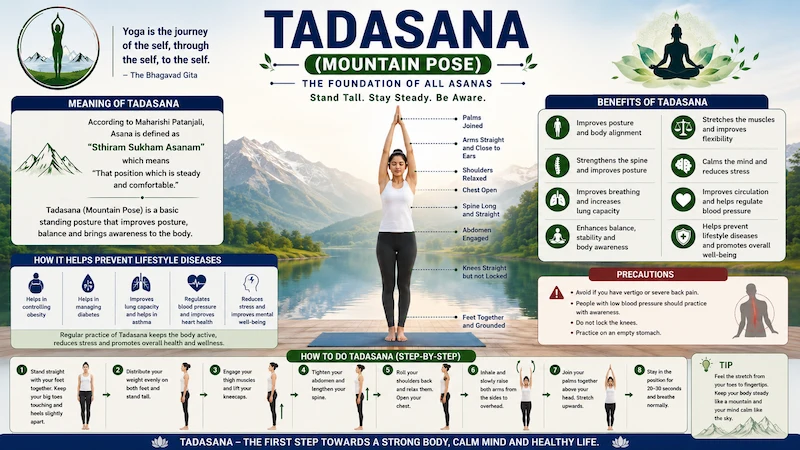
A. Tadasana (Mountain Pose)
- Procedure: Stand straight with your feet together and hands by your side. Interlock your fingers, turn the palms upwards, and raise your arms over your head. Inhale deeply and slowly lift your heels, standing on your toes. Stretch your entire body upward. Hold the position, then exhale and slowly bring your heels down.
- Benefits:
- It provides a full-body stretch that helps burn extra fat around the abdomen and waist.
- It corrects body posture and helps in increasing height in growing children.
- Contraindications:
- Individuals suffering from low blood pressure or severe headaches should avoid it.
- People with insomnia (sleeplessness) should not practice it for a long duration.
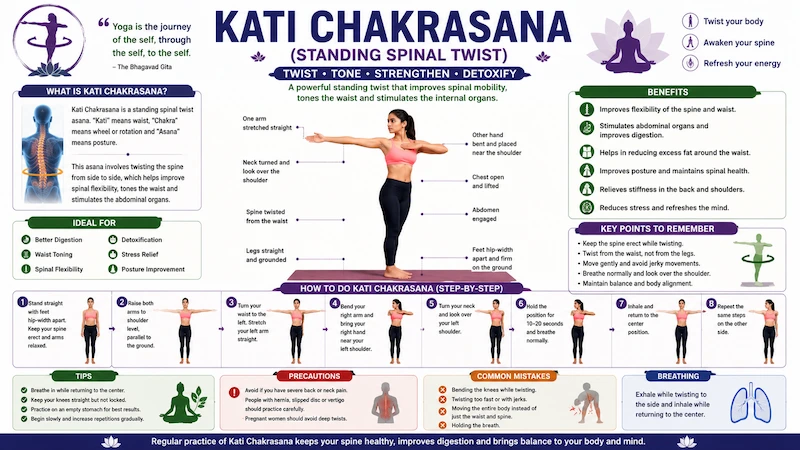
B. Kati Chakrasana (Standing Spinal Twist)
- Procedure: Stand straight with your feet shoulder-width apart. Raise both arms in front of you at shoulder level. Inhale, and as you exhale, twist your upper body to the right side. Place your left hand on your right shoulder and wrap your right arm around your back. Look over your right shoulder. Inhale to return to the center, and repeat on the left side.
- Benefits:
- The twisting motion effectively burns fat from the waistline (love handles).
- It tones the neck, shoulders, and spine, improving flexibility.
- Contraindications:
- Pregnant women must avoid this twisting Asana.
- People suffering from hernia, severe spinal injuries, or slipped disc should not perform it. [📌 Upload Image of Kati Chakrasana]
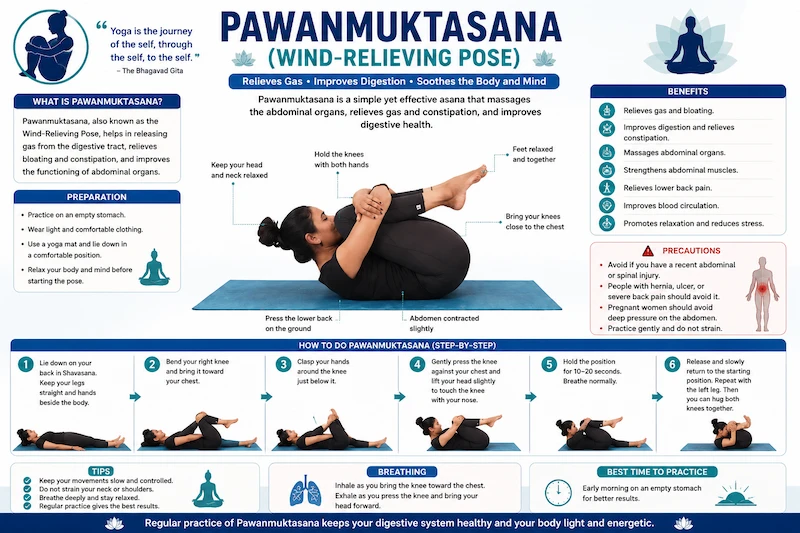
C. Pawanmuktasana (Wind-Relieving Pose)
- Procedure: Lie flat on your back (supine position). Inhale and bring both your knees toward your chest. Clasp your hands tightly over your shins/knees. Exhale, lift your head and shoulders off the ground, and try to touch your nose or chin to your knees. Hold the position with normal breathing, then slowly release.
- Benefits:
- It directly targets and reduces excess fat accumulated around the abdomen and hips.
- It cures constipation, improves digestion, and releases trapped gastrointestinal gases.
- Contraindications:
- People suffering from high blood pressure or severe back pain/sciatica should avoid lifting their head.
- Individuals who have recently undergone abdominal surgery or suffer from hernia must avoid it. [📌 Upload Image of Pawanmuktasana]
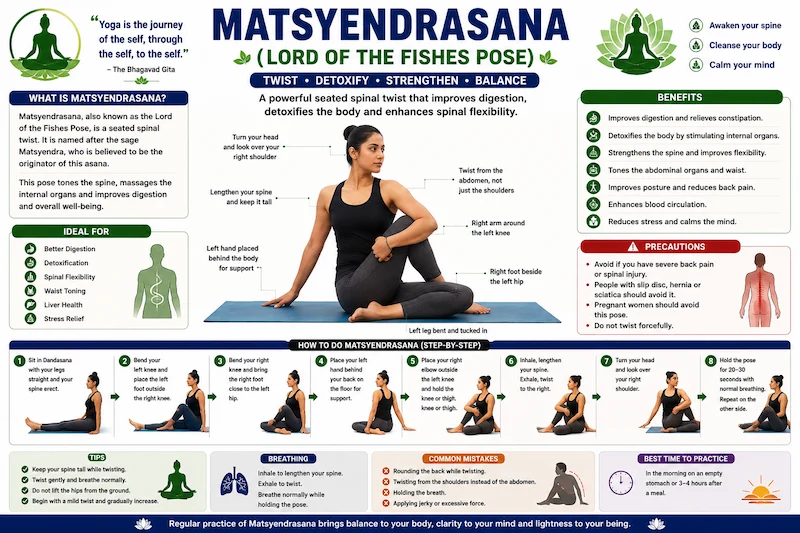
D. Matsyendrasana (Lord of the Fishes Pose)
- Procedure: Sit on the floor with your legs straight. Place your left foot on the right thigh crease (like in Half Lotus). Bend your right knee and place your right foot flat on the floor outside the left knee. Twist your upper body to the right, grasp your right foot with your left hand, and place your right hand behind your back. Look over your right shoulder.
- Benefits:
- It provides an extreme massage to the abdominal organs, burning deep visceral fat.
- It highly stimulates the pancreas and liver, making it an excellent cure for diabetes.
- Contraindications:
- Pregnant women should strictly avoid this intense twisting pose.
- Individuals with peptic ulcers or severe spinal cord issues must not practice it. [📌 Upload Image of Matsyendrasana]
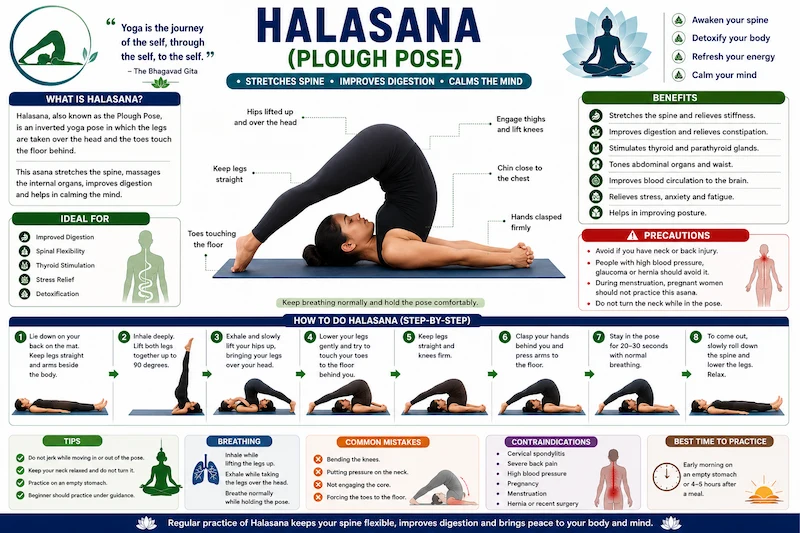
E. Halasana (Plough Pose)
- Procedure: Lie flat on your back with your arms resting beside your body. Inhale and slowly raise both legs to a 90-degree angle. Exhale and continue lifting your hips and lower back, pushing your legs over your head until your toes touch the ground behind your head. Keep your legs straight and support your back with your hands if needed.
- Benefits:
- It regulates the thyroid gland (which controls the body’s metabolic rate), thereby aiding in rapid weight loss.
- It burns fat from the belly, thighs, and hips while making the spine incredibly flexible.
- Contraindications:
- People suffering from cervical spondylosis or severe neck injuries must strictly avoid this Asana.
- Individuals with high blood pressure, slipped disc, or pregnant women should not perform it. [📌 Upload Image of Halasana]
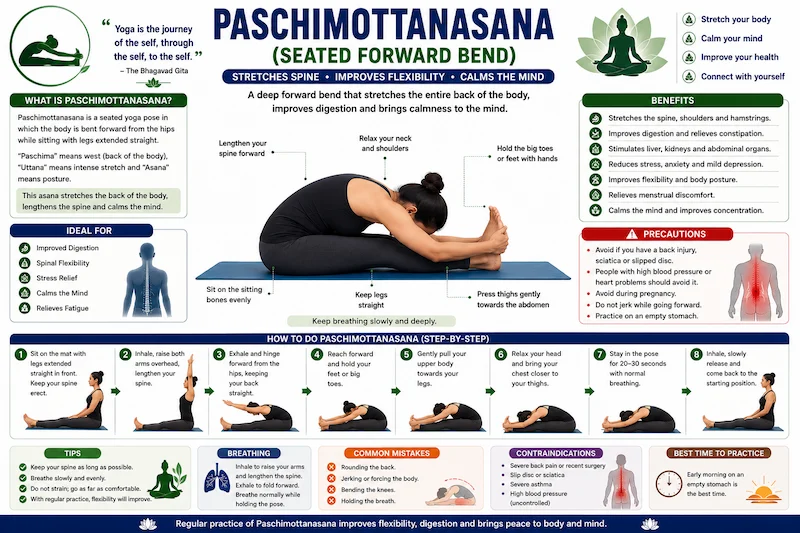
F. Paschimottanasana (Seated Forward Bend)
- Procedure: Sit on the floor with both legs stretched straight in front of you. Keep your back straight. Inhale deeply and raise both arms upward. Exhale and bend forward from the hips, trying to hold your toes with your hands. Try to rest your forehead on your knees without bending them.
- Benefits:
- It intensely compresses the abdomen, reducing belly fat and stimulating digestive organs.
- It stretches the entire back of the body, including the spine, hamstrings, and shoulders.
- Contraindications:
- Individuals suffering from asthma or respiratory diseases should avoid this pose.
- People with slipped disc, severe backache, or abdominal ulcers must not perform it. [📌 Upload Image of Paschimottanasana]
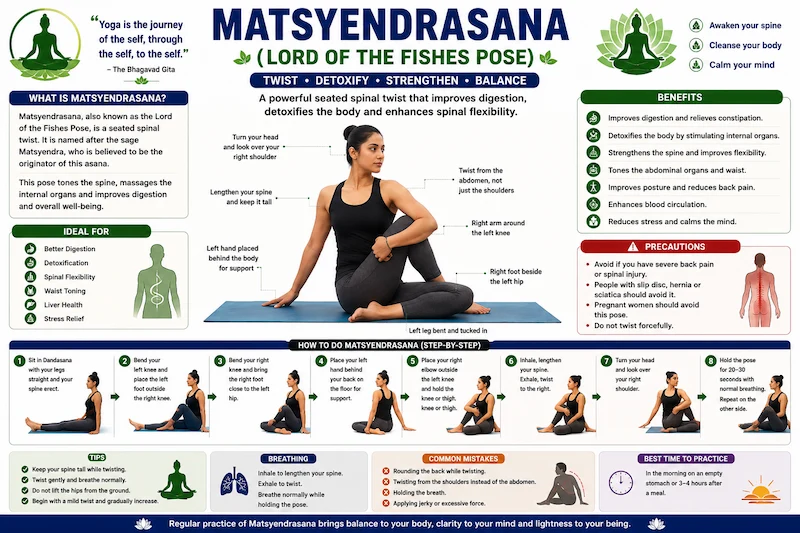
G. Ardha Matsyendrasana (Half Lord of the Fishes Pose)
- Procedure: Sit on the floor with your legs stretched out. Bend your right knee and place your right foot over your left knee on the ground. Fold your left leg and bring the left heel near your right hip. Twist your upper body to the right side, bring your left arm over the right knee, and hold your right toe. Place your right hand behind your back and look over your right shoulder.
- Benefits:
- The twisting motion deeply massages the abdominal organs, highly reducing stubborn belly fat.
- It stimulates the pancreas, making it highly effective for curing both obesity and diabetes.
- Contraindications:
- Pregnant women must strictly avoid this Asana due to the abdominal twist.
- Individuals suffering from peptic ulcers, hernia, or severe spinal injuries should avoid it. [📌 Upload Image of Ardha Matsyendrasana]
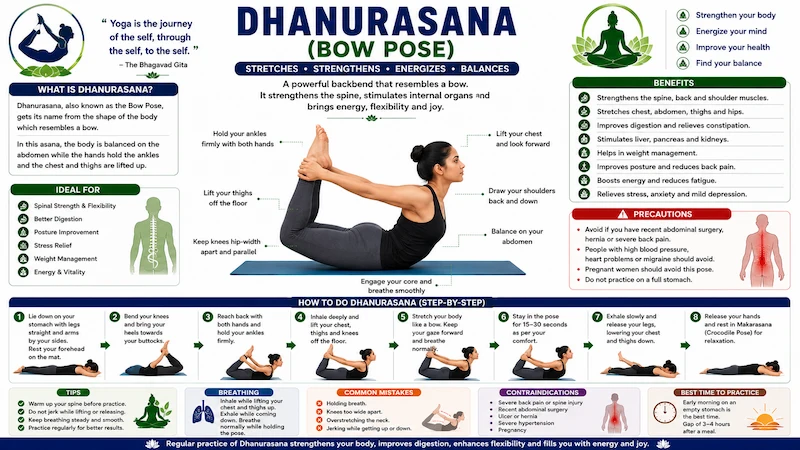
H. Dhanurasana (Bow Pose)
- Procedure: Lie down on your stomach (prone position). Bend your knees and bring your heels close to your buttocks. Reach back with your hands and hold your ankles. Inhale deeply and lift your chest, head, and thighs off the floor simultaneously, pulling your legs upward and backward. The entire body weight should rest on your navel area.
- Benefits:
- It is one of the most powerful Asanas for burning abdominal fat and toning the digestive organs.
- It expands the chest, improves respiratory functions, and corrects hunchback posture.
- Contraindications:
- Individuals suffering from hernia, peptic ulcers, or recent abdominal surgery must avoid it.
- Pregnant women and people with severe lower back pain should not practice this pose. [📌 Upload Image of Dhanurasana]
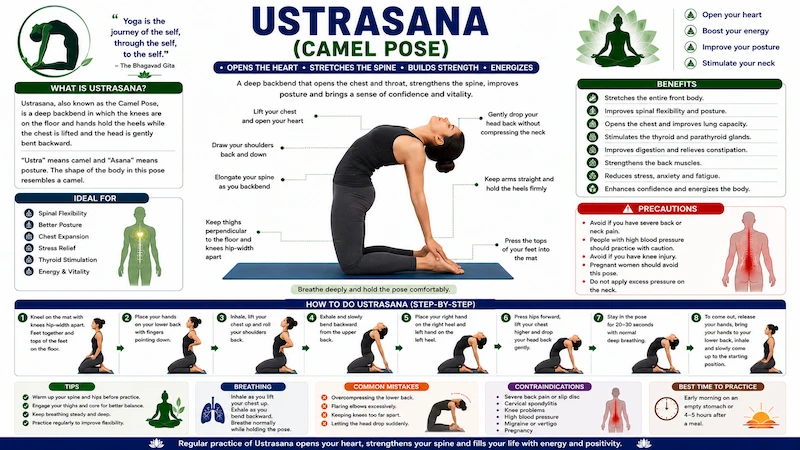
I. Ustrasana (Camel Pose)
- Procedure: Kneel on the floor with your knees shoulder-width apart. Keep your spine straight. Inhale, slowly lean backward, and reach your hands down to hold your heels. Push your hips and pelvis forward, expand your chest, and drop your head backward gently.
- Benefits:
- It gives an intense stretch to the front of the body, particularly the abdomen, effectively melting belly fat.
- It improves lung capacity, stimulates the thyroid gland, and strengthens the back muscles.
- Contraindications:
- People suffering from severe high or low blood pressure should avoid this Asana.
- Individuals with migraines, severe neck injuries, or lower back issues must not perform it. [📌 Upload Image of Ustrasana]
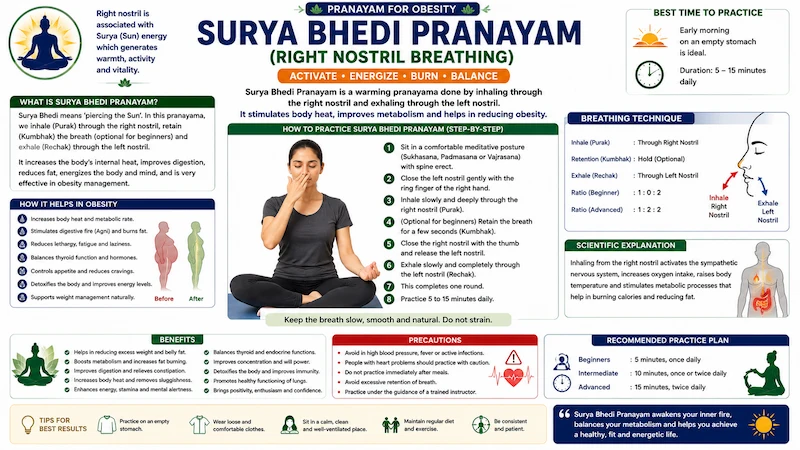
3. Pranayam for Obesity: Surya Bhedi Pranayam (Right Nostril Breathing)
What is Surya Bhedi Pranayam? In Yoga, the human body has two main energy channels: the Surya Nadi (Right nostril, representing solar energy and heat) and the Chandra Nadi (Left nostril, representing lunar energy and coolness). “Surya Bhedi” translates to piercing or activating the solar channel. In this Pranayam, inhalation is always done through the right nostril, and exhalation through the left. This deeply activates the body’s fire element, boosting metabolism and aiding in rapid weight loss.
Procedure:
- Sit in a comfortable meditative posture like Padmasana, Sukhasana, or Vajrasana.
- Keep your spine, neck, and head perfectly straight and close your eyes.
- Rest your left hand on your left knee in Gyan Mudra (joining the tips of the index finger and thumb).
- Bring your right hand to your face. Use your right thumb to close your right nostril. (Wait, correct method: use right thumb to close LEFT nostril to inhale from RIGHT). Correction: Use your right ring/little finger to close your left nostril.
- Inhale slowly and deeply through your right nostril.
- (Optional for advanced practitioners: Hold your breath inside for a few seconds).
- Now, close your right nostril with your right thumb, open the left nostril, and exhale slowly through the left nostril.
- This completes one cycle. Remember: Always inhale from the right and exhale from the left. Repeat this process for 5 to 10 minutes.
Benefits:
- It significantly boosts the basal metabolic rate (BMR), helping the body burn excess fat and calories much faster.
- It generates internal heat, which clears the sinuses, cures cold/cough, and helps asthma patients.
- It energizes the nervous system, removes lethargy, and is highly beneficial for individuals suffering from low blood pressure.
Contraindications:
- Because it generates intense body heat, people suffering from High Blood Pressure or heart diseases must strictly avoid it.
- Individuals suffering from high fever, acidity, or peptic ulcers should not practice it.
- It should ideally be practiced during winters or cold mornings, and avoided during peak summer heat.
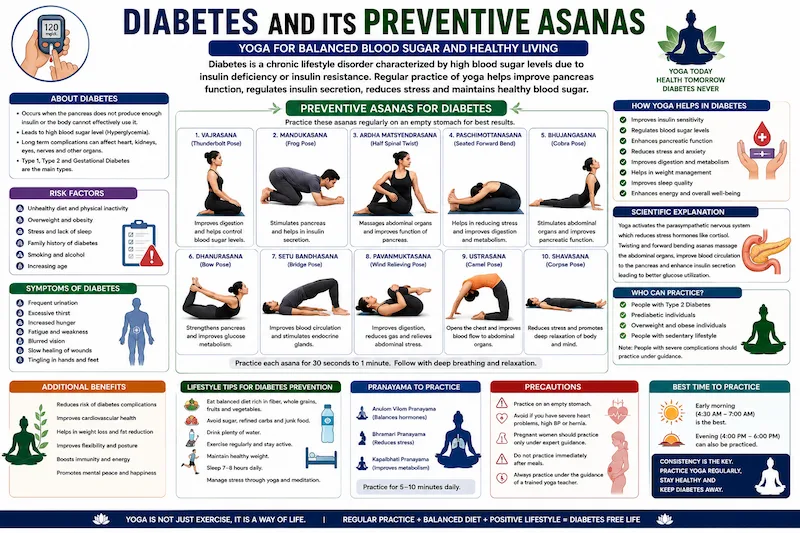
Topic 3: Diabetes and its Preventive Asanas
1. What is Diabetes?
Diabetes is a very common lifestyle disease in which a person’s blood sugar (glucose) level becomes too high. It happens because the pancreas is either unable to produce enough insulin hormone or the body is unable to use the insulin properly.
- Main Causes: Unhealthy eating habits, obesity, lack of physical exercise, and mental stress.
2. Asanas to Prevent and Cure Diabetes
A. Bhujangasana (Cobra Pose)
- Procedure: Lie down on your stomach with your legs straight and feet together. Place your palms on the floor near your shoulders. Inhale and slowly raise your head, chest, and upper abdomen upwards, looking toward the sky.
- Benefits: It directly stimulates the pancreas to produce more insulin, thereby controlling blood sugar levels. It also makes the spine highly flexible.
- Contraindications: Pregnant women and people suffering from severe back injuries or hernias should strictly avoid it.
B. Paschimottanasana (Seated Forward Bend)
- Procedure: Sit straight on the floor with your legs stretched out in front of you. Inhale and raise your arms up. Exhale, bend forward from your waist, and try to hold your toes. Keep your knees completely straight and try to touch your head to your knees.
- Benefits: It provides a deep massage to the internal abdominal organs (like the pancreas and liver), which helps cure diabetes and digestive disorders.
- Contraindications: Individuals suffering from asthma, slip disc, or severe lower back pain should not perform this asana.
C. Pavanmuktasana (Wind-Relieving Pose)
- Procedure: Lie on your back. Bend both your knees and bring them close to your chest. Wrap your arms around your knees. Inhale, and as you exhale, lift your head and try to touch your nose to your knees.
- Benefits: It massages the pancreas to regulate insulin and helps release trapped gas from the stomach, instantly curing indigestion.
- Contraindications: People with neck pain (cervical), high blood pressure, or abdominal surgery should avoid it.
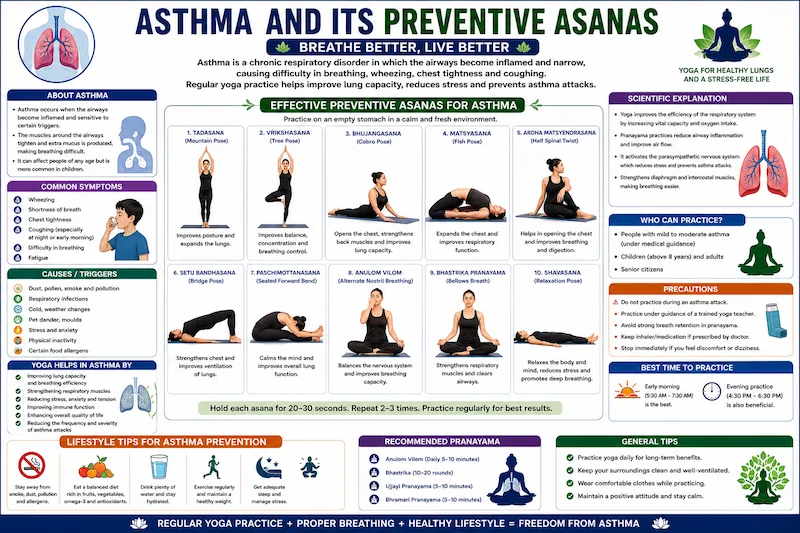
🏆 Topic 4: Asthma and its Preventive Asanas
1. What is Asthma?
Asthma is a chronic disease of the respiratory system. In this condition, the airways (breathing tubes) in the lungs swell up and become narrow, making it very difficult for the person to breathe. It often causes wheezing, coughing, and shortness of breath.
- Main Causes: Air pollution, dust, smoke, allergies, and genetic factors.
2. Asanas to Prevent and Cure Asthma
A. Sukhasana (Easy Pose)
- Procedure: Sit comfortably on the floor with crossed legs. Keep your spine, neck, and head perfectly straight. Place your hands on your knees in Gyan Mudra. Close your eyes and focus on your deep breathing.
- Benefits: It calms the mind, deeply relaxes the respiratory system, and improves concentration.
- Contraindications: People with severe knee arthritis or recent hip injuries should avoid sitting in this posture for too long.
B. Chakrasana (Wheel Pose)
- Procedure: Lie down on your back. Bend your knees and place your feet flat on the floor. Place your palms on the floor beside your ears with fingers pointing toward your shoulders. Inhale and slowly lift your entire body upwards, making a semi-circle or wheel shape.
- Benefits: It massively expands the chest, increases lung capacity, and allows more oxygen to flow, making it excellent for asthma patients.
- Contraindications: People with high blood pressure, heart problems, or severe spinal issues should not attempt it.
C. Gomukhasana (Cow Face Pose)
- Procedure: Sit on the floor and fold your left leg so that the left heel touches your right hip. Now place your right leg over the left leg. Raise your right arm upward, bend it at the elbow behind your back, and try to catch your left hand from below.
- Benefits: It stretches the chest muscles deeply, which helps open up the lungs and airways. It also cures stiff shoulders.
- Contraindications: Anyone with severe shoulder, neck, or knee injuries should avoid this pose.
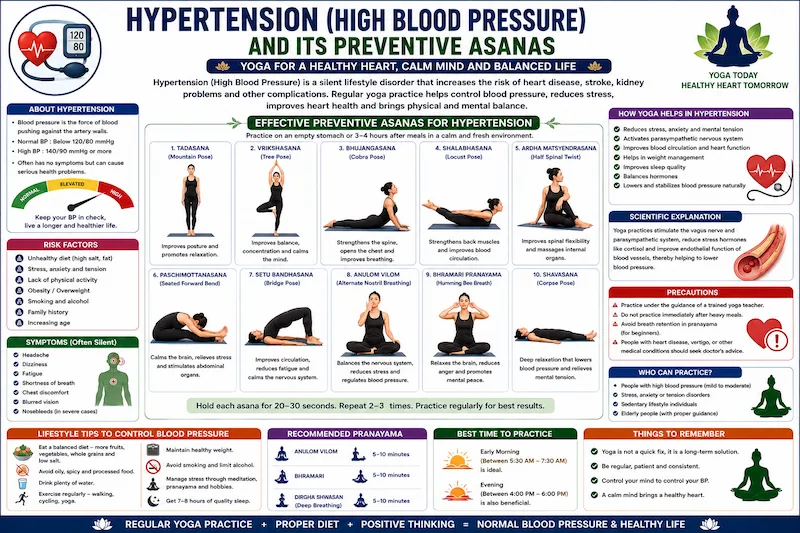
Topic 5: Hypertension (High Blood Pressure) and its Preventive Asanas
1. What is Hypertension?
Hypertension, commonly known as high blood pressure, is a condition in which the force of the blood against the artery walls is too high. A normal blood pressure reading is 120/80 mmHg, but if it frequently stays above 140/90 mmHg, the person is suffering from hypertension.
- Main Causes: High stress, anxiety, eating too much salt, smoking, and lack of exercise.
2. Asanas to Prevent and Cure Hypertension
A. Tadasana (Mountain Pose)
- Procedure: Stand absolutely straight with your feet together. Inhale, raise your arms upward, and interlock your fingers. Slowly lift your heels and stand on your toes, stretching your whole body upwards.
- Benefits: It develops deep physical and mental balance, improves body posture, and helps calm the nervous system.
- Contraindications: People suffering from low blood pressure, headaches, or insomnia should avoid this stretching.
B. Shavasana (Corpse Pose)
- Procedure: Lie down flat on your back like a dead body. Keep a gap of about one foot between your legs. Keep your hands a little away from your body with palms facing upward. Close your eyes, relax every muscle, and take slow, deep breaths.
- Benefits: It is the best asana for hypertension. It instantly lowers blood pressure, removes all physical fatigue, and completely eliminates mental stress.
- Contraindications: There are no strict contraindications for Shavasana, but people suffering from severe depression should practice it under guidance.
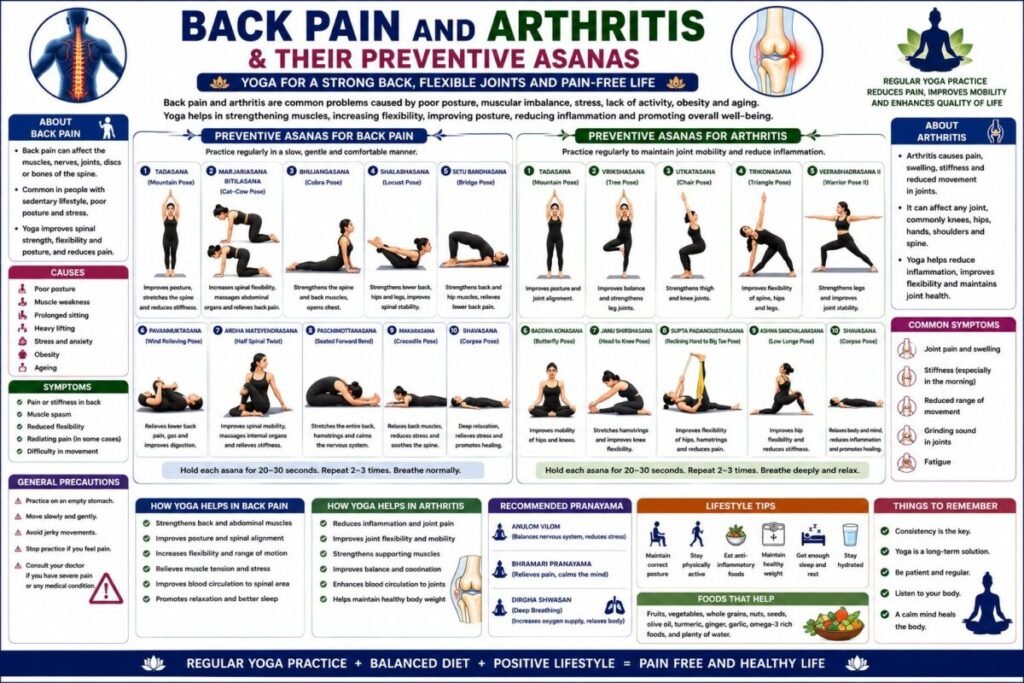
Topic 6: Back Pain and Arthritis & Their Preventive Asanas
Part 1: Back Pain
1. What is Back Pain? Back pain is a highly common physical ailment that affects the muscles, nerves, bones, or joints of the human back. In the modern era, it has become a prominent lifestyle disease. It can range from a dull, constant ache to a sudden, sharp pain that makes movement difficult. It most commonly affects the lower back (lumbar region).
Main Causes: A sedentary lifestyle, prolonged sitting in incorrect postures (slouching), lack of physical exercise, lifting heavy weights improperly, muscle strain, obesity, and weak core muscles.
Asanas to Prevent and Cure Back Pain
(Exam Tip: Remember the procedure, two benefits, and two contraindications for each Asana).
A. Shalabhasana (Locust Pose)
- Procedure: Lie down on your stomach (prone position). Place your arms under your thighs or beside your body with palms facing down. Keep your chin on the floor. Inhale deeply and lift both legs upward as high as possible without bending the knees. Hold the position for a few seconds, then exhale and bring your legs down slowly.
- Benefits:
- It highly strengthens the lower back muscles and is one of the best cures for lumbar backache and sciatica.
- It tones the pelvic organs and aids in digestion.
- Contraindications:
- People suffering from severe hernia, peptic ulcers, or high blood pressure should avoid it.
- Pregnant women must strictly avoid this Asana. [📌 Upload Image of Shalabhasana]
B. Bhujangasana (Cobra Pose)
- Procedure: Lie down on your stomach with legs straight and feet together. Place your palms on the floor near your shoulders. Inhale and slowly lift your head, chest, and upper abdomen using your back muscles, keeping the navel on the floor. Look upwards. Hold the pose, then exhale and return to the starting position.
- Benefits:
- It makes the spine highly flexible and strengthens the deep back muscles, instantly relieving back pain.
- It opens up the chest, which is highly beneficial for asthma patients.
- Contraindications:
- Individuals suffering from hernia or severe spinal injuries must avoid this Asana.
- Pregnant women and people with recent abdominal surgeries should not perform it. [📌 Upload Image of Bhujangasana]
C. Vakrasana (Seated Twisted Pose)
- Procedure: Sit on the floor with legs stretched straight in front of you. Bend the right leg at the knee and place the right foot beside the left knee. Keep the spine straight. Exhale and twist your trunk to the right. Bring the left arm over the right knee and hold the right ankle or knee. Place the right hand on the floor behind your back for support. Look back over your right shoulder. Hold, release, and repeat on the other side.
- Benefits:
- It gives a deep twist to the spine, relieving stiffness and curing lower back pain.
- It massages the abdominal organs, aiding in digestion and managing diabetes.
- Contraindications:
- Individuals suffering from severe spinal cord injuries, slipped disc, or severe ulcers should not perform it.
- Pregnant women should avoid this twisting pose. [📌 Upload Image of Vakrasana]
Part 2: Arthritis (Arthritis / Joint Pain)
1. What is Arthritis? Arthritis is a medical condition characterized by the swelling, inflammation, and tenderness of one or more joints. The main symptoms of arthritis are intense joint pain and stiffness, which typically worsen with age. The two most common types are Osteoarthritis (wear and tear of cartilage) and Rheumatoid arthritis (an autoimmune disorder).
Main Causes: Aging, wear and tear of joint cartilage, genetic factors, autoimmune disorders, previous joint injuries, and obesity (which puts extra stress on weight-bearing joints like knees and hips).
Asanas to Prevent and Cure Arthritis
A. Gomukhasana (Cow Face Pose)
- Procedure: Sit on the floor with your legs stretched out. Bend your left knee and place the left heel under the right hip. Bend your right knee and place it directly over the left knee. Raise your right arm, bend it at the elbow, and reach behind your back from the top. Bring your left arm from below and try to clasp the fingers of both hands behind your back. Keep your spine and head straight.
- Benefits:
- It provides an excellent stretch to the shoulders, elbows, and knees, reducing arthritis stiffness.
- It makes the leg muscles flexible and cures sciatica.
- Contraindications:
- Individuals with severe shoulder, knee, or neck injuries should not force their hands to clasp.
- People with bleeding piles should avoid sitting in this posture for long. [📌 Upload Image of Gomukhasana]
B. Setu Bandhasana (Bridge Pose)
- Procedure: Lie flat on your back. Bend your knees and place your feet flat on the floor, hip-width apart. Keep your arms beside your body with palms facing down. Inhale and slowly lift your lower back, middle back, and upper back off the floor. Your chest should touch your chin. Support your body weight on your shoulders, arms, and feet.
- Benefits:
- It strengthens the back, glutes, and knees, taking the pressure off arthritic joints.
- It improves blood circulation to the joints and relieves stress in the spine.
- Contraindications:
- People with severe neck or shoulder injuries should strictly avoid it.
- Pregnant women should perform it only under expert guidance. [📌 Upload Image of Setu Bandhasana]
C. Tadasana (Mountain Pose)
People experiencing severe joint inflammation (acute arthritis flare-up) should not stand on their toes. [📌 Upload Image of Tadasana]
Procedure: Stand straight with your feet together. Interlock your fingers, turn the palms upwards, and raise your arms over your head. Inhale deeply and slowly lift your heels, standing on your toes. Stretch your entire body upward. Hold the position, then exhale and slowly bring your heels down.
Benefits:
It improves overall body posture and evenly distributes body weight, reducing stress on the knee and ankle joints (crucial for arthritis).
It stretches the spine and surrounding muscles, removing stiffness.
Contraindications:
Individuals suffering from low blood pressure or severe headaches should avoid it.
Chapter Conclusion: Yoga as Preventive Measure for Lifestyle Disease
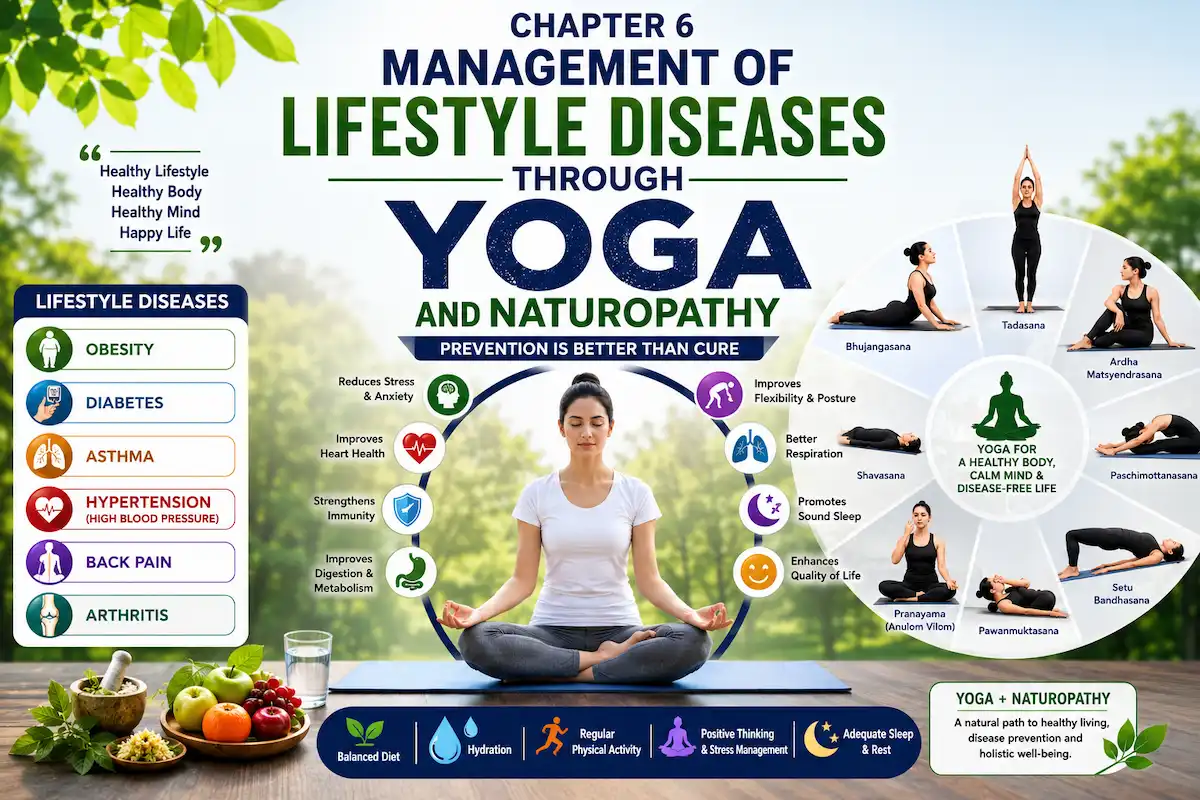
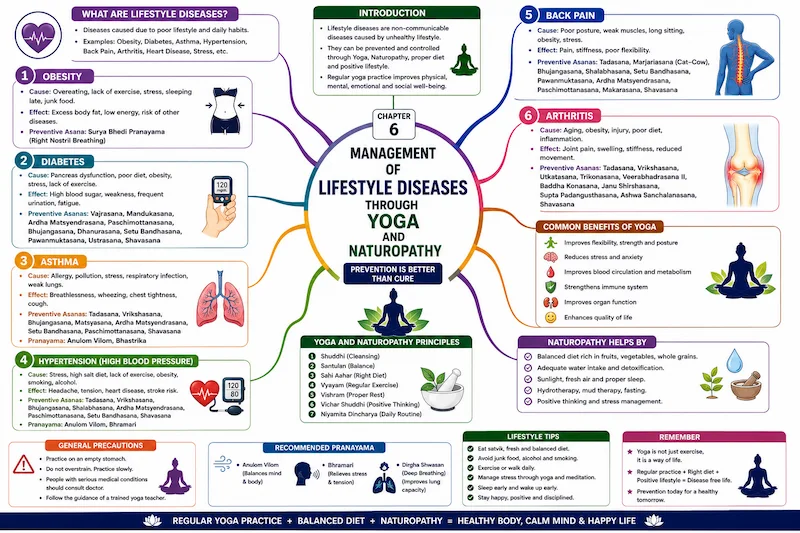
This chapter bridges the ancient wisdom of Yoga with modern health challenges. It defines Asanas not merely as physical postures, but as tools to prevent and manage lifestyle diseases that arise from sedentary habits, stress, and poor diet. The chapter provides a detailed breakdown of four major lifestyle diseases: Obesity, Diabetes, Asthma, and Hypertension (and Back Pain). For each condition, specific therapeutic asanas are recommended. By understanding the procedure, benefits, and contraindications of asanas like Vajrasana, Bhujangasana, and Shavasana, students learn how Yoga strengthens the respiratory, cardiovascular, and endocrine systems naturally, acting as both a preventive and curative measure.
Frequently Asked Questions (FAQs)
Objective Type Questions (1 Mark)
Q1. According to Maharishi Patanjali, what is the definition of ‘Asana’? +
Ans. B) Sthiram Sukham Asanam (That position which is comfortable and steady).
Q2. Which of the following Asanas can be performed immediately after having meals? +
Ans. B) Vajrasana
Q3. Bhujangasana (Cobra Pose) is highly recommended for curing which of the following lifestyle diseases? +
Ans. A) Asthma and Back Pain
Q4. A condition in which the airways narrow and swell and produce extra mucus is called: +
Ans. C) Asthma
Q5. Which disease is characterized by elevated blood pressure levels? +
Ans. B) Hypertension
Very Short Answer Type Questions (2 Marks)
Q6. Define Obesity. +
Ans. Obesity is a complex medical condition characterized by an excessive accumulation of body fat to the extent that it may have a negative effect on health. A person is generally considered obese if their Body Mass Index (BMI) is 30 or higher.
Q7. What is Hypertension? +
Ans. Hypertension, commonly known as high blood pressure, is a condition where the force of the blood against the artery walls is consistently too high. A normal blood pressure reading is 120/80 mmHg. Hypertension can lead to severe complications like heart attacks and strokes.
Q8. Name any two Asanas that help in preventing and curing Diabetes. +
Ans. Two effective Asanas for managing Diabetes are Bhujangasana (Cobra Pose) and Ardha Matsyendrasana (Half Lord of the Fishes Pose), as they stimulate the pancreas.
Q9. What do you mean by ‘Contraindications’ in the context of Yoga? +
Ans. Contraindications refer to specific medical conditions or situations under which a particular Asana should not be performed, as it may cause harm or worsen the injury (e.g., a person with a recent abdominal surgery should not perform stretching abdominal poses).
Short Answer Type Questions (3 Marks)
Q10. Briefly explain how Asanas act as preventive measures for lifestyle diseases. +
Ans. Asanas prevent lifestyle diseases in the following ways:
- Strengthens Systems: Regular practice strengthens the respiratory, cardiovascular, and digestive systems, improving their efficiency.
- Hormonal Balance: Specific poses stimulate endocrine glands (like the pancreas and thyroid), ensuring proper hormone secretion.
- Stress Reduction: Asanas, combined with proper breathing, drastically reduce stress and anxiety, which are root causes of diseases like hypertension and obesity.
Q11. Explain the procedure and any two benefits of Tadasana (Mountain Pose). +
Ans. Procedure: Stand straight with feet together. Interlock your fingers and raise your arms overhead. Inhale and slowly raise your heels, standing on your toes. Stretch your entire body upwards. Hold the position, then slowly exhale and bring the heels down.
Benefits:
- It helps in increasing height in children.
- It improves posture and cures issues related to flat feet.
- It is highly effective in managing obesity.
Q12. What is Asthma? Name two Asanas to cure it and write the contraindications of one. +
Ans. Asthma is a chronic disease of the respiratory system where the airways become inflamed, narrow, and produce excess mucus, causing difficulty in breathing, coughing, and wheezing.
Asanas for Asthma: Gomukhasana and Chakrasana.
Contraindications of Chakrasana: People suffering from high blood pressure, severe back pain, or hernia should not perform Chakrasana.
Q13. Explain the procedure of Vajrasana. +
Ans. Procedure: Sit on the floor and fold both legs backward such that the heels touch the hips and the toes touch each other. Keep the spine, neck, and head perfectly straight. Rest the palms on the knees. Close your eyes and take deep breaths. It is uniquely beneficial as it can be practiced immediately after a meal to aid digestion.
Long Answer Type Questions (5 Marks)
Q14. What is Diabetes? Explain the procedure, benefits, and contraindications of Bhujangasana in managing Diabetes. +
Ans. Diabetes: It is a metabolic disorder where the body cannot regulate blood sugar (glucose) levels properly. This happens either because the pancreas does not produce enough insulin (Type 1) or the body’s cells do not respond properly to insulin (Type 2).
Bhujangasana (Cobra Pose):
- Procedure: Lie down on your stomach with legs straight and feet together. Place your palms on the floor near your shoulders. Inhale and slowly lift your head, chest, and upper abdomen using your back muscles, keeping the navel on the floor. Look upwards. Hold the pose, then exhale and return to the starting position.
- Benefits: It stimulates the abdominal organs, especially the pancreas, thereby helping in the secretion of insulin. It strengthens the spine, relieves lower back pain, and cures respiratory disorders like asthma.
- Contraindications: Individuals suffering from hernia, severe spinal injuries, peptic ulcers, or pregnant women should avoid this Asana.
Q15. Define Obesity. Describe the procedure, benefits, and contraindications of Pawanmuktasana. +
Ans. Obesity: It is a lifestyle condition in which excess body fat accumulates, increasing the risk of diseases like diabetes, hypertension, and cardiovascular issues. It is usually caused by an imbalance between calorie intake and calorie expenditure.
Pawanmuktasana (Wind-Relieving Pose):
- Procedure: Lie flat on your back (supine position). Inhale, fold your knees, and bring them towards your chest. Clasp your hands over your knees/shins. Exhale, lift your head and try to touch your chin or nose to your knees. Hold the position with normal breathing. Inhale, bring the head down, and exhale while straightening the legs.
- Benefits: It is highly effective in reducing fat in the abdominal area, thereby curing obesity. It releases trapped gases from the digestive tract, cures constipation, and improves digestion.
- Contraindications: People suffering from high blood pressure, sciatica, severe back issues, hernia, or those who have recently undergone abdominal surgery should strictly avoid this pose.
Q16. What is Hypertension? Write the procedure, benefits, and contraindications of Shavasana as a preventive measure. +
Ans. Hypertension: It is a condition where the blood pressure in the arteries is persistently elevated (above 140/90 mmHg). It forces the heart to work harder to pump blood, often caused by stress, obesity, and an unhealthy lifestyle.
Shavasana (Corpse Pose):
- Procedure: Lie flat on your back on the floor. Keep your legs comfortably apart and let your toes fall outward. Keep your arms slightly away from the body with palms facing upward. Close your eyes. Breathe naturally and slowly, consciously relaxing every single muscle in your body from the toes up to the head. Stay completely motionless.
- Benefits: Shavasana completely relaxes the nervous system, bringing the heart rate and blood pressure down to normal levels. It cures stress, anxiety, and insomnia (sleeplessness), making it the most powerful pose for treating Hypertension.
- Contraindications: There are no physical contraindications for Shavasana as it is a relaxation pose. However, people suffering from severe depression should practice it under guidance, as closing the eyes might trigger negative thoughts.
Q17. Explain Back Pain as a lifestyle issue. Detail the procedure, benefits, and contraindications of Vakrasana to cure it. +
Ans. Back Pain: It is a common ailment that affects the muscles, nerves, or bones of the back. In modern times, it is primarily a lifestyle disease caused by prolonged sitting, poor posture, lack of exercise, and muscle stiffness.
Vakrasana (Seated Twisted Pose):
- Procedure: Sit on the floor with legs stretched straight in front of you. Bend the right leg at the knee and place the right foot beside the left knee. Keep the spine straight. Exhale and twist your trunk to the right. Bring the left arm over the right knee and try to hold the right ankle. Place the right hand on the floor behind your back for support. Look back over your right shoulder. Hold, release, and repeat on the other side.
- Benefits: It gives a deep twist to the spine, relieving stiffness and curing lower back pain. It massages the abdominal organs, aiding in digestion and managing diabetes.
- Contraindications: Individuals suffering from severe spinal cord injuries, slipped disc, or severe ulcers should not perform Vakrasana.