Introduction: Understanding Biomechanics in Sports
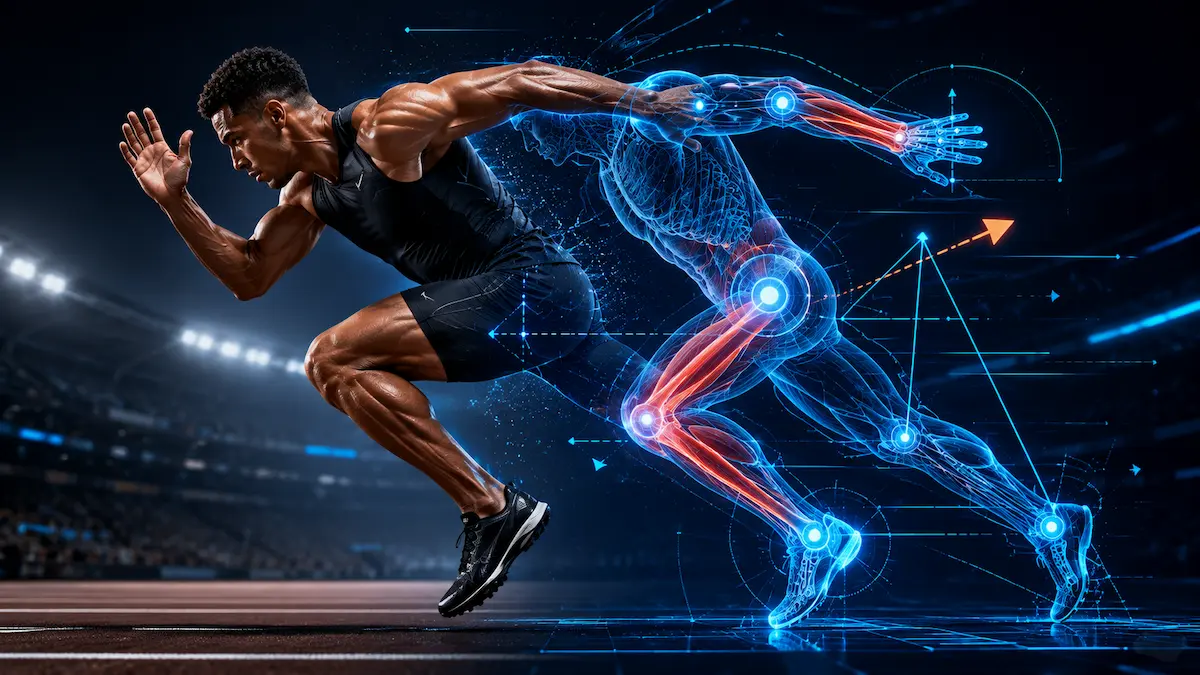
Biomechanics is a highly specialized scientific discipline that combines the principles of biology and mechanical physics to study the movements of the human body. In the context of sports, it involves analyzing the internal and external forces acting on an athlete’s body and the physiological effects produced by these forces. By understanding the mechanical laws that govern human movement, coaches and athletes can perfectly optimize athletic techniques, design better sports equipment, and create strategies that maximize energy efficiency. More importantly, biomechanics acts as the ultimate tool for injury prevention, ensuring that the human machine operates within its safest and most productive mechanical limits.
Topic 1: Meaning and Importance of Biomechanics in Sports
Meaning of Biomechanics
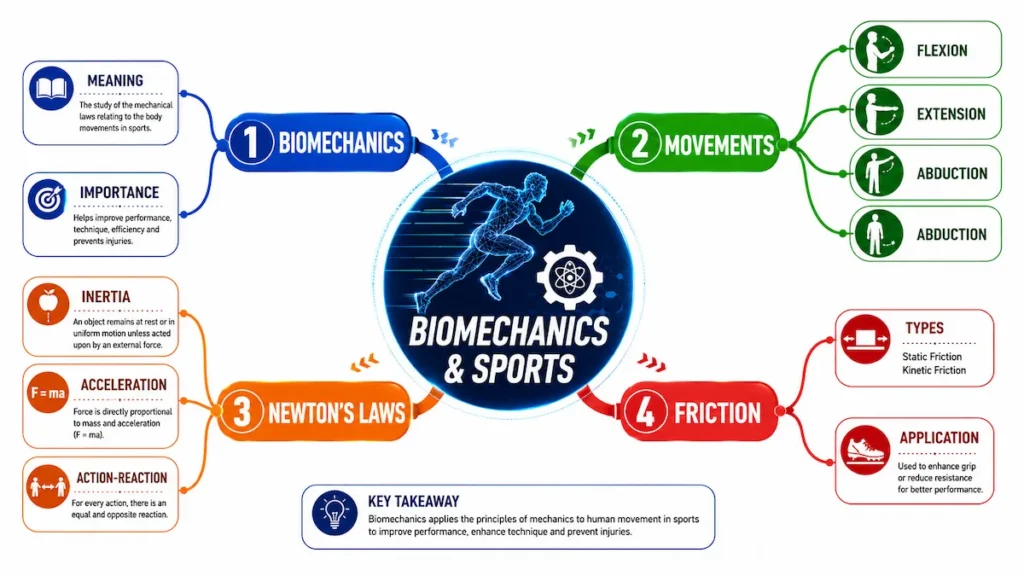
The term “Biomechanics” is derived from two distinct Greek words: ‘Bio’, meaning living organisms or life, and ‘Mechanics’, which is the field of physics concerned with the study of forces and their effects on matter. Therefore, sports biomechanics is the systematic study of the mechanical laws relating to the movement or structure of the living human body during athletic activities. It is traditionally divided into two main areas:
- Kinematics: The study of motion itself (velocity, acceleration, and displacement) without considering the forces that cause the motion.
- Kinetics: The study of the actual forces (like gravity, friction, and muscular tension) that cause, modify, or stop the movement.
Importance of Biomechanics in Physical Education and Sports
- Improvement of Technique: This is the most crucial application. By utilizing biomechanical analysis (such as high-speed camera tracking and force plates), coaches can identify microscopic flaws in an athlete’s technique. Correcting these flaws allows for flawless execution, such as a swimmer adjusting their stroke angle to drastically reduce water drag.
- Enhancement of Sports Equipment: Biomechanics plays a massive role in designing modern sports gear. From the aerodynamic shape of a cycling helmet to the specific shock-absorbing sole of a marathon running shoe, equipment is mechanically engineered to boost performance and reduce physical stress on the athlete’s joints.
- Injury Prevention and Rehabilitation: By calculating the exact amount of mechanical stress a specific joint or ligament can handle, biomechanics helps in modifying dangerous training techniques. Furthermore, it aids physiotherapists in designing precise rehabilitation exercises that safely restore the range of motion without overloading the healing tissues.
- Improvement in Training Methods: It helps sports scientists understand which specific muscle groups are activated during a particular athletic movement. Coaches can then design highly targeted strength and conditioning programs (like specific plyometric drills for basketball players) that translate directly into competitive performance.
- Understanding of the Human Body: It provides physical education teachers and students with a profound, science-backed understanding of how bones act as levers, joints act as fulcrums, and muscles generate the vital force required for athletic dominance.
Topic 2: Types of Movements in Sports (Anatomical Actions)
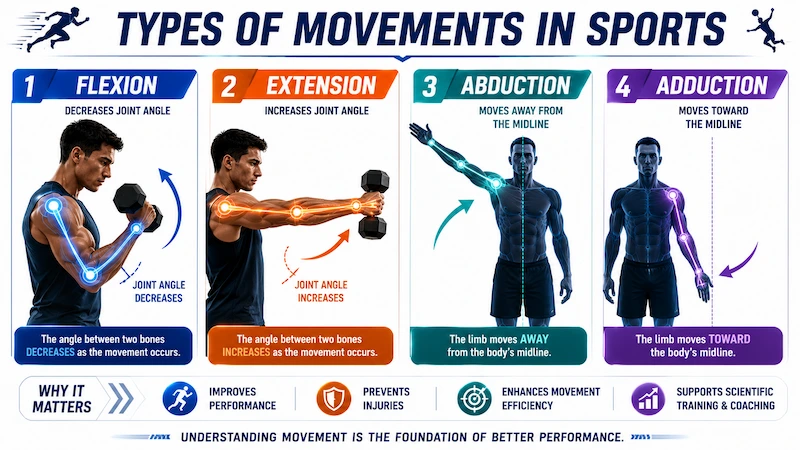
To accurately describe how the human body moves during sports, biomechanists and medical professionals use a universal anatomical terminology based on body planes and joint angles. Understanding these fundamental joint movements is essential for analyzing exercise forms and athletic skills. The four primary types of joint movements are Flexion, Extension, Abduction, and Adduction.
1. Flexion
- Definition: Flexion is a bending movement around a joint in a sagittal plane that significantly decreases the angle between the bones of the limb at a joint. It essentially brings two body parts closer together.
- Application in Sports: When a weightlifter performs the upward lifting phase of a bicep curl, the angle between the forearm and the upper arm decreases; this is elbow flexion. Similarly, when a football player bends their knee backward just before kicking the ball, they are performing knee flexion. Bending the head forward toward the chest is neck flexion.
2. Extension
- Definition: Extension is the exact anatomical opposite of flexion. It is a straightening movement that increases the angle between the bones of the limb at a joint, returning the body part to its normal anatomical resting position or stretching it further.
- Application in Sports: During a basketball jump shot, as the player releases the ball, they straighten their arm forcefully at the elbow—this is elbow extension. Similarly, a sprinter pushing off the starting blocks aggressively straightens their back leg, performing powerful hip and knee extension to generate maximum forward velocity.
3. Abduction
- Definition: Abduction refers to a movement that pulls a structure or limb laterally away from the midline (center) of the human body.
- Application in Sports: In gymnastics, when an athlete performs a perfectly flat side split, they are violently abducting their legs. In the weight room, performing a “lateral dumbbell raise” by lifting the arms straight out to the sides involves shoulder abduction. Even spreading your fingers wide apart is considered abduction of the digits.
4. Adduction
- Definition: Adduction is the direct opposite of abduction. It involves moving a body part inward, toward the central midline of the body, or simply bringing the limbs back to their resting position beside the torso.
- Application in Sports: When a swimmer performs the breaststroke, bringing their arms powerfully back toward the center of their body against the water resistance is adduction. In fitness, using the inner thigh machine at the gym to squeeze the legs together actively engages the hip adductor muscles.
Topic 3: Newton’s Laws of Motion and Their Application in Sports
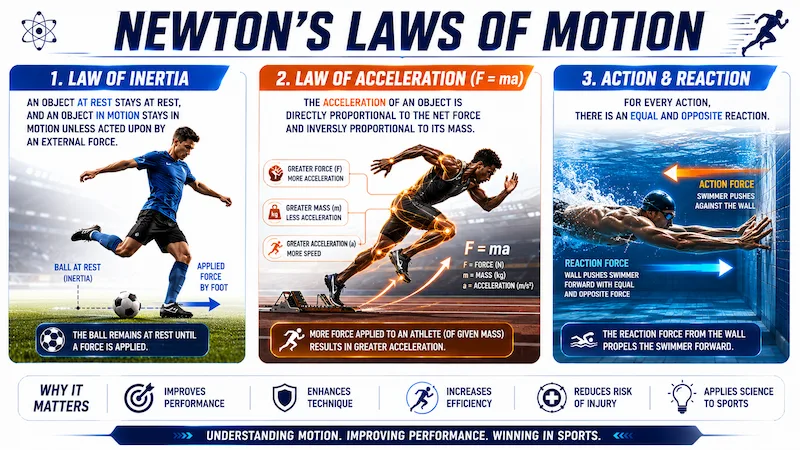
Sir Isaac Newton formulated three fundamental laws of classical mechanics that describe the relationship between a body and the forces acting upon it. In sports, every single human movement, from throwing a javelin to diving into a pool, is strictly governed by these three immutable laws.
1. Newton’s First Law: The Law of Inertia
- The Law: A body at rest will remain at rest, and a body in motion will continue in motion with the same speed and in the same direction unless acted upon by an external, unbalanced force. Inertia is the natural resistance of any physical object to a change in its state of motion.
- Application in Sports:
- Static Inertia: A golf ball sitting perfectly still on a tee will not move until the violent external force of the golf club strikes it.
- Dynamic Inertia: A sprinter bursting out of the starting blocks must generate massive muscular force to overcome their body’s resting inertia. Once running at top speed, their body wants to keep moving forward, which is why sprinters require an extra 10-20 meters past the finish line to safely apply braking forces and come to a halt.
2. Newton’s Second Law: The Law of Acceleration (Force and Momentum)
- The Law: The acceleration of an object is directly proportional to the net force applied to it, and inversely proportional to its mass. Mathematically, this is expressed as Force = Mass × Acceleration (F = ma). This means a heavier object requires more force to move at the same speed as a lighter object.
- Application in Sports:
- In athletics, throwing a lightweight baseball requires significantly less muscular force to achieve high acceleration compared to throwing a heavy 7.26 kg shotput.
- If a football player wants to kick the ball further (higher acceleration), they must apply a significantly larger muscular force upon impact. Conversely, if two rugby players apply the exact same tackling force, the player with the lower body mass will accelerate backward much faster.
3. Newton’s Third Law: The Law of Action and Reaction
- The Law: For every action, there is an equal and opposite reaction. Whenever an object applies a force to a second object, the second object applies an equal force back on the first object, but in the exact opposite direction.
- Application in Sports:
- Swimming: When a swimmer pulls their arms backward forcefully through the water (the action force), the water pushes the swimmer forward with an equal and opposite force (the reaction force).
- Basketball: When a player dribbles, they push the basketball aggressively into the wooden floor (action). The floor pushes back with the exact same amount of force, causing the ball to aggressively bounce back up into the player’s hand (reaction). High jumpers and long jumpers heavily rely on this law, stomping the ground with massive downward force to achieve maximum upward reaction lift.
Topic 4: Friction and Its Application in Sports
Meaning and Concept of Friction
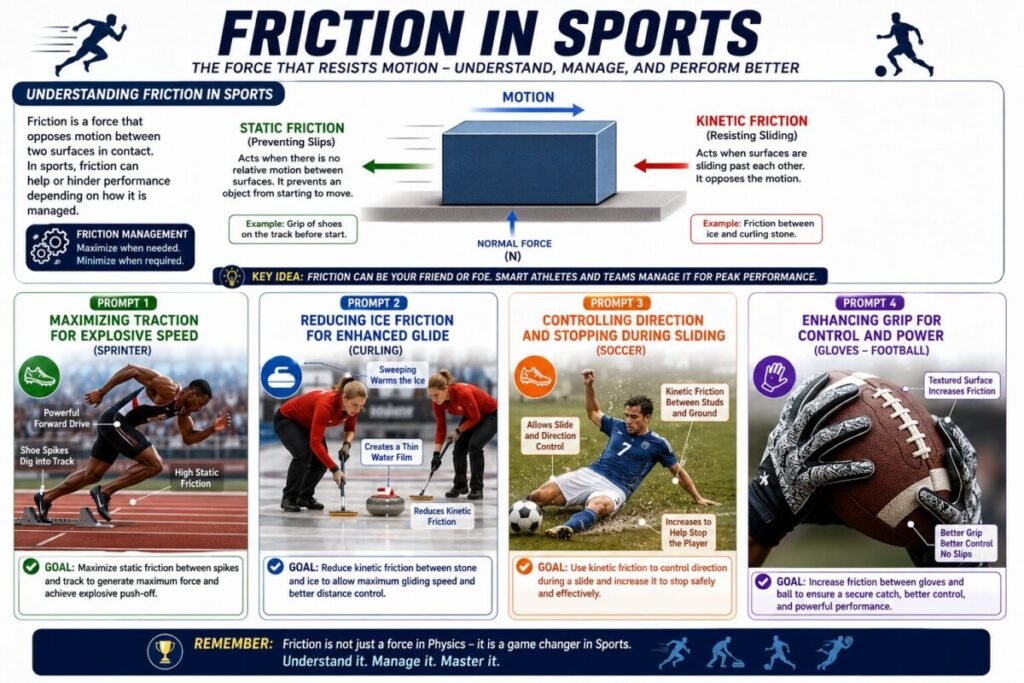
Friction is a fundamental mechanical force that actively resists the relative motion (or attempted motion) of two solid surfaces, fluid layers, or material elements sliding against each other. Whenever two surfaces come into contact, microscopic irregularities interlock, creating resistance. In the realm of sports, friction is highly paradoxical—it is both a major hindrance that athletes constantly try to eliminate, and an absolute necessity without which most sports would be physically impossible to play.
Types of Friction
- Static Friction: The friction that exists between a stationary object and the surface on which it rests. You must overcome static friction to initiate movement.
- Dynamic (Kinetic) Friction: The friction that acts between objects that are actively in motion against each other. It is further divided into:
- Sliding Friction: Created when two solid surfaces slide over each other (e.g., a hockey puck sliding across ice).
- Rolling Friction: Created when an object rolls over a surface (e.g., a football rolling on grass or a bicycle wheel on asphalt). Rolling friction is generally much weaker than sliding friction.
- Fluid Friction (Drag): The resistance faced by an object moving through a fluid, which includes both water and air.
Application and Role of Friction in Sports
In sports, biomechanists carefully manipulate friction depending on the specific requirements of the game. Athletes either seek to maximize friction for better grip and stability, or minimize friction for greater speed and efficiency.
- When High Friction is Advantageous (Maximizing Grip):
- Spiked Shoes: Sprinters, footballers, and golfers wear shoes with sharp spikes or cleats. These dig deep into the track or grass, dramatically increasing the static friction between the foot and the ground. This prevents slipping and allows the athlete to apply massive explosive force.
- Chalk in Gymnastics and Weightlifting: Athletes apply magnesium carbonate (gym chalk) to their hands to rapidly absorb slippery sweat. This massively increases sliding friction, allowing a gymnast to hold securely onto the uneven bars or a weightlifter to maintain a solid grip on a heavy barbell without it slipping out of their hands.
- When Low Friction is Advantageous (Minimizing Resistance):
- Ice Skating and Skiing: Ice skates feature incredibly thin, sharp metal blades that glide over the ice. The high pressure melts a microscopic layer of water, virtually eliminating sliding friction and allowing the skater to achieve incredible speeds with minimal physical effort.
- Cycling and Swimming: Cyclists wear skin-tight aerodynamic suits, shave their legs, and use specially designed aerodynamic helmets to radically reduce fluid friction (air resistance). Similarly, elite swimmers wear specialized tight swimsuits and silicone caps to reduce drag as they slice through the water.
Chapter Conclusion: Biomechanics and Sports
This chapter emphasizes the application of physics and mechanics to human movement in sports. Biomechanics helps in analyzing athletic techniques to enhance performance, design better sports equipment, and minimize the risk of injuries. By understanding fundamental principles such as Newton’s Laws of Motion (Inertia, Acceleration, and Action-Reaction), athletes can optimize their force production and efficiency. Furthermore, the chapter details the critical roles of Friction (both as an advantage and disadvantage) and the kinematic factors affecting a Projectile (angle, speed, and height of release), which are essential for sports like javelin throw, basketball, and long jump.
Frequently Asked Questions (FAQs)
Objective Type Questions (1 Mark)
Q1. Newton’s First Law of Motion is also known as the Law of: +
Ans. B) Inertia
Q2. The force that opposes the relative motion between two surfaces in contact is called: +
Ans. C) Friction
Q3. The path followed by a projectile in the air is known as its: +
Ans. A) Trajectory
Q4. Which type of friction offers the least resistance to motion? +
Ans. C) Rolling friction
Q5. For achieving the maximum horizontal distance, a projectile should ideally be released at an angle of: +
Ans. B) 45°
Very Short Answer Type Questions (2 Marks)
Q6. Define Biomechanics in the context of sports. +
Ans. Biomechanics is the study of the structure and function of biological systems (humans) using the methods of mechanics. In sports, it involves analyzing the internal and external forces acting on an athlete’s body and the effects produced by these forces to improve technique and prevent injuries.
Q7. What is a Projectile? Give two examples from sports. +
Ans. A projectile is any object or body thrown into the air (space) which moves under the sole influence of gravity and air resistance. Examples: A javelin thrown by an athlete, or a basketball shot toward the hoop.
Q8. State Newton’s Second Law of Motion. +
Ans. Newton’s Second Law of Motion (Law of Acceleration) states that the rate of change of momentum of an object is directly proportional to the force applied, and occurs in the direction in which the force is applied (F = ma).
Q9. Differentiate between Static and Dynamic Friction. +
Ans. Static Friction: It is the opposing force that comes into play when an object tends to move over the surface of another, but actual motion has not yet started. Dynamic (Kinetic) Friction: It is the opposing force that comes into play when an object is actually in motion over the surface of another.
Short Answer Type Questions (3 Marks)
Q10. Explain how Newton’s Third Law of Motion applies to swimming. +
Ans. Newton’s Third Law states that “for every action, there is an equal and opposite reaction.” In swimming, when a swimmer pushes the water backward with their hands and feet (Action), the water exerts an equal and opposite force, pushing the swimmer forward (Reaction). Without this reactive force, moving forward in the water would be impossible.
Q11. Briefly explain the two types of Dynamic Friction with examples from sports. +
Ans. Dynamic friction is of two main types:
- Sliding Friction: The resistance created when two objects slide over each other. Example: Skiing on snow or sliding to reach a base in baseball.
- Rolling Friction: The resistance created when one object rolls over another surface. It is weaker than sliding friction. Example: A football or hockey ball rolling on the ground.
Q12. What are the key factors affecting the trajectory of a projectile? +
Ans. The parabolic path (trajectory) of a projectile is primarily affected by three kinematic factors:
- Angle of Release: The optimal angle (usually around 45°) dictates whether the projectile achieves maximum height or maximum distance.
- Initial Velocity (Speed of Release): A higher initial velocity results in a longer horizontal range.
- Height of Release: If the release point is higher than the landing point (e.g., shot put), the optimal angle of release is slightly less than 45°.
Q13. Write down any three points highlighting the importance of Biomechanics in Physical Education and Sports. +
Ans. Importance of Biomechanics:
- Performance Enhancement: Helps coaches and athletes analyze and correct technical flaws, leading to highly efficient movements and better performance.
- Injury Prevention: Identifies dangerous or unnatural movements that put stress on joints and muscles, thus helping in modifying techniques to prevent injuries.
- Equipment Improvement: Aids in designing safer and highly specialized sports equipment (e.g., aerodynamic cycling helmets or specialized running spikes).
Long Answer Type Questions (5 Marks)
Q14. “Friction is a necessary evil in sports.” Justify this statement by explaining the advantages and disadvantages of friction with suitable examples. +
Ans. Friction is termed a “necessary evil” because, while it opposes motion (disadvantage), sports activities would be impossible without it (advantage).
Advantages of Friction (The Necessary aspect):
- Grip and Control: Spikes in athletic shoes increase friction, allowing sprinters to grip the track and accelerate without slipping.
- Holding Equipment: Gymnasts use chalk powder on their hands to increase friction, preventing them from slipping off the horizontal bar.
- Stopping Motion: Friction between the shoe sole and the ground allows a basketball player to stop or change direction suddenly.
Disadvantages of Friction (The Evil aspect):
- Reduces Speed: In sports like cycling, swimming, or skiing, fluid or sliding friction acts as resistance, slowing the athlete down.
- Wear and Tear: Excessive friction causes wear and tear on sports equipment (e.g., cycle tires or tennis rackets) and can cause skin abrasions or blisters to the athlete.
Q15. State all three of Newton’s Laws of Motion. Explain their specific applications in different sports. +
Ans. Sir Isaac Newton formulated three laws that govern how objects move in sports:
- Law of Inertia (First Law): A body at rest remains at rest, and a body in motion continues in motion with the same speed and in the same direction unless acted upon by an external force.
Application: A sprinter stays in the starting blocks (inertia of rest) until they apply muscular force to push off against the blocks to start running. - Law of Acceleration (Second Law): The acceleration of an object depends on the mass of the object and the amount of force applied (F=ma).
Application: In shot put, an athlete must apply a massive amount of explosive force to accelerate the heavy iron ball. The stronger the force applied, the further the shot will go. - Law of Action and Reaction (Third Law): For every action, there is an equal and opposite reaction.
Application: In a high jump, the athlete forcefully pushes down against the ground (Action). The ground exerts an equal and opposite force upward (Reaction), lifting the jumper into the air over the bar.
Q16. Define Projectile. Elaborate in detail on the kinematic factors that determine the flight of a projectile in sports. +
Ans. Projectile: An object thrown into the air with an initial velocity, moving under the influence of gravity and air resistance, is called a projectile (e.g., a football pass or a long jumper).
Kinematic Factors Affecting a Projectile:
- Angle of Projection: The angle at which the object is released determines its trajectory. An angle of 45° generally yields the maximum horizontal distance (range) if the take-off and landing are at the same level. If the angle is too steep (e.g., 60°), it goes higher but covers less distance.
- Velocity of Release (Speed): This is the most crucial factor for maximizing range. The harder/faster the object is thrown (like a javelin), the further it will travel, assuming the angle is optimal.
- Height of Release: If an object is released from a point higher than its landing zone (like a tall basketball player shooting a jump shot or a shot putter), it stays in the air longer. In such cases, the optimum angle for maximum distance is slightly less than 45°.
- Gravity and Air Resistance: Gravity constantly pulls the projectile downward, shaping its parabolic curve. Air resistance (aerodynamics) acts in the opposite direction of the motion, slowing the projectile down (highly relevant in discus or golf).
Q17. Analyze the role of Biomechanics in preventing injuries and improving sports equipment. +
Ans. Role of Biomechanics in Injury Prevention:
- Faulty Technique Identification: Biomechanical analysis (using slow-motion cameras and software) can identify if an athlete is landing incorrectly or throwing with poor form. Correcting this reduces immense stress on ligaments and joints (e.g., fixing a bowler’s action to prevent back injuries).
- Force Analysis: It calculates the impact forces absorbed by the body during activities like jumping or tackling, allowing coaches to modify training loads to prevent stress fractures and overuse injuries.
Role of Biomechanics in Equipment Improvement:
- Footwear Design: Running shoes are engineered using biomechanics to absorb shock (cushioning) and correct pronation or supination, preventing ankle and knee injuries.
- Aerodynamics: In sports like cycling and speed skating, biomechanics helps design aerodynamic helmets, suits, and bikes to drastically reduce fluid friction (air resistance) and increase speed.
- Protective Gear: The design of lighter yet stronger helmets, shin guards, and padding in contact sports relies on biomechanical principles to disperse impact force safely away from the athlete’s body.