Chapter 4: Physical Education and Sports for CWSN
Topic 1: Meaning and Concept of Disability and Disorder
A. What is Disability?
Disability is defined as a physical, mental, cognitive, or sensory condition that long-term or permanently limits a person’s ability to perform routine daily activities, communicate, or interact effectively with their surrounding environment. It can be present congenitally (from birth) or acquired later in life due to accidents, trauma, or illnesses.
B. What is a Disorder?
A disorder refers to a functional abnormality, disruption, or impairment in the normal psychological, behavioral, or physical functioning of an individual. Unlike a permanent disability, a disorder is often manageable or temporary with appropriate medical treatment, therapy, and behavioral interventions.
- Examples:
- ADHD (Attention Deficit Hyperactivity Disorder): A behavioral disorder characterized by difficulty maintaining focus, hyperactivity, and impulsive behavior.
- ASD (Autism Spectrum Disorder): A developmental condition that impacts social interaction, communication, and behavioral patterns.
Topic 2: Types of Disabilities, Classification, Divisioning, and Major International Sports Organizations
Part A: Types of Disabilities: Causes and Nature
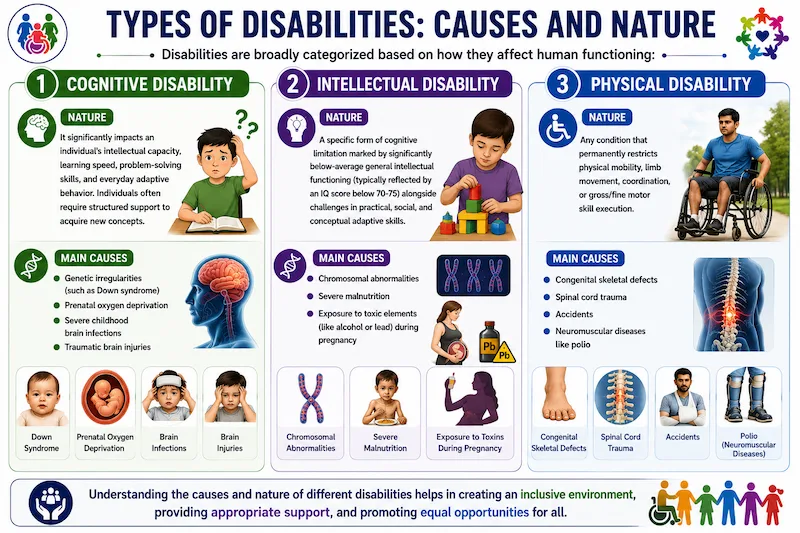
Disabilities are broadly categorized based on how they affect human functioning:
- 1. Cognitive Disability
- Nature: It significantly impacts an individual’s intellectual capacity, learning speed, problem-solving skills, and everyday adaptive behavior. Individuals often require structured support to acquire new concepts.
- Main Causes: Genetic irregularities (such as Down syndrome), prenatal oxygen deprivation, severe childhood brain infections, or traumatic brain injuries.
- 2. Intellectual Disability
- Nature: A specific form of cognitive limitation marked by significantly below-average general intellectual functioning (typically reflected by an IQ score below 70-75) alongside challenges in practical, social, and conceptual adaptive skills.
- Main Causes: Chromosomal abnormalities, severe malnutrition, or exposure to toxic elements (like alcohol or lead) during pregnancy.
- 3. Physical Disability
- Nature: Any condition that permanently restricts physical mobility, limb movement, coordination, or gross/fine motor skill execution.
- Main Causes: Congenital skeletal defects, spinal cord trauma, accidents, or neuromuscular diseases like polio.
Part B: Concept of Classification and Divisioning in Sports
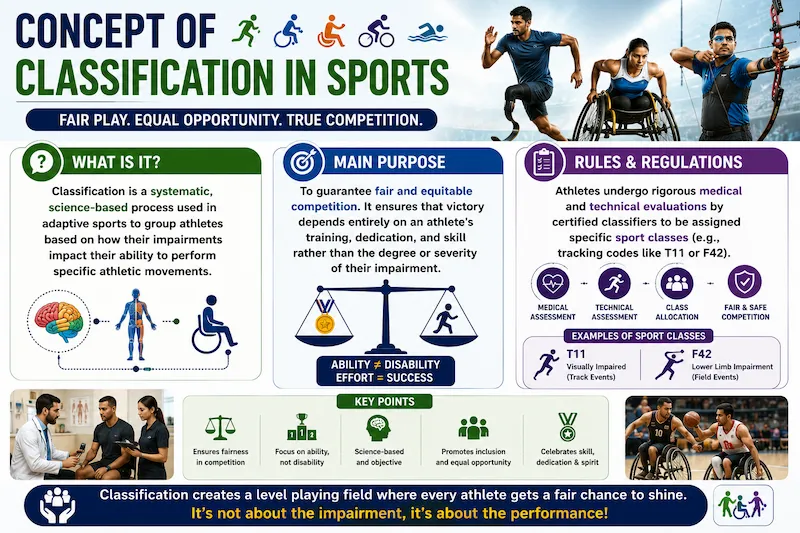
- 1. Concept of Classification in Sports:
- What is it? Classification is a systematic, science-based process used in adaptive sports to group athletes based on how their impairments impact their ability to perform specific athletic movements.Main Purpose: To guarantee fair and equitable competition. It ensures that victory depends entirely on an athlete’s training, dedication, and skill rather than the degree or severity of their impairment.Rules & Regulations: Athletes undergo rigorous medical and technical evaluations by certified classifiers to be assigned specific sport classes (e.g., tracking codes like T11 or F42).
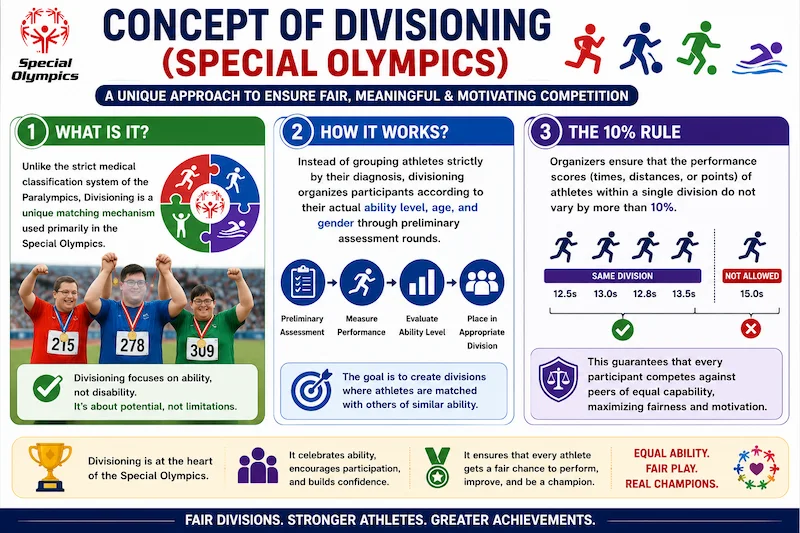
- 2. Concept of Divisioning (Special Olympics):
- What is it? Unlike the strict medical classification system of the Paralympics, Divisioning is a unique matching mechanism used primarily in the Special Olympics.How it Works: Instead of grouping athletes strictly by their diagnosis, divisioning organizes participants according to their actual ability level, age, and gender through preliminary assessment rounds.The 10% Rule: Organizers ensure that the performance scores (times, distances, or points) of athletes within a single division do not vary by more than 10%. This guarantees that every participant competes against peers of equal capability, maximizing fairness and motivation.
Part C: Major International Sports Organizations for CWSN
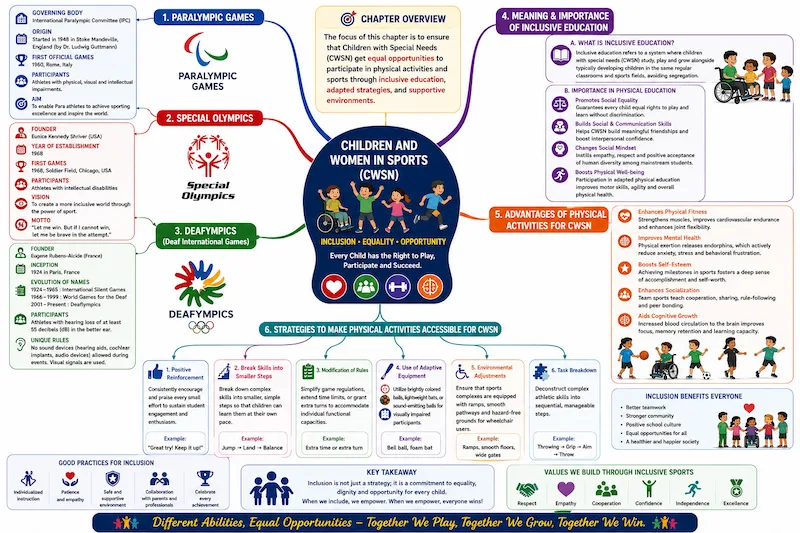
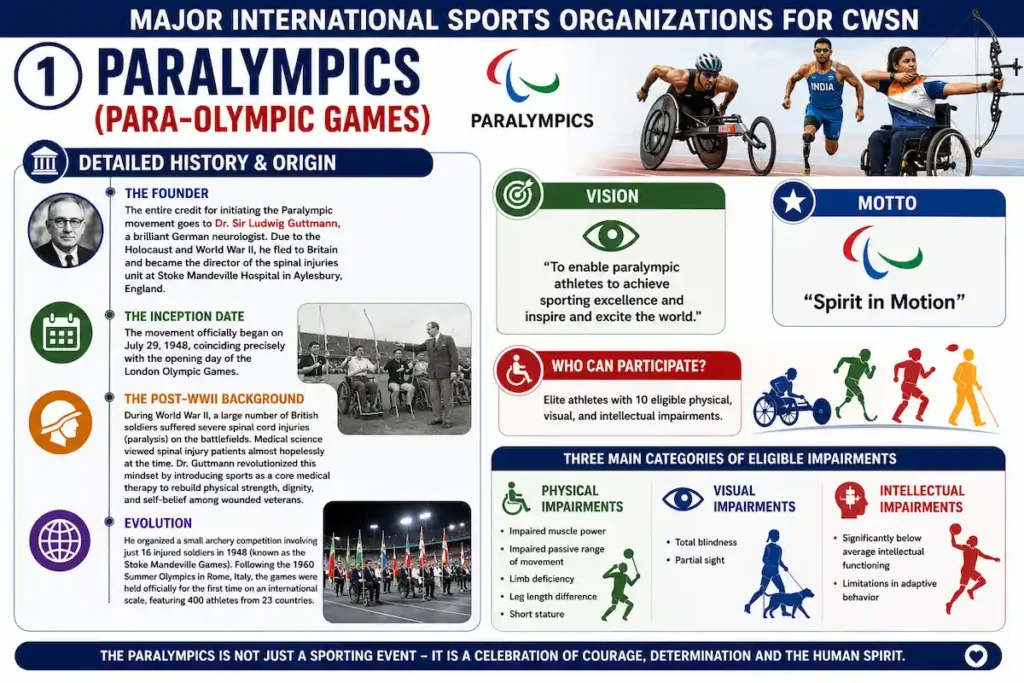
1. Paralympics (Para-Olympic Games)
- Detailed History & Origin:
- The Founder: The entire credit for initiating the Paralympic movement goes to Dr. Sir Ludwig Guttmann, a brilliant German neurologist. Due to the Holocaust and World War II, he fled to Britain and became the director of the spinal injuries unit at Stoke Mandeville Hospital in Aylesbury, England.
- The Inception Date: The movement officially began on July 29, 1948, coinciding precisely with the opening day of the London Olympic Games.
- The Post-WWII Background: During World War II, a large number of British soldiers suffered severe spinal cord injuries (paralysis) on the battlefields. Medical science viewed spinal injury patients almost hopelessly at the time. Dr. Guttmann revolutionized this mindset by introducing sports as a core medical therapy to rebuild physical strength, dignity, and self-belief among wounded veterans.
- Evolution: He organized a small archery competition involving just 16 injured soldiers in 1948 (known as the Stoke Mandeville Games). Following the 1960 Summer Olympics in Rome, Italy, the games were held officially for the first time on an international scale, featuring 400 athletes from 23 countries.
- Vision and Motto:
- Vision: “To enable paralympic athletes to achieve sporting excellence and inspire and excite the world.”
- Motto: “Spirit in Motion”
- Who Can Participate? Elite athletes with 10 eligible physical, visual, and intellectual impairments.
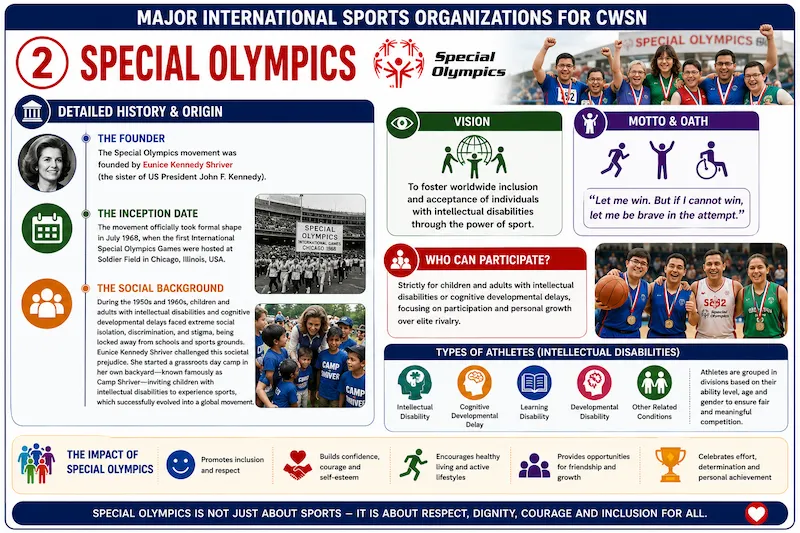
2. Special Olympics
- Detailed History & Origin:
- The Founder: The Special Olympics movement was founded by Eunice Kennedy Shriver (the sister of US President John F. Kennedy).
- The Inception Date: The movement officially took formal shape in July 1968, when the first International Special Olympics Games were hosted at Soldier Field in Chicago, Illinois, USA.
- The Social Background: During the 1950s and 1960s, children and adults with intellectual disabilities and cognitive developmental delays faced extreme social isolation, discrimination, and stigma, being locked away from schools and sports grounds. Eunice Kennedy Shriver challenged this societal prejudice. She started a grassroots day camp in her own backyard—known famously as Camp Shriver—inviting children with intellectual disabilities to experience sports, which successfully evolved into a global movement.
- Vision, Motto, and Oath:
- Vision: To foster worldwide inclusion and acceptance of individuals with intellectual disabilities through the power of sport.
- Motto & Oath: “Let me win. But if I cannot win, let me be brave in the attempt.”
- Who Can Participate? Strictly for children and adults with intellectual disabilities or cognitive developmental delays, focusing on participation and personal growth over elite rivalry.
3. Deaflympics (Deaf International Games)
- Detailed History & Origin:
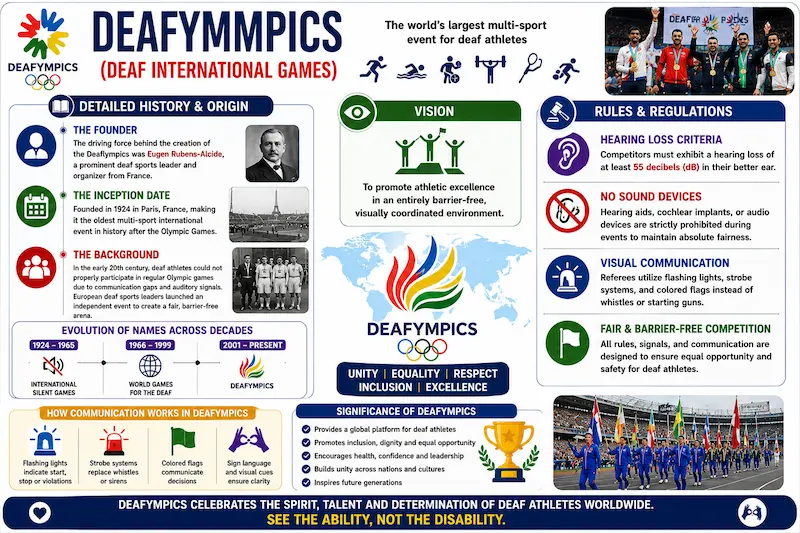
- The Founder: The driving force behind the creation of the Deaflympics was Eugen Rubens-Alcide, a prominent deaf sports leader and organizer from France.
- The Inception Date: Founded in 1924 in Paris, France, making it the oldest multi-sport international event in history after the Olympic Games.
- The Background & Evolution of Names: In the early 20th century, deaf athletes could not properly participate in regular Olympic games due to communication gaps and auditory signals. European deaf sports leaders launched an independent event to create a fair, barrier-free arena.
- Name Changes Across Decades: 1924 to 1965 as “International Silent Games”; 1966 to 1999 as “World Games for the Deaf”; and from 2001 to Present officially renamed as “Deaflympics”.
- Vision and Rules & Regulations:
- Vision: To promote athletic excellence in an entirely barrier-free, visually coordinated environment.
- Hearing Loss Criteria: Competitors must exhibit a hearing loss of at least 55 decibels (dB) in their better ear.
- No Sound Devices: Hearing aids, cochlear implants, or audio devices are strictly prohibited during events to maintain absolute fairness.
- Visual Communication: Referees utilize flashing lights, strobe systems, and colored flags instead of whistles or starting guns.
Topic 3: Meaning and Importance of Inclusive Education
A. What is Inclusive Education?
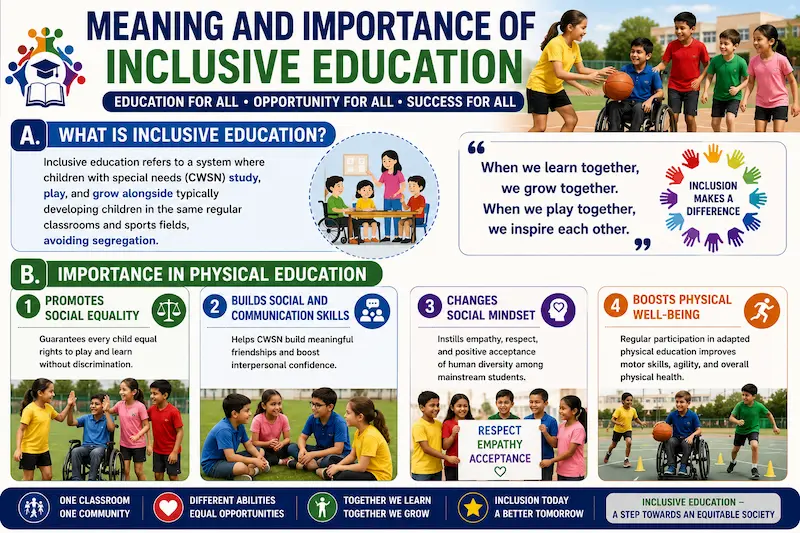
Inclusive education refers to a system where children with special needs (CWSN) study, play, and grow alongside typically developing children in the same regular classrooms and sports fields, avoiding segregation.
B. Importance in Physical Education
- Promotes Social Equality: Guarantees every child equal rights to play and learn without discrimination.
- Builds Social and Communication Skills: Helps CWSN build meaningful friendships and boost interpersonal confidence.
- Changes Social Mindset: Instills empathy, respect, and positive acceptance of human diversity among mainstream students.
- Boosts Physical Well-being: Regular participation in adapted physical education improves motor skills, agility, and overall physical health.
Topic 4: Advantages of Physical Activities for Children with Special Needs
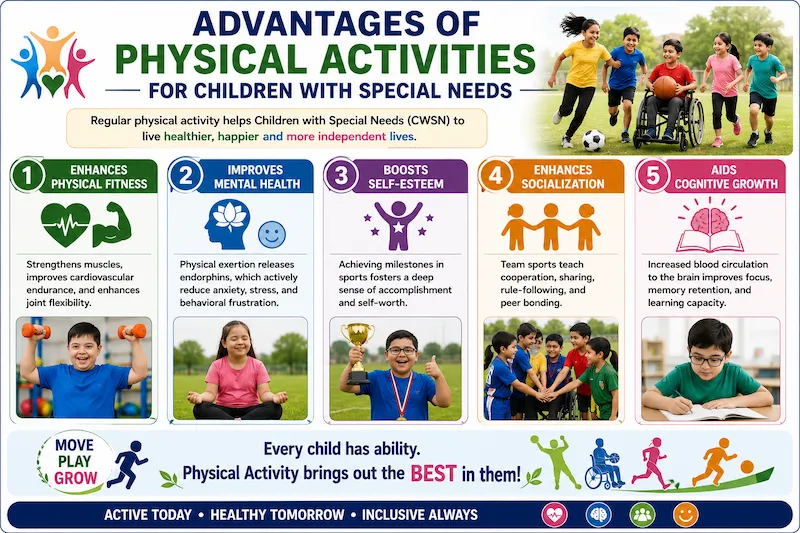
- Enhances Physical Fitness: Strengthens muscles, improves cardiovascular endurance, and enhances joint flexibility.
- Improves Mental Health: Physical exertion releases endorphins, which actively reduce anxiety, stress, and behavioral frustration.
- Boosts Self-Esteem: Achieving milestones in sports fosters a deep sense of accomplishment and self-worth.
- Enhances Socialization: Team sports teach cooperation, sharing, rule-following, and peer bonding.
- Aids Cognitive Growth: Increased blood circulation to the brain improves focus, memory retention, and learning capacity.
Topic 5: Strategies to Make Physical Activities Accessible for CWSN
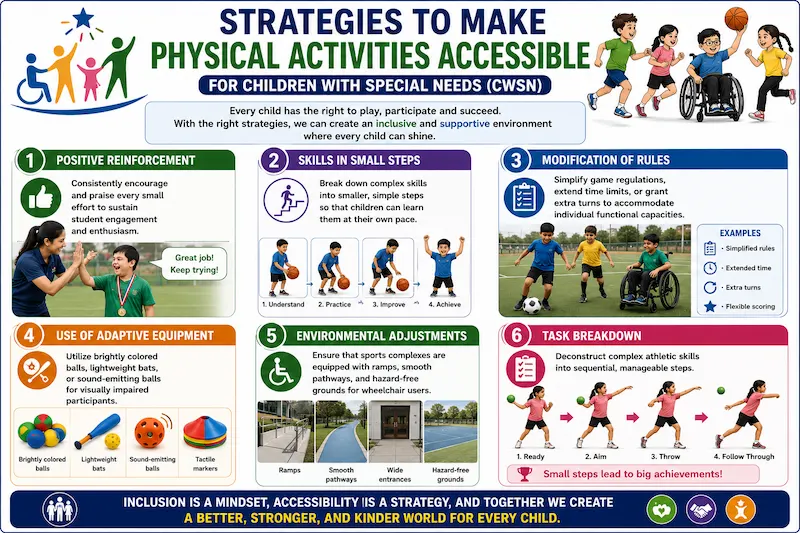
Positive Reinforcement: Consistently encourage and praise every small effort to sustain student engagement and enthusiasm.ills into smaller, simple steps so that children can learn them at their own pace.
Modification of Rules: Simplify game regulations, extend time limits, or grant extra turns to accommodate individual functional capacities.
Use of Adaptive Equipment: Utilize brightly colored balls, lightweight bats, or sound-emitting balls for visually impaired participants.
Environmental Adjustments: Ensure that sports complexes are equipped with ramps, smooth pathways, and hazard-free grounds for wheelchair users.
Task Breakdown: Deconstruct complex athletic skills into sequential, manageable steps.
Chapter Conclusion: Physical Education and Sports for CWSN
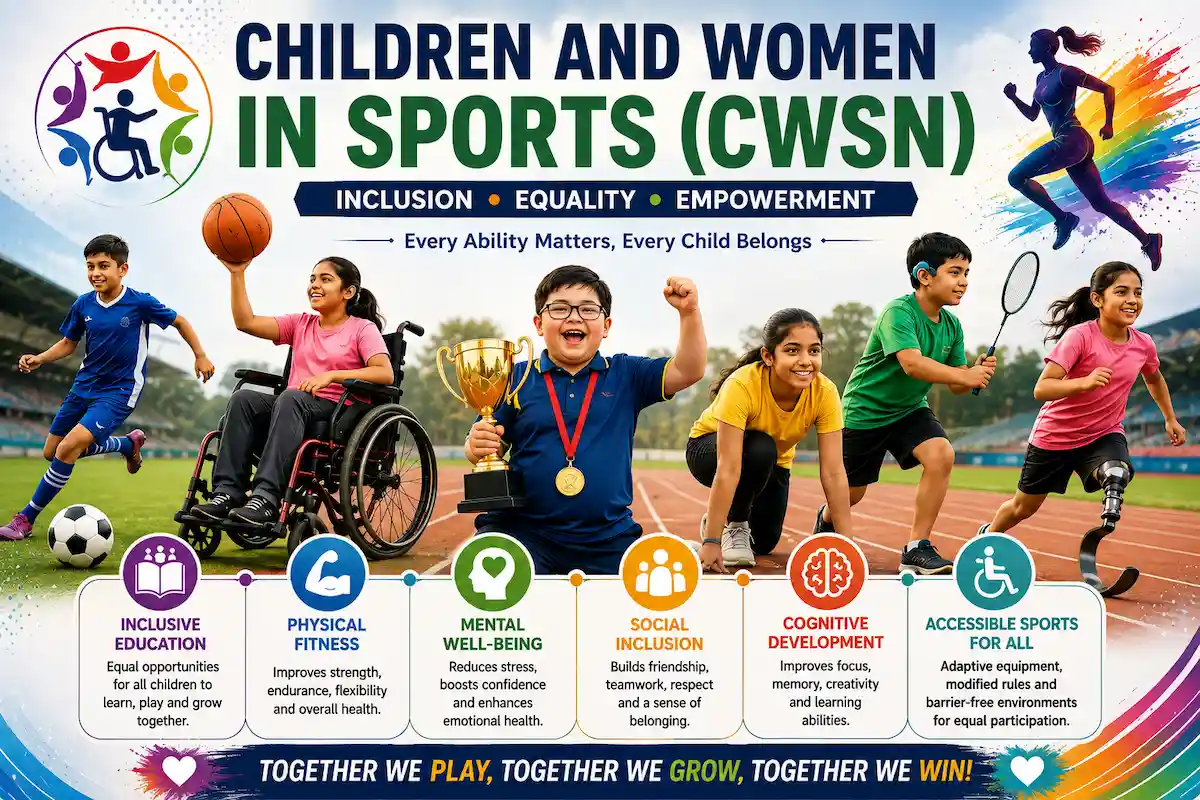
This chapter advocates for equal sporting opportunities for Children With Special Needs (CWSN). It focuses on the concept of Inclusion, ensuring that students with disabilities learn and play alongside their mainstream peers in a supportive environment. The chapter details the history, motto, and objectives of organizations that promote adaptive sports, such as the Special Olympics (for intellectual disabilities), Paralympics (for physical and intellectual disabilities), and Deaflympics (for the hearing impaired). Crucially, it highlights the strategies to make physical activities accessible and the indispensable roles of professionals like Physiotherapists, Occupational Therapists, and Special Educators in enhancing the motor skills and confidence of Divyang children.
Frequently Asked Questions (FAQs)
Objective Type Questions (1 Mark)
Q1. Who was the founder of the Special Olympics? +
Ans. B) Eunice Kennedy Shriver
Q2. The motto of the Deaflympics is: +
Ans. C) Per Ludos Aequalitas (Equality through sports)
Q3. Which professional helps Children With Special Needs (CWSN) in improving their fine motor skills and performing daily life activities? +
Ans. C) Occupational Therapist
Q4. The Paralympic Games are primarily organized for athletes with: +
Ans. B) Physical and Intellectual Disabilities
Q5. What does the term ‘Inclusion’ mean in physical education? +
Ans. B) Educating and playing with CWSN in regular, mainstream classes
Very Short Answer Type Questions (2 Marks)
Q6. Define the concept of Inclusion. +
Ans. Inclusion is an educational approach where students with special needs (CWSN) spend most or all of their time learning and participating in activities with non-disabled, mainstream students. It promotes equality, acceptance, and a barrier-free environment for everyone.
Q7. What is the motto of the Paralympic Games and what does its symbol represent? +
Ans. The motto of the Paralympic Games is “Spirit in Motion”. The symbol consists of three “Agitos” (Latin for “I move”) in red, blue, and green, encircling a central point. It represents athletes bringing people together from all corners of the world to compete.
Q8. State the main role of a Speech Therapist for CWSN. +
Ans. A Speech Therapist works with children who have difficulties with communication, articulation, or swallowing. They use specialized exercises to help children express themselves clearly, improving their social interactions and confidence.
Q9. Write the oath of the Special Olympics. +
Ans. The athlete’s oath for the Special Olympics is: “Let me win. But if I cannot win, let me be brave in the attempt.”
Short Answer Type Questions (3 Marks)
Q10. Explain any three advantages of physical activities for Children With Special Needs. +
Ans. Advantages of physical activities for CWSN include:
- Physical Fitness: Regular participation improves cardiovascular health, bone density, muscle strength, and motor coordination.
- Mental and Emotional Well-being: Sports act as a stress reliever, significantly reducing anxiety and depression while boosting self-esteem and confidence.
- Social Inclusion: Team sports allow CWSN to interact, make friends, and develop social skills, reducing feelings of isolation.
Q11. What is the role of a Special Education Counsellor? +
Ans. A Special Education Counsellor plays a vital role by:
- Assessing the psychological and emotional needs of the child.
- Providing emotional support and guidance to help the child overcome feelings of frustration or inferiority.
- Working closely with parents and teachers to develop Individualized Education Programs (IEPs) tailored to the child’s specific behavioral and academic needs.
Q12. Write a short note on Deaflympics. +
Ans. The Deaflympics (formerly known as the World Games for the Deaf) is an International Olympic Committee (IOC) sanctioned event at which deaf athletes compete at an elite level. Unlike other IOC-sanctioned events, athletes cannot be guided by sounds (e.g., starter’s guns or referee whistles). Instead, visual cues like flags or flashing lights are used. A participant must have a hearing loss of at least 55 decibels in their better ear.
Q13. Differentiate between Paralympics and Special Olympics. +
Ans.
- Target Group: Paralympics is primarily for elite athletes with physical disabilities (amputations, spinal cord injuries, blindness), though it includes some intellectual disabilities. Special Olympics is exclusively for children and adults with intellectual disabilities.
- Competition Level: Paralympics is highly competitive and elite. Special Olympics focuses on participation, personal bests, and giving everyone a chance to compete regardless of their skill level.
- Founder: Paralympics was founded by Sir Ludwig Guttmann. Special Olympics was founded by Eunice Kennedy Shriver.
Long Answer Type Questions (5 Marks)
Q14. Discuss the concept of Inclusion. Why is there a need for Inclusion in physical education? +
Ans. Concept of Inclusion: Inclusion is the philosophy that all children, regardless of their physical, intellectual, or emotional disabilities, should learn, play, and grow together in the same mainstream educational environment. It removes discrimination and physical barriers.
Need for Inclusion in Physical Education:
- Builds Self-Esteem: When CWSN play alongside non-disabled peers, they feel valued, which drastically improves their self-worth and confidence.
- Promotes Empathy and Understanding: Mainstream students learn to be compassionate, tolerant, and helpful. It breaks down prejudices and normalizes disabilities.
- Equal Opportunities: It ensures that the basic human right to education and physical development is provided to everyone without segregation.
- Better Motor Development: Observing and playing with mainstream peers often encourages CWSN to push their limits, leading to faster development of gross and fine motor skills.
- Socialization: It creates a sense of belonging and community, preparing both disabled and non-disabled students for a real-world, inclusive society.
Q15. Detail the role of various professionals (Physiotherapist, Occupational Therapist, Physical Education Teacher) for CWSN. +
Ans. The rehabilitation and integration of CWSN require a team of dedicated professionals:
- Physiotherapist: Focuses on gross motor skills. They use exercises, massages, and mobility therapies to improve the child’s muscular strength, balance, posture, and coordination. They help children who have difficulty walking or moving.
- Occupational Therapist: Focuses on fine motor skills and activities of daily living (ADL). They help the child learn how to perform essential tasks like eating, dressing, writing, and using tools, making them as independent as possible.
- Physical Education Teacher (PET): Adapts sports and physical activities to suit the abilities of CWSN. They modify rules, equipment, and playing spaces to ensure safe and meaningful participation, fostering teamwork and physical fitness.
- Special Educator: A teacher trained to work with children who have learning disabilities. They adapt the academic curriculum and use specialized teaching materials to suit the child’s learning pace.
Q16. What are the various strategies to make physical activities accessible for Children with Special Needs? Explain in detail. +
Ans. To ensure that CWSN can participate fully and safely in physical activities, several strategies must be implemented:
- Medical Check-up: Before starting any activity, a thorough medical evaluation is necessary to understand the child’s specific disability, capabilities, and limitations.
- Modified Equipment: Standard sports equipment should be adapted. For example, using lighter bats, larger and softer balls, auditory balls (with bells inside) for the visually impaired, or velcro catch-mitts.
- Modified Rules: Rules of the game should be simplified. For instance, allowing extra bounces in tennis, reducing the distance of a race, or giving extra time to complete a task.
- Barrier-Free Environment: The playing area must be safe and accessible. This includes wheelchair ramps, smooth surfaces without obstacles, proper lighting, and visual/auditory cues.
- Specific Environment and Positive Behavior: The environment should be highly encouraging. Coaches and peers must show patience, use positive reinforcement, and avoid criticism to build the child’s confidence.
- Use of Multi-Sensory Approaches: Instructions should not just be verbal. Coaches should use demonstrations (visual), touch (tactile), and sound (auditory) to explain the activity effectively.
Q17. Elaborate on the organizational structure, history, and objectives of Special Olympics Bharat. +
Ans. History: Special Olympics Bharat (SOB) is the officially recognized program of Special Olympics International in India. It was founded in 1987 as Special Olympics India and was renamed Special Olympics Bharat in 2001. It is recognized by the Government of India as a National Sports Federation.
Organizational Structure: SOB operates across all states and union territories in India. It mobilizes a vast network of volunteers, coaches, and families to organize local, district, state, and national level games for individuals with intellectual disabilities.
Key Objectives:
- To provide year-round sports training and athletic competition in various Olympic-type sports for children and adults with intellectual disabilities.
- To focus on holistic development by improving their physical fitness, motor skills, and overall health.
- To integrate them into society by providing a platform where they can demonstrate courage, experience joy, and share their skills with the community.
- To train coaches and physical education teachers in adaptive sports techniques.
- To change public attitudes towards people with intellectual disabilities, fostering a more inclusive society.