1. Introduction: The Physics of Athletic Performance
When a gymnast lands a backflip with pinpoint accuracy, a cricket fast bowler delivers a $150\text{ km/h}$ yorker, or an Olympic weightlifter cleans $200\text{ kg}$ off the platform, they are doing more than displaying raw physical exertion—they are actively executing the laws of classical Newtonian physics.
Sports Biomechanics is the quantitative and qualitative scientific discipline dedicated to the study of human movement, examining both the internal forces generated by skeletal muscle contractions and the external forces (such as gravity, friction, and ground reaction forces) acting upon the biological frame
For physical education practitioners, elite strength coaches, and sports scientists, biomechanics delivers the precise structural blueprint for movement efficiency. By evaluating joint lever mechanics, angular torque generation, vector force orientation, and centre of gravity ($CoG$) manipulation, sports scientists can systematically:
Optimise Mechanical Efficiency: Maximize muscular force output while minimizing wasted kinetic energy.
Refine Technical Execution: Identify energy leaks in kinetic chains to enhance athletic performance.
Mitigate Injury Risk: Distribute mechanical stress safely across joint structures to avoid tissue failure.
👉 Pro Tip (Strength & Conditioning): Learn how force production and dynamic movement mechanics are trained under heavy loads in ourStrength & Conditioning Guide.
👉 Pro Tip (Anatomy & Kinesiology): Integrate biomechanical lever systems directly with muscle insertion sites and joint articulation planes in ourAnatomy & Kinesiology Guide.
2. Planes & Axes: The 3D Map of Human Movement
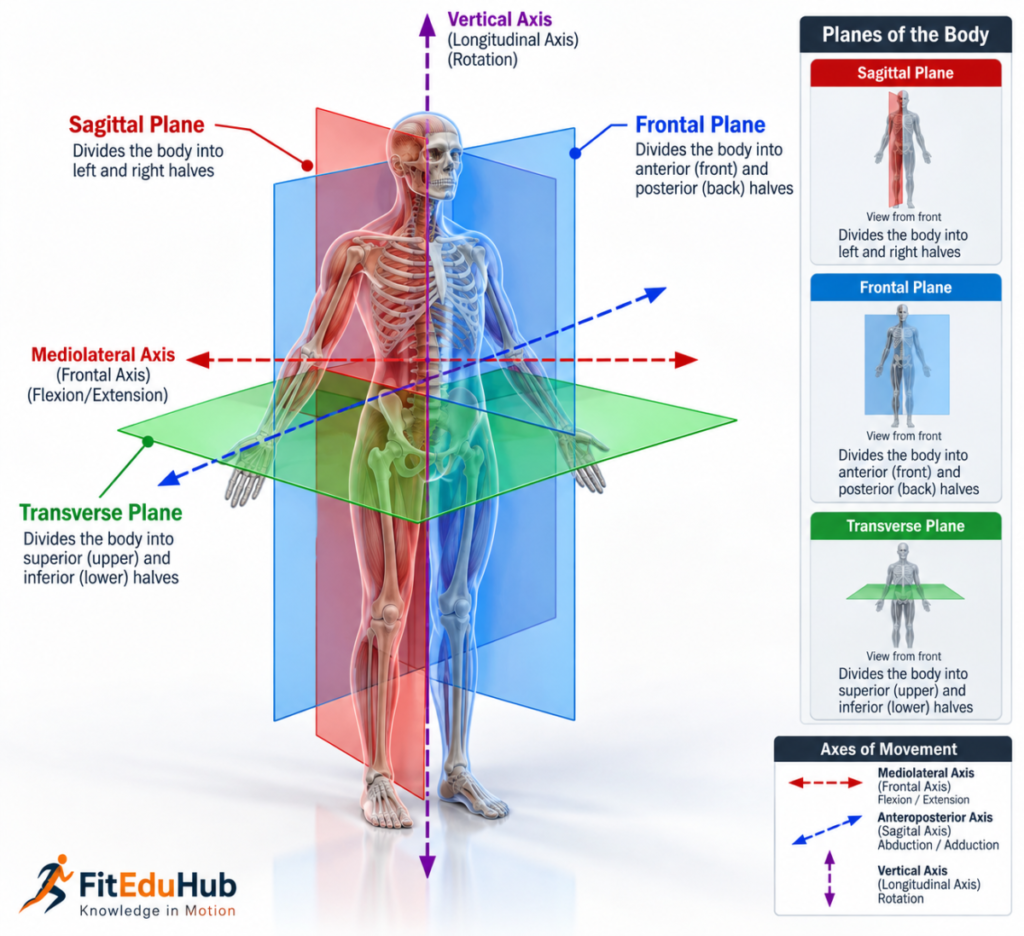
To scientifically analyze human movement, sports scientists use an imaginary $3\text{D}$ mapping system consisting of planes (flat, two-dimensional surfaces dividing the body) and axes (imaginary lines around which angular rotation occurs). Every athletic movement, no matter how complex, takes place within these spatial dimensions.
The Three Anatomical Planes
1. Sagittal Plane
This vertical plane passes longitudinally through the body, dividing it into left and right halves. Movements occurring within the sagittal plane involve forward and backward motions (flexion and extension).
Practical Scientific Example: Sprinting, cycling, performing a bicep curl, or kicking a football.
2. Frontal (Coronal) Plane
This vertical plane divides the body into anterior (front) and posterior (back) halves. Movements within this plane occur in a side-to-side or lateral direction (abduction and adduction).
Practical Scientific Example: Performing jumping jacks, lateral dumbbell shoulder raises, or a basketball defender side-stepping laterally.
3. Transverse (Horizontal) Plane
This horizontal plane divides the body into superior (upper) and inferior (lower) halves. Movements within the transverse plane primarily involve rotational mechanics (internal and external rotation, horizontal abduction/adduction).
Practical Scientific Example: Executing a golf swing, throwing a discus, or rotating the torso to deliver a hook punch in boxing.
The Corresponding Axes of Rotation
Movement in any anatomical plane always occurs around an axis running perpendicular ($90^\circ$) to that specific plane.
Frontal Axis: Runs horizontally from side to side (perpendicular to the Sagittal Plane).
Biomechanical Analogy: A gymnast performing a forward somersault around a high bar.
Sagittal Axis: Runs horizontally from front to back (perpendicular to the Frontal Plane).
Biomechanical Analogy: A gymnast executing a lateral cartwheel.
Vertical (Longitudinal) Axis: Runs vertically from top to bottom (perpendicular to the Transverse Plane).
Biomechanical Analogy: A figure skater executing a rapid upright spin.
Summary of Anatomical Planes and Axes
Anatomical Plane
Spatial Orientation
Primary Movement Types
Perpendicular Axis of Rotation
Sagittal
Divides Left & Right
Flexion / Extension
Frontal Axis
Frontal (Coronal)
Divides Front & Back
Abduction / Adduction
Sagittal Axis
Transverse
Divides Top & Bottom
Rotation / Horizontal Flexion
Vertical (Longitudinal) Axis
👉 Pro Tip (Anatomy & Kinesiology): Explore the specific skeletal articulations and muscular origins/insertions that facilitate multi-planar joint movement in our completeAnatomy & Kinesiology Guide.
Body planes and axes of movement: sagittal, frontal, and transverse planes illustrated with a 3D anatomical figure.
3. Force & Torque: The Engines of Action
In biomechanics, linear displacement requires force, and angular motion requires torque. Understanding how to manipulate these kinetic parameters is the foundation of optimizing human athletic power.
Understanding Force in Human Kinetics
Force ($\mathbf{F}$) is defined as a push or pull that alters or tends to alter the state of rest or uniform motion of a body. Measured in Newtons ($N$), force is a vector quantity possessing both magnitude and direction:
$$\mathbf{F} = m \cdot \mathbf{a}$$
Where:
$m$ = Mass ($\text{kg}$)
$\mathbf{a}$ = Acceleration ($\text{m/s}^2$)
Biomechanical forces fall into two primary classifications:
Internal Forces: Forces generated within the biological frame through skeletal muscle contractions pulling on bony insertion points via tendinous structures.
External Forces: Environmental loads acting upon the athlete’s body, including gravity, air resistance (aerodynamic drag), ground friction, fluid resistance, or contact forces applied by opponents.
Practical Scientific Example
When a sprinter drives explosively out of the starting blocks, their lower-limb musculature generates massive internal force. This force transfers through the feet into the block face, causing the blocks to exert an equal and opposite Ground Reaction Force ($GRF$) against the foot plate (Newton’s Third Law), accelerating the athlete down the track.
Torque: Rotational Force Generation
While force induces linear acceleration, torque ($\mathbf{T}$) is the quantitative measure of rotational force causing angular acceleration around an axis. Because human joint articulations act as hinges or pivots, virtually all voluntary skeletal movements are inherently rotational.
$d_\perp$ (Moment Arm) = The perpendicular distance from the joint line of rotation to the line of force action ($\text{m}$)
Plaintext
       Axis of Rotation (Joint)
               │
               ├─── Moment Arm (d⊥) ───►| Line of Force Action (F)
               │                        │
               ▼                        ▼
Extending the moment arm multiplies the magnitude of generated torque without requiring an increase in raw muscular force output. This explains why athletes with longer structural limb lengths (such as tall tennis servers or volleyball hitters) can leverage long moment arms to generate elite angular velocity at the distal endpoint.
👉 Pro Tip (Strength & Conditioning): Discover how biological lever lengths, moment arms, and joint torque dictate maximal force expression under heavy axial loading in ourStrength & Conditioning Guide.
4. Levers: The Body’s Mechanical Advantage
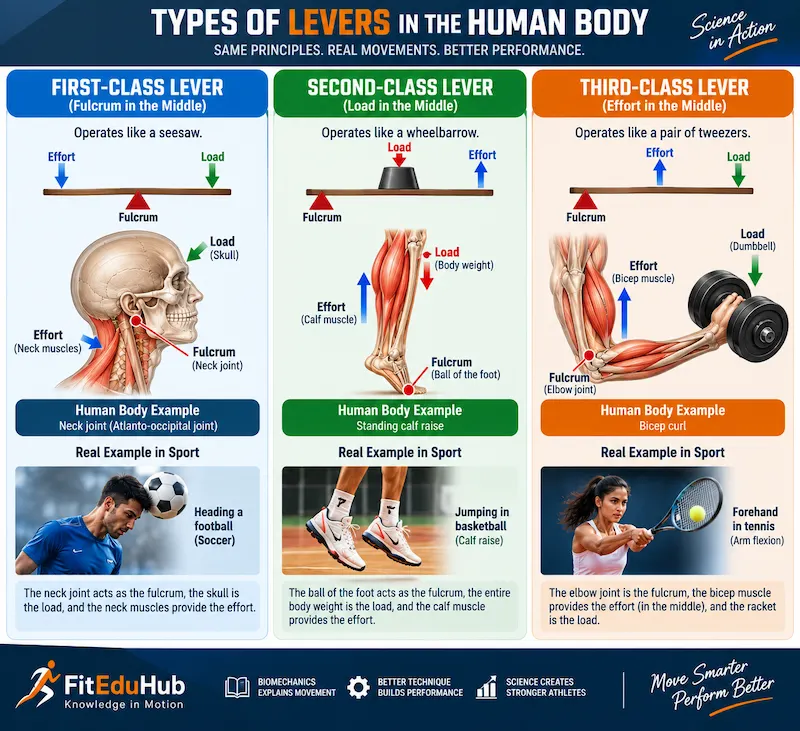
The human musculoskeletal system functions as an interconnected system of biological levers. A lever system consists of four fundamental components:
Rigid Bar: The bone moving around an axis.
Fulcrum ($F$): The articulation or joint axis of rotation.
Effort ($E$): The internal force produced by muscular contraction.
Load / Resistance ($R$): The external mass or weight being moved.
The Three Classes of Anatomical Levers
Understanding the classification of anatomical levers dictates whether a movement pattern provides a force advantage (lifting heavy loads easily) or a speed/range-of-motion advantage (moving light loads rapidly).
Configuration: The fulcrum lies directly between the effort force and the resistance load ($E – F – R$).
Function: Provides balance, direction reversal, and variable mechanical advantage depending on relative arm lengths.
Anatomical Example: The atlanto-occipital joint in the neck. The cranium acts as the load, the atlanto-occipital articulation forms the fulcrum, and the posterior neck extensors (trapezius/splenius capitis) supply the effort force to hold the head upright.
Second-Class Levers (Load in the Middle)
Configuration: The resistance load lies between the fulcrum and the effort force ($F – R – E$).
Function: Operates with a permanent mechanical advantage greater than 1 ($\text{MA} > 1$). A relatively small muscular effort can move a substantial external load, sacrificing velocity and range of motion for force amplification.
Anatomical Example: Performing a standing calf raise. The metatarsophalangeal (MTP) joint acts as the fulcrum, full body mass acts as the load centred over the talocrural joint, and the gastrocnemius-soleus complex exerts upward effort force via the calcaneal tendon.
Third-Class Levers (Effort in the Middle)
Configuration: The effort force is applied between the fulcrum and the resistance load ($F – E – R$).
Function: Operates with a mechanical advantage less than 1 ($\text{MA} < 1$). Although requiring significant internal muscle force to move smaller loads, it yields exceptional distal limb speed and extensive range of motion ($RoM$). Third-class levers comprise the vast majority of human skeletal articulations.
Anatomical Example: A bicep curl. The elbow joint acts as the fulcrum, the forearm and hand-held dumbbell serve as the load, and the biceps brachii inserts onto the radial tuberosity (effort in the middle) to pull the forearm into flexion.
Comparative Analysis of Lever Systems
Lever Class
Component Arrangement
Mechanical Advantage
Primary Biomechanical Purpose
Anatomical Example
First-Class
Effort — Fulcrum — Load
Variable ($\text{MA} \gtrless 1$)
Balance and equilibrium
Atlanto-occipital neck joint
Second-Class
Fulcrum — Load — Effort
Force ($\text{MA} > 1$)
Force amplification under heavy loads
Talocrural joint during calf raises
Third-Class
Fulcrum — Effort — Load
Speed / $RoM$ ($\text{MA} < 1$)
High distal velocity and range of motion
Elbow joint during bicep curls
👉 Pro Tip (Anatomy & Kinesiology): Master how skeletal insertion points determine lever class arrangements across the upper and lower extremities in ourAnatomy & Kinesiology Guide.
Three classes of human body levers explained through anatomy and real sports movements.
5. Centre of Gravity (CoG): The Core of Control
The Centre of Gravity ($CoG$), synonymous with the centre of mass, is the exact theoretical point around which an object or human body’s total mass is equally distributed and balanced in all three geometric dimensions.
The Dynamic Nature of the Centre of Gravity
In a non-deformable, uniform object (such as a solid shot-put sphere), the $CoG$ remains fixed at its exact geometric centre regardless of spatial orientation. However, because the human body is segmented, multi-jointed, and highly flexible, its $CoG$ shifts dynamically in response to changes in body posture, joint positioning, and relative limb displacement.
Plaintext
       UPRIGHT POSTURE                  ARMS ELEVATED                TRUNK FLEXION
          (Standing)                     (Raised Arms)              (Touching Toes)

             O                              O
            /|\                            /|\                            O
             |                              |                            /|\
            / \                            / \                            / \

     CoG: ~Umbilicus                CoG: Shifts Upward            CoG: Outside Body
    (Behind Belly Button)               Into Thorax                 (In Empty Space)
Anatomical Baseline: In an anatomical standing position, an adult’s $CoG$ is located approximately anterior to the second sacral vertebra ($S_2$), roughly $55\text{–}57\%$ of total standing height from the floor (slightly higher in males due to shoulder girdle mass, and slightly lower in females due to pelvic mass distribution).
Segmental Manipulation: Raising both arms overhead elevates the total-body $CoG$ superiorly into the thoracic cavity.
Extracorporeal $CoG$: Deep trunk flexion (such as bending over to touch the toes) shifts the combined mass distribution such that the $CoG$ actually projects outside the physical body into the open air beneath the torso.
Biomechanical Hacks Using the Centre of Gravity
Elite athletes deliberately manipulate their $CoG$ trajectories to optimize energy transfer and performance outcomes.
Practical Scientific Example (The Fosbury Flop)
In the high jump, athletes using the modern Fosbury Flop technique hyper-extend and arch their back in a retroflexed position over the crossbar. By doing so, the jumper projects their physical body over the bar segment by segment while their calculated total-body Centre of Gravity remains underneath the bar. This mechanical advantage allows high jumpers to clear greater absolute heights without elevating their mass as high as traditional straddle or scissors techniques required.
👉 Pro Tip (Anatomy & Kinesiology): Understand how core musculature and spinal articulation allow for precise multi-segmental $CoG$ control in ourAnatomy & Kinesiology Guide.
6. Balance & Stability: Defying Gravity
Stability is defined as the physical resistance offered by a body to the disruption of its equilibrium. In sports biomechanics, maximizing stability is essential for maintaining control against external forces (such as tackling or grappling), whereas intentionally destabilizing the body is the fundamental trigger for rapid directional acceleration.
The Biomechanical Laws of Maximum Stability
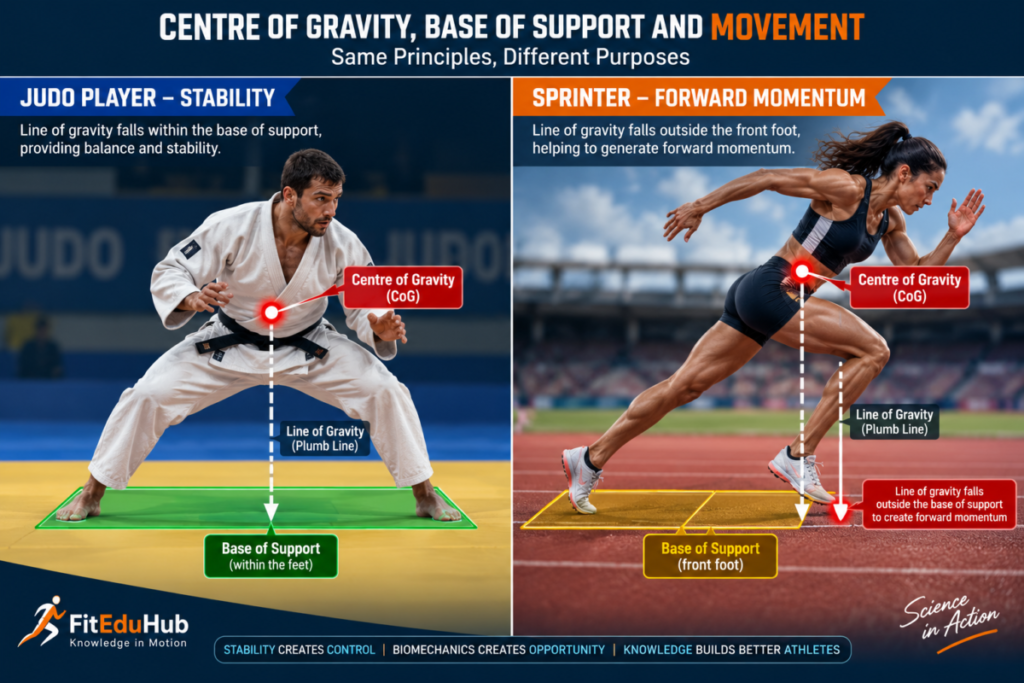
An athlete’s mechanical stability is governed by the structural interplay between their Centre of Gravity ($CoG$), their Base of Support ($BoS$), and their vertical Line of Gravity ($LoG$).
Plaintext
                            ┌────────────────────────┐
                            │    CENTRE OF GRAVITY   │
                            └───────────┬────────────┘
                                        │
                                 Line of Gravity
                                     (LoG)
                                        │
                                        ▼
                   ═════════════[ BASE OF SUPPORT ]═════════════
                                     (BoS)
Expand the Base of Support ($BoS$): The $BoS$ encompasses the entire perimeter surrounding all contact points between the body and the supporting surface. Widening the foot stance directly increases the area of the $BoS$, increasing the external force required to displace the body.
Lower the Centre of Gravity ($CoG$): Flexing the hip, knee, and ankle joints lowers the $CoG$ relative to the ground. A lower $CoG$ expands the angular tipping margin before equilibrium is compromised.
Align the Line of Gravity ($LoG$): The $LoG$ is an imaginary vertical vector dropping straight down from the $CoG$ toward the floor. As long as the $LoG$ intersects well within the boundaries of the $BoS$, static or dynamic balance is preserved. If the $LoG$ falls outside the perimeter of the $BoS$, tipping occurs.
Comparative Analysis of Mechanical Stability Strategies
Biomechanical Parameter
Defensive / Heavy Load Stance
Explosive Acceleration Stance
Base of Support ($BoS$)
Maximised (Wide multi-directional stance)
Restricted or Asymmetric (Narrow foot/hand touchpoints)
Centre of Gravity ($CoG$)
Lowered significantly (Deep knee/hip flexion)
Elevated & Projecting Forward
Line of Gravity ($LoG$)
Centred firmly in middle of $BoS$
Shifted deliberately past the anterior margin of $BoS$
Primary Goal
Resist external force & prevent disruption
Unbalance body to initiate linear acceleration
Practical Scientific Examples
Defensive Grappling Stance: A judo practitioner or football lineman drops into a low crouch with knees flexed ($CoG$ lowered) and feet set wider than shoulder-width apart ($BoS$ enlarged). Because their $LoG$ projects dead-centre within a wide base, an opponent must apply significant force to destabilize them.
Sprinter in Starting Blocks: Conversely, a $100\text{m}$ sprinter set in the starting blocks intentionally shifts their body weight forward until the $LoG$ falls outside the forward edge of their hand contacts. By intentionally creating equilibrium failure, gravity assists rapid forward acceleration the instant their hands leave the track.
👉 Pro Tip (Sports Research & Technology): Discover standardized balance testing protocols and stability assessments—including the Stork Stand Test, Y-Balance Test, and force plate posturography—in ourSports Research & Technology Guide.ory.
Centre of gravity and base of support explained through a judo stance and sprinting movement.
7. Joint Movements and Kinematics
Kinematics is the branch of biomechanics that quantitatively describes the exact motion of a body—including displacement, velocity, angular acceleration, and joint angles—without considering the forces that cause the movement. To evaluate human movement scientifically, sports specialists must master the precise anatomical terminology of kinematic joint actions.
Fundamental Kinematic Joint Actions
Flexion & Extension (Sagittal Plane)
Flexion: Decreases the joint angle between two articulating bones (e.g., flexing the elbow during a bicep curl or bringing the thigh forward during running).
Extension: Increases the joint angle, returning the articulation to anatomical position or past it (e.g., extending the knee to kick a football or pressing overhead).
Abduction & Adduction (Frontal Plane)
Abduction: Drives a limb laterally away from the imaginary midline of the body (e.g., raising arms out to the sides during lateral shoulder raises).
Adduction: Pulls a limb medially back toward the midline of the body (e.g., pulling the legs together during breaststroke kicking).
Internal & External Rotation (Transverse Plane)
Internal (Medial) Rotation: Rotates the anterior surface of a bone inward toward the longitudinal midline axis of the body.
External (Lateral) Rotation: Rotates the anterior surface of a bone outward away from the longitudinal midline axis.
Plantarflexion: Presses the forefoot downward away from the tibia, extending the ankle angle (e.g., pushing off the toes during sprinting or calf raises).
Dorsiflexion: Pulls the toes and dorsal foot upward toward the anterior shin (e.g., maintaining clearance during sprinting swing phase or achieving deep ankle range of motion in a squat).
👉 Pro Tip (Anatomy & Kinesiology): Explore which specific muscle architecture and fibre recruitment patterns drive these kinematic joint actions in ourAnatomy & Kinesiology Guide.
8. Newton’s Laws of Motion in Sports
Sir Isaac Newton’s three classical laws of motion remain the absolute foundation of sports biomechanics and movement kinetics.
First Law: The Law of Inertia
“A body continues in its state of rest or uniform motion in a straight line unless acted upon by an external net force.”
Mass (m) is the direct physical measure of inertia. The greater an object’s mass, the greater its resistance to any change in its state of motion.
Sports Application
A 120 kg rugby forward possesses massive mechanical inertia. When standing stationary, an opponent must generate substantial external force to alter his state of rest and drive him backward. Conversely, once sprinting at 8 m/s, that same 120 kg mass demands an equally immense opposing force to arrest its momentum (p=m⋅v).
Second Law: The Law of Acceleration (F=m⋅a)
“The rate of change of momentum of a body is directly proportional to the applied force and takes place in the direction in which the force acts.”
F=m⋅a⟹a=mF
Where:
F = Net force vector (N)
m = Mass (kg)
a = Acceleration (m/s2)
Sports Application
To hit a home run, a baseball batter must accelerate the bat quickly. If the batter switches to a heavier bat (m), they must generate proportionally more internal muscle force (F) simply to achieve the same angular bat acceleration (a) as with a lighter bat.
Third Law: The Law of Action-Reaction
“To every action force, there is always an equal and opposite reaction force.”
When Body A exerts a force on Body B (FA→B), Body B simultaneously exerts an equal and opposite force on Body A (FB→A=−FA→B).
Plaintext
                  [ Athlete's Foot ]
                          │
            Action Force  │  Ground Reaction
            (Downward)    │  Force (Upward)
                          ▼
            ─────────────────────────────
                   [ Ground Surface ]
Sports Application
When a basketball player jumps for a rebound, they do not simply lift themselves upward. They drive down into the hardwood floor with their lower extremities (the action force). The rigid court surface responds by pushing back against the soles of their shoes with an identical force vector in the opposite direction (the reaction force). In exercise science, this upward reactive force vector is termed Ground Reaction Force (GRF).
👉 Pro Tip (Sports Research & Technology): Learn how sports scientists use dual force plates to measure Ground Reaction Force (GRF) metrics and rate of force development (RFD) in ourSports Research & Technology Guide.
9. Applied Exercise Biomechanics: Analyzing the Big Three
Translating kinetic and kinematic principles onto the gym floor allows coaches to analyze movement patterns and eliminate mechanical inefficiencies in foundational compound lifts.
1. The Barbell Squat
Planes & Axes: Operates primarily in the Sagittal plane around a Frontal axis across the hip, knee, and ankle joints.
Levers & Joint Torques: The coxofemoral (hip) and tibiofemoral (knee) joints act as parallel rotational fulcrums. Mechanical execution balances external moment arms between the barbell’s line of action, the knee joint (demanding quadriceps effort), and the hip joint (demanding gluteal and hamstrings force).
Biomechanical Flaw (Knee Valgus): When a lifter’s knees collapse medially during the concentric ascent, they introduce an unwanted Frontal plane movement. Medial valgus collapse alters joint alignment, increasing dangerous shear stress on the anterior cruciate ligament (ACL) and medial collateral ligament (MCL).
👉 Pro Tip (Strength & Conditioning): Master squat kinetic alignment and programming protocols in our comprehensiveStrength & Conditioning Guide.
2. The Deadlift
Stability & CoG Control: To maintain static and dynamic balance during a heavy deadlift, the combined barbell-lifter Centre of Gravity (CoG) must remain vertically aligned directly over the mid-foot (the center of the Base of Support, or BoS).
The Danger of Excessive Moment Arms: If the barbell drifts anteriorly away from the shins by even 2–3 cm, the perpendicular moment arm (d⊥) between the load’s line of force and the lumbar spine increases significantly.
Spinal Kinetics: Extending this moment arm multiplies the flexor torque applied to the lower lumbar vertebrae (L4/L5–S1), converting vertical compressive load into destructive shear force on intervertebral discs.
3. The Bench Press
Base of Support Structure: Although categorized as an upper-body pressing movement, a biomechanically sound bench press creates a broad, five-point Base of Support: the cranium, upper thoracic spine/scapulae, sacrum on the bench surface, and both feet planted firmly on the floor.
Kinetic Chain Force Transfer: Utilizing Newton’s Third Law, driving the feet downward into the floor (leg drive) generates a ground reaction force that travels through the rigid pelvic and spinal structures. This kinetic energy transfers directly into the shoulder girdle, increasing horizontal pressing stability and total force production.
Comparative Biomechanical Overview of Heavy Lifts
Movement
Primary Plane of Motion
Axis of Rotation
Key Mechanical Risk
Primary Kinetic Objective
Barbell Squat
Sagittal
Frontal
Medial Knee Valgus (ACL shear force)
Balance knee/hip moment arms evenly
Deadlift
Sagittal
Frontal
Barbell drift anteriorly (Lumbar shear torque)
Keep line of force directly over mid-foot
Bench Press
Sagittal / Transverse
Frontal / Longitudinal
Scapular instability / Flares elbows
Leverage leg drive via GRF kinetic chain
Conclusion: Bridging Physics and Athletics
Sports Biomechanics removes empirical guesswork from physical preparation and athletic development. By applying the laws of spatial planes, joint axes, anatomical levers, and Newtonian kinetics, sports scientists can systematically break down complex human movements—from an Olympic snatch to a sprint stroke—to locate and correct energy leaks.
For strength coaches, physical educators, and sports scientists, biomechanical analysis serves as the ultimate diagnostic system for athletic performance. Integrating these physical principles enables coaches to build faster, stronger, and more mechanically efficient athletes while building structural resilience against musculoskeletal injury.
📚 Resources & Evidence-Based References
To maintain evidence-based practice and allow our readers to explore sports biomechanics further, we recommend the following academic resources, textbooks, and peer-reviewed journals:
(Gold standard introductory text for qualitative movement analysis, fluid mechanics, and lever systems).
Research Journal:Journal of Biomechanics
– Leading international peer-reviewed journal publishing flagship research on human motion and musculoskeletal force mechanics.
Research Journal:Journal of Applied Biomechanics
– Highly regarded academic journal focused on applied sports performance, gait kinetics, and movement technique analysis.
Frequently Asked Questions: Sports Biomechanics
1. What is Sports Biomechanics?
Sports biomechanics is the quantitative and qualitative scientific study of human movement, focusing on the internal muscular forces and external environmental forces acting upon the body during athletic performance.
2. What are the three anatomical planes and their corresponding axes of rotation?
The three anatomical planes are the Sagittal plane (flexion and extension around the Frontal axis), Frontal plane (abduction and adduction around the Sagittal axis), and Transverse plane (rotational movements around the Vertical/Longitudinal axis).
3. How does torque differ from force in joint mechanics?
Force creates linear acceleration (F = m × a), whereas torque is rotational force that induces angular acceleration around a joint axis. Torque is calculated as Force multiplied by the perpendicular Moment Arm (T = F × d⊥).
4. What are the three classes of anatomical levers in the human body?
First-class levers have the fulcrum in the middle (e.g., atlanto-occipital neck joint), second-class levers have the load in the middle providing force advantage (e.g., calf raises), and third-class levers have the effort in the middle providing speed and range of motion (e.g., bicep curls).
5. What is the Centre of Gravity (CoG) and why does it shift during movement?
The Centre of Gravity (CoG) is the exact theoretical point around which the body’s mass is equally balanced in all three dimensions. Because the human body is flexible and multi-segmented, postural shifts dynamically alter mass distribution and move the CoG.
6. How do Base of Support (BoS) and Line of Gravity (LoG) dictate mechanical stability?
Stability increases when an athlete expands their Base of Support (BoS), lowers their Centre of Gravity (CoG), and ensures their vertical Line of Gravity (LoG) intersects well within the boundaries of their BoS.
7. What is the difference between Kinematics and Kinetics?
Kinematics quantitatively describes motion itself (displacement, velocity, acceleration, and joint angles) without considering the forces causing it. Kinetics analyzes the underlying internal and external forces that produce or alter that motion.
8. How does Newton’s Third Law apply to Ground Reaction Force (GRF)?
Newton’s Third Law (Action-Reaction) dictates that for every applied force, there is an equal and opposite reaction. When an athlete drives down into the ground, the ground pushes back with an identical upward force vector known as Ground Reaction Force (GRF).
9. How does Newton’s Law of Inertia affect heavy athletes?
Mass is a direct measure of inertia. A heavier athlete possesses greater mechanical inertia, requiring significantly more external force to accelerate from rest and an equally massive opposing force to alter their momentum when moving.
10. Why is maintaining the barbell over the mid-foot critical in compound lifts like the deadlift?
Aligning the barbell over the mid-foot keeps the load directly within the athlete’s Base of Support and Centre of Gravity. If the bar drifts anteriorly, it extends the moment arm to the lumbar spine, converting vertical compressive load into dangerous shear force.