
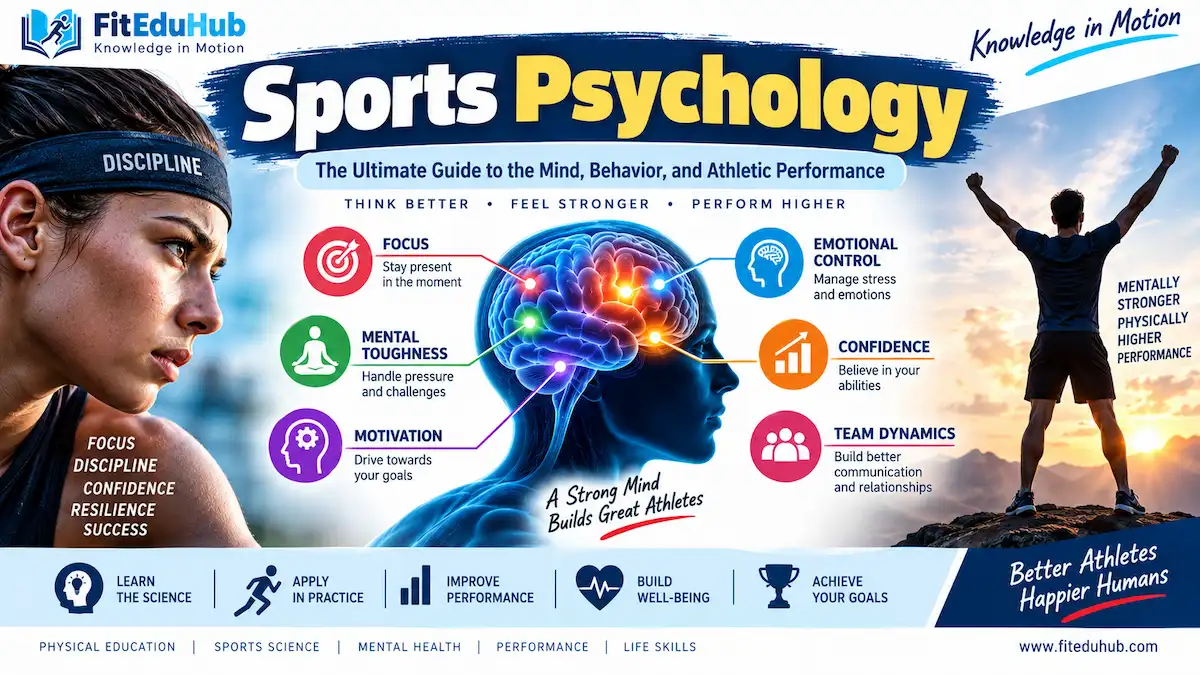
Introduction: The Mental Edge in Sports
In the modern era of athletics, physical conditioning, biomechanics, and nutrition have become exact sciences. Yet, when two physically equal athletes step onto the field, what determines the winner? The answer lies in the mind. Sports Psychology is the scientific study of human behavior, cognitive processes, and emotional regulation within the context of sports and physical education.
Athletic performance is never just physical. A perfectly designed strength program or a flawless nutritional plan is useless if an athlete crumbles under pressure, loses focus during a critical moment, or lacks the motivation to train consistently. Whether you are managing an elite professional roster or coaching 7th and 8th-grade students in a high-stakes inter-house final, understanding the psychology of the athlete is the ultimate key to unlocking peak performance. In this comprehensive guide, we will explore the psychological frameworks that dictate human behavior in sports.
1. Motivation: The Engine of Athletic Behavior
Motivation is the psychological driving force that initiates, guides, and maintains goal-oriented behaviors. It is the reason an athlete wakes up at 5:00 AM for practice when they would rather sleep. In sports psychology, motivation is broadly categorized into two distinct types.
Intrinsic vs. Extrinsic Motivation
- Intrinsic Motivation: This comes from within the athlete. It is the pure love of the game, the desire for self-improvement, and the internal satisfaction of mastering a new skill. Athletes driven by intrinsic motivation are highly resilient and less likely to experience burnout.
- Extrinsic Motivation: This comes from outside sources. It includes tangible rewards like medals, trophies, prize money, or social validation like praise from a coach or cheering from a crowd.
- The Cognitive Evaluation Theory (CET): Sports scientists warn against relying too heavily on extrinsic rewards. If a young athlete is only playing to win a trophy, their intrinsic love for the sport diminishes. Once the trophy is no longer available, the athlete will likely quit.
👉 Pro Tip: Strength & Conditioning] Learn how motivation directly impacts an athlete’s ability to push through the pain barrier during heavy Resistance Training.

2. Anxiety & Stress: Managing the Pressure Cooker
Stress is a physiological and psychological response to a demand placed upon the body. In sports, anxiety is the negative emotional state associated with that stress, often characterized by nervousness, worry, and apprehension.
Eustress vs. Distress
Not all stress is bad.
- Eustress (Positive Stress): This is the optimal level of stress that makes an athlete feel energized, alert, and ready to perform.
- Distress (Negative Stress): When the perceived demands of a situation outweigh the athlete’s perceived ability to handle it. This leads to severe performance anxiety (choking).
The Inverted-U Hypothesis
This is one of the most famous theories in sports psychology. It states that athletic performance improves as arousal (excitement/stress) increases, but only up to a certain optimal point.
- If arousal is too low, the athlete is lethargic and unmotivated.
- If arousal is too high, the athlete is panicked, leading to muscle tension and poor decision-making.
- Practical Scientific Example: Consider a basketball player stepping to the free-throw line with 2 seconds left on the clock during a tense match between Jyoti House and Pragati House. The physical skill to shoot the ball is already ingrained in their muscle memory. However, if their psychological arousal spikes too high due to the screaming crowd, their heart rate skyrockets, their shoulders tense up (disrupting biomechanics), and they miss the shot.
👉 Pro Tip: Sports Biomechanics] Read how severe anxiety causes unwanted muscle tension that actively disrupts fluid Joint Movements and kinematics.
3. Confidence: The Armor of a Champion
In sports psychology, confidence is scientifically referred to as Self-Efficacy. Coined by psychologist Albert Bandura, self-efficacy is an individual’s strict belief in their innate ability to execute the specific behaviors necessary to produce a successful outcome.
The Four Sources of Self-Efficacy
Coaches cannot simply tell an athlete to “be confident.” Confidence must be built systematically through four proven channels:
- Past Performance Accomplishments (The strongest source): If an athlete has successfully executed a skill in the past (like hitting a game-winning shot), their brain believes they can do it again.
- Vicarious Experiences (Modeling): Watching a teammate or a competitor of equal ability successfully complete a task. It triggers the thought: “If they can do it, I can do it.”
- Verbal Persuasion: Positive reinforcement, feedback, and encouragement from a respected coach or physical education teacher.
- Physiological Arousal: How the athlete interprets their body’s physical signals. A confident athlete interprets a racing heart as “readiness,” while a nervous athlete interprets it as “fear.”
4. Concentration & Focus: Tuning Out the Noise
Concentration is the ability to maintain focused attention on relevant environmental cues while completely ignoring irrelevant distractions (like crowd noise, a bad referee call, or fatigue).
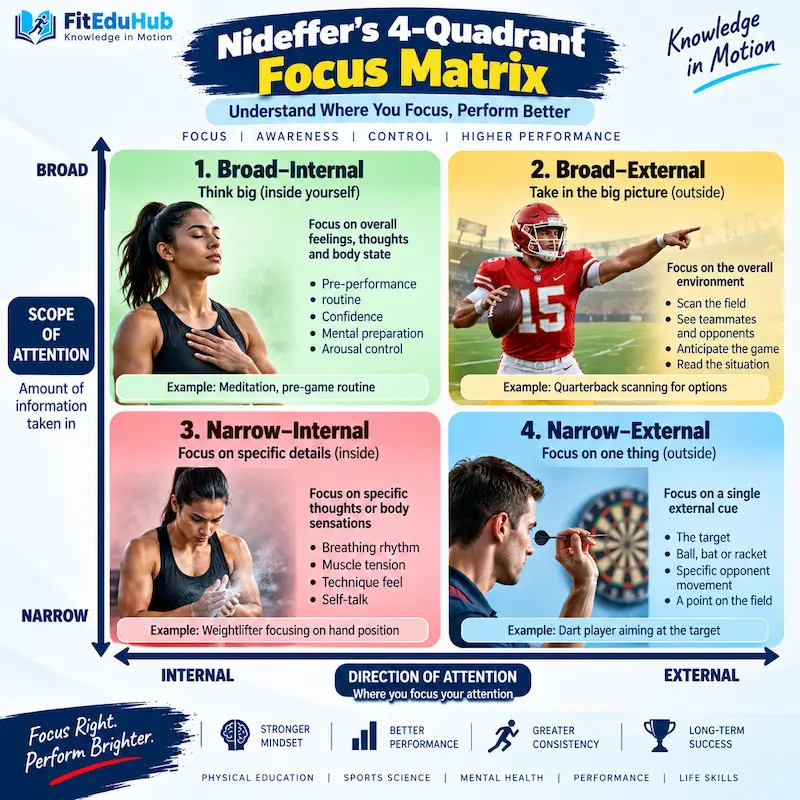
Nideffer’s Attentional Focus Theory
Psychologist Robert Nideffer categorized athletic focus into two dimensions: Width (Broad vs. Narrow) and Direction (Internal vs. External). This creates four specific types of focus required in sports:
- Broad-External: Used to rapidly assess a situation. (e.g., A football quarterback scanning the entire field to see where the defenders are).
- Broad-Internal: Used for analyzing and planning. (e.g., A coach analyzing the flow of the game and formulating a new strategy).
- Narrow-External: Used to focus exclusively on one or two external cues. (e.g., A batter focusing solely on the release of the baseball from the pitcher’s hand).
- Narrow-Internal: Used to mentally rehearse a movement or regulate emotions. (e.g., A gymnast visualizing their routine and taking a deep breath before stepping onto the mat).
The greatest athletes in the world are those who can seamlessly shift their focus between these four quadrants in a fraction of a second depending on what the game demands.
👉 Pro Tip: Exercise Physiology] Discover how Central Fatigue in the nervous system diminishes an athlete’s ability to maintain Narrow-External focus during endurance events.
5. Goal Setting: The Blueprint for Success
Goal setting is perhaps the most heavily utilized psychological technique in sports. Without clear goals, training becomes aimless, and motivation plummets. However, sports psychologists emphasize that setting the wrong type of goal can actually destroy an athlete’s confidence.
The Three Types of Goals
- Outcome Goals: These focus purely on the final result of a competition (e.g., “I want to win the gold medal” or “I want our team to win the championship”). While these are great for long-term motivation, they are dangerous because the outcome is never 100% in the athlete’s control (the opponent might simply be better on that day).
- Performance Goals: These focus on achieving a specific personal standard, independent of other competitors (e.g., “I want to run my 100m sprint in under 11 seconds” or “I want to improve my shooting percentage to 45%”). These are highly effective because the athlete has control over their own performance.
- Process Goals: These focus on the exact physical or psychological actions an athlete must execute during performance (e.g., “I will focus on keeping my elbow tucked during every free throw” or “I will drive my knees high during the acceleration phase”). These are the most effective goals for reducing anxiety and improving focus.
The SMART Principle
Effective goals must be structurally sound. Coaches should always use the SMART acronym:
- Specific (Clear and unambiguous)
- Measurable (Quantifiable so progress can be tracked)
- Adjustable (Flexible if injuries or setbacks occur)
- Realistic (Challenging, but physically attainable)
- Time-bound (Having a strict deadline)
👉 Pro Tip: Fitness Testing & Assessment] Use the metrics from our Fitness Testing guide to establish highly accurate and measurable Performance Goals.
6. Mental Skills Training (MST): Conditioning the Brain
Just as a physical education teacher implements a weightlifting program to build muscle, sports psychologists implement Mental Skills Training (MST) to build cognitive resilience.
MST programs are designed to help athletes regulate their emotions and maintain ideal performance states. Key mental skills include:
- Arousal Regulation (Breathing Techniques): If an athlete is overly anxious (distress), they are taught diaphragmatic breathing (deep belly breathing) to activate the parasympathetic nervous system, which physically slows down a racing heart rate.
- Self-Talk: The internal dialogue an athlete has with themselves. Negative self-talk (“I’m going to miss this shot”) creates devastating self-fulfilling prophecies. MST teaches cognitive restructuring—replacing negative thoughts with instructional or motivational cues (“Bend the knees, follow through”).
- Pre-Performance Routines: A sequence of task-relevant thoughts and actions engaged in systematically before a performance (e.g., Rafael Nadal’s incredibly precise routine before serving in tennis). Routines act as psychological anchors, giving the athlete a sense of total control and familiarity, even in highly stressful environments.
7. Imagery and Visualization: The Theater of the Mind
Imagery (often called visualization or mental rehearsal) is the psychological process of creating or recreating an experience in the mind. It is a cornerstone of elite sports psychology.
The Psychoneuromuscular Theory
Why does just “thinking” about a sport make you better at it? According to the psychoneuromuscular theory, when an athlete vividly imagines performing a physical movement, the brain sends weak, sub-threshold electrical signals to the exact muscles required for that movement. While these signals are not strong enough to cause physical movement, they effectively “grease the groove” of the neural pathways, making the actual physical execution smoother and faster later on.
How to Practice Effective Imagery
To maximize the benefits of visualization, athletes must use PETTLEP imagery, ensuring the mental image is as close to reality as possible:
- Physical (Imagine wearing your actual uniform)
- Environment (Visualize the exact stadium or court, like Ramagya School’s basketball court)
- Task (Ensure the imagined task matches the real task)
- Timing (Visualize the movement in real-time, not slow motion)
- Learning (Update the imagery as your physical skills improve)
- Emotion (Feel the adrenaline and excitement)
- Perspective (Use internal perspective—seeing through your own eyes, rather than watching yourself like a movie on TV).
👉 Pro Tip: Sports Nutrition] Just like visualizing success, ensure your brain has the chemical energy it needs to focus by following our Pre-Exercise Nutrition protocols.
8. Team Cohesion: The Psychology of Winning Together
In team sports like basketball, volleyball, or football, individual brilliance is rarely enough to secure a championship. The psychological glue that binds a group of individuals together is called Team Cohesion.
Task vs. Social Cohesion
- Task Cohesion: The degree to which team members work together to achieve specific, identifiable goals (e.g., executing a flawless defensive rotation in basketball). A team can have very high task cohesion even if the players do not personally like each other off the court.
- Social Cohesion: The degree to which team members like each other and enjoy each other’s company. While social cohesion makes the sporting experience more enjoyable, research shows that Task Cohesion is far more critical for actual winning performance.
The Ringelmann Effect & Social Loafing
Coaches must be highly aware of the Ringelmann Effect, which states that as the size of a group increases, individual productivity decreases. The psychological cause of this is Social Loafing—a phenomenon where an individual player exerts less effort because they believe their teammates will pick up the slack, or because they feel their individual contribution is not being noticed by the coach.
- Solution: To prevent social loafing, coaches must ensure every single player’s specific contribution is measured, acknowledged, and valued.
Conclusion: The Mind Dictates the Body
Sports psychology bridges the gap between physical potential and actual performance. By understanding the intricate dynamics of motivation, utilizing arousal regulation techniques to combat stress, practicing vivid imagery, and setting precise process-oriented goals, athletes can build unbreakable mental toughness.
A well-conditioned body is a prerequisite for sports, but a well-conditioned mind is what ultimately steps onto the podium.
📚 Evidence-Based References
To deeply master the psychological frameworks used by elite coaches and sports scientists, we recommend these two foundational academic texts:
- Foundations of Sport and Exercise Psychology by Robert S. Weinberg and Daniel Gould. (The most widely used and respected textbook globally, covering everything from motivation to group dynamics).
- Applied Sport Psychology: Personal Growth to Peak Performance by Jean M. Williams and Vikki Krane. (An incredibly practical guide focused on implementing mental skills training and imagery in real-world coaching scenarios).