
Introduction
Table Tennis, commonly known as Ping-Pong, is one of the fastest, most highly skilled, and globally recognized indoor racket sports in the world. It is a game that serves as the ultimate test of physical endurance, lightning-fast reflexes, and extreme tactical intelligence. Despite being played on a small table, the canvas of this sport is immense. In Table Tennis, players have fractions of a second (about 0.1 to 0.2 seconds) to judge the speed, spin, and incoming trajectory of the ball and react accordingly.
This sport is not just about power; it is deeply rooted in biomechanics, racket angles, and advanced friction physics. The Magnus effect comes into play with every shot, forcing the ball to curve and dip in the air. In the modern era, Table Tennis is a major part of the Olympic Games, and its fan following is continuously growing across Asia, Europe, and gradually the Americas. Whether you are a recreational player playing in your basement or an aspiring professional aiming for the national team, the soul of Table Tennis lies in its speed, spin, and accuracy.
History of Table Tennis
The history of Table Tennis is fascinating. It originated in late 19th-century Victorian England. During that era, it was played as an after-dinner recreational activity by the upper-class society. People were influenced by lawn tennis at the time, but playing outside in bad weather wasn’t always possible, so they created an indoor, miniature version of it.
In its early days, there was no standard equipment for this game. Players used everyday household items. A line of thick, heavy books was placed in the middle of the table to serve as a ‘net’. Cigar box lids were used as paddles (rackets), and rounded champagne corks were hit back and forth like a ball. In the 1880s and 1890s, various toy manufacturers in England began producing commercial versions of the game, giving them names like “Gossima”, “Flim-Flam”, and “Whiff-Whaff”.
Later in 1901, an English company named J. Jaques & Son Ltd registered the trademark “Ping-Pong”. This name was inspired by the sound the ball made when it hit the paddle and the table (Ping and Pong). Once this name was trademarked, other manufacturers and players started calling the game “Table Tennis” to avoid copyright issues.
Evolution of Table Tennis
The evolution of Table Tennis is divided into different “Eras.” Over time, advancements in technology and equipment completely changed the rules and style of the game:
- The Hardbat Era (Pre-1950s): In the early decades, paddles were only covered with pimpled rubber (pips-out) with no sponge underneath. Because of this, the ball didn’t generate much speed or spin. Matches were very long, and defensive rallies were common. Once, during the 1936 World Championship, a single rally lasted for nearly 2 hours.
- The Sponge Rubber Revolution (1950s): In 1952, Japan’s Hiroji Satoh introduced a new racket at the World Championship that featured a thick sponge under the rubber. The sponge provided a trampoline effect, leading to a sudden, massive increase in the ball’s speed and spin. This shook the entire table tennis world, and Satoh won the tournament. The ITTF eventually had to limit the thickness of the racket to control the speed of the game.
- The Speed Glue Era (1980s – 2008): Players discovered that applying liquid glue containing VOCs (Volatile Organic Compounds) to attach the rubber to the blade caused the sponge to expand. This generated even more speed and spin in their shots and was termed “Speed Glue.” However, since VOC gases were harmful to players’ health, it was globally banned after the 2008 Beijing Olympics.
- The Ball Evolution (38mm to 40+ Poly): Until 2000, the ball size was 38mm. The game had become so fast that TV spectators had difficulty seeing the ball. Therefore, the ITTF increased the ball size to 40mm, which increased air resistance and slowed the game down slightly. In 2014, celluloid material was banned, and the use of plastic (Poly) balls was made mandatory because celluloid is highly flammable. The new Poly balls are marked with “40+”.
Governing Bodies
Several major organizations work continuously to ensure the smooth regulation and global promotion of Table Tennis:
- International Table Tennis Federation (ITTF): Founded in 1926, the ITTF is headquartered in Lausanne, Switzerland. It is the supreme global governing body of table tennis. The ITTF is responsible for official game rules, approving the racket rubber list, equipment standardization, and organizing the World Championships.
- Continental Federations: Each continent has its own governing body, such as the Asian Table Tennis Union (ATTU) and the European Table Tennis Union (ETTU). They conduct regional tournaments and development programs within their respective continents.
- Table Tennis Federation of India (TTFI): Established in 1926, the TTFI is the apex body regulating table tennis in India. Its primary responsibilities include organizing National Championships, selecting the Indian national team, and conducting grass-root level coaching camps across the country.
Table Dimensions & Playing Area Setup
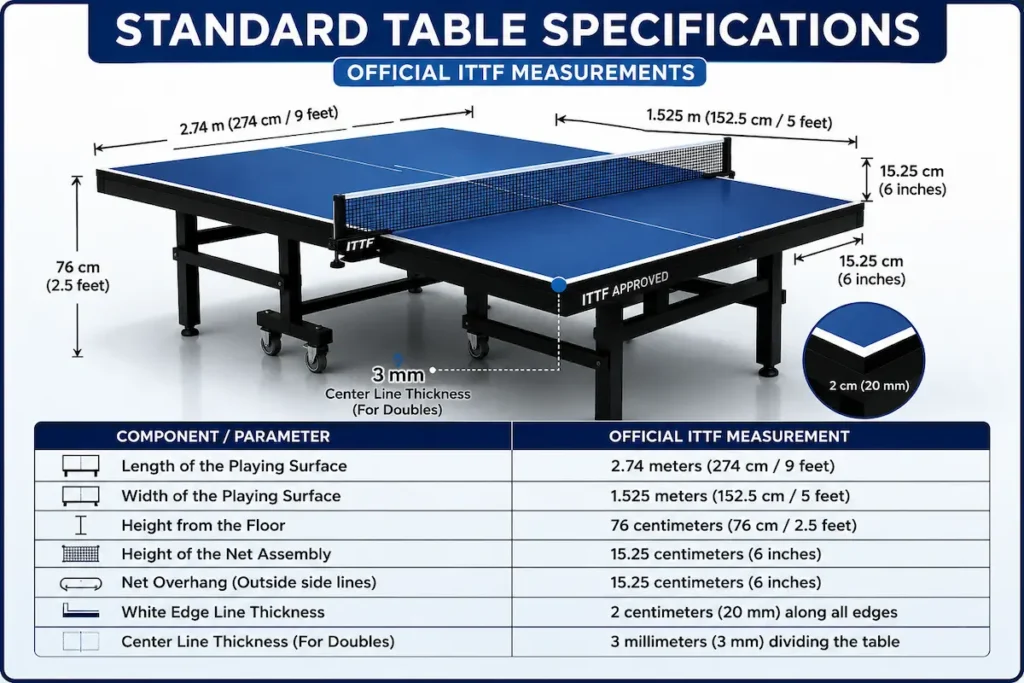
To ensure a fair and standard environment in professional competitions, strict adherence to table and surrounding area dimensions is maintained. Not only the table, but lighting, flooring, and background are also carefully regulated.
Standard Table Specifications
| Component / Parameter | Official ITTF Measurement |
| Length of the Playing Surface | 2.74 meters (274 cm / 9 feet) |
| Width of the Playing Surface | 1.525 meters (152.5 cm / 5 feet) |
| Height from the Floor | 76 centimeters (76 cm / 2.5 feet) |
| Height of the Net Assembly | 15.25 centimeters (6 inches) |
| Net Overhang (Outside side lines) | 15.25 centimeters (6 inches) |
| White Edge Line Thickness | 2 centimeters (20 mm) along all edges |
| Center Line Thickness (For Doubles) | 3 millimeters (3 mm) dividing the table |
The Playing Arena (Court)
For international-level matches, a proper playing court area is essential so players can move freely and step back from the table while playing defensive strokes. A standard international table tennis court must have a minimum length of 14 meters (46 feet) and a width of 7 meters (23 feet). Dark-colored surrounds (barriers), approximately 75cm high, are placed around the court to keep the ball from rolling out.
The flooring must always be non-slippery and shock-absorbing (typically red or dark red synthetic Taraflex flooring is used). Lighting is also crucial; the light intensity on the playing surface should be at least 1000 lux to create a shadow-less environment without any glare.
Equipment in Deep Detail
Success in table tennis depends heavily on selecting the right equipment. The gear for this game looks simple but is technically very complex:
The Racket (Blade)
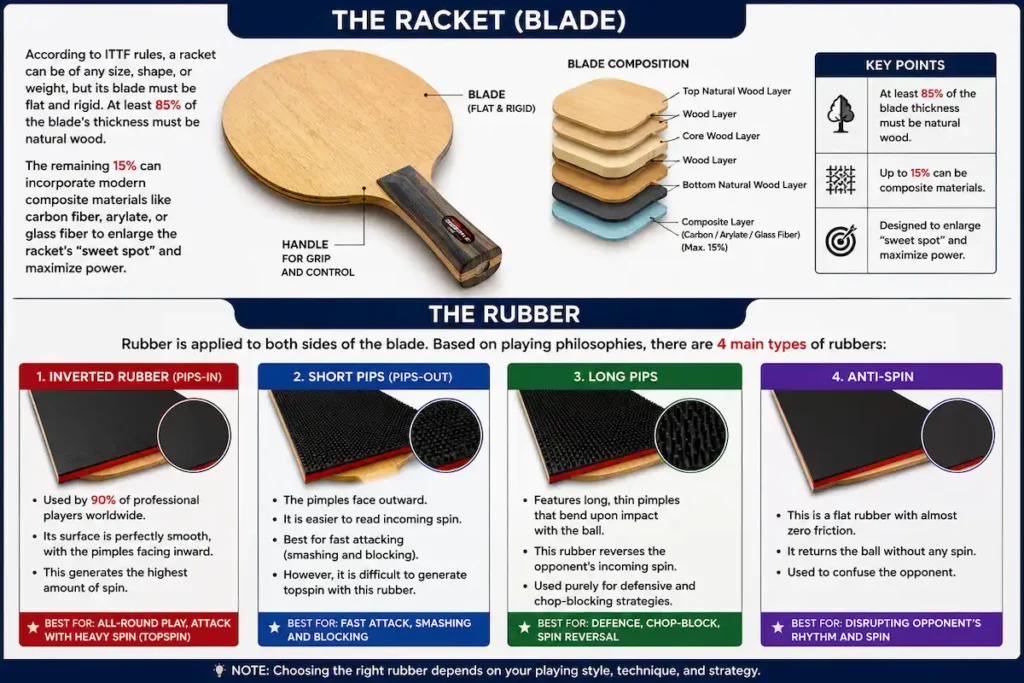
According to ITTF rules, a racket can be of any size, shape, or weight, but its blade must be flat and rigid. At least 85% of the blade’s thickness must be natural wood. The remaining 15% can incorporate modern composite materials like carbon fiber, arylate, or glass fiber to enlarge the racket’s “sweet spot” and maximize power.
The Rubber
Rubber is applied to both sides of the blade. Based on playing philosophies, there are 4 main types of rubbers:
- Inverted Rubber (Pips-In): Used by 90% of professional players worldwide. Its surface is perfectly smooth, with the pimples facing inward. This generates the highest amount of spin.
- Short Pips (Pips-Out): The pimples face outward. It is easier to read incoming spin and is best for fast attacking (smashing and blocking). However, it is difficult to generate topspin with this rubber.
- Long Pips: This features long, thin pimples that bend upon impact with the ball. This rubber reverses the opponent’s incoming spin. It is purely used for defensive and chop-blocking strategies.
- Anti-Spin: This is a flat rubber with almost zero friction. It returns the ball without any spin and is used to confuse the opponent.
The rules regarding racket colors are strict. Previously, one side had to be red and the other black so the opponent could identify the rubber type. Recently, the ITTF has also approved pink, green, blue, and violet colors, but the other side must always remain black.
The Ball
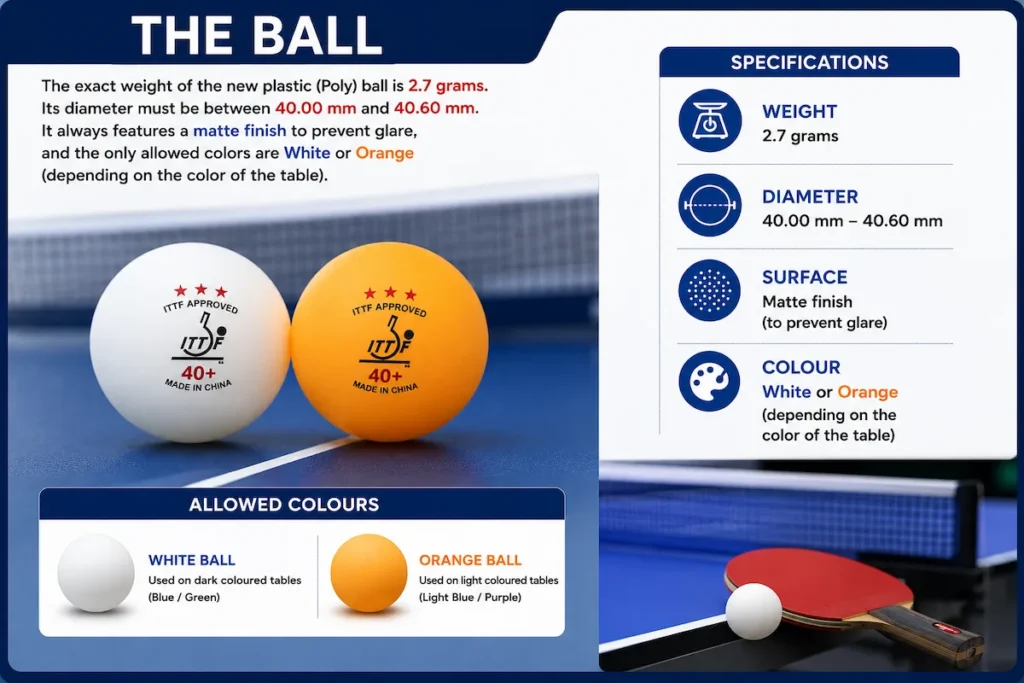
The exact weight of the new plastic (Poly) ball is 2.7 grams. Its diameter must be between 40.00 mm and 40.60 mm. It always features a matte finish to prevent glare, and the only allowed colors are White or Orange (depending on the color of the table).
Rules & Regulations
Table Tennis rules are designed at a micro-level to ensure no player gains an unfair advantage. Below are the most important rules:
The Service Rule
The service is the most crucial part of the game, as it is the only shot where the player has complete control over the ball. According to the rules:
- At the start of the service, the ball must rest freely on the stationary, open, and flat palm of the server’s free hand. Gripping the ball with fingers is not allowed.
- The ball must be tossed straight up into the air without imparting any spin. A minimum toss height of 16 centimeters (about 6 inches) is mandatory.
- When the ball is tossed in the air, it must remain above the level of the playing surface and behind the end line.
- The server must immediately remove their free arm from the space between the ball and the receiver so the receiver can clearly see the ball’s contact point and racket angle. If the receiver’s view is obstructed, the umpire can call a fault.
The “Let” Rule
Usually, a rally continues until a point is scored, but in certain situations, a rally is stopped and replayed without a point being awarded. This is called a ‘Let’:
- If the ball touches the net assembly during a service but lands correctly in the receiver’s court, it is considered a Let. The server gets a chance to serve again, with no limit on how many times this can happen.
- If the service is delivered when the receiver is not ready (and makes no attempt to strike the ball).
- If there is an external interruption (such as a ball rolling in from another court, loud noise, or a power outage).
The Expedite System
If a game lasts for 10 minutes and the combined score of both players is less than 18, the ‘Expedite System’ is introduced. Under this rule, both players alternate service after every single point. The biggest change is that if the receiving player manages to safely return the ball 13 consecutive times, the point is automatically awarded to the receiver. This rule was introduced to break long, tedious defensive rallies and encourage aggressive gameplay.
Scoring System & Match Formats
To make the modern game faster and more TV-friendly, the scoring system was changed from 21 points to 11 points. Let’s understand this in deeper detail:
- Game Duration: A normal match is played as a Best of 5 games (the first to win 3 games is the winner) or a Best of 7 games (the first to win 4 games is the winner). Grand Slams and the Olympics are always Best of 7.
- Points to Win: Exactly 11 points are needed to win each game.
- The Two-Point Margin (Deuce): If the score is tied at 10-10, the situation is called “Deuce.” From here, the game continues until one player establishes a consecutive 2-point lead (e.g., 12-10, 15-13).
- Service Change: In a normal game, the service goes to the other player after every 2 points. After a deuce (10-10 score), the service alternates after every single (1) point. At the end of a game, the first serve of the next game goes to the player who received first in the previous game.
Types of Events
Table Tennis championships offer various formats for players to showcase their abilities:
Individual Events
- Men’s & Women’s Singles: This is the most prestigious format where a player competes based on their individual mental and physical capacity. The highest level of speed and strategy is seen here.
- Men’s, Women’s & Mixed Doubles: Doubles rules are slightly different and more challenging than singles. The table is divided into two halves by a center line. Services must always be hit diagonally from the server’s right-hand half-court to the receiver’s right-hand half-court. Additionally, during a rally, both partners must strictly take ‘alternate hits’ (one after the other). A single player cannot hit the ball twice in a row.
Team Events
In World Championships and the Olympics, Team Events determine a nation’s dominance. A standard team consists of 3 or 4 players. Matches are usually played in a “Best of 5 matches” format, featuring a mix of singles and occasionally one doubles match. Team coordination and selecting the right player against the right opponent (line-up strategy) are crucial.
Fundamental & Advanced Skills
To achieve mastery in table tennis, knowledge of both basic and advanced techniques is essential. Let’s understand these in technical detail below:
Grip Mechanics
The way you hold the racket dictates your entire playing style. Primarily, 2 grips are used:
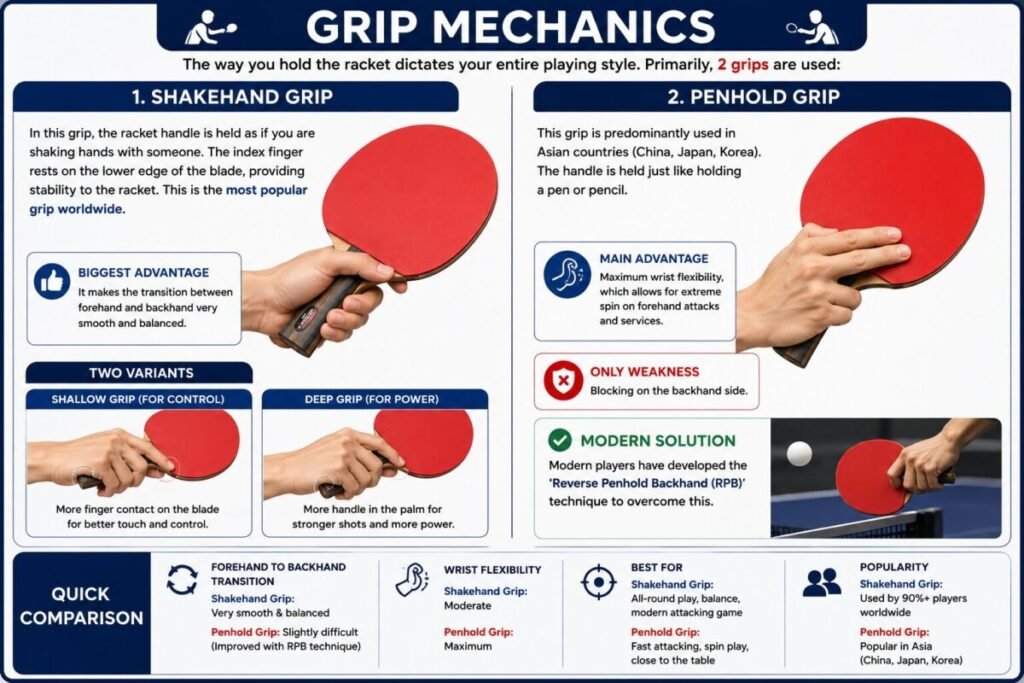
- Shakehand Grip: In this grip, the racket handle is held as if you are shaking hands with someone. The index finger rests on the lower edge of the blade, providing stability to the racket. This is the most popular grip worldwide. Its biggest advantage is that it makes the transition between forehand and backhand very smooth and balanced. It has two variants – a shallow grip (for control) and a deep grip (for power).
- Penhold Grip: This grip is predominantly used in Asian countries (China, Japan, Korea). The handle is held just like holding a pen or pencil. The main advantage of this grip is maximum wrist flexibility, which allows for extreme spin on forehand attacks and services. Its only weakness is blocking on the backhand side, though modern players have developed the ‘Reverse Penhold Backhand (RPB)’ technique to overcome this.
Ready Stance & Biomechanics
A perfect ready stance gives you the foundation to move quickly in any direction. The distance between the player’s feet should be slightly wider than shoulder-width (about 1.5 times). The knees should be bent at an angle of roughly 130 to 140 degrees, and the body weight should be shifted entirely forward (onto the toes or balls of the feet). The upper body should have a slight forward lean. The racket should be in a neutral position, just above the table and in front of the chest.
Footwork Patterns
No matter how good your strokes are, if your footwork is wrong, you won’t be able to put full power into the ball. There are 3 main footwork patterns used in Table Tennis:
- Side-to-Side (Shuffle / Slide Step): This is the most basic footwork, using short, quick sliding steps to move left and right parallel to the table. The feet never cross in this movement.
- Pivot Step: When an attacking player wants to hit a forehand smash on a ball coming toward their backhand side, they rotate (pivot) on the spot to create space to execute a forehand stroke.
- Crossover Step: When the ball travels very fast from one end of the table to the other, and it’s impossible to reach it with a slide step, a long running stride (crossing the legs) is used.
The Core Strokes
- Forehand / Backhand Drive: These are basic attacking strokes. The racket is swung from bottom to top and slightly forward, imparting light topspin to the ball. This is used to build consistent rallies.
- The Push: This is a defensive touch shot used to return backspin balls. Holding the racket with an open angle, the player touches the bottom half of the ball so it clears the net and takes a short bounce.
- The Block: Used when the opponent hits a heavy topspin or smash. The player closes their racket angle to absorb the ball’s speed and energy, safely dropping it back onto the table.
- The Smash: A flat, maximum-power shot. Whenever the opponent mistakenly pops up a high ball, the player uses their full body weight and shoulder rotation to “kill” the ball into the court.
Advanced Techniques
- The Loop Topspin: This is the deadliest weapon in modern table tennis. Instead of hitting the ball flat, the rubber is used to ‘brush’ against the ball. This generates massive topspin, making the ball dart forward like a rocket as soon as it hits the table. The loop can be executed from close to the table or from far away.
- The Chop: A classical defensive stroke. The player moves 2-3 meters away from the table and cuts down on an incoming topspin ball using a heavy axe-like motion. This imparts heavy backspin on the ball, making it very difficult for the attacking player to lift it over the net.
- The Banana Flick (Chiquita): This technique is used during service reception. When the opponent hits a short serve inside the table, the receiver rotates their wrist 180 degrees and executes a backhand flick. The ball curves over the table in the shape of a banana. It is incredibly difficult to defend against.
Health & Physiology Benefits
Table tennis is not just entertainment; it is a complete package for physical and neurological health:
- High-Speed Brain Activity: According to neuroscientists, playing TT constantly activates the brain’s motor cortex and cerebellum. It pushes hand-eye coordination and decision-making speed to extreme levels. It is even suggested for delaying the onset of Alzheimer’s disease.
- Aerobic Workout & Calorie Burn: Continuous short, explosive movements elevate the heart rate. In a one-hour intense match, a player can easily burn 300 to 400 calories.
- Zero Joint Impact: Compared to tennis or football, the risk of heavy impact injuries or collisions is almost zero. Therefore, it is considered safe for the joints (ankles and knees) of everyone, from an 8-year-old child to an 80-year-old senior citizen.
- Core & Leg Strength: In table tennis, power shots are not generated by the arms alone, but through the rotation of the legs, hips, and core muscles. This builds significant lower body strength and balance.
Indian Table Tennis Icons
Table tennis has been making continuous progress in India. Several stars have raised the national flag on the global stage:
- Achanta Sharath Kamal: The undisputed legend of India. He has carried Indian TT on his shoulders for decades. Sharath won Gold at the 2006 and 2010 Commonwealth Games and recently made history by winning 3 Golds and 1 Silver at the 2022 Birmingham CWG. He has also been honored with the country’s highest sporting honor, the “Khel Ratna”.
- Manika Batra: India’s first female TT superstar. She shocked everyone by winning a historic Singles Gold medal at the 2018 Gold Coast Commonwealth Games. Her unique playing style using long-pips rubber sets her apart. She has ranked among the top-40 in the world.
- Gnanasekaran Sathiyan: Another top-ranked Indian player known worldwide for his speed, precision, and tactical intelligence. He has won medals for the Indian team at both the Asian Games and the Commonwealth Games.
- Harmeet Desai: This star player from Gujarat has brought glory to India on the international stage with his solid backhand and consistent performances.
International Legends
A few international players are universally regarded as the Greatest of All Time (GOAT) in history:
- Ma Long (China): Known as “The Dictator”, Ma Long is the only male player in table tennis history to win a double Grand Slam (Olympics, World Cup, WTTC). His forehand attack is considered the most powerful in the world.
- Jan-Ove Waldner (Sweden): Called “The Mozart of Table Tennis”, this Swede was the only player in his era capable of stopping the entire Chinese army. His creativity, blocks, and service reception skills were unparalleled. He is a 1992 Olympic gold medalist.
- Deng Yaping (China): The most dominant player in women’s table tennis history. She won 4 Olympic Gold medals and held the world number 1 ranking for 8 consecutive years.
- Fan Zhendong & Zhang Jike (China): Zhang Jike is known for his aggressive style and winning a fast Grand Slam in just 445 days, while Fan Zhendong is today’s most technically solid world champion, known for his brute power.
Major Championships & Global Stage
In the professional table tennis circuit, there are mainly 4 major tournaments where victory is considered the ultimate pinnacle:
- The Olympic Games: Included in 1988 (Seoul). Winning a medal here is the ultimate goal of every TT player.
- World Table Tennis Championships (WTTC): Organized annually by the ITTF. Odd years (like 2021, 2023) feature individual events, while even years (like 2022, 2024) host team championships.
- WTT Series (World Table Tennis): A new, modernized, and commercialized tour structure (similar to Tennis’s ATP tour) featuring Grand Smashes, Champions, and Contender tournaments throughout the year where players win massive prize money and ranking points.
- Table Tennis World Cup: An invitational tournament for the top 20 players in the world, representing the champions of their respective continents.
Awards & Honors
At the international level, the ITTF honors the best male, female, and breakthrough players of the year at its annual ‘Star Awards’. In India, top-performing table tennis players are awarded the Arjuna Award and the Major Dhyan Chand Khel Ratna Award by the Government of India. Their mentors (coaches) are honored with the Dronacharya Award for their hard work.
Career Opportunities in Table Tennis
Previously seen merely as a hobby, table tennis has today become a full-fledged multi-million dollar career option. If you have a passion for this field, you have several career paths:
- Professional Player: By winning national championships and climbing the world rankings, you can play on international tours. Furthermore, professional leagues like UTT (Ultimate Table Tennis) in India and around the world sign players to lucrative contracts.
- Certified Professional Coach: There is a massive demand for coaches from the grassroots to the elite level. By completing ITTF Level 1, 2, and 3 certifications, you can become a Head Coach for a national team, state board, or a premium private academy.
- Sports Management & Officiating: You can build a career as a Table Tennis umpire or referee. Qualifying from the national level to become an International Umpire gives you the opportunity to officiate at the Olympics and World Cups.
Conclusion
In conclusion, Table Tennis is a magnificent sport that represents a unique blend of power, speed, spin, and strategy. It is not merely a physical exercise but a high-speed chess match played at 100 kmph that keeps the brain sharp. The thrill generated by a small paddle and a 2.7-gram plastic ball easily rivals that of major sports played in massive stadiums. From selecting the right equipment to perfecting your grip and footwork, there is something new to learn at every level. If you want to push your body’s reflexes, cardiovascular stamina, and concentration power to their absolute peak, then embrace Table Tennis. The table is ready, and the serve is yours!