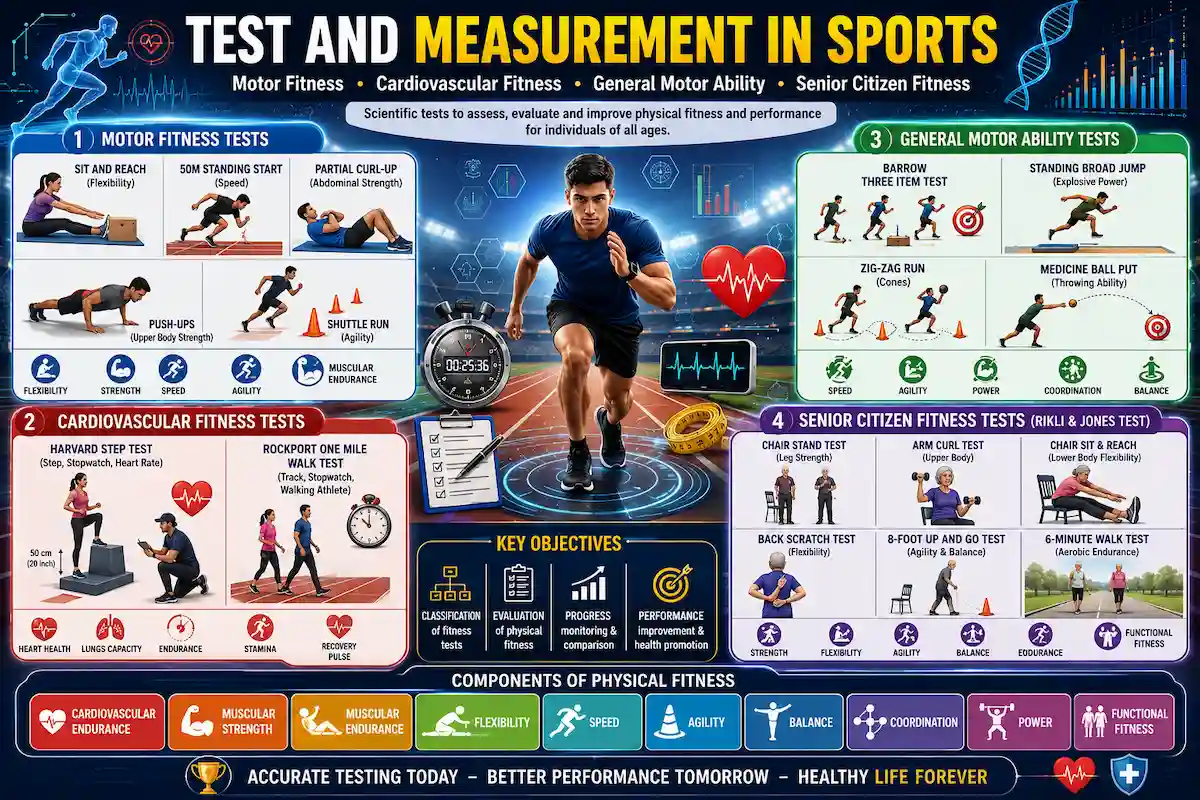
The Khelo India Fitness Assessment Program was initiated by the Sports Authority of India (SAI) and the Ministry of Youth Affairs and Sports, Government of India. The primary vision behind this initiative is to evaluate the physical fitness levels levels of school children across the nation, identify grass-root level athletic talent, and build a culture of sports and active living. Instead of relying on random selections, this test provides a standardized, data-driven approach to measuring fundamental physical components such as speed, flexibility, strength, endurance, and body composition.
To ensure age-appropriate evaluation, the test battery is scientifically divided into two major age categories: 5 to 8 years (Classes 1 to 3) and 9 to 18+ years (Classes 4 to 12).
Assessment for Age Group 5–8 Years (Classes 1 to 3)
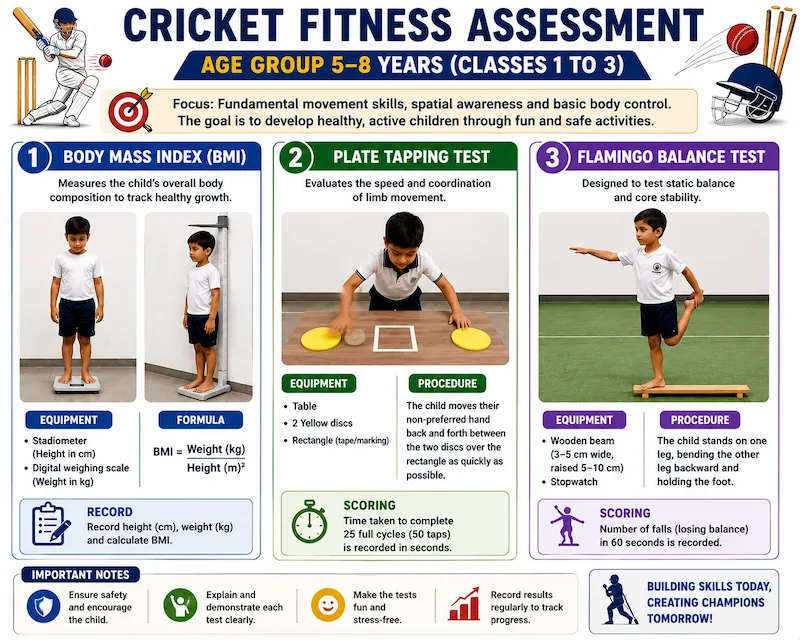
For this younger demographic, the focus is entirely on measuring fundamental movement skills, spatial awareness, and basic body control rather than intense cardiovascular or strength metrics.
Body Mass Index (BMI): This measures the child’s overall body composition to track healthy growth. The child’s height is measured using a stadiometer (in centimeters), and weight is measured using a digital scale (in kilograms). The formula applied is BMI = Weight (kg) / Height (m)².
Plate Tapping Test: This test evaluates the speed and coordination of limb movement. The child stands in front of a table featuring two yellow discs and a rectangle in the middle. The student moves their non-preferred hand back and forth between the two discs over the rectangle as quickly as possible. The time taken to complete 25 full cycles (50 taps) is recorded.
Flamingo Balance Test: Designed to test static balance and core stability. The child stands on a small wooden beam on one leg, bending the other leg backward and holding the top of the foot like a flamingo. The tester records the number of falls (losing balance) in a 60-second period.
Cricket Fitness Assessment for Age Group 5–8 Years (Classes 1–3): This educational infographic explains three essential physical fitness assessments—Body Mass Index (BMI), Plate Tapping Test, and Flamingo Balance Test. These tests help evaluate healthy growth, hand-eye coordination, movement speed, static balance, and overall motor skill development in young children through safe and age-appropriate activities.
Assessment for Age Group 9–18+ Years (Classes 4 to 12)
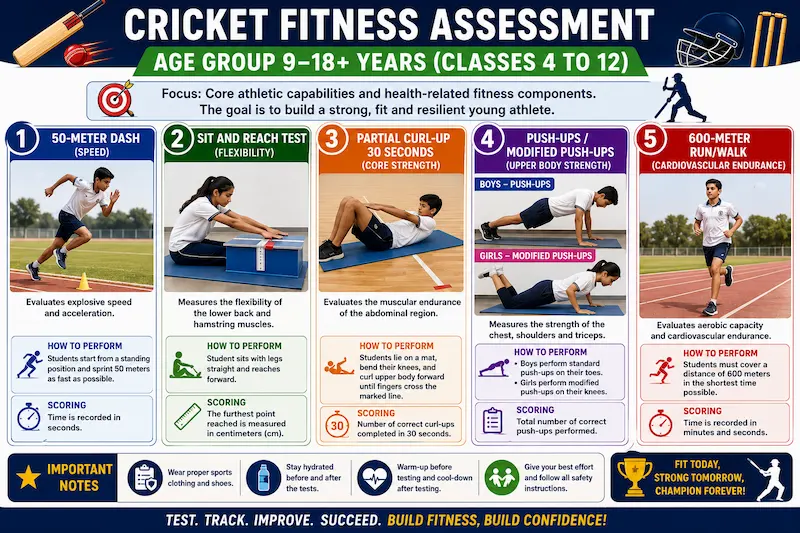
50-Meter Dash (Speed): Evaluates explosive speed and acceleration. Students start from a standing position and sprint 50 meters as fast as possible. The time is recorded in seconds.
Sit and Reach Test (Flexibility): Uses a specialized box to measure the flexibility of the lower back and hamstring muscles. The student sits with legs straight and reaches forward; the furthest point reached is measured in centimeters.
Partial Curl-Up 30 Seconds (Core Strength): Evaluates the muscular endurance of the abdominal region. Students lie on a mat, bending their knees, and curl their upper body forward until their fingers cross a designated marker line, repeating as many times as possible in 30 seconds.
Push-Ups / Modified Push-Ups (Upper Body Strength): Boys perform standard push-ups on their toes, while girls perform modified push-ups resting on their knees. It measures the strength of the chest, shoulders, and triceps.
600-Meter Run/Walk (Cardiovascular Endurance): Evaluates aerobic capacity. Students must cover a distance of 600 meters in the shortest time possible, indicating the efficiency of their heart and lungs.
Physical Fitness Assessment for Age Group 9–18+ Years (Classes 4–12): This educational infographic explains five standard physical fitness tests used in schools to assess speed, flexibility, core muscular endurance, upper-body strength, and cardiovascular endurance. It includes the 50-Meter Dash, Sit and Reach Test, Partial Curl-Up Test, Push-Up/Modified Push-Up Test, and 600-Meter Run/Walk, helping students, teachers, and coaches evaluate overall physical fitness.
Topic 2: Measurement of Cardiovascular Fitness – Harvard Step Test
Introduction to Cardiovascular Fitness
Cardiovascular fitness (or aerobic endurance) is the ability of the heart, lungs, and blood vessels to supply oxygenated blood to the working muscles efficiently during prolonged physical activity. It is considered one of the most critical components of physical health and athletic performance. The Harvard Step Test is a globally recognized, standardized method for measuring this specific type of endurance.
History and Purpose
The Harvard Step Test was developed by Lucien Brouha and his associates at Harvard University in 1943. Originally designed to evaluate the physical stamina of military personnel during World War II, it quickly became a staple in sports science. The primary purpose of this test is to measure the cardiovascular endurance of an individual by observing how quickly their resting heart rate recovers after a strenuous period of stepping exercise.
Equipment and Test Administration
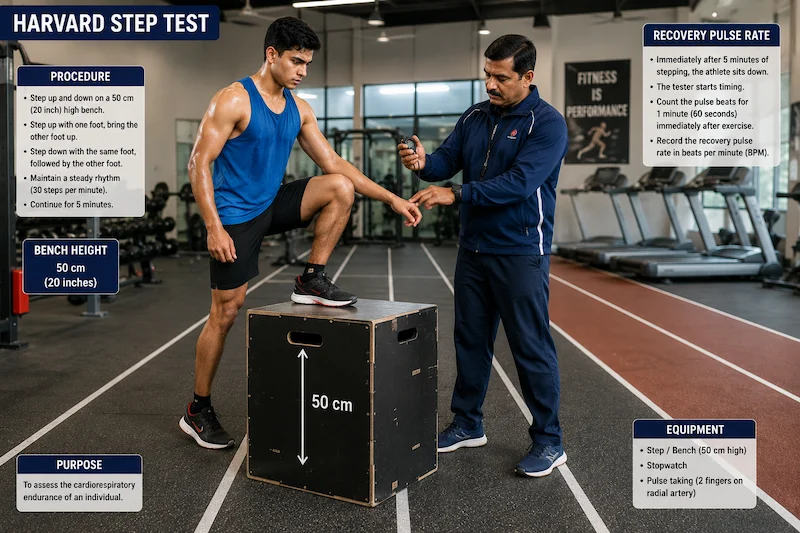
The equipment required is highly minimal and cost-effective, which makes it an excellent choice for schools and academies. It requires a sturdy wooden gym bench or step box (traditionally 20 inches high for men and 16 inches high for women), a stopwatch, and a metronome to maintain a consistent stepping rhythm.
The Procedure:
The athlete stands in front of the bench. The metronome is set to a pace of 120 beats per minute, which dictates 30 complete step-ups and step-downs per minute.
On the command “Go,” the athlete steps up onto the bench (leading with one foot, then the other) and steps back down in a continuous “up-up-down-down” rhythm.
This exercise continues non-stop for exactly 5 minutes (or until the athlete is completely exhausted and cannot maintain the pace for 15 consecutive seconds).
As soon as the 5 minutes are over (or the athlete stops), they immediately sit down on the bench.
Pulse Rate Recovery and Calculation
The most crucial part of the test is counting the heartbeats during the recovery phase to calculate the Fitness Index Score. There are two methods for calculating this:
1. Long-Term Method: The pulse is measured at three distinct intervals after the exercise ends:
From 1 minute to 1.5 minutes (Pulse 1)
From 2 minutes to 2.5 minutes (Pulse 2)
From 3 minutes to 3.5 minutes (Pulse 3)
The formula used is:
Fitness Index=2×(Sum of Pulse 1+Pulse 2+Pulse 3)100×Test Duration in Seconds
2. Short-Term Method: If time is limited, the pulse is counted only once, from 1 minute to 1.5 minutes after the exercise stops. The formula used is:
Fitness Index=5.5×(Pulse count between 1 and 1.5 min)100×Test Duration in Seconds
By applying these formulas, the resulting score classifies the athlete’s cardiovascular condition into categories ranging from “Poor” to “Excellent.” This helps coaches design personalized aerobic conditioning programs
Harvard Step Test: A student performs the Harvard Step Test on a 50 cm step bench while a coach measures the recovery pulse rate using a stopwatch. This test is widely used in Physical Education to evaluate cardiorespiratory endurance, aerobic fitness, and cardiovascular efficiency.
Topic 3: Computing Basal Metabolic Rate (BMR)
Understanding Basal Metabolic Rate
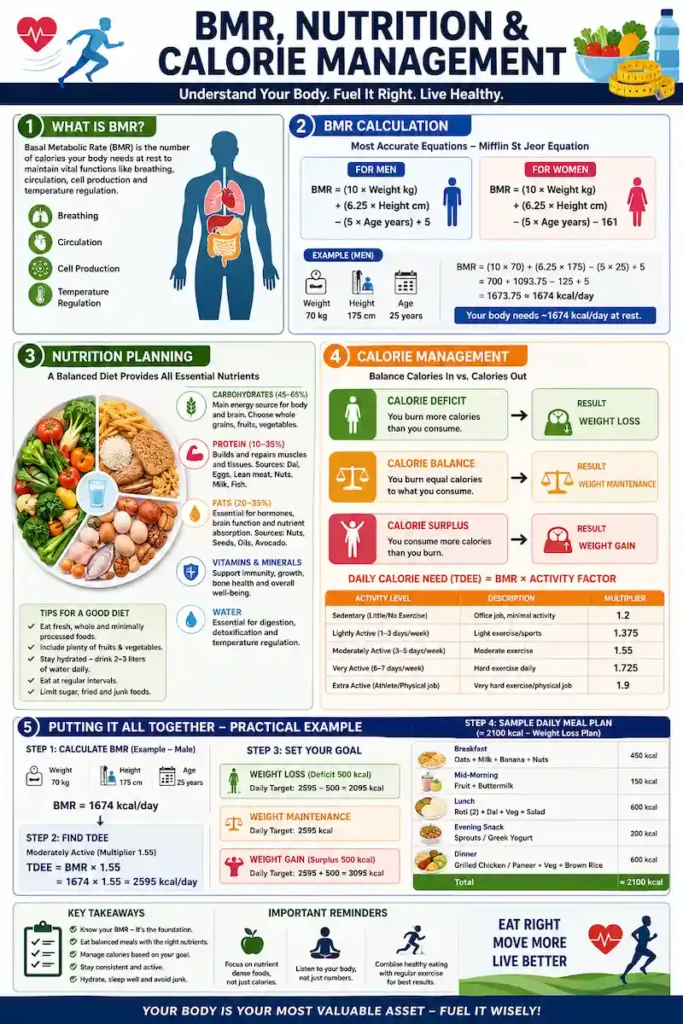
Basal Metabolic Rate, commonly referred to as BMR, is a fundamental concept in sports nutrition and physical education. It represents the absolute minimum number of calories (energy) your body requires to maintain basic, life-sustaining physiological functions while at complete physical and mental rest. These vital functions include breathing, blood circulation, cellular repair, brain function, and maintaining core body temperature. Even if you were to sleep in a dark room for 24 hours without moving a single muscle, your body would still burn calories equal to your BMR.
Importance of BMR for Athletes and Students
Understanding one’s BMR is the very first step in designing any athletic diet or weight management program. Since BMR accounts for approximately 60% to 75% of an individual’s total daily energy expenditure (TDEE), it serves as the baseline metric.
For Weight Loss: An athlete looking to drop body fat must consume calories below their total energy expenditure, but optimally never below their BMR to avoid muscle loss and metabolic slowdown.
For Muscle Gain: Athletes seeking to build muscle (hypertrophy) need to consume a caloric surplus above their TDEE, which starts by accurately calculating their BMR.
BMR is heavily influenced by several factors, including genetics, age, gender, and body composition. Individuals with a higher percentage of lean muscle mass naturally have a higher BMR because muscle tissue requires more metabolic energy to sustain itself compared to adipose (fat) tissue.
The Harris-Benedict Equation
The most widely used and scientifically accepted method for computing BMR without expensive laboratory equipment is the Harris-Benedict Equation. Revised over the years for accuracy, it factors in a person’s weight, height, age, and biological sex. Because men generally possess a higher percentage of lean muscle mass and less body fat than women of the exact same weight and height, the equations are distinct for each gender.
Formula for Men:
BMR=88.362+(13.397×weight in kg)+(4.799×height in cm)−(5.677×age in years)
Formula for Women:
BMR=447.593+(9.247×weight in kg)+(3.098×height in cm)−(4.330×age in years)
Example Application: If a 17-year-old male athlete weighs 70 kg and is 175 cm tall, a coach can plug these exact numbers into the formula to discover his resting metabolic needs. Once the BMR is calculated, the coach multiplies it by an “Activity Multiplier” (ranging from 1.2 for sedentary individuals to 1.9 for elite athletes) to determine the exact number of calories the student needs every day to perform optimally in their sport.
BMR Calculation, Nutrition & Calorie Management: This educational infographic explains how to calculate Basal Metabolic Rate (BMR), estimate daily calorie needs (TDEE), plan a balanced diet with carbohydrates, proteins, and fats, and manage calories for weight loss, weight maintenance, and muscle gain through proper nutrition and physical activity.
Topic 4: Rikli and Jones – Senior Citizen Fitness Test
The Need for Assessing Senior Citizens
While youth and adult fitness tests focus on elite performance, speed, and competitive strength, evaluating the physical fitness of senior citizens requires a completely different perspective. As people age, they naturally experience a decline in bone density, muscle mass, joint flexibility, and cardiovascular capacity. Therefore, the goal of testing older adults is not to measure athletic excellence, but to assess Functional Fitness—the physical capacity needed to perform normal everyday activities independently, without excessive fatigue or risk of injury. Activities like getting out of a chair, lifting groceries, walking up stairs, or reaching for an item on a high shelf become the core focus.
History and Development
To address this specific need, Dr. Roberta Rikli and Dr. Jessie Jones developed the “Senior Citizen Fitness Test” (often referred to as the Fullerton Functional Test) in 2001 at California State University, Fullerton. It is a highly respected, safe, and practical battery of tests designed specifically for adults over the age of 60. The tests require minimal equipment and can be conducted in community centers, clinics, or homes.
The Six Items of the Test Battery
The Rikli and Jones test battery comprehensively evaluates the major physiological components necessary for independent living. It consists of six specific test items, each taking minimal time to administer:
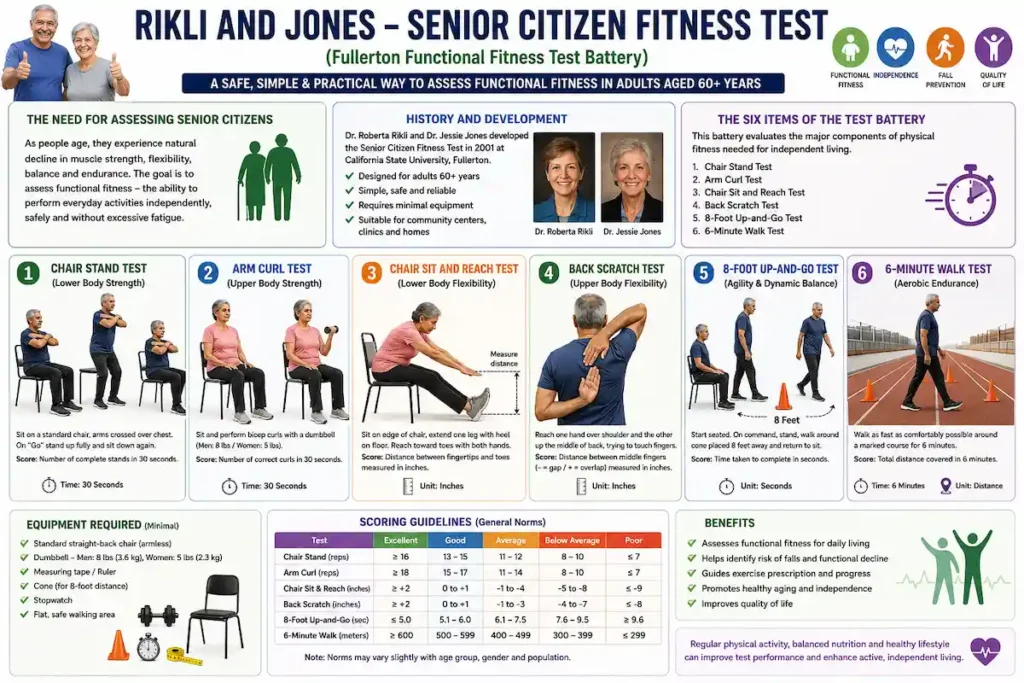
Chair Stand Test (Lower Body Strength): Lower body strength is vital for walking and stair climbing. In this test, the senior sits on a standard straight-backed chair with their arms crossed over their chest. On the “Go” signal, they stand up fully and sit back down. The score is the total number of complete stands executed within a 30-second timeframe.
Arm Curl Test (Upper Body Strength): This measures the upper body strength required for household chores and carrying items. The participant sits on a chair and performs bicep curls using a dumbbell (typically 8 lbs for men and 5 lbs for women). The score is the total number of correct curls completed in 30 seconds.
Chair Sit and Reach Test (Lower Body Flexibility): Adequate hamstring and lower back flexibility prevents lower back pain and aids in walking. The participant sits on the edge of a chair, extends one leg straight out with the heel on the floor, and reaches toward their toes with both hands. The distance between the fingertips and the toes is measured in inches.
Back Scratch Test (Upper Body Flexibility): This evaluates shoulder joint mobility, which is necessary for tasks like combing hair or zipping up a dress. The participant reaches one hand over their shoulder behind their head and the other hand up the middle of their back, trying to touch their fingers together. The gap or overlap is measured.
8-Foot Up-and-Go Test (Agility and Dynamic Balance): This is a critical test for fall prevention. The participant starts seated in a chair. On command, they stand up, walk quickly around a cone placed exactly 8 feet away, and return to a seated position. The time is recorded in seconds.
6-Minute Walk Test (Aerobic Endurance): To assess cardiovascular endurance, the participant walks as fast as they comfortably can around a measured rectangular course for exactly 6 minutes. The total distance covered is measured, reflecting their heart and lung efficiency.
Rikli and Jones Senior Citizen Fitness Test (Fullerton Functional Fitness Test): This educational infographic explains the six functional fitness assessments used to evaluate lower-body strength, upper-body strength, flexibility, agility, dynamic balance, and aerobic endurance in older adults. The test battery helps determine an individual’s ability to perform daily activities independently and safely.
Conclusion: Test and Measurement in Sports (Chapter Summary)
The primary objective of this chapter is to understand how the fitness of athletes and general individuals is measured scientifically. A ‘Test’ is a tool or instrument, while ‘Measurement’ is the specific data or score obtained from that test. Through this chapter, we have learned that:
Motor Fitness: Speed, endurance, strength, and flexibility can be accurately evaluated through tests like the 50m Standing Start, 600m Run/Walk, Sit & Reach, and Push-ups.
Cardiovascular Fitness: The Harvard Step Test and the Rockport One Mile Test are the most proven methods for measuring the functional capacity of the heart and lungs ($VO_2$ Max and Fitness Index).
General Motor Ability: The Barrow 3-Item Test (Standing Broad Jump, Zig-Zag Run, Medicine Ball Put) is an excellent way to measure an athlete’s agility and explosive strength.
Senior Citizen Fitness: To safely measure the functional fitness and ability to perform Activities of Daily Living (ADL) in older adults, the Rikli and Jones Test is utilized.
Without proper testing and measurement, it is impossible to evaluate the success or effectiveness of any sports training program
Frequently Asked Questions (FAQs)
Objective Type Questions (1 Mark)
Q1. What is the weight of the medicine ball used for boys in the Barrow 3-Item Test? +
A) 1 kg
B) 2 kg
C) 3 kg
D) 4 kg
Ans. C) 3 kg
Q2. Which of the following tests is used to measure cardiovascular fitness? +
A) Sit and Reach Test
B) Harvard Step Test
C) Push-ups
D) Standing Broad Jump
Ans. B) Harvard Step Test
Q3. The ‘Chair Stand Test’ for senior citizens is designed to measure: +
A) Upper body strength
B) Lower body strength
C) Agility
D) Flexibility
Ans. B) Lower body strength
Q4. What is the standard height of the bench used for girls in the Harvard Step Test? +
A) 16 inches
B) 18 inches
C) 20 inches
D) 22 inches
Ans. A) 16 inches
Q5. Which of the following is NOT a part of the Rikli and Jones Senior Citizen Fitness Test? +
A) 8-Foot Up and Go Test
B) Back Scratch Test
C) Zig-Zag Run
D) 6-Minute Walk Test
Ans. C) Zig-Zag Run (Note: Zig-Zag run is part of the Barrow 3-Item Test)
Very Short Answer Type Questions (2 Marks)
Q6. What is the main difference between a Test and a Measurement? +
Ans. A test is a specific tool, procedure, or technique used to collect data regarding an individual’s skill or physical fitness. Measurement is the quantitative data, score, or time obtained as a result of administering that test.
Q7. Which three events are included in the Barrow Three-Item Test? +
Ans. The Barrow Three-Item Test measures General Motor Ability and includes the following three events:
Standing Broad Jump (for explosive leg strength)
Zig-Zag Run (for agility)
Medicine Ball Put (for arm and shoulder strength)
Q8. What is the standard height of the bench or box used in the Harvard Step Test? +
Ans. In the Harvard Step Test, the standard height of the bench or box is 20 inches (50.8 cm) for men/boys and 16 inches (40.6 cm) for women/girls.
Q9. What is the primary purpose of the ‘Back Scratch Test’ in the Rikli and Jones test? +
Ans. The primary purpose of the ‘Back Scratch Test’ is to measure the flexibility of the upper body (specifically the shoulders). This flexibility is essential for senior citizens to easily perform daily tasks, such as getting dressed or reaching for objects above their heads.
Short Answer Type Questions (3 Marks)
Q10. How do the objectives of the 50m Standing Start and the 600m Run/Walk tests differ? +
Ans.
50m Standing Start: This test is primarily conducted to measure an athlete’s acceleration and maximum speed. The subject is required to cover the 50-meter distance in the shortest possible time.
600m Run/Walk: The objective of this test is to measure cardiovascular endurance. It evaluates how quickly an athlete can cover a 600-meter distance, testing stamina over a longer period.
Q11. How is the ‘Fitness Index’ calculated in the Harvard Step Test? Write the formula. +
Ans. The Fitness Index indicates an individual’s cardiovascular recovery rate. Using the short form method, the pulse is counted for 30 seconds (from 1 minute to 1.5 minutes after finishing the step test).
Formula: Fitness Index = (100 × Test Duration in Seconds) / (5.5 × Pulse count between 1 to 1.5 min after the test)
Q12. Explain the administration procedure for the ‘Sit and Reach’ test. +
Ans.
Objective: To measure the flexibility of the lower back and hamstring muscles.
Equipment: A standard Sit and Reach Box.
Procedure: The athlete sits on the floor barefoot, with legs fully extended and the soles of the feet flat against the box. With hands placed one on top of the other, the athlete slowly reaches forward along the measuring scale as far as possible without jerking. The maximum reach is held for a couple of seconds and recorded in centimeters.
Q13. Explain the procedure for the ‘8-Foot Up and Go Test’ in Senior Citizen Fitness. +
Ans.
Objective: To measure agility and dynamic balance in older adults.
Procedure: A chair is placed against a wall, and a cone is positioned exactly 8 feet away from the front of the chair. On the “Go” command, the senior citizen stands up from the chair, walks as quickly and safely as possible around the cone, and returns to sit back in the chair. The total time taken to complete this circuit is recorded in seconds.
Long Answer Type Questions (5 Marks)
Q14. What is cardiovascular fitness? Detail the procedure of the ‘Rockport One Mile Test’ and the formula used to calculate VO2 Max. +
Ans. Cardiorespiratory/Cardiovascular Fitness: It is the ability of the heart, lungs, and blood vessels to efficiently supply oxygen to the working muscles during sustained physical activity.
Rockport One Mile Test Procedure: This test is highly suitable for individuals who are unable to run, such as beginners or older adults.
Execution: The individual is required to walk 1 mile (1609 meters) as quickly as possible on a standard 400-meter track.
Data Collection: Immediately upon completing the mile, the total time is recorded, and the heart rate (pulse) is counted for 15 seconds. This count is multiplied by 4 to determine beats per minute (bpm).
VO2 Max Formula:
VO2 Max = 132.853 – (0.0769 × Weight in lbs) – (0.3877 × Age) + (6.315 × Gender: Male=1, Female=0) – (3.2649 × Time in minutes) – (0.1565 × Heart Rate)
Q15. Name any five tests included in the Rikli and Jones Senior Citizen Fitness Test and state the specific purpose of each. +
Ans. Developed by Dr. Roberta Rikli and Dr. Jessie Jones, this test battery assesses the functional fitness of older adults. Five key tests include:
Chair Stand Test: Measures lower body strength, vital for getting in and out of a chair or vehicle (30 seconds duration).
Arm Curl Test: Measures upper body strength, necessary for lifting everyday household items (30 seconds duration using 5 lbs/8 lbs dumbbells).
Chair Sit and Reach Test: Measures lower body flexibility (lower back and hamstrings).
Back Scratch Test: Measures upper body flexibility (shoulders).
6-Minute Walk Test: Measures cardiovascular endurance by evaluating total distance walked safely within 6 minutes.
Q16. Describe the procedure and utility of the ‘Partial Curl-up’ and ‘Push-ups’ tests under the Motor Fitness Test. +
Ans.
Partial Curl-up (Abdominal Strength):
Utility: Measures the strength and endurance of abdominal muscles.
Procedure: Athlete lies supine with knees bent and feet flat. Arms are straight at the sides. Following a metronome beat, shoulders are curled up off the floor and smoothly lowered back down until exhaustion or rhythm break.
Push-ups (Boys) / Modified Push-ups (Girls):
Utility: Measures upper body strength targeting chest, shoulders, and triceps.
Procedure (Boys): Body is supported on hands and toes, back straight, lowering the chest to 90 degrees elbow bend and pushing back up.
Procedure (Girls): Performed as a modified version with weight supported on hands and knees instead of toes. Maximum correct repetitions are recorded.
Q17. What is General Motor Ability? Explain the complete procedure of the Barrow 3-Item Test used to evaluate it. +
Ans. General Motor Ability refers to an individual’s overall capacity to perform a variety of physical activities effectively using speed, agility, and strength. The Barrow 3-Item Test evaluates this through three events:
Standing Broad Jump: Athlete stands behind a take-off line, swings arms, bends knees, and jumps forward landing on both feet simultaneously. Distance from the line to the closest landing point (heel) is measured (best of 3 attempts).
Zig-Zag Run: Five cones are placed in a 16×10 feet area. The athlete sprints in a Figure-8 pattern across three continuous laps, timed with a stopwatch to measure agility.
Medicine Ball Put: Using a 3 kg ball (boys) or 1 kg ball (guests/girls), the athlete throws the ball forward using both hands from behind a boundary line using a shot-put style technique to measure arm and shoulder explosive strength.
📊 Continue Your Fitness Learning
Use your understanding of fitness assessment to explore the major components of physical performance.