
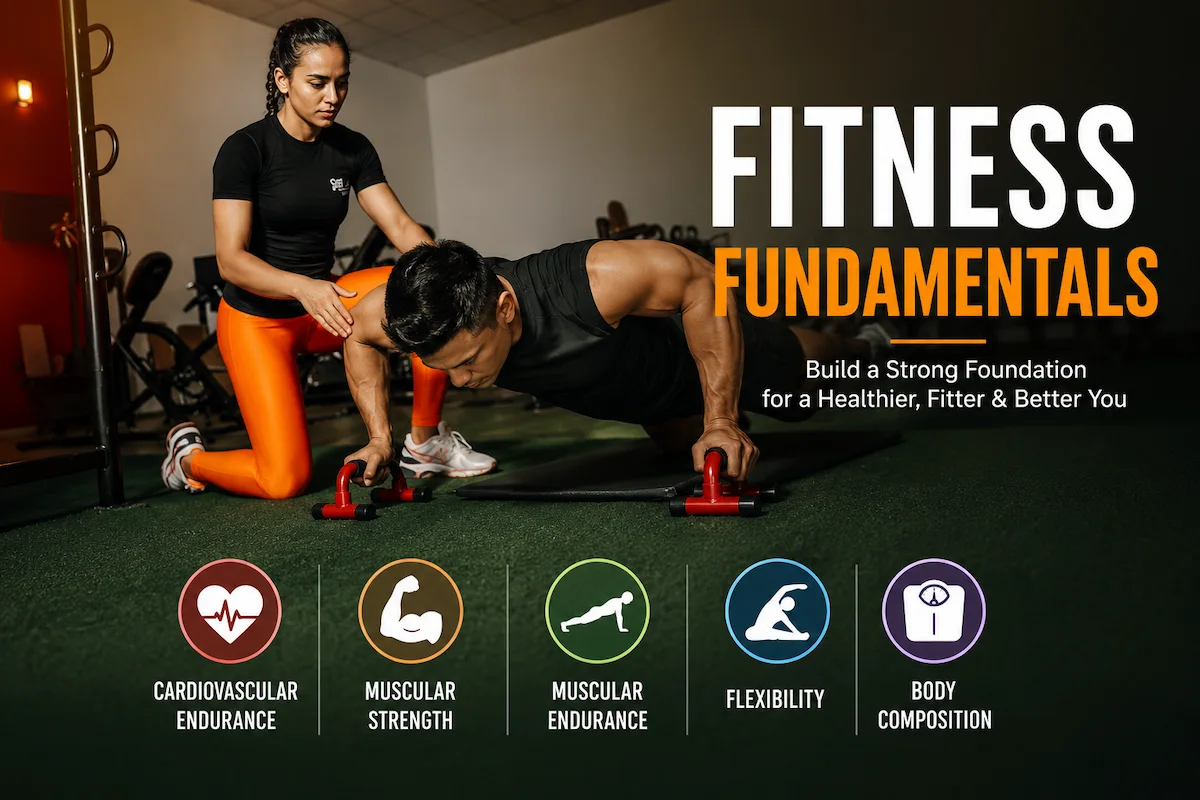
Physical fitness is not simply about lifting heavy weights, running long distances, or looking athletic. It is about developing the physical capacity to perform everyday activities effectively, participate in exercise or sport, and support long-term health and well-being.
Understanding fitness fundamentals gives you the foundation for making exercise safer, more structured, and more purposeful. Instead of randomly choosing workouts, you can understand what fitness includes, which areas you need to develop, and how training can be adjusted according to your goals, abilities, and lifestyle.
This guide explains the major components of physical fitness, the FITT principle, fundamental training principles, practical ways to build a balanced fitness routine, common mistakes to avoid, and important safety considerations.
Quick Answer
Fitness fundamentals are the basic components and training principles that help people understand and develop physical fitness effectively.
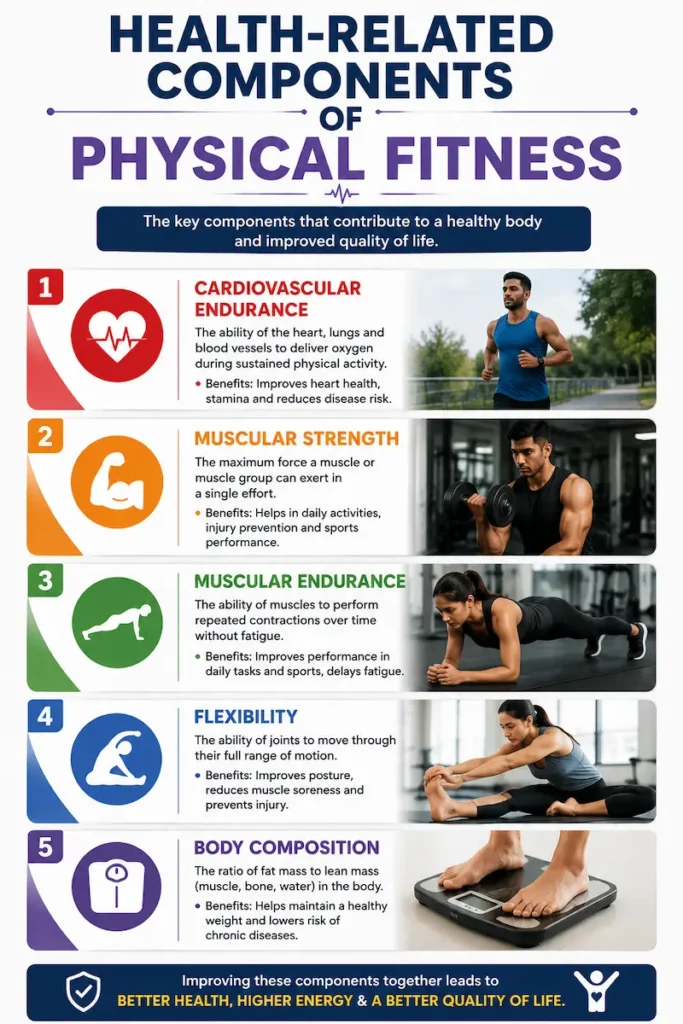
The major health-related components of fitness are cardiorespiratory endurance, muscular strength, muscular endurance, flexibility, and body composition.
Effective training also involves principles such as frequency, intensity, time, type, overload, progression, specificity, individuality, consistency, and recovery.
What Is Physical Fitness?
Physical fitness can be understood as the ability to perform physical activities and everyday tasks effectively while maintaining the capacity to participate in exercise, recreation, and other physical demands.
Fitness is not a single ability.
A person may have excellent muscular strength but relatively limited cardiorespiratory endurance. Another person may have excellent flexibility but less muscular strength.
Similarly, a distance runner, weightlifter, gymnast, football player, and recreational exerciser may all be physically fit in different ways.
This is why physical fitness should be understood as a combination of several interconnected qualities rather than a single measure.
Physical Activity, Exercise, and Physical Fitness
Although these terms are related, they do not mean exactly the same thing.
Physical activity includes bodily movement that requires energy expenditure. Walking, cycling, household activities, active recreation, and playing sports are examples.
Exercise is a planned and structured form of physical activity generally performed to develop or maintain one or more components of fitness.
Physical fitness refers to the physical qualities and capacities that allow a person to perform activity effectively.
For example, a planned 30-minute brisk walk is exercise. Performing that activity regularly may contribute to improved cardiorespiratory fitness.
In simple terms, exercise is one method used to develop fitness, while fitness describes the capacities being developed.
Why Are Fitness Fundamentals Important?
Fitness fundamentals provide a framework for understanding what to train, why to train it, and how exercise can be organized effectively.
Without this foundation, exercise can become a collection of random workouts rather than a structured process.
Regular physical activity is associated with important physical and mental health benefits. The World Health Organization (WHO) emphasizes that physical activity contributes to the health of the heart, body, and mind and can help prevent or manage several noncommunicable diseases.
Understanding fitness fundamentals can help people:
- choose activities that match their goals;
- develop multiple areas of physical fitness;
- understand training intensity and volume;
- progress more gradually;
- include appropriate recovery;
- recognize individual differences;
- avoid unrealistic expectations; and
- develop sustainable physical-activity habits.
For students of Physical Education, these fundamentals also provide a foundation for understanding exercise science, sports training, health-related fitness, and athletic performance.
Components of Physical Fitness
Physical fitness is commonly discussed through two broad groups:
- Health-related components of fitness
- Skill-related components of fitness
Health-related components are particularly important for general health and physical functioning.
Skill-related components become especially relevant in sports and activities that require specialized movement and performance abilities.
1. Cardiorespiratory Endurance
Cardiorespiratory endurance is the ability of the cardiovascular and respiratory systems to support sustained physical activity.
Activities such as brisk walking, running, cycling, swimming, and continuous sports can challenge this component.
Good cardiorespiratory fitness helps a person sustain physical activity for longer periods without becoming excessively fatigued.
For adults, WHO recommends generally accumulating 150–300 minutes of moderate-intensity aerobic physical activity per week, or 75–150 minutes of vigorous-intensity aerobic activity, or an equivalent combination.
These are population-level health recommendations rather than individualized exercise prescriptions.
2. Muscular Strength
Muscular strength refers to the ability of a muscle or muscle group to produce force.
Resistance exercises involving lifting, pushing, pulling, or moving against resistance can help develop muscular strength when appropriately programmed. Learn more in our Strength & Conditioning guide.
Strength is important not only for athletes.
It contributes to many everyday activities, including lifting objects, carrying loads, climbing stairs, and performing physically demanding tasks.
3. Muscular Endurance
Muscular endurance is the ability of muscles to perform repeated contractions or maintain muscular effort over time.
It is different from maximal muscular strength.
For example, repeatedly performing bodyweight squats involves muscular endurance, while producing very high force during a heavy lift places greater emphasis on muscular strength.
Both qualities can be valuable depending on the person’s activity and goals.
4. Flexibility
Flexibility refers to the available range of motion around a joint or group of joints.
Adequate flexibility can support movement and help a person perform activities requiring particular ranges of motion.
Stretching and mobility exercises can form part of a balanced fitness program, although individual flexibility needs vary according to the person and activity.
5. Body Composition
Body composition describes the relative proportions of different tissues that make up the body, including fat mass and fat-free tissues such as muscle and bone.
Body composition should not be confused simply with body weight.
Two people with the same body weight may have substantially different body compositions.
It is also important to recognize that body composition is only one component of physical fitness. It should not be used alone to judge a person’s health, fitness, athletic ability, or personal value.
Skill-Related Components of Fitness
Physical fitness also includes qualities that are especially important for skilled movement and sports performance.
Common skill-related components include:
| Component | What It Represents | Example |
|---|---|---|
| Speed | Ability to perform movement rapidly | Sprinting |
| Agility | Ability to change direction effectively | Changing direction in football |
| Balance | Ability to maintain body control | Gymnastics |
| Coordination | Ability to organize movements efficiently | Catching a ball |
| Power | Ability to produce force rapidly | Jumping |
| Reaction Time | Ability to respond quickly to a stimulus | Responding to a starting signal |
The importance of each component depends on the activity or sport.
For example, a sprinter requires a different combination of physical abilities than a marathon runner, while a gymnast has different performance demands from a football player. Learn how to develop faster movement, acceleration, reaction, and change-of-direction skills in our Speed & Agility guide.
Understanding the FITT Principle
The FITT principle provides a simple framework for organizing exercise.
FITT stands for:
Frequency – Intensity – Time – Type
These four variables can be adjusted according to the person’s fitness level, activity, goals, and circumstances.
Frequency – How Often?
Frequency refers to how often an activity is performed.
Examples include:
- walking five days per week;
- resistance training two or three days per week; or
- performing mobility activities on several days.
The appropriate frequency depends on the activity, intensity, training status, goals, and recovery requirements.
Intensity – How Hard?
Intensity refers to how hard the body is working during an activity.
A gentle walk and a fast run are both aerobic activities, but they represent very different levels of intensity.
Depending on the activity, intensity may be monitored using measures such as:
- perceived effort;
- pace or speed;
- heart rate;
- resistance or load; or
- exercise difficulty.
The appropriate intensity depends on the individual and the purpose of the session.
Time – How Long?
Time refers to the duration of an exercise session or activity.
Examples include:
- 30 minutes of brisk walking;
- a 45-minute resistance-training session; or
- a shorter period of higher-intensity activity.
More time is not automatically better.
Exercise duration should be appropriate for the intensity, activity, individual, and goal.
Type – What Activity?
Type refers to the kind of physical activity or exercise being performed.
Examples include:
- walking;
- running;
- swimming;
- cycling;
- resistance training;
- mobility exercises; and
- recreational sports.
The type of activity should be selected according to the fitness component or goal being developed.
A Simple FITT Example
Suppose a generally healthy beginner wants to develop aerobic fitness through brisk walking.
A simple starting framework might look like this:
| FITT Variable | Example |
|---|---|
| Frequency | 3–5 days per week |
| Intensity | Comfortable to moderate effort |
| Time | Begin with a manageable duration and gradually progress |
| Type | Brisk walking |
This is an educational example and not an individualized exercise prescription.
Exercise requirements can vary according to age, health, disability, training experience, medications, goals, and other individual factors.
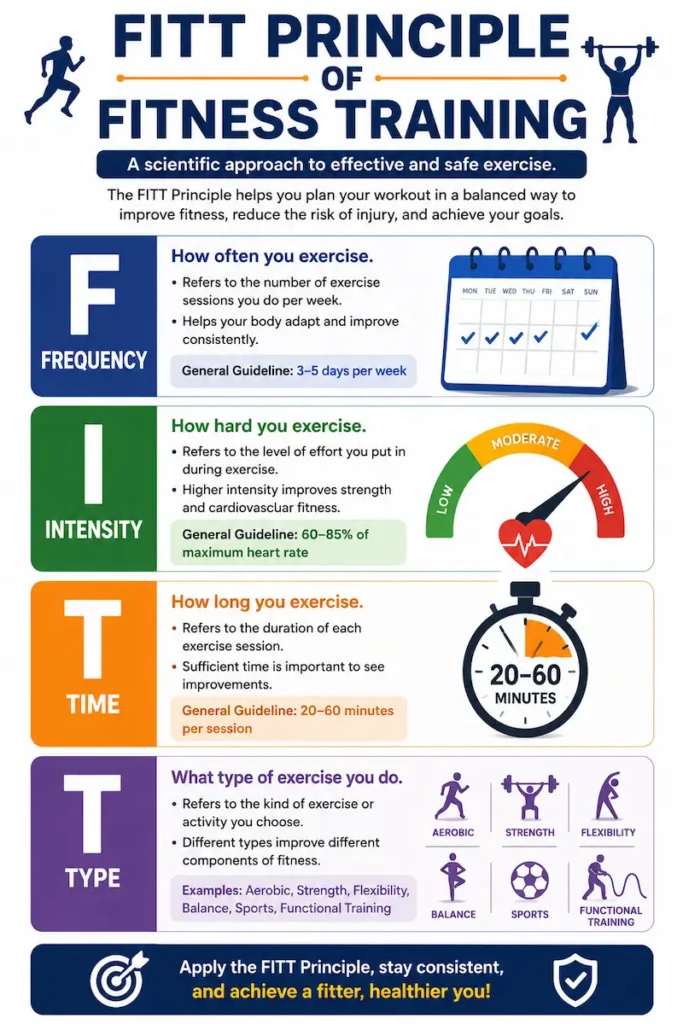
The FITT Principle explains how frequency, intensity, time and type can be used to structure fitness training.Fundamental Principles of Fitness Training
Understanding FITT is important, but effective fitness training also involves several broader principles.
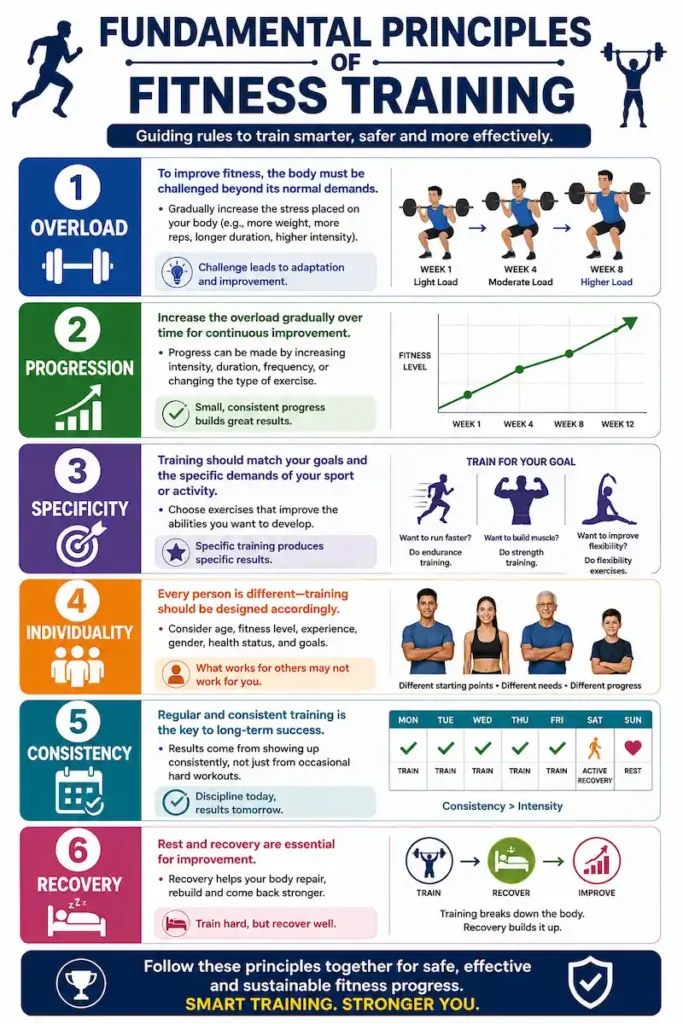
Six fundamental principles of fitness training: overload, progression, specificity, individuality, consistency and recovery.Overload
The body generally requires an appropriate challenge to stimulate adaptation.
If training never challenges the body beyond what it is already accustomed to, improvement may eventually slow.
However, overload does not mean exercising as hard as possible during every workout.
The training challenge should remain appropriate and manageable.
Progression
Training should progress gradually as physical capacity improves.
Progression may involve changing:
- resistance;
- repetitions;
- duration;
- frequency;
- intensity; or
- exercise complexity.
Increasing too many training variables too quickly can create unnecessary fatigue and may increase injury risk.
Specificity
The body adapts according to the demands placed upon it.
Therefore, training should reflect the desired outcome.
Someone who wants to improve endurance requires sufficient endurance-oriented activity.
Someone seeking greater muscular strength needs an appropriate form of resistance training.
Athletic performance may require even greater specificity according to the demands of the sport.
Individuality
People do not respond to exercise in exactly the same way.
Training response can be influenced by factors such as:
- age;
- previous training experience;
- health status;
- sleep;
- nutrition;
- stress;
- injury history;
- lifestyle; and
- individual biological differences.
This is one reason why copying another person’s workout does not guarantee the same results.
Consistency
Fitness develops through repeated training over time.
A realistic routine that can be performed consistently is generally more sustainable than an extreme program that cannot be maintained.
Recovery
Training creates a physical stimulus, while recovery provides time for the body to respond to that stimulus.
Rest, sleep, nutrition, hydration, and appropriate training schedules are therefore important parts of the overall fitness process. Learn how nutrition, hydration, sleep, and rest support exercise recovery in our Recovery & Nutrition guide.
How to Build a Balanced Fitness Program
A balanced fitness program should generally avoid focusing exclusively on one fitness component.
For general fitness, a program may include a combination of:
Aerobic Activity
Activities such as brisk walking, cycling, swimming, jogging, or other continuous movements can help develop cardiorespiratory fitness.
Resistance Training
Appropriate resistance exercises can help develop muscular strength and endurance.
[INTERNAL LINK – Strength & Conditioning – ADD WHEN PUBLISHED]
Flexibility and Mobility
Flexibility and mobility activities can support useful ranges of motion and movement quality.
Learn how flexibility and mobility can improve range of motion and movement control in our Flexibility & Mobility guide.
Recovery
Appropriate recovery helps manage fatigue and supports continued participation in training.
The exact balance between these areas should depend on the individual’s goals, fitness level, health status, preferences, and circumstances.
Example of a Balanced Fitness Week
The following table demonstrates how different fitness elements might be distributed across a week.
| Day | Example Activity |
|---|---|
| Monday | Strength training + light mobility |
| Tuesday | Moderate aerobic activity |
| Wednesday | Recovery or light physical activity |
| Thursday | Strength training |
| Friday | Moderate aerobic activity |
| Saturday | Recreational activity, sport, or longer easy activity |
| Sunday | Rest or light mobility |
This is an educational example rather than a universal workout program.
Image Topic: Balanced Weekly Fitness Program
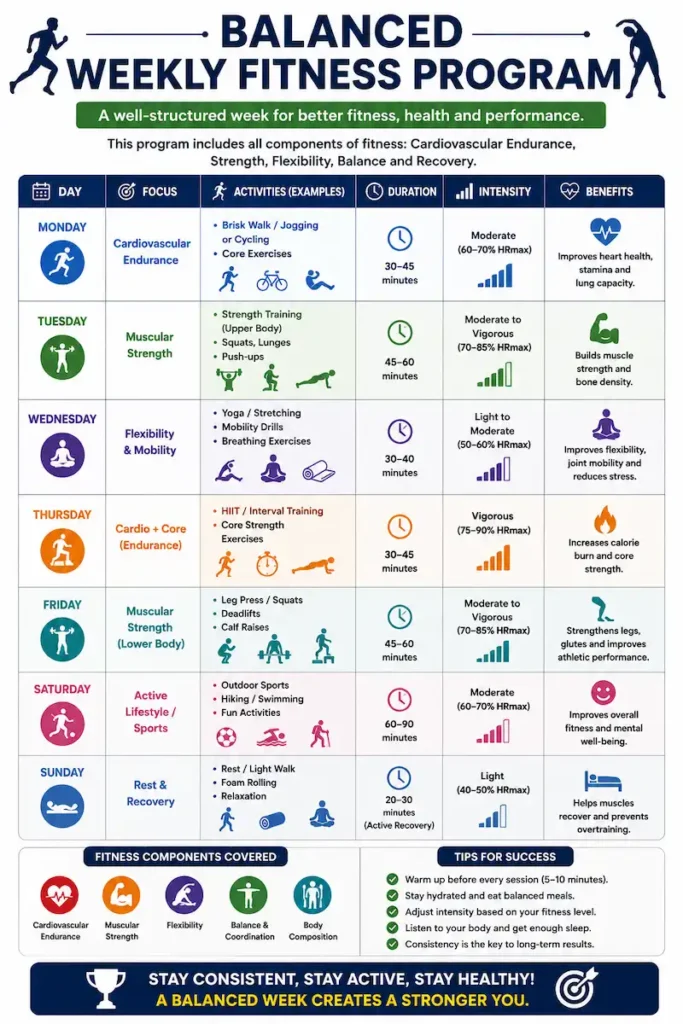
Example of a balanced weekly fitness program combining cardiovascular exercise, strength training, flexibility, mobility, active recreation and recovery.How Much Physical Activity Do Adults Need?
According to current WHO physical activity guidelines, adults should generally aim for 150–300 minutes of moderate-intensity aerobic physical activity per week, or 75–150 minutes of vigorous-intensity aerobic activity, or an equivalent combination.
Adults are also advised to perform muscle-strengthening activities involving major muscle groups on two or more days per week.
These recommendations provide a useful public-health benchmark, but they should not be treated as an individualized exercise prescription.
The appropriate amount and type of physical activity can vary according to health, age, ability, lifestyle, and personal goals.
Common Fitness Mistakes to Avoid
Understanding fitness fundamentals also involves recognizing common mistakes.
1. Doing Too Much Too Soon
Beginners sometimes increase exercise intensity, frequency, or duration too quickly.
Gradual progression gives the body time to adapt.
2. Training Only One Component
Performing only cardio or only resistance training can leave other areas of fitness underdeveloped.
The right balance depends on the individual’s goals.
3. Ignoring Recovery
More exercise does not automatically produce more improvement.
Fatigue can accumulate, which makes recovery an important part of training.
4. Copying Someone Else’s Program
A program designed for an experienced athlete may not be appropriate for a beginner.
Training should reflect individual capacity and goals.
5. Chasing Rapid Results
Physical adaptation requires time.
Programs promising dramatic results within extremely short periods should be approached critically.
6. Ignoring Exercise Technique
Exercise quality matters.
Appropriate technique, exercise selection, and progression become particularly important when resistance or complex movements are involved.
7. Treating Pain as Proof of Progress
Exercise can involve physical effort and temporary muscular discomfort, but significant or unusual pain should not simply be considered evidence of an effective workout.
Persistent or concerning symptoms should receive appropriate professional assessment.
Fitness Across Different Ages and Ability Levels
Fitness is relevant throughout life, but physical activity needs and appropriate exercise methods can change with age and individual circumstances.
Children and Adolescents
Children and adolescents benefit from varied physical activities that develop movement skills, fitness, muscle strength, and bone health.
WHO recommends that children and adolescents aged 5–17 average around 60 minutes per day of moderate-to-vigorous physical activity, with vigorous activities and activities that strengthen muscles and bones incorporated regularly.
Activities should remain appropriate for age and development.
Adults
Adults can combine aerobic activity, muscle-strengthening exercise, mobility work, recreation, and other forms of physical activity according to their needs and interests.
Long-term consistency is particularly important.
Older Adults
Physical activity remains important as people age.
Alongside aerobic and muscle-strengthening activities, older adults may benefit from activities that emphasize functional strength and balance, particularly where fall prevention is relevant.
People With Disabilities or Health Conditions
Fitness should be inclusive.
People living with disabilities or chronic health conditions can often participate in physical activity, although exercise may need to be adapted according to individual abilities and health status.
Where appropriate, professional guidance can help identify suitable activities.
Safety and When to Seek Professional Guidance
General fitness information cannot replace individualized medical or exercise advice.
People who are new to exercise should generally begin at a manageable level and progress gradually.
Professional guidance may be particularly important when someone:
- has a diagnosed medical condition;
- is recovering from surgery or a significant injury;
- experiences unexplained chest pain, fainting, or severe shortness of breath;
- has significant mobility limitations;
- is pregnant and has medical or exercise-related concerns;
- takes medication that may influence exercise response; or
- is uncertain whether a particular activity is appropriate.
A qualified healthcare professional can address medical concerns, while an appropriately qualified exercise professional can provide individualized exercise guidance where needed.
Fitness Fundamentals for Long-Term Health
Fitness should not be viewed only as a temporary challenge or short-term transformation.
Physical fitness develops and is maintained over time.
Regular physical activity is associated with important health benefits, and maintaining an active lifestyle can support physical and mental well-being throughout life.
This makes sustainability important.
A fitness program that fits realistically into a person’s lifestyle can be more useful in the long term than an extreme program that is difficult to maintain.
Fitness is therefore not simply about how hard you can exercise today.
It is also about developing the knowledge, physical capacity, and habits needed to remain active over time.
Frequently Asked Questions About Fitness Fundamentals
What are the five main components of physical fitness?
The five commonly recognized health-related components are cardiorespiratory endurance, muscular strength, muscular endurance, flexibility, and body composition.
What does FITT stand for?
FITT stands for Frequency, Intensity, Time, and Type. These variables provide a useful framework for planning and adjusting exercise.
What is the difference between physical activity and exercise?
Physical activity includes bodily movement that increases energy expenditure. Exercise is a planned and structured form of physical activity generally performed to develop or maintain fitness.
Is cardio enough to stay fit?
Cardiorespiratory exercise develops an important component of fitness, but overall physical fitness includes other qualities such as muscular strength, muscular endurance, and flexibility.
Public-health recommendations also include muscle-strengthening activities alongside aerobic activity.
How often should beginners exercise?
There is no single exercise frequency suitable for every beginner.
Appropriate frequency depends on the type and intensity of activity, current fitness, health status, goals, and recovery capacity.
Starting at a manageable level and progressing gradually is generally preferable to beginning with an excessively demanding schedule.
Is muscle soreness necessary for fitness improvement?
No.
Muscle soreness may occur after unfamiliar or demanding exercise, but soreness itself is not required for physical improvement.
How long does it take to become physically fit?
There is no universal timeline.
Progress depends on factors including starting fitness level, training consistency, exercise type, intensity, recovery, nutrition, health, and individual response.
Can you improve fitness without joining a gym?
Yes.
Walking, running, cycling, bodyweight exercise, recreational sports, and many other activities can contribute to physical fitness.
The most appropriate activities depend on the person’s goals and circumstances.
Key Takeaways
Fitness fundamentals provide the foundation for understanding physical activity, exercise, and training.
Physical fitness consists of multiple components rather than one ability.
The major health-related components include cardiorespiratory endurance, muscular strength, muscular endurance, flexibility, and body composition.
Skill-related qualities such as speed, agility, balance, coordination, power, and reaction time become especially important in sports and skilled movement.
The FITT principle—Frequency, Intensity, Time, and Type— provides a practical framework for organizing exercise.
Training principles such as overload, progression, specificity, individuality, consistency, and recovery help explain how a fitness program can develop over time.
Most importantly, effective fitness does not require extreme training.
A balanced, progressive, individualized, and sustainable approach can provide a stronger foundation for long-term physical activity and fitness.
Continue Learning on FitEduHub
After understanding fitness fundamentals, continue your learning with these topics:
Understand cardiorespiratory fitness, aerobic exercise, and endurance-training methods. Endurance & Cardio
Learn how resistance and conditioning methods can develop muscular strength, endurance, and physical performance. Strength & Conditioning
Explore acceleration, speed, reaction ability, agility, and athletic movement. Speed & Agility
Learn about flexibility, joint mobility, range of motion, and movement quality. Flexibility & Mobility
Understand the role of recovery, sleep, hydration, and nutrition in supporting exercise and physical performance. Recovery & Nutrition
References & Further Reading
For reliable and evidence-based information on physical activity, fitness, and exercise guidelines, readers can explore the following authoritative resources:
World Health Organization (WHO) — Guidelines on Physical Activity and Sedentary Behaviour
Evidence-based public-health recommendations for children, adolescents, adults, older adults, and relevant population groups.
WHO Physical Activity Guidelines
World Health Organization (WHO) — Physical Activity Fact Sheet
Authoritative information about physical activity, health benefits, recommended activity levels, and sedentary behaviour.
WHO Physical Activity Fact Sheet
Centers for Disease Control and Prevention (CDC) — Physical Activity
Public-health information and educational resources about physical activity and its role in health and healthy aging.
CDC Physical Activity
American College of Sports Medicine (ACSM) — Exercise Testing and Prescription
Evidence-based professional resources covering exercise testing, prescription, progression, and the FITT principle.
ACSM Exercise Testing and Prescription
About This Article
Editorial Purpose
This educational resource is designed to help students, teachers, coaches, fitness learners, and general readers understand the foundational concepts of physical fitness and exercise training.
Information related to public-health physical activity recommendations should be reviewed against authoritative sources such as the World Health Organization, Centers for Disease Control and Prevention, and established exercise-science organizations.
Health & Safety Note
This article provides general educational information and is not a substitute for individualized medical diagnosis, treatment, or exercise prescription. People with medical conditions, injuries, significant symptoms, or specific health concerns should seek appropriate professional guidance before making significant changes to their exercise routine.