
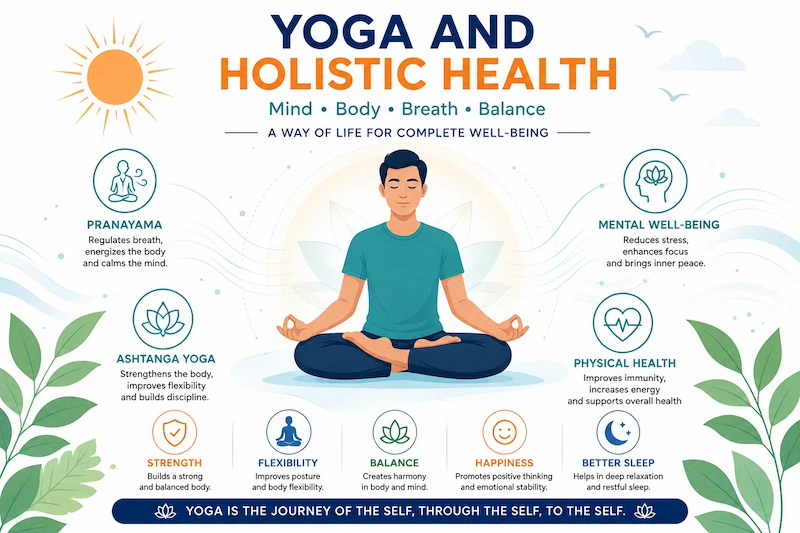
1. Meaning and Importance of Yoga
The word ‘Yoga’ is derived from the ancient Sanskrit root word “Yuj,” which means “to join,” “to attach,” or “to unite.” In a spiritual sense, Yoga is the union of the individual soul (Atman) with the supreme universal soul (Brahman). In a practical, everyday sense, it is the perfect harmony between the body, mind, and spirit. Maharishi Patanjali, known as the father of modern yoga, defined it in his Yoga Sutras as “Yogash chitta vritti nirodhah,” which translates to “Yoga is the control of the modifications of the mind.”
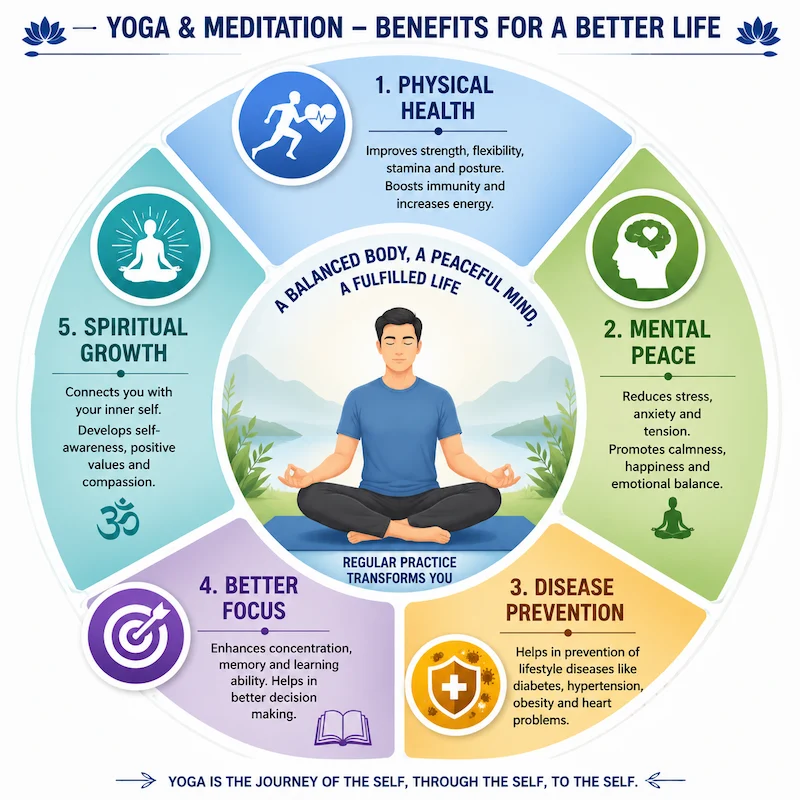
Yoga is not merely a set of physical exercises; it is a comprehensive lifestyle. In the modern era, where stress, pollution, and sedentary habits are common, the importance of Yoga has increased immensely.
Importance of Yoga:
- Physical Fitness and Flexibility: Regular practice of Asanas (postures) stretches the muscles, lubricates the joints, and improves the overall flexibility and posture of the body. It cures structural deformities naturally. For a broader understanding of physical fitness, wellness, and healthy lifestyle habits, see Physical Fitness, Wellness & Lifestyle
- Mental Peace and Concentration: Modern life is full of distractions. Yoga practices, especially meditation (Dhyana), calm the wandering mind, reduce anxiety, and dramatically improve memory and concentration power, which is highly beneficial for students. The psychological aspects of sports, concentration, and emotional well-being are also discussed in Psychology & Sports
- Cures Lifestyle Diseases: Yoga is a proven alternative medicine. Regular practice helps prevent and manage chronic lifestyle diseases like obesity, diabetes, hypertension (high blood pressure), and asthma. For more information about fitness, wellness, and lifestyle-related health concerns, explore Physical Fitness, Wellness & Lifestyle
- Enhances Respiratory and Cardiovascular Health: Deep breathing exercises (Pranayama) increase the lung’s vital capacity, ensuring that an optimal amount of oxygen reaches the blood and brain, keeping the heart healthy.
- Spiritual Growth: Beyond the physical and mental benefits, Yoga cleanses the internal impurities of human nature, such as greed and anger, leading to inner peace, self-awareness, and spiritual enlightenment.
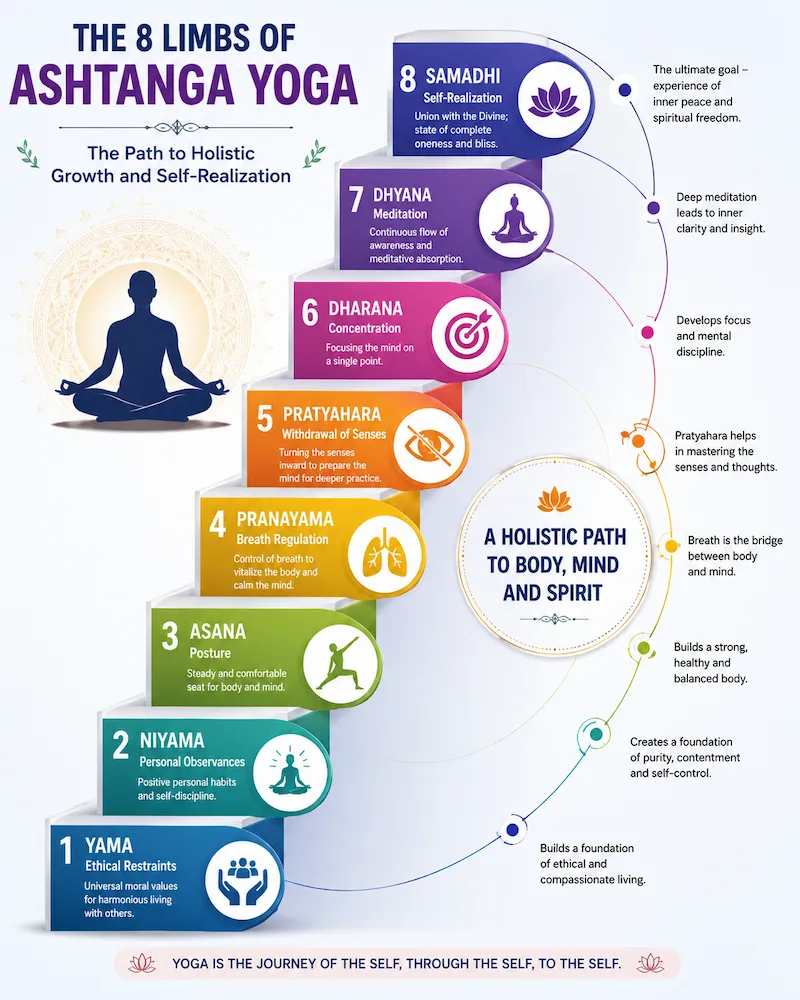
2. Introduction to Astanga Yoga
Astanga Yoga, formulated by the great sage Maharishi Patanjali, translates to the “Eight-Fold Path” of Yoga (Ashta = Eight, Anga = Limbs). Patanjali realized that achieving the ultimate goal of Yoga (Salvation/Samadhi) cannot happen overnight; it requires a systematic, step-by-step approach. These eight limbs act as a ladder, guiding an individual from basic physical and social discipline to the highest state of spiritual awakening.
The Eight Limbs of Astanga Yoga are:
- Yama (Social Discipline): These are moral codes of conduct related to how we treat the outside world. It includes five principles: Ahimsa (Non-violence), Satya (Truthfulness), Asteya (Non-stealing), Brahmacharya (Celibacy/Control of senses), and Aparigraha (Non-possessiveness).
- Niyama (Personal Discipline): These are rules for personal purification and self-care. It includes Saucha (Purity/Cleanliness), Santosh (Contentment), Tapa (Austerity/Hard work), Svadhyaya (Self-study), and Ishvara Pranidhana (Surrender to God).
- Asana (Physical Posture): Defined as “Sthiram Sukham Asanam” (a steady and comfortable posture). Asanas prepare the physical body to sit comfortably for long hours during meditation.
- Pranayama (Breath Control): The conscious regulation and control of the breath (life force). It purifies the nervous system and calms the mind.
- Pratyahara (Withdrawal of Senses): Detaching the five senses (sight, hearing, etc.) from external objects and directing the focus inward.
- Dharana (Concentration): Fixing the mind on a single point, object, or thought without any distraction.
- Dhyana (Meditation): A continuous, uninterrupted flow of concentration towards the object of focus. The mind becomes completely still.
- Samadhi (Salvation/Union): The ultimate stage of Yoga where the practitioner loses personal identity and merges completely with the supreme consciousness. It is a state of absolute bliss.
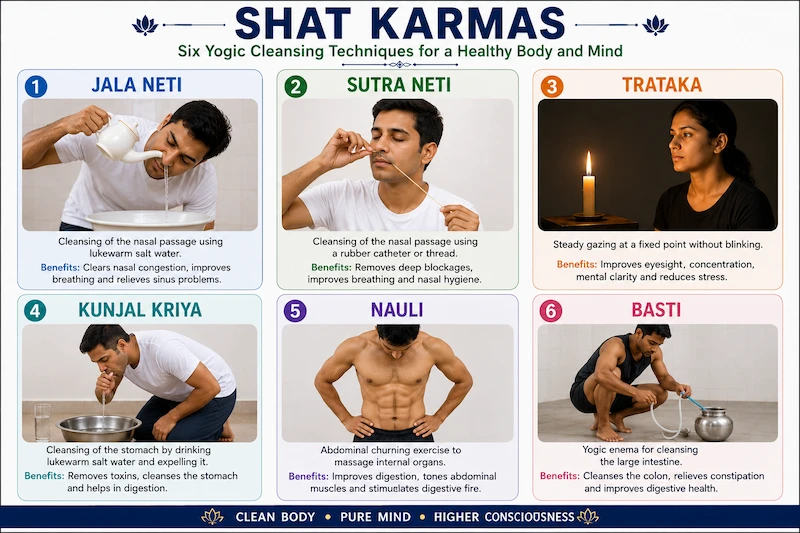
3. Yogic Kriyas (Shat Karma)
According to ancient Yogic texts, before a practitioner begins advanced Asanas and Pranayama, they must purify their internal body. Just as we bathe every day to clean our outer body, Yogic Kriyas (also known as Shat Karmas) are specific cleansing techniques designed to wash and purify the internal organs. The word ‘Shat’ means six, and ‘Karma’ means action or duty.
These six internal cleansing processes are essential to balance the three doshas of the human body (Vata, Pitta, and Kapha), remove toxins, and clear the energy channels (Nadis) to ensure the smooth flow of vital energy (Prana).
The Six Yogic Kriyas (Shat Karmas) are:
- Neti (Nasal Cleansing): This process purifies the nasal passages and the respiratory tract. The two common types are Jal Neti (using lukewarm saltwater passed through the nostrils) and Sutra Neti (using a soft thread). It is highly effective in curing sinus issues and allergies.
- Dhauti (Digestive Tract Cleansing): This is a technique to clean the upper digestive tract, stomach, and food pipe. It is traditionally done by swallowing a long piece of clean cotton cloth (Vastra Dhauti) and then pulling it back out, bringing along excess mucus and impurities.
- Basti (Colon Cleansing): Also known as Yogic enema, Basti is used to clean the large intestine (colon) by drawing water in through the rectum. It effectively cures digestive disorders and severe constipation.
- Nauli (Abdominal Massage): A highly advanced technique that involves isolating and rolling the abdominal muscles. It acts as a deep massage for the internal organs like the liver, spleen, and intestines, improving digestion.
- Trataka (Eye Cleansing/Concentration): This involves gazing continuously at a single point (usually a candle flame) without blinking until tears start flowing. It cleanses the eyes, improves eyesight, and dramatically enhances concentration and memory.
- Kapalabhati (Frontal Brain Cleansing): A breathing technique involving forceful, rapid exhalations and passive inhalations. It cleanses the lungs, energizes the brain, and revitalizes the entire nervous system.
4. Pranayama and its Types
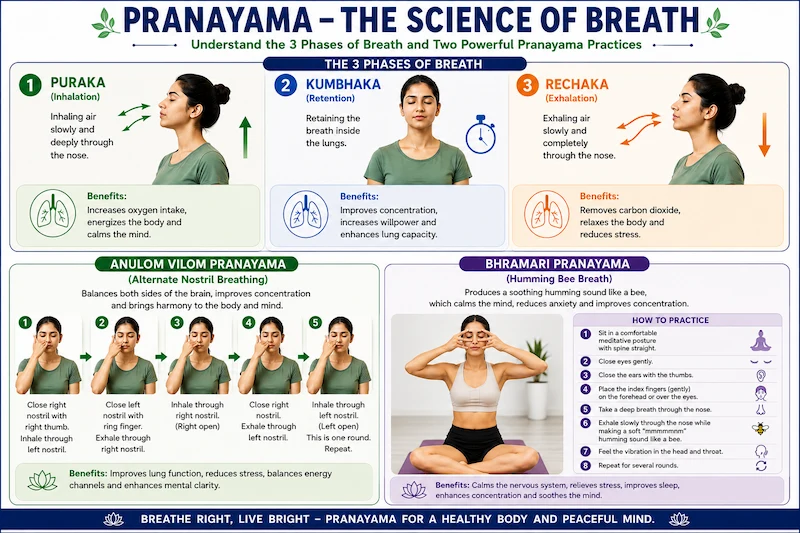
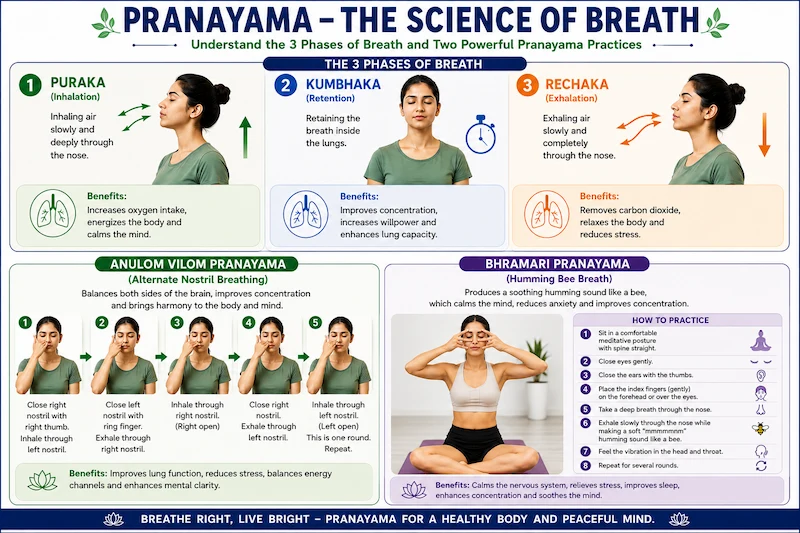
Pranayama is a combination of two Sanskrit words: “Prana” (the vital life force or breath) and “Ayama” (to control, extend, or regulate). Therefore, Pranayama is the ancient yogic science of breath control. It is not just deep breathing; it is the deliberate manipulation of the respiratory system to influence the mind and body.
Every Pranayama practice generally consists of three distinct phases:
- Puraka: The process of smooth and controlled inhalation.
- Kumbhaka: The process of retaining or holding the breath (internal or external).
- Rechaka: The process of smooth, controlled, and complete exhalation.
Different types of Pranayama have different physiological and psychological effects on the body. The major types of Pranayama are:
- Suryabhedana Pranayama (Right Nostril Breathing): Inhalation is done through the right nostril, which represents the ‘Surya Nadi’ (Sun channel). It generates heat in the body, stimulates the sympathetic nervous system, and increases energy levels.
- Ujjayi Pranayama (Ocean Breath): Performed by slightly constricting the back of the throat during breathing, producing a soft hissing or ocean-like sound. It profoundly soothes the nervous system and cures thyroid problems.
- Sheetali and Sheetkari Pranayama (Cooling Breaths): These involve inhaling air over a folded tongue or through the teeth. The incoming air cools the body instantly. They are excellent for reducing body temperature, anger, and hypertension during hot weather.
- Bhastrika Pranayama (Bellows Breath): Involves rapid, forceful inhalations and exhalations, much like a blacksmith’s bellows. It floods the body with oxygen and generates immense internal heat and energy.
- Bhramari Pranayama (Humming Bee Breath): The practitioner exhales while making a gentle humming sound like a bee, keeping the ears closed. The vibrations instantly calm the brain, acting as a magical cure for stress, anxiety, and insomnia.
- Anulom Vilom (Alternate Nostril Breathing): A balancing breath where inhalation and exhalation are alternated between the left and right nostrils. It balances the right and left hemispheres of the brain and cleanses the entire nervous system.
5. Active Lifestyle and Stress Management through Yoga
In today’s fast-paced digital world, students and adults alike are victims of two major problems: a sedentary (inactive) lifestyle and chronic psychological stress. We spend hours sitting in front of screens, leading to physical ailments like obesity and back pain, while academic or work pressures lead to severe anxiety and mental burnout. Yoga is the most holistic solution to both these modern crises.
Promoting an Active Lifestyle through Yoga: Unlike heavy weightlifting which only builds muscle mass, Yoga Asanas engage the entire body in a balanced way. Postures like Surya Namaskar (Sun Salutation) provide a complete cardiovascular workout. Standing and twisting Asanas keep the spine flexible, lubricate the joints, and ensure that the body remains active and agile. Since Yoga requires minimal space and zero equipment, it is the easiest way to integrate a physically active lifestyle into a busy daily routine, keeping obesity and lethargy completely at bay.
Managing Stress through Yoga: Stress is a physical and mental response to pressure, causing the body to release cortisol (the stress hormone). Yoga acts as a direct antidote to stress.
- Deep Relaxation: Practices like Shavasana (Corpse Pose) and Yoga Nidra (Yogic Sleep) provide deep, conscious relaxation to the nervous system, bringing the heart rate and blood pressure back to normal.
- Emotional Balance: Meditation (Dhyana) trains the mind to stay in the present moment rather than worrying about the past or the future. It declutters the brain, providing immense mental clarity.
- Instant Relief: Breathing exercises like Bhramari and Anulom Vilom trigger the parasympathetic nervous system (the “rest and digest” mode), which instantly reduces anxiety, cures tension headaches, and promotes deep, restful sleep. For more on the relationship between mental factors and sports performance, see Psychology & Sports
Through the consistent practice of Yoga, an individual not only builds a disease-free, active body but also cultivates a resilient, stress-free mind. For a broader understanding of active living, physical fitness, wellness, and lifestyle, see Physical Fitness, Wellness & Lifestyle
Relaxation Techniques in Yoga Nidra
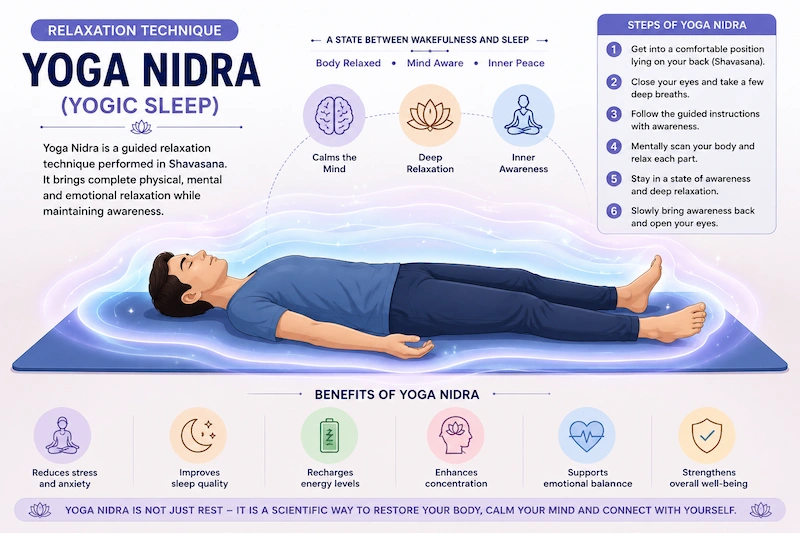
Yoga Nidra, often referred to as “Yogic Sleep,” is not merely about sleeping; it is a state of dynamic sleep where the body is completely relaxed, but the mind remains conscious and alert. To achieve this profound state of physical, mental, and emotional relaxation, a practitioner goes through a systematic sequence of internal techniques.
Here are the detailed techniques and stages used during Yoga Nidra:
1. Preparation and Physical Stilling (Sthirta)
- The Technique: The practice begins by lying flat on the back in Shavasana (Corpse Pose). The eyes are closed, arms are kept slightly away from the body with palms facing upward, and feet are dropped slightly apart.
- The Purpose: The goal here is physical stillness. The practitioner is asked to make all necessary adjustments beforehand so that the body does not move during the practice. This signals the brain that the physical body is shutting down for rest.
2. Sankalpa (The Resolve or Intention)
- The Technique: Before entering deep relaxation, the practitioner takes a short, positive, and clear mental resolve (e.g., “I am completely healthy,” or “I am calm and confident”). It is repeated mentally three times with full feeling and faith.
- The Purpose: During Yoga Nidra, the subconscious mind is highly receptive. Sowing a positive seed (Sankalpa) at this stage helps in reshaping personality and overcoming negative habits or mental blocks.
3. Rotation of Consciousness (Body Scan)
- The Technique: The instructor guides the practitioner’s awareness rapidly through different parts of the body in a specific sequence (e.g., right-hand thumb, index finger, middle finger… down to the right foot, then the left side, then the back, and finally the front).
- The Purpose: This is the core physical relaxation technique. By moving awareness rapidly, the mind doesn’t get time to wander. It systematically relaxes every muscle and nerve, clearing the motor cortex of the brain and releasing physical tension.
4. Breath Awareness (Prana Dharana)
- The Technique: After the body scan, awareness is shifted to the natural, spontaneous breath. The practitioner does not change the breathing pattern but simply observes the breath moving in and out of the nostrils, chest, or abdomen. Often, this is paired with counting breaths backward (e.g., from 27 to 1).
- The Purpose: Focusing on the breath disconnects the mind from external stimuli and deepens relaxation. Counting backward prevents the mind from falling asleep and releases mental tension.
5. Feeling of Opposite Sensations (Emotional Balancing)
- The Technique: The practitioner is guided to awaken specific, opposing physical sensations in the body. For example, first experiencing extreme heaviness (as if sinking into the floor), followed by extreme lightness (as if floating). This is often followed by sensations of heat and cold, or pain and pleasure.
- The Purpose: This technique stimulates the emotional centers of the brain. By experiencing opposite sensations consciously without reacting to them, the practitioner learns emotional control and releases deep-rooted emotional tension.
6. Visualization (Guided Imagery)
- The Technique: The instructor calls out rapid images or scenarios (e.g., a burning candle, a snow-capped mountain, a flying bird, a peaceful temple). The practitioner tries to visualize them in the Chidakasha (the dark space in front of closed eyes).
- The Purpose: Visualization brings hidden, suppressed memories and desires from the unconscious mind to the conscious level, allowing them to be released. It purifies the mind and brings a state of deep mental peace.
7. Externalization (The Return)
The Purpose: This ensures a smooth and safe transition from the deep subconscious state back to the waking state, leaving the individual feeling completely refreshed, energized, and stress-free.
The Technique: The practice must not end abruptly. The Sankalpa (Resolve) is repeated three times again. Then, awareness is slowly brought back to the breath, then to the physical body, and finally to the external surroundings. The practitioner gently moves their fingers and toes before slowly opening their eyes.
Chapter 3: Yoga
This chapter explores the ancient Indian science of Yoga, derived from the Sanskrit word ‘Yuj’, meaning to join or unite (the individual soul with the supreme soul). It details Maharishi Patanjali’s Ashtanga Yoga (the eightfold path) including Yama, Niyama, Asana, Pranayama, and more. A major focus is placed on various Asanas and their benefits, as well as highly effective relaxation techniques like Yoga Nidra (Yogic Sleep), which systematically releases physical, mental, and emotional tension, making it a crucial tool for stress management in modern life.
Frequently Asked Questions (FAQs)
Objective Type Questions (1 Mark)
Q1. The word ‘Yoga’ is derived from which Sanskrit root word? +
Ans. B) Yuj (meaning to bind, join, or unite)
Q2. How many elements are there in Ashtanga Yoga? +
Ans. D) 8
Q3. Which of the following is considered a highly effective relaxation technique in Yoga? +
Ans. C) Yoga Nidra
Q4. Pranayama is the control of: +
Ans. B) Breath
Q5. Which asana is highly recommended to be performed immediately after meals to improve digestion? +
Ans. B) Vajrasana
Very Short Answer Type Questions (2 Marks)
Q6. Define Yoga. +
Ans. Yoga is a spiritual, mental, and physical discipline rooted in ancient India. According to Maharishi Patanjali, “Checking the impulses of the mind is Yoga.” It aims to achieve harmony between the mind, body, and spirit, leading to overall well-being and self-realization.
Q7. What do you mean by ‘Yoga Nidra’? +
Ans. Yoga Nidra, also known as “yogic sleep,” is a state of conscious relaxation. It is a systematic method of inducing complete physical, mental, and emotional relaxation while maintaining full consciousness. It is usually performed lying down in Shavasana.
Q8. Name the three components of Pranayama. +
Ans. The three components of Pranayama are:
- Puraka: Inhalation of breath.
- Kumbhaka: Retaining or holding the breath.
- Rechaka: Exhalation of breath.
Q9. Differentiate between Yama and Niyama. +
Ans. Yama refers to social discipline or universal moral commandments (like non-violence, truthfulness) that guide how we interact with the world. Niyama refers to personal discipline and self-purification observances (like cleanliness, contentment) that guide our internal behavior.
Short Answer Type Questions (3 Marks)
Q10. What are the key benefits of practicing Yoga Nidra? +
Ans. The benefits of Yoga Nidra include:
- Reduces Stress and Anxiety: It deeply relaxes the nervous system, reducing the levels of cortisol (stress hormone) in the body.
- Improves Sleep Quality: A brief session of Yoga Nidra can be as restorative as a few hours of regular sleep, helping to cure insomnia.
- Enhances Concentration: By clearing the mind of subconscious clutter and emotional tension, it improves focus, memory, and cognitive functioning.
Q11. Explain any three importance of Yoga in modern life. +
Ans. Importance of Yoga today:
- Physical Fitness: Regular practice of asanas improves flexibility, muscle strength, and cardiovascular health, preventing lifestyle diseases like obesity and diabetes.
- Mental Peace: Through meditation and breathing exercises (Pranayama), yoga helps calm the restless mind, reducing modern-day anxiety and depression.
- Curing Postural Deformities: Continuous desk work leads to bad posture. Yoga corrects spinal alignments and cures deformities like Kyphosis and Scoliosis.
Q12. What are the different classifications of Asanas? +
Ans. Asanas are generally classified into three categories:
- Meditative Asanas: Used for meditation to increase focus and concentration (e.g., Padmasana, Sukhasana).
- Relaxative Asanas: Practiced to remove physical and mental fatigue (e.g., Shavasana, Makarasana).
- Cultural/Corrective Asanas: Practiced to regulate the body’s systems, develop strength, and correct postural defects (e.g., Bhujangasana, Chakrasana).
Q13. Briefly describe the elements of ‘Yama’. +
Ans. Yama is the first element of Ashtanga Yoga, consisting of five moral codes:
- Ahimsa (Non-violence): Not harming any living being physically, mentally, or verbally.
- Satya (Truthfulness): Always speaking the truth and being honest.
- Asteya (Non-stealing): Not taking anything that belongs to others without permission.
- Brahmacharya (Celibacy): Exercising control over physical senses and desires.
- Aparigraha (Non-possessiveness): Living a simple life without greed or hoarding wealth.
Long Answer Type Questions (5 Marks)
Q14. Explain the concept of ‘Yoga Nidra’ in detail. Discuss its stages and how it works as a powerful relaxation technique. +
Ans. Yoga Nidra (Yogic Sleep) is a highly powerful meditation technique where the practitioner enters a state of deep relaxation while remaining fully awake and aware. Unlike normal sleep, where the mind is unconscious, in Yoga Nidra, the consciousness remains active and is directed inward.
How it works as a Relaxation Technique:
It works by systematically relaxing the body, breathing, and mind. It shifts the brain from the beta state (awake, stressed, active) to alpha and theta states (deeply relaxed, meditative). It releases three types of tensions: muscular, emotional, and mental.
Basic Stages of Yoga Nidra:
- Preparation: Lying down completely still in Shavasana (Corpse Pose) with eyes closed.
- Sankalpa (Intention): Making a short, positive mental resolution to plant a seed of transformation in the subconscious mind.
- Rotation of Consciousness: Systematically shifting awareness to different parts of the body (e.g., right thumb, index finger, wrist, shoulder) to induce physical relaxation.
- Breath Awareness: Focusing on the natural flow of breath without altering it, which deeply relaxes the nervous system.
- Externalization: Slowly bringing the awareness back to the external environment, gently moving the fingers and toes, and opening the eyes feeling completely refreshed.
Q15. What is Ashtanga Yoga? List all its eight elements and explain the first four in detail. +
Ans. Ashtanga Yoga was compiled by Maharishi Patanjali. ‘Ashta’ means eight and ‘Anga’ means limbs. It is the eightfold path for physical, mental, and spiritual purification.
The Eight Elements: 1. Yama, 2. Niyama, 3. Asana, 4. Pranayama, 5. Pratyahara, 6. Dharana, 7. Dhyana, 8. Samadhi.
First Four Elements Explained:
- Yama (Social Discipline): It involves ethical rules for living in society. It includes Ahimsa (non-violence), Satya (truthfulness), Asteya (non-stealing), Brahmacharya (celibacy), and Aparigraha (non-possessiveness).
- Niyama (Personal Discipline): It deals with self-purification and personal observances. It includes Saucha (purity), Santosh (contentment), Tapa (austerity), Swadhyaya (self-study), and Ishvara Pranidhana (surrender to God).
- Asana (Physical Postures): Patanjali defines Asana as “Sthiram Sukham Asanam,” meaning a posture that is steady and comfortable. Practicing asanas keeps the body healthy, flexible, and prepares it for long meditation.
- Pranayama (Breath Control): It is the science of regulating breath. It involves controlled inhalation (Puraka), retention (Kumbhaka), and exhalation (Rechaka). It purifies the nervous system and calms the mind.
Q16. Discuss the procedure, benefits, and contraindications of Tadasana. +
Ans. Tadasana (Mountain Pose): ‘Tada’ means mountain. It is a standing asana that forms the base for all other standing postures.
Procedure:
- Stand erect with feet slightly apart and arms resting by the sides.
- Inhale deeply, raise both arms upwards, and interlock the fingers with palms facing the sky.
- Simultaneously, lift your heels and stand on your toes.
- Stretch the entire body upwards as much as possible. Hold the posture for 10-15 seconds while breathing normally.
- Exhale and slowly bring the heels and arms back to the starting position.
Benefits:
- It is highly beneficial for increasing height in growing children.
- Improves overall body posture and body balance.
- Strengthens the knees, ankles, and thighs.
- Relieves physical and mental fatigue.
Contraindications:
- Individuals suffering from low blood pressure should avoid it or do it with caution.
- People suffering from frequent headaches, insomnia, or severe varicose veins should avoid holding the pose for long.