
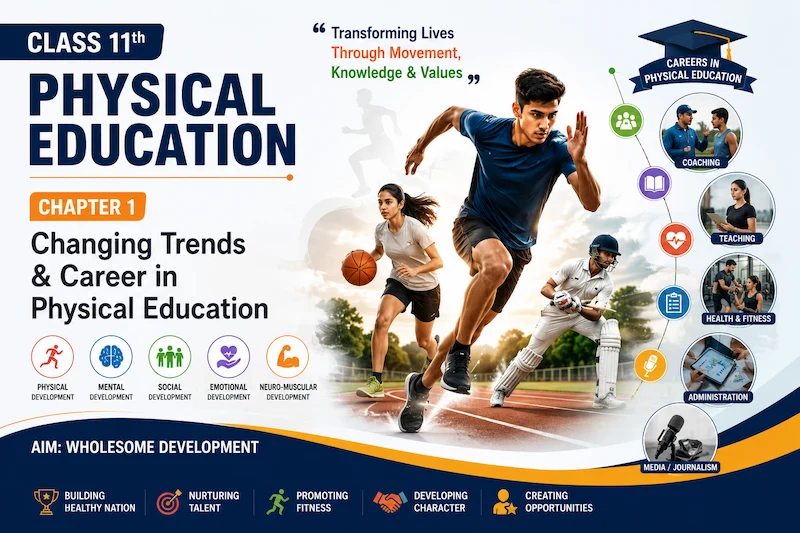
1. Concept, Aims & Objectives of Physical Education
The concept of Physical Education (P.E.) is frequently misunderstood by students and parents alike. Many limit its definition to merely playing games on a school ground or doing basic morning exercises. However, in the modern educational framework, Physical Education is a highly comprehensive and scientific field. It is defined as an integral part of the total educational process that utilizes physical activities to improve the overall personality and well-being of an individual. Renowned scholar Delbert Oberteuffer rightly defined it as, “The sum of those experiences which come to the individual through movement.”
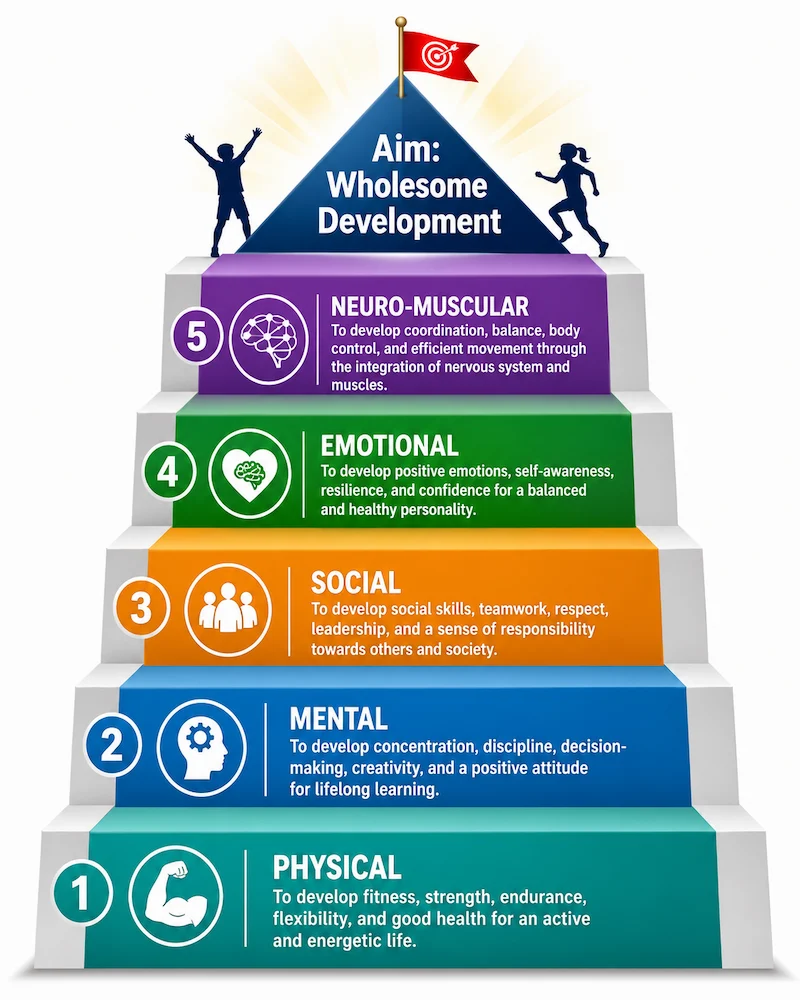
The ultimate Aim of Physical Education is the “Wholesome Development of an Individual.” This means the goal is not just to produce elite Olympic athletes, but to shape a human being who is physically fit, mentally alert, emotionally balanced, and socially responsible, enabling them to live a happy and productive life.
To achieve this grand aim, Physical Education relies on five fundamental Objectives (which act as stepping stones):
- Physical Development: This is the most visible objective. Through sports and exercise, the body’s internal systems (circulatory, respiratory, muscular, and digestive) are stimulated. It enhances strength, speed, endurance, flexibility, and overall immunity. For a detailed understanding of physical fitness, wellness, and lifestyle, see Physical Fitness, Wellness & Lifestyle
- Neuro-Muscular Coordination: This objective focuses on building a seamless connection between the nervous system (brain) and the muscular system. Good coordination results in better reaction time, balance, and precision—essential for hitting a cricket ball or shooting a basketball. These movement concepts are further explained in Fundamentals of Kinesiology & Biomechanics in Sports
- Emotional Development: Sports are full of intense emotions—joy, sorrow, anger, and fear. P.E. teaches students how to control these emotions, gracefully accept defeat without aggression, and celebrate victory without arrogance. The psychological aspects of sports are discussed in Psychology & Sports
- Social Development: Humans are social beings. The sports field acts as a laboratory for social skills where students learn teamwork, leadership, cooperation, sportsmanship, and respect for rules and opponents.
- Mental/Cognitive Development: Sports require immense brainpower. Students learn game rules, develop strategies, make split-second tactical decisions, and improve their concentration and memory.
2. Development of Physical Education in India – Post Independence
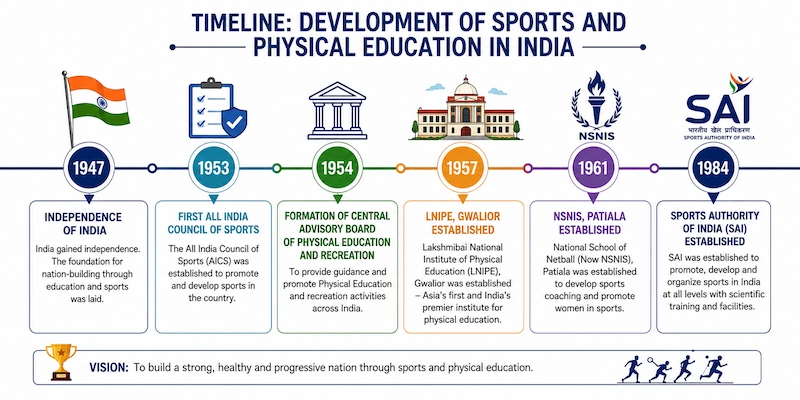
When India gained independence in 1947, the nation was facing numerous challenges, including a lack of proper sports infrastructure and poor health conditions among the youth. The Indian government quickly realized that for a nation to be strong, its youth must be physically fit and actively involved in sports. Consequently, several monumental steps were taken to develop Physical Education in post-independence India.
The journey began in 1948 with the formation of the Tara Chand Committee, which recommended the establishment of a central body for sports. This led to the creation of the Central Advisory Board of Physical Education and Recreation in 1950, which was tasked with drafting national policies for sports promotion.
In 1953, the Rajkumari Amrit Kaur Coaching Scheme was launched. Named after India’s first Health Minister, this scheme aimed to identify talented athletes and provide them with top-tier coaching facilities, marking a crucial step towards organized sports training. Soon after, in 1954, the All India Council of Sports (AICS) was established to advise the government on all matters related to sports and physical education.
The biggest milestone came in 1957, during the centenary of the 1857 revolt, with the establishment of the Lakshmibai National Institute of Physical Education (LNIPE) in Gwalior. It was the first institute in India to offer a 3-year degree course in Physical Education, producing highly qualified P.E. teachers. To cater to the need for elite sports coaches, the Netaji Subhas National Institute of Sports (NSNIS) was set up in Patiala in 1961, which is now considered the “Mecca of Indian Sports.”
Following the massive success of the 1982 Asian Games held in New Delhi, the government formed the Sports Authority of India (SAI) in 1984. Today, SAI is the apex national sports body responsible for managing national camps, maintaining world-class stadiums, and implementing various sports promotion schemes across the country.
3. Changing Trends in Sports
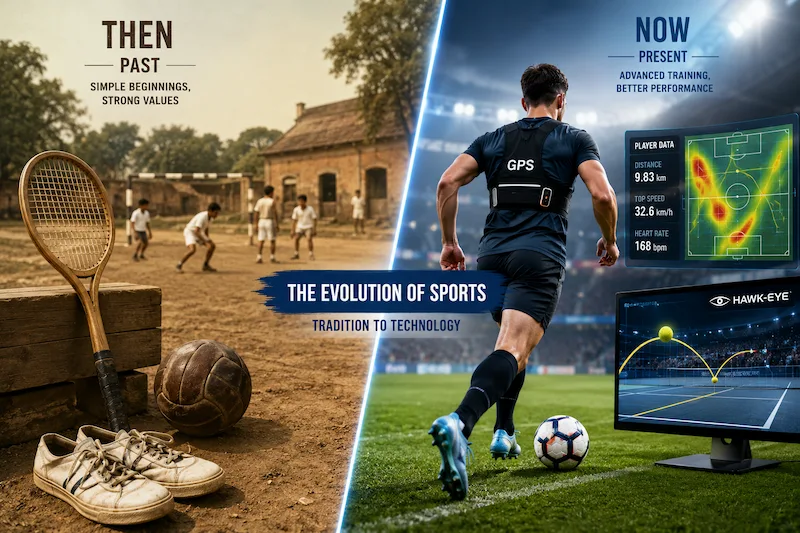
The world of sports has undergone a massive revolution in the 21st century. The integration of science and technology has completely changed how games are played, viewed, and managed. These changing trends have not only enhanced athletes’ performances but also significantly reduced the risk of injuries and made officiating 100% fair.
1. Playing Surfaces: Traditionally, sports were played on natural mud, clay, or grass, which were heavily affected by rain and weather conditions. Today, surfaces are scientifically engineered. Athletics uses Synthetic (Tartan) Tracks made of polyurethane, which provide excellent grip and bounce. Hockey has shifted to Astroturf (artificial grass), making the game incredibly fast. Indoor sports like basketball and badminton now use specialized shock-absorbing wooden floors or synthetic PVC mats that protect players’ knees and joints from impact injuries.
2. Wearable Gear: The concept of sports clothing has evolved from basic cotton to highly advanced technological garments. Athletes now use Moisture-wicking fabrics (like Dri-FIT) that instantly absorb sweat and keep the body cool. More importantly, players wear smart technology such as GPS vests, heart-rate monitors, and biometric sensors during practice. These wearables track their top speed, distance covered, fatigue levels, and vital signs, allowing coaches to monitor their health in real-time.
3. Sports Equipment: Heavy wooden equipment is a thing of the past. Modern sports equipment is designed using principles of aerodynamics and advanced materials like Carbon Fiber, Graphite, Kevlar, and Titanium. For example, tennis rackets and badminton racquets are now incredibly lightweight yet highly durable, allowing for faster swings. Helmets in cycling and cricket are designed to be aerodynamic and highly impact-resistant, ensuring maximum safety without compromising speed.
4. Technological Advancements: Technology has eradicated human errors in refereeing. Systems like Hawk-Eye (used in Cricket and Tennis for ball tracking), VAR (Video Assistant Referee) in football, and high-speed slow-motion cameras allow officials to make highly accurate decisions. Furthermore, biomechanical video analysis software helps athletes correct their posture and techniques down to the millimeter. For a deeper understanding of how biomechanics is applied to sports movement and performance, see Fundamentals of Kinesiology & Biomechanics in Sports
4. Career Options in Physical Education
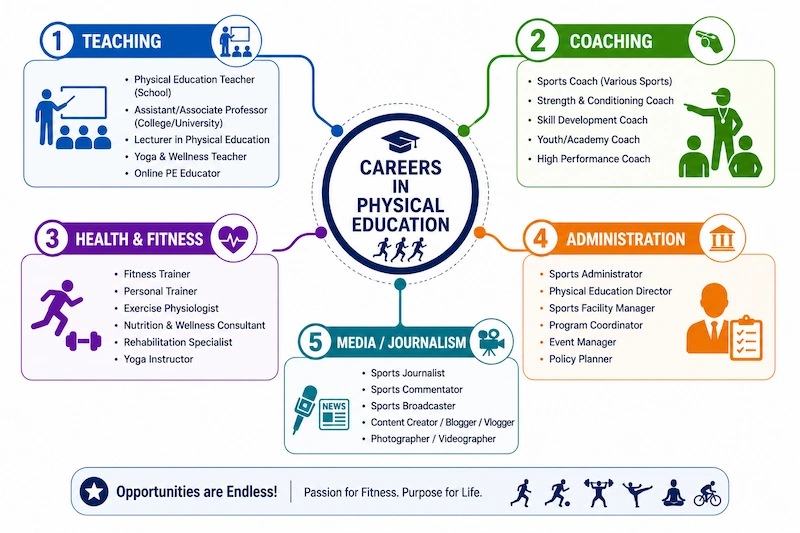
There was a time in India when a degree in Physical Education meant only one career path: becoming a school P.E. teacher. However, with the commercialization of sports (like IPL, ISL, and Pro Kabaddi) and a growing awareness of health and fitness among the general public, the sports industry has exploded. Today, Physical Education offers highly lucrative and diverse career options.
1. Teaching Careers: This remains the most traditional and respected path. Professionals can work as Physical Training Instructors (PTI) or P.E. Teachers in elementary, middle, and senior secondary schools. With higher qualifications (like a Master’s degree or PhD), one can become a Lecturer, Assistant Professor, or Principal in Physical Education colleges and universities.
2. Coaching Careers: If you have a deep tactical understanding of a specific sport, coaching is a highly rewarding career. You can work as a specialized sports coach in schools, private sports academies, professional clubs, or even for state and national teams. Specialized coaches (like fielding coaches or strength & conditioning coaches) are in massive demand globally. Understanding systematic sports preparation is an important part of coaching, which is covered in Training & Doping in Sports
3. Health and Fitness Related Careers: Due to the rising problem of obesity and lifestyle diseases, the fitness sector is booming. Career options include becoming a Personal Fitness Trainer, Gym Instructor, Yoga Guru, Athletic Trainer, or Sports Dietician/Nutritionist. Physical therapists and sports psychologists are also crucial for rehabilitating athletes and keeping them mentally tough. Students interested in Yoga can also explore Yoga
4. Sports Administration and Management: For those who are good at management, this field offers roles like Sports Director, Facility/Stadium Manager, and Event Manager. Organizing mega-events like the Olympics, World Cups, or national marathons requires thousands of qualified sports administrators.
5. Performance, Media, and Communication Careers: Athletes themselves make a career by playing professionally. Beyond playing, individuals with good communication skills can pursue Sports Journalism, Sports Broadcasting (Commentary), Sports Photography, or Sports Marketing. Data analysts who decode match statistics are also becoming highly sought after by top sports franchises.
5. Khelo-India Program and Fit-India Program
To revive the sports culture in India and tackle the growing issue of sedentary lifestyles among the youth, the Ministry of Youth Affairs and Sports launched two revolutionary flagship programs: the Khelo India Program and the Fit India Movement.
A. Khelo India Program (Play India): Launched in 2018, the primary objective of the Khelo India program is to build a strong framework for all sports played in the country and establish India as a great sporting nation. It focuses heavily on grassroots talent identification.
- Structure: The program is divided into 12 distinct verticals, including the development of playfields, support to national sports academies, promotion of rural and indigenous games, and sports for women.
- Competitions: It conducts massive annual events like the Khelo India Youth Games (KIYG) and Khelo India University Games (KIUG), which give young athletes a platform to showcase their talent on national television.
- Scholarship: The biggest highlight of this program is its financial support. The best 1,000 talented athletes identified each year receive an annual scholarship of ₹5 Lakhs per annum for 8 continuous years to fund their elite training, diet, and education.
B. Fit India Movement: While Khelo India focuses on competitive sports, the Fit India Movement was launched to target the general health of every Indian citizen. It was inaugurated by Honorable Prime Minister Shri Narendra Modi on 29th August 2019 (National Sports Day, celebrating the birth anniversary of hockey legend Major Dhyan Chand).
- Objective: The goal is to bring about a behavioral change and move people towards a more physically active lifestyle. It aims to combat modern lifestyle diseases like diabetes, obesity, and hypertension.
- Core Concept: The campaign promotes simple, everyday activities like walking, cycling, dancing, and practicing yoga. Its famous slogan, “Fitness Ka Dose, Aadha Ghanta Roz” (A dose of fitness, half an hour daily), urges citizens to dedicate at least 30 minutes every day to physical fitness.
- School Integration: The movement also awards ‘Fit India School’ certifications to educational institutions that maintain excellent sports infrastructure and allocate sufficient time for daily physical activities.
Chapter 1: Changing Trends & Career in Physical Education
This chapter introduces the fundamental concepts of Physical Education. It explains that the ultimate Aim of physical education is the wholesome development of an individual, which is achieved through specific Objectives like physical, mental, social, and emotional development. The chapter highlights the evolving trends in sports and the vast Career Options available today, ranging from teaching and coaching to sports journalism and management. Furthermore, it covers significant national initiatives like the Khelo India Program and the Fit India Movement, aimed at reviving the sports culture and promoting fitness among citizens at the grassroots level.
Frequently Asked Questions (FAQs)
Objective Type Questions (1 Mark)
Q1. What is the main aim of Physical Education? +
Ans. C) All-round development of an individual
Q2. When was the Fit India Movement launched? +
Ans. B) 29th August 2019 (On National Sports Day)
Q3. Which of the following is a career in communication media within sports? +
Ans. B) Sports Journalism
Q4. The ‘Khelo India Program’ was introduced to revive sports culture in India at which level? +
Ans. B) Grassroots level
Q5. Which objective of physical education deals with the elimination of unnecessary worries and anxiety? +
Ans. C) Emotional Development
Very Short Answer Type Questions (2 Marks)
Q6. Define Physical Education. +
Ans. Physical Education is an integral part of the total educational process. It is a field of endeavor that aims at the physical, mental, emotional, and social development of citizens through the medium of physical activities that have been selected to realize these outcomes.
Q7. Write any two main objectives of Physical Education. +
Ans. 1. Physical Development: Focuses on building strength, endurance, speed, and overall fitness of the body.
2. Social Development: Helps in developing qualities like teamwork, cooperation, sportsmanship, and leadership.
Q8. Mention any two traditional sports of India. +
Ans. 1. Kabaddi: A highly popular contact team sport played across rural and urban India.
2. Kho-Kho: A traditional Indian tag game that demands physical fitness, speed, and stamina.
Q9. What is the motto of the Fit India Movement? +
Ans. The core motto is to bring about a behavioral change and move towards a more physically active lifestyle. Its aim is to make fitness an integral part of daily life for all Indians.
Short Answer Type Questions (3 Marks)
Q10. Differentiate between Aim and Objectives in Physical Education. +
Ans.
- Aim: The aim is the ultimate, singular goal that one strives to achieve. In physical education, the aim is the “all-round development of an individual.” It is the final destination.
- Objectives: Objectives are the specific, measurable steps or milestones required to achieve that main aim. In physical education, physical, mental, and social developments are the objectives (the pathways) to reach the ultimate aim.
Q11. Explain ‘Sports Journalism’ as a career option. +
Ans. With the massive growth of the sports industry, Sports Journalism has become a highly lucrative career. It involves reporting, writing, and broadcasting sports news for newspapers, magazines, television, radio, and sports websites. Professionals in this field work as sports writers, editors, commentators, and web content developers, requiring a deep knowledge of sports and excellent communication skills.
Q12. Briefly discuss the ‘Khelo India Program’. +
Ans. The Khelo India Program was introduced by the Ministry of Youth Affairs and Sports to revive sports culture in India at the grassroots level. Its main features include:
- Talent Identification: Finding talented players across the country in various disciplines.
- Financial Support: Providing an annual financial assistance of ₹5 lakh per annum for 8 years to selected talented athletes.
- Infrastructure Development: Upgrading and creating sports facilities at school and university levels.
Q13. How does physical education help in Emotional Development? +
Ans. Sports and physical activities expose individuals to intense emotional situations like winning, losing, anger, and excitement. Physical education teaches students to control and channel these emotions positively. It helps in eliminating anxiety and stress, promoting emotional stability, resilience, and a balanced state of mind even in pressure situations.
Long Answer Type Questions (5 Marks)
Q14. Discuss in detail the various career options available in the field of Physical Education. +
Ans. The field of physical education has expanded immensely, offering diverse career paths:
- Teaching Career: One of the most traditional options. Opportunities exist at elementary schools, middle schools, high schools, and colleges/universities as P.E. Teachers or Professors.
- Coaching Career: Requires deep tactical knowledge of a specific sport. Coaches are hired by schools, clubs, state teams, and national sports academies to train athletes.
- Health and Fitness Related Careers: With rising health awareness, professionals work as gym instructors, fitness trainers, yoga gurus, and sports dieticians.
- Sports Administration & Management: Involves managing sports events, clubs, or stadiums. Roles include Sports Director, Event Manager, or Facility Manager.
- Careers in Communication Media: Includes sports journalism, sports photography, sports broadcasting/commentary, and digital sports marketing.
Q15. Elaborate on the main objectives of Physical Education. +
Ans. To achieve the aim of all-round development, physical education focuses on the following objectives:
- Physical Development: The primary objective. It focuses on developing organ systems (circulatory, respiratory, nervous) and improving physical fitness components like strength, speed, and endurance.
- Neuro-muscular Coordination: It ensures a better relationship between the nervous system and the muscular system, leading to better reaction time, balance, and smooth execution of sports skills.
- Emotional Development: Every individual has emotions like anger, fear, and jealousy. Sports teach athletes how to control these emotions, cope with success and failure, and develop a balanced personality.
- Social Development: When students play together, they develop social traits like sympathy, cooperation, brotherhood, sportsmanship, and leadership, making them better citizens.
- Mental Development: Physical activities require alertness, strategic thinking, and quick decision-making, which sharpen the brain and improve concentration.
Q16. Explain the significance of the Fit India Movement in today’s modern lifestyle. +
Ans. Launched by the Hon’ble Prime Minister of India, the Fit India Movement is highly significant due to the following reasons:
- Combating Sedentary Lifestyle: In the digital age, physical activity has drastically reduced. This movement encourages people to walk, run, and play to stay active.
- Preventing Lifestyle Diseases: It aims to reduce the risk of obesity, diabetes, and hypertension by promoting a culture of daily exercise.
- Mental Well-being: Physical fitness is directly linked to mental health. The movement promotes yoga and sports to reduce modern-day stress and anxiety.
- Creating a Fitness Culture: It shifts the focus from treating illness to preventing it, making fitness a daily routine rather than a task.
- Inclusivity: It is designed for everyone—children, youth, adults, and senior citizens—encouraging indigenous games and simple exercises that require no expensive equipment.