
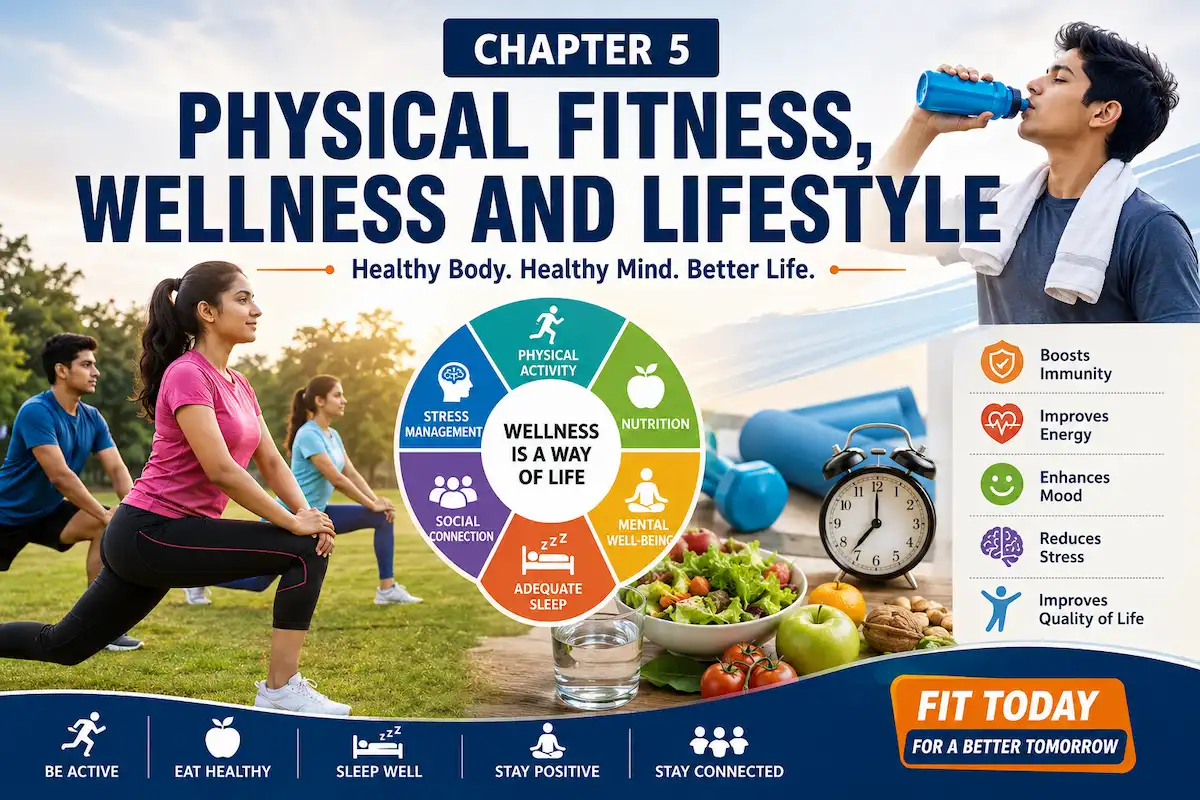
1. Meaning & Importance of Wellness, Health, and Physical Fitness
In our daily conversations, we often use the terms health, wellness, and physical fitness as if they mean the exact same thing. However, in the realm of physical education, these three terms have distinct meanings and significance. Understanding the difference is the first step toward living a high-quality life.
Meaning of Health: According to the World Health Organization (WHO), “Health is a state of complete physical, mental, and social well-being and not merely the absence of disease or infirmity.” This means you are not truly healthy just because you don’t have a fever; you must also be mentally peaceful and socially adjusted.
Meaning of Physical Fitness: Physical fitness is the ability of an individual to carry out their daily routine tasks without experiencing undue fatigue, and still having enough reserve energy to handle any sudden emergencies or enjoy leisure activities. A physically fit person can run for a bus, climb stairs, or carry heavy groceries without gasping for breath.
Meaning of Wellness: Wellness is a broader concept than health or fitness. It is an active, conscious, and continuous process of making healthy choices toward a more successful and fulfilling existence. It is about striving for a perfect balance in life, including diet, exercise, habits, and mental peace.
Importance in Modern Life: In today’s highly mechanized world, human beings have become incredibly inactive. We use cars instead of walking, and elevators instead of stairs. This sedentary lifestyle has led to a massive rise in chronic diseases like obesity, diabetes, and heart problems. Regular physical activity and healthy lifestyle habits support physical fitness, mental well-being, healthy weight management, and a lower risk of several chronic health conditions.

2. Components/Dimensions of Wellness, Health, and Physical Fitness
To achieve true fitness and wellness, an individual must work on various specific components. You cannot be perfectly fit just by having huge muscles; you also need stamina and flexibility.
Components of Physical Fitness: Physical fitness is divided into two main categories:
- Health-Related Fitness: These are essential for overall health and disease prevention. They include:
- Cardiovascular Endurance: The ability of the heart and lungs to supply oxygen during sustained physical activity (e.g., long-distance running).
- Muscular Strength: The maximum amount of force a muscle can produce in a single effort (e.g., lifting a heavy weight).
- Muscular Endurance: The ability of a muscle to perform repeated contractions without getting tired.
- Flexibility: The range of motion around a joint, which prevents injuries.
- Body Composition: The ratio of fat mass to lean muscle mass in the body. The different methods used to assess body composition are discussed in Test, Measurement & Evaluation
- Skill-Related Fitness: These are crucial for sports performance and include Agility, Balance, Coordination, Speed, Power, and Reaction Time. The role of movement, coordination, and biomechanics in sports performance is further explained in Fundamentals of Kinesiology & Biomechanics in Sports
Dimensions of Wellness: Wellness is a multidimensional concept. To be truly “well,” one must balance the following dimensions:
- Physical Wellness: Maintaining a healthy diet, exercising regularly, and avoiding harmful habits like smoking or alcohol.
- Emotional Wellness: The ability to understand your own feelings, manage stress, and cope with life’s challenges positively.
- Social Wellness: Building strong, supportive relationships and interacting effectively with the community.
- Intellectual Wellness: Continuously expanding your knowledge, learning new skills, and keeping the brain active.
- Spiritual Wellness: Finding a sense of purpose and meaning in life, whether through religion, meditation, or personal values.
- Occupational & Environmental Wellness: Finding satisfaction in your work and living in harmony with the natural environment.

3. Traditional Sports & Regional Games for Promoting Wellness
India has a deeply rich history and culture of traditional sports and regional games. Long before modern gyms and expensive sports equipment were invented, these indigenous games were the primary source of physical fitness, entertainment, and community bonding in Indian villages.
What are Traditional and Regional Games? These are sports that are deeply rooted in the culture of a specific region. Examples include Kabaddi, Kho-Kho, Mallakhamb, Gilli-Danda, Kalaripayattu (a martial art from Kerala), and Kushti (traditional wrestling).
How They Promote Wellness:
- Excellent Physical Fitness: Games like Kabaddi and Kho-Kho are incredibly fast-paced. They require massive amounts of cardiovascular endurance, explosive speed, agility to dodge opponents, and tremendous neuro-muscular coordination. Regular participation in these games can contribute to cardiovascular endurance, speed, agility, and coordination.
- Low-Cost and Accessible: The greatest advantage of traditional games is that they often require minimal equipment. You do not need expensive synthetic courts, rackets, or gear. They are played on mud or grass, making them accessible to every child, regardless of their economic background.
- Social and Emotional Wellness: Regional games are deeply community-oriented. They are usually played in groups during festivals or village gatherings. This builds strong team spirit, social integration, and teaches children how to cooperate and communicate effectively.
- Cultural Connection: Participating in these sports connects the youth to their roots and heritage. Recognizing their immense value for wellness, the Indian Government’s Khelo India program has recently started promoting indigenous games on a national level, bringing them back into the mainstream education system.

4. Leadership Through Physical Activity and Sports
A great leader in society and a great captain on the sports field share the exact same traits. A great leader in society and a great captain on the sports field share the exact same traits. Physical education provides students with practical, real-time opportunities to cultivate these vital skills.
What is Leadership in Sports? Leadership in sports is the ability to guide, motivate, and influence a team toward achieving a common goal, while maintaining discipline and high morale, especially during highly stressful situations (like losing a match).
Qualities Developed Through Sports:
- Decision Making: A sports leader (like a team captain or point guard) has to make split-second decisions under immense pressure. This translates to quick and effective problem-solving skills in real life.
- Empathy and Communication: A good leader knows how to talk to their teammates. They know when a player needs strict instruction and when they need a supportive arm around their shoulder after making a mistake.
- Integrity and Fair Play: Sports teach leaders to lead by example. A leader who respects the referee, follows the rules, and plays fairly earns the respect of their team and society.
- Resilience: Sports teach you how to lose. A leader learns how to absorb a defeat, analyze the mistakes without blaming others, and motivate the team to bounce back stronger the next day. The psychological aspects of resilience, motivation, and sports performance are discussed further in Psychology & Sports
How to Cultivate Leadership: Schools promote leadership by assigning roles during physical education classes. By making students team captains, equipment managers, or event organizers for inter-house tournaments, teachers give them direct responsibility. Leading warm-up sessions or organizing intramural sports festivals are excellent ways to transform a regular student into a confident, capable leader.

5. Introduction to First Aid – PRICE
In the world of physical activity and sports, injuries are unfortunately inevitable. No matter how much protective gear is worn, accidents happen. Therefore, every physical education student must possess basic knowledge of first aid to manage sports injuries effectively until professional medical help arrives.
What is First Aid? First aid is the immediate, temporary, and essential care given to a person who has been injured or suddenly taken ill. The main objectives of first aid are to preserve life, prevent the injury from getting worse, and promote early recovery.
The PRICE Protocol: For common soft-tissue sports injuries like sprains (ligament injury, e.g., twisted ankle) and strains (muscle injury, e.g., pulled hamstring), Continuing to move or play on a injured joint will worsen the tissue tear and delay the healing process significantly.
- P – Protection: The first step is to protect the injured area from further damage. Stop the athlete from playing immediately. Use crutches or a splint to protect the injured body part from any more impact or stress.
- R – Rest: The injured area must be completely rested. Continuing to move or play on a injured joint will worsen the tissue tear and delay the healing process significantly.
- I – Ice: Apply ice packs (wrapped in a cloth, never directly on the skin) to the injured area for 15-20 minutes every 2-3 hours during the first 48 hours. rapidly reducing swelling and throbbing pain, swelling, and numbs the pain.
- C – Compression: Wrap the injured area firmly (but not too tight to stop blood flow) with an elastic crepe bandage. Compression helps physically limit and control the swelling.
- E – Elevation: Keep the injured body part elevated above the level of the heart whenever possible (e.g., propping an injured ankle up on a few pillows). Gravity helps drain excess fluid away from the injury, rapidly reducing swelling and throbbing pain.

Chapter 5: Physical Fitness, Wellness and Lifestyle
This chapter explains the concepts of physical fitness, wellness and lifestyle. It highlights the importance of maintaining a healthy and active lifestyle through regular physical activity, balanced nutrition, proper rest, stress management and healthy habits. Physical fitness helps an individual perform daily activities efficiently, while wellness represents overall physical, mental, emotional and social well-being. The chapter also emphasizes the role of exercise and healthy lifestyle practices in preventing lifestyle-related diseases and promoting a better quality of life.
Frequently Asked Questions (FAQs)
Objective Type Questions (1 Mark)
Q1. Physical fitness refers to the ability to perform daily activities efficiently without undue fatigue. This statement is: +
Ans. A) True
Ans. C) Cardiovascular endurance
Q3. Which component of physical fitness is the ability of a muscle or muscle group to exert force? +
Ans. B) Strength
Q4. Which of the following is an important part of a healthy lifestyle? +
Ans. A) Regular physical activity
Q5. Which type of fitness is mainly associated with efficient functioning of the heart and lungs? +
Ans. A) Cardiovascular endurance
Very Short Answer Type Questions (2 Marks)
Q6. Define physical fitness. +
Ans. Physical fitness is the ability of an individual to perform daily activities efficiently and effectively without excessive fatigue and with sufficient energy to enjoy leisure activities and meet unexpected demands.
Q7. What is wellness? +
Ans. Wellness is a state of overall well-being involving different dimensions of health, including physical, mental, emotional and social well-being. It involves making healthy choices and maintaining a balanced lifestyle.
Ans. Any two health-related components are:
- Cardiovascular endurance
- Muscular strength
- Muscular endurance
- Flexibility
- Body composition
Q9. Mention any two benefits of regular physical activity. +
- It improves physical fitness and functional capacity.
- It helps maintain healthy body weight.
- It improves mental well-being and reduces stress.
- It lowers the risk of several lifestyle-related diseases.
Short Answer Type Questions (3 Marks)
Ans. Three important components are:
- Cardiovascular Endurance: The ability of the heart and lungs to supply oxygen to working muscles during prolonged physical activity.
- Muscular Strength: The ability of a muscle or muscle group to exert force against resistance.
- Flexibility: The ability of joints to move through an appropriate range of motion.
Q11. Explain the importance of a balanced lifestyle. +
Ans. A balanced lifestyle is important because it:
- Helps maintain physical fitness and healthy body weight.
- Promotes mental and emotional well-being.
- Provides adequate energy for daily activities.
- Helps reduce the risk of lifestyle-related diseases.
- Improves overall quality of life.
Q12. What are lifestyle diseases? Give examples. +
Ans. Lifestyle diseases are health conditions that are often associated with unhealthy habits, sedentary behaviour, poor diet, stress and lack of physical activity.
Examples:
- Obesity
- Type 2 diabetes
- Hypertension
- Cardiovascular diseases
Q13. Explain the role of exercise in maintaining wellness. +
Ans. Regular exercise contributes to wellness by improving physical fitness, supporting healthy body composition, reducing stress, improving mood and promoting better sleep. It also supports social interaction when activities are performed in groups.
Long Answer Type Questions (5 Marks)
Q14. Explain the importance of physical fitness in daily life. +
Ans. Physical fitness plays an important role in maintaining health and performing daily activities efficiently. Its major importance includes:
- Efficient Performance: A fit person can perform daily activities with less fatigue.
- Improved Health: Regular physical activity supports the healthy functioning of the heart, lungs, muscles and other body systems.
- Disease Prevention: An active lifestyle can reduce the risk of several lifestyle-related health problems.
- Mental Well-being: Exercise can help manage stress and support positive mood and self-confidence.
- Better Quality of Life: Good fitness allows an individual to participate actively in work, recreation and social activities.
Ans. The major components of health-related physical fitness are:
- Cardiovascular Endurance: The ability of the cardiovascular and respiratory systems to provide oxygen during sustained physical activity.
- Muscular Strength: The maximum force that a muscle or muscle group can exert against resistance.
- Muscular Endurance: The ability of muscles to perform repeated contractions or sustain force over time.
- Flexibility: The ability of joints and surrounding tissues to move through an appropriate range of motion.
- Body Composition: The relative proportion of fat mass and fat-free mass in the body.
Q16. Explain the dimensions of wellness. +
Ans. Wellness is a multidimensional concept. Important dimensions include:
- Physical Wellness: Maintaining fitness, nutrition, sleep and healthy physical habits.
- Mental/Intellectual Wellness: Developing knowledge, learning skills and maintaining healthy thinking.
- Emotional Wellness: Understanding and managing emotions effectively.
- Social Wellness: Developing healthy relationships and communicating effectively with others.
- Spiritual Wellness: Developing a sense of purpose, values and meaning in life.
Ans. Healthy lifestyle habits play an important role in maintaining health and reducing the risk of lifestyle-related diseases. Important habits include:
- Regular Physical Activity: Helps improve fitness and supports healthy body weight.
- Balanced Nutrition: Provides essential nutrients and helps maintain healthy body composition.
- Adequate Sleep: Supports physical recovery, concentration and emotional health.
- Stress Management: Relaxation, exercise and healthy social interaction can help manage stress.
- Avoiding Harmful Habits: Avoiding tobacco, excessive alcohol and other harmful substances supports long-term health.