

Introduction to Chess
Chess is one of the world’s most widely known strategy board games. It is played between two opponents on a square chessboard, with each player controlling a set of pieces that move according to specific rules. The central aim is to use these pieces effectively, protect the king, create threats, and ultimately checkmate the opponent’s king.
Chess combines simple basic rules with increasingly complex decision-making. A beginner can learn the movement of the pieces relatively quickly, but developing strong chess skills requires practice, calculation, planning, and an understanding of strategic and tactical ideas.
What is Chess?
Chess is a two-player board game in which White and Black take turns making legal moves. The game is played on an 8×8 chessboard containing 64 squares. Each player begins with 16 pieces: one king, one queen, two rooks, two bishops, two knights, and eight pawns. Under the Laws of Chess, White makes the first move.
The objective is not to capture the opponent’s king. Instead, a player wins by placing the opponent’s king in checkmate—a position in which the king is under attack and there is no legal move that can remove the threat.
This makes chess different from many games in which winning depends mainly on collecting points or pieces. In chess, every move can change the position and create new possibilities for both players.
Basic Concept of the Game
At the beginning of a chess game, both players have the same number and type of pieces. The players then take turns moving their pieces across the board.
Each piece has its own movement pattern. Some pieces move along ranks, files, or diagonals, while the knight has a distinctive jumping movement. Pawns have their own movement and capturing rules.
As the game develops, players make decisions such as:
- Which pieces should be developed first?
- How can the centre of the board be controlled?
- How can the king be kept safe?
- Should a piece be exchanged?
- Is there a tactical opportunity?
- What is the opponent threatening?
- What plan should be followed in the position?
Therefore, chess is not simply about making legal moves. It is about choosing useful moves and anticipating their consequences.
The Chessboard, Players, Pieces and Objective
A standard chessboard consists of 64 equal squares arranged in an 8×8 grid, with alternating light and dark squares. Each player starts with 16 pieces.
The two sides are traditionally called White and Black. White moves first, after which the players alternate turns.
The six types of chess pieces are:
- King — the most important piece because the king must not remain under attack.
- Queen — the most powerful piece in terms of movement and range.
- Rook — moves along ranks and files.
- Bishop — moves diagonally.
- Knight — moves in an L-shaped pattern and can jump over pieces.
- Pawn — moves forward according to its rules and captures diagonally.
The ultimate objective is to checkmate the opponent’s king. A player who checkmates the opponent wins the game. Chess can also end in a draw under circumstances provided by the Laws of Chess.
Why Chess Is a Strategic Board Game
Chess is commonly described as a strategic game because players must make decisions with both immediate and future consequences in mind.
A strong player does not look only at the current move. They also consider what may happen after their move and how the opponent might respond.
Important strategic ideas include:
- controlling important areas of the board;
- developing pieces efficiently;
- maintaining king safety;
- improving piece activity;
- managing material;
- creating and defending threats;
- planning several moves ahead;
- recognizing changes in the position.
Strategy and tactics work together. Strategy concerns broader plans and long-term features of a position, while tactics involve concrete combinations and immediate opportunities.
For beginners, learning to ask “What does my opponent’s move threaten?” before making a move is one of the simplest ways to develop better chess thinking.
Chess as a Competitive Mind Sport
Chess is played both recreationally and competitively. Players can participate in school events, clubs, national competitions, and international tournaments. Competitive chess also uses ratings, titles, and different time controls to organize and evaluate play.
At the same time, chess has an important educational dimension. FIDE’s Chess in Education Commission describes chess as an educational tool that can support the development of intellectual and 21st-century skills, and it can be taught as a stand-alone activity or integrated into other subjects.
This combination of competition, learning, problem-solving, and disciplined decision-making makes chess particularly relevant in educational settings.
For FitEduHub, chess can therefore be understood from two complementary perspectives: as a competitive mind sport and as an educational activity. These perspectives will be explored in greater detail in later sections of this complete guide.
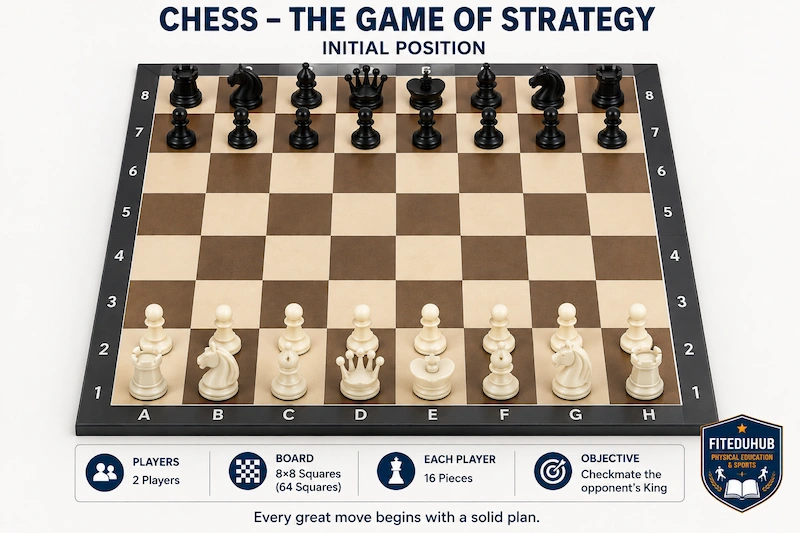
What Is Chess?
Chess is a two-player strategy board game played on a square board consisting of 64 squares. Each player begins the game with 16 pieces and takes turns moving those pieces according to the established rules of chess. The main objective is to checkmate the opponent’s king.
Chess has a simple basic structure, but the decisions involved can become highly complex. Players must consider the position of their pieces, the opponent’s threats, king safety, possible captures, tactical opportunities, and longer-term plans.
Definition of Chess
Chess is a turn-based strategy game in which two opponents, traditionally identified as White and Black, compete by moving pieces on an 8×8 board.
The pieces have different movement and capturing rules, and every move must comply with the Laws of Chess. White makes the first move, after which the players alternate turns.
The game is won by checkmate: the opponent’s king is under attack and there is no legal move that can remove the attack.
Chess is therefore not a game in which the king is physically captured. Instead, the decisive objective is to place the opposing king in a position from which it cannot escape check.
Basic Characteristics of Chess
Chess has several characteristics that define its basic structure:
- It is played by two players.
- It uses an 8×8 chessboard.
- The board contains 64 squares.
- Each player starts with 16 pieces.
- The two sides are called White and Black.
- White moves first.
- Players make alternate moves.
- Each piece follows specific movement rules.
- The main objective is checkmate.
- A game may also end in a draw under the applicable rules.
These characteristics make chess easy to describe at a basic level while leaving considerable room for advanced strategy and tactical play.
Chess Is a Two-Player Game
Chess is fundamentally a game between two opponents.
One player controls the White pieces and the other controls the Black pieces. The players do not move simultaneously. Instead, they take turns, beginning with White.
Because only one player moves at a time, every move creates a new position that the opponent must evaluate.
This turn-based structure makes decision-making an essential part of chess. A player must consider not only what they want to achieve but also how the opponent may respond.
The 8×8 Chessboard
A standard chessboard has 64 squares arranged in eight ranks and eight files.
The squares alternate between light and dark colours, creating the familiar pattern associated with a chessboard.
The board provides the playing space for all chess pieces. The position of a piece on the board determines what squares it can control, where it can move, and what tactical or strategic possibilities may be available.
Understanding the board is therefore one of the first steps in learning chess.
Beginners gradually become familiar with:
- Files
- Ranks
- Squares
- Diagonals
- The centre of the board
- Piece placement
- Important areas of activity
A clear understanding of the board also helps players learn chess notation later in the guide.
16 Pieces Per Player
Each player begins a standard game with 16 pieces.
These consist of:
| Piece | Number per Player |
|---|---|
| King | 1 |
| Queen | 1 |
| Rooks | 2 |
| Bishops | 2 |
| Knights | 2 |
| Pawns | 8 |
| Total | 16 |
Although both players begin with an identical set of pieces, the pieces have different movement patterns and roles.
The king is the central piece in terms of the game’s objective. The queen has the greatest range of movement, while rooks, bishops, knights, and pawns contribute in different ways throughout the game.
Learning the names and basic roles of all six types of pieces is an essential foundation for beginners.
Objective: Checkmate
The primary objective of chess is to checkmate the opponent’s king.
A king is in check when it is attacked by one or more opposing pieces. If the player whose king is in check has a legal move that removes the attack, the game continues.
Checkmate occurs when:
- The king is in check.
- The player has no legal move that can remove the check.
When checkmate occurs, the game is won by the player who delivered it.
This objective gives chess its distinctive character. Players are not required to capture every opposing piece. In many games, a player may win while several pieces remain on the board.
Nature of the Game
Chess is a turn-based, rule-governed strategy game. Its rules determine how pieces move, capture, interact, and how games are concluded.
At the same time, chess allows players to make a wide range of decisions within those rules.
A player may choose to:
- Develop a piece.
- Control the centre.
- Protect the king.
- Attack an opponent’s piece.
- Exchange pieces.
- Create a tactical threat.
- Improve the position of a piece.
- Prepare a longer-term plan.
This combination of fixed rules and flexible decision-making is one of the reasons chess can be played at both beginner and advanced levels.
Chess and Organized Competition
Chess is also an organized competitive activity.
Players can participate in:
- School chess competitions
- Chess clubs
- Local tournaments
- National competitions
- International tournaments
Competitive chess may use different time controls, ratings, tournament formats, and playing conditions.
Players can also progress through organized competitive systems and, depending on the governing regulations and performance, pursue recognized chess titles.
For students, school chess competitions can provide an opportunity to experience structured competition while learning how to follow rules, manage time, respect opponents, and respond to both winning and losing situations.
Chess: More Than Moving Pieces
At the beginner level, chess may appear to be mainly about learning how each piece moves. However, understanding movement is only the foundation.
As players gain experience, they begin to recognize patterns and relationships between pieces. They learn to evaluate threats, calculate possible moves, develop plans, and respond to changing positions.
Thus, chess can be viewed at several levels:
Rules → Movement → Tactics → Strategy → Planning → Competitive Play
This progression is important for beginners because strong chess skills are developed gradually rather than learned in a single step.

History of Chess
The history of chess is a long journey of cultural exchange, changing rules, and growing international competition. The modern game did not appear in its present form all at once; rather, it developed over many centuries from earlier forms of strategic board games in India, through Persia and the Islamic world, and later across Europe.
FIDE’s historical materials describe chess as a game whose continuous history reaches back more than a millennium and whose development involved contributions from several cultures. Because the early history of chess is based partly on historical interpretation and incomplete evidence, individual details should be presented carefully rather than as absolute facts.
Ancient Origins of Chess
The commonly accepted historical account places the early development of chess in India, with an early form of the game known as Chaturanga appearing around the 6th century CE. FIDE’s Rules Commission also notes that chess is thought to have been invented in India around 600 AD.
Chaturanga is generally understood as an early strategic game connected with the four divisions of an army:
- Infantry
- Cavalry
- Elephants
- Chariots
These military elements are traditionally associated with the later chess pieces represented by the pawn, knight, bishop, and rook. The game provided an early framework in which different types of pieces had different capabilities and strategic roles.
It is important to remember that the exact origins of chess remain a subject of historical study. The surviving evidence does not provide a single complete record showing exactly how the modern game emerged.
Chaturanga
Chaturanga is one of the most important names in the early history of chess.
The Sanskrit term is commonly interpreted as referring to the four divisions of an army. The game was associated with military strategy and featured different types of units with different movement or strategic functions.
Although Chaturanga was not identical to modern chess, it is widely regarded as an important predecessor in the historical development of the game.
Over time, the game changed as it moved between regions and cultures. New rules, names, interpretations, and playing practices gradually contributed to the evolution of chess.
Development Through Persia
Chess moved from India into Persia, where it developed into a form known as Shatranj.
FIDE’s historical account states that by around 600 CE, the game had reached Persia, where its name became shatranj and its rules were further developed. Persian terminology also influenced the language of chess, including concepts associated with the king and the announcement of check.
Persia played an important role in transmitting and developing the game.
The Persian form of chess was different from modern chess in several respects. Some pieces had different movement abilities, and the queen did not yet possess the powerful range that the modern queen has.
The game was therefore continuing to evolve rather than simply being transferred unchanged from one civilization to another.
Chess and the Islamic World
Following the expansion of Islam into Persia, Shatranj became established across the wider Islamic world.
Players, scholars, and writers contributed to the development and documentation of chess. The game became an important intellectual and recreational activity in several parts of the Islamic world, helping it travel further westward.
The movement of chess across cultures is an important part of its history because it shows that the game developed through cultural exchange rather than through a single isolated tradition.
Spread into Europe
From the Islamic world, chess gradually reached Europe.
FIDE’s historical materials indicate that the game reached Western Europe and Russia from around the 9th century, and by approximately 1000 CE it had spread widely across Europe.
As chess entered different European regions, the game continued to change.
Its terminology was adapted into different languages, while its rules and playing practices also evolved. During the medieval period, chess became increasingly associated with European courts, nobility, literature, and education.
The game was therefore becoming not only a form of entertainment but also a recognized intellectual and social activity.
Evolution of Modern Chess
One of the most important periods in chess history occurred during the late 15th century.
Around this period, major rule changes transformed the game into something much closer to modern chess. In particular, the powers of important pieces increased, making the game faster and more tactical than earlier forms of chess.
FIDE’s historical account places major changes around 1475, after which the game became essentially similar to the chess we recognize today.
The modern queen became particularly powerful, while other changes to piece movement and pawn rules helped create a more dynamic game.
These changes fundamentally altered the character of chess. Games could develop more quickly, attacks became more powerful, and tactical combinations became increasingly important.
Standardization of Chess Rules
Although the game had become much closer to modern chess by the late 15th century, chess rules were not immediately identical everywhere.
Different regions and competitions could use different conventions. Over the following centuries, chess organizations, players, writers, and tournament organizers gradually contributed to greater consistency.
The development of chess literature also helped spread common ideas and rules.
One important historical work is Luis Ramírez de Lucena’s 1497 book, Repetición de Amores y Arte de Ajedrez. FIDE describes it as the oldest surviving document on modern chess in which the game is played according to the current rules.
By the 18th and 19th centuries, chess clubs, publications, tournaments, and organized competitions were helping establish more consistent competitive practices.
Rise of Organized Competitive Chess
During the 19th century, organized chess developed rapidly.
Chess clubs and chess publications became increasingly common, while major tournaments and matches attracted strong players from different countries.
The London tournament of 1851 is widely regarded as the first modern international chess tournament. Its importance helped demonstrate the growing international character of competitive chess.
As competitive chess developed, the need for international organization and standardized regulations became increasingly important.
FIDE and Modern International Chess
The International Chess Federation, known by its French acronym FIDE, was founded in Paris in 1924.
FIDE became the international governing body responsible for regulating international chess competitions and supporting the development of chess worldwide. FIDE states that it was founded in Paris in 1924 under the motto “Gens una Sumus”, meaning “We are one Family.”
The organization later became central to the development of international chess competition, including regulations, titles, ratings, championships, and major events.
FIDE was recognized by the International Olympic Committee in 1999 as a Global Sporting Organization.
Today, chess is played internationally in schools, clubs, tournaments, homes, and online platforms. FIDE’s historical records document more than a century of organized international chess development since its establishment in 1924.
A Brief Chess History Timeline
| Period | Major Development |
|---|---|
| Around 6th century CE | Early form of chess associated with Chaturanga in India |
| Around 600 CE | Chess develops as Shatranj in Persia |
| From around 9th century | Chess spreads into Western Europe and Russia |
| Around 1000 CE | Chess becomes widespread across Europe |
| Around 1475 | Major rule changes produce a game much closer to modern chess |
| 1497 | Lucena’s important surviving work on modern chess is published |
| 1851 | London hosts the first modern international chess tournament |
| 1924 | FIDE is founded in Paris |
| 1999 | FIDE is recognized by the International Olympic Committee |
The exact dates of early chess development should be understood as approximate historical milestones rather than a perfectly documented sequence.
From an Ancient Game to a Global Sport
The history of chess demonstrates how a game can change while retaining its fundamental strategic character.
From early Indian forms and Persian Shatranj to medieval Europe, the rise of modern rules, organized tournaments, and the creation of FIDE, chess gradually developed into a globally organized competitive activity.
Today, chess exists in both traditional and digital forms. Players can compete across borders, study historical games, use digital databases and chess engines, and participate in international events.
Its long history is therefore not simply a story about an old board game. It is also a story of cultural exchange, evolving rules, organized competition, and the globalization of a strategic mind sport.

Chess Board and Setup
Before learning how the chess pieces move, a beginner should understand the chessboard and the correct starting position. Knowing the board’s structure, coordinates, orientation, and initial arrangement makes it much easier to learn chess notation, piece movement, tactics, and strategy.
According to the FIDE Laws of Chess, chess is played on an 8×8 board containing 64 equal squares, alternating between light and dark colours. The board is placed so that the square at each player’s right-hand corner is light.
64 Squares
A standard chessboard contains 64 squares, arranged in:
- 8 files
- 8 ranks
- 8 × 8 = 64 squares
The squares alternate between light and dark colours.
The chessboard provides the complete playing area for both players. Every move takes place from one square to another, except that certain special moves involve more than one piece or a special interaction between pieces.
The 64 squares can be identified using a coordinate system, which is essential for recording chess moves.
Files and Ranks
Chessboard coordinates are based on files and ranks.
Files
The eight vertical columns are called files.
They are labelled:
a, b, c, d, e, f, g, h
The letters are normally written in lowercase in algebraic notation.
Ranks
The eight horizontal rows are called ranks.
They are numbered:
1, 2, 3, 4, 5, 6, 7, 8
A square is identified by combining its file letter with its rank number.
For example:
- a1
- c3
- e4
- h8
This gives every square on the board a unique name.
For White, the home rank is rank 1, while the pawns begin on rank 2. Black’s main pieces begin on rank 8, while Black’s pawns begin on rank 7.
Understanding files, ranks, and squares becomes particularly important when learning algebraic chess notation.
Chessboard Orientation
Correct board orientation is essential when setting up a chess game.
The easiest rule for beginners to remember is:
The light-coloured square must be on each player’s right-hand corner.
This is often remembered by the phrase:
“White on right.”
FIDE’s Laws specify that the chessboard’s right-hand corner square is white.
If the board is incorrectly oriented, the piece arrangement and square coordinates will also be incorrect.
A Simple Orientation Check
Before placing the pieces:
- Place the board between the two players.
- Make sure each player has a light-coloured square at their right-hand corner.
- Once the orientation is correct, arrange the pieces.
This simple check prevents one of the most common setup mistakes made by beginners.
Light and Dark Squares
A chessboard contains alternating light and dark squares.
The colours may vary depending on the physical board—for example, traditional boards may use combinations such as light and dark wood—but the important feature is the alternating pattern.
The colour of a square can become strategically important because:
- Bishops remain on squares of the same colour throughout a game.
- Players may refer to light-square and dark-square complexes.
- Certain openings and tactical positions depend on control of particular squares.
- Board colour helps players visualize piece movement and positional relationships.
For beginners, however, the first priority is simply to recognize the alternating pattern and locate individual squares accurately.
Initial Arrangement of the Pieces
Once the board has been oriented correctly, the pieces are placed in their standard starting position.
Each player begins with:
- 1 King
- 1 Queen
- 2 Rooks
- 2 Bishops
- 2 Knights
- 8 Pawns
This gives each player 16 pieces at the beginning of the game.
The arrangement is symmetrical between White and Black.
Back Rank Arrangement
From the player’s left to right, the major pieces are arranged as:
Rook → Knight → Bishop → Queen → King → Bishop → Knight → Rook
For White, this arrangement occupies the first rank.
For Black, the corresponding pieces occupy the eighth rank.
The pawns are placed directly in front of these pieces:
- White pawns → rank 2
- Black pawns → rank 7
This creates the familiar starting position of a standard chess game.
The Queen-on-Her-Color Rule
One of the most useful setup rules for beginners is:
“Queen on her own colour.”
This means:
- The White queen starts on a light-coloured square.
- The Black queen starts on a dark-coloured square.
Therefore:
- White queen → d1
- Black queen → d8
The kings occupy the squares next to their queens:
- White king → e1
- Black king → e8
This rule provides a quick way to check whether the queens have been placed correctly.
White Moves First
After the pieces are correctly arranged, White makes the first move.
The players then alternate turns, with Black making the next move.
The starting position therefore follows this sequence:
Initial setup → White’s move → Black’s move → White’s move → Black’s move → …
This alternating structure continues until the game reaches a result, such as checkmate, resignation, or a draw according to the applicable rules.
The Complete Starting Position
The standard starting position can be represented using the board coordinates:
| Rank | Starting Pieces |
|---|---|
| 8 | Black Rook, Knight, Bishop, Queen, King, Bishop, Knight, Rook |
| 7 | Black Pawns |
| 6 | Empty |
| 5 | Empty |
| 4 | Empty |
| 3 | Empty |
| 2 | White Pawns |
| 1 | White Rook, Knight, Bishop, Queen, King, Bishop, Knight, Rook |
From White’s perspective, the initial arrangement is:
a1 Rook — b1 Knight — c1 Bishop — d1 Queen — e1 King — f1 Bishop — g1 Knight — h1 Rook
and:
a2–h2 = White Pawns
Black’s corresponding arrangement is:
a8 Rook — b8 Knight — c8 Bishop — d8 Queen — e8 King — f8 Bishop — g8 Knight — h8 Rook
and:
a7–h7 = Black Pawns
Why Correct Setup Matters
Correct board setup is more than a beginner’s formality. It creates the foundation for everything that follows in a chess game.
An incorrectly positioned board or piece can change:
- The coordinates of the squares
- The movement possibilities of pieces
- The legality of moves
- The starting position
- The notation of the game
Learning the setup correctly from the beginning helps students develop accurate board visualization and makes later chess concepts much easier to understand.
Quick Setup Checklist
Before starting a chess game, check:
- 64 squares are present.
- The board has 8 files and 8 ranks.
- Each player’s right-hand corner is light.
- Each player has 16 pieces.
- Rooks are in the corners.
- Knights are next to the rooks.
- Bishops are next to the knights.
- The queen is on her own colour.
- The king is next to the queen.
- Pawns are placed in front of the main pieces.
- White moves first.
Once these points are correct, the chessboard is ready for play.

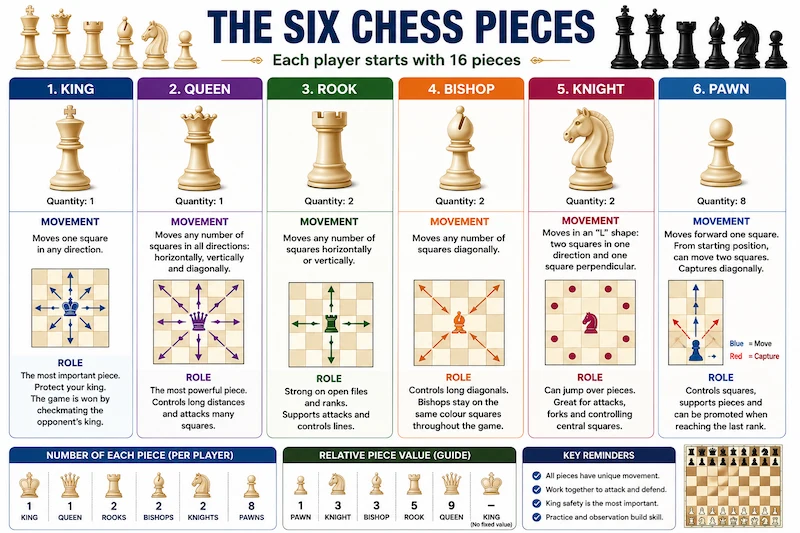
Chess Pieces
The six types of chess pieces are the foundation of the game. Every player begins with the same set of pieces, but each type has a different movement pattern, range, and role.
Understanding the pieces is one of the first essential steps for a beginner. Before learning openings, tactics, or strategy, a player should be able to identify each piece, understand its basic purpose, and recognize how the pieces work together.
Each player starts with 16 pieces:
- 1 King
- 1 Queen
- 2 Rooks
- 2 Bishops
- 2 Knights
- 8 Pawns
Although the king is usually assigned the lowest numerical material value in conventional piece-value systems, it is the most important piece because the objective of the game is to checkmate the opponent’s king.
King
The King is the most important piece in chess.
Each player has one king. The king normally moves one square in any direction—horizontally, vertically, or diagonally.
The king cannot move to a square where it would be under attack by an opponent’s piece.
The king’s importance is different from that of the other pieces. It is not normally evaluated simply by its material value because losing the king is not the way the game ends. Instead, the game ends when the king is checkmated.
Role of the King
The king’s role changes during the game.
- In the opening, king safety is a major priority.
- In the middlegame, the king often needs protection from attacks.
- In the endgame, the king can become an active and powerful piece.
Learning when the king should remain protected and when it can become active is an important part of chess development.
Queen
The Queen is generally considered the most powerful piece in terms of movement and range.
Each player begins with one queen.
The queen can move:
- Horizontally
- Vertically
- Diagonally
It can therefore move along ranks, files, and diagonals as long as its path is not blocked.
Because of its long range, the queen can attack several areas of the board and can cooperate effectively with other pieces.
However, its power does not mean that the queen should always be developed early. Beginners often bring the queen out too soon and allow the opponent to gain time by attacking it.
A strong player considers the queen’s safety, activity, and coordination with the other pieces.
Rook
Each player starts with two rooks.
A rook moves horizontally or vertically along:
- Ranks
- Files
The rook cannot move through another piece.
Rooks are particularly effective on open files and ranks because they can use their long-range movement without being blocked by pawns or other pieces.
Role of the Rook
Rooks often become increasingly active as the game progresses.
Common strategic roles include:
- Controlling open files
- Supporting passed pawns
- Attacking weaknesses
- Protecting important pieces
- Coordinating with the other rook
When the king has moved away from its starting position, the rooks may also become connected when there are no pieces between them on the back rank.
Bishop
Each player begins with two bishops.
A bishop moves diagonally any number of squares, provided its path is clear.
One important characteristic of bishops is that a bishop remains on the same colour of square throughout the game.
For example, a bishop that begins on a light-coloured square will always move on light-coloured squares. A bishop that begins on a dark-coloured square will remain on dark-coloured squares.
Because the two bishops begin on opposite colours, a player has one bishop operating on each colour complex.
Role of the Bishop
Bishops can become particularly effective when their diagonals are open.
Their long-range movement allows them to:
- Control long diagonals
- Attack distant pieces
- Support pawn advances
- Work with the queen and rooks
- Create pressure against the opponent’s king
The value of a bishop often depends on the position. In open positions, its long-range movement can be especially useful.
Knight
Each player begins with two knights.
The knight has a unique movement pattern. It moves in an L-shaped pattern: two squares in one direction followed by one square perpendicular to that direction, or one square in one direction followed by two squares perpendicular to it.
The knight has one special characteristic that distinguishes it from the other pieces:
It can jump over pieces.
This means that a knight does not require a completely clear path between its starting and destination squares.
Role of the Knight
Knights are often useful in positions where they can establish themselves on strong central or advanced squares.
They can:
- Attack several squares at once
- Create forks
- Control central squares
- Attack pieces from unusual angles
- Jump over blocked positions
Because knights do not move along straight lines, beginners sometimes need additional practice to visualize their possible destinations.
Pawn
Each player begins with eight pawns.
Pawns are different from all the other chess pieces because their movement and capturing rules are not the same.
A pawn normally moves forward but captures diagonally forward.
From its starting position, a pawn may have the option to move two squares forward, provided the required conditions are met. After moving from its starting position, it normally advances one square at a time.
Pawns cannot move backward.
Role of Pawns
Pawns are extremely important because they influence the structure and character of the position.
They can:
- Control important squares
- Protect other pieces
- Create attacking opportunities
- Form pawn chains
- Open or close files and diagonals
- Advance toward promotion
Although an individual pawn has limited movement, the arrangement of all the pawns can have a major strategic effect on the game.
Number of Each Piece
The complete starting set for one player is:
| Chess Piece | Number |
|---|---|
| King | 1 |
| Queen | 1 |
| Rook | 2 |
| Bishop | 2 |
| Knight | 2 |
| Pawn | 8 |
| Total | 16 |
Since both players start with the same set, a standard chess game begins with 32 pieces on the board.
Some pieces may later be captured, while a pawn can eventually be promoted into another piece.
Relative Role of Each Piece
Chess players often use approximate material values to compare pieces.
A commonly used educational system is:
| Piece | Approximate Value |
|---|---|
| Pawn | 1 |
| Knight | 3 |
| Bishop | 3 |
| Rook | 5 |
| Queen | 9 |
| King | No conventional material value |
These numbers are guidelines rather than fixed prices.
The actual usefulness of a piece depends on the position. A knight occupying a powerful central square may be more valuable in practical terms than a bishop trapped behind its own pawns. Similarly, a rook on an open file can be much more effective than a rook restricted by blocked pieces.
The king is not assigned a normal material value because checkmate, rather than material capture, determines the game’s decisive objective.
How Chess Pieces Work Together
Chess is not only about understanding individual pieces. Strong play depends on coordination between pieces.
For example:
- A queen and bishop can work together against a king.
- Rooks can cooperate on open files.
- Knights can create forks supported by pawns or other pieces.
- Bishops can control diagonals while rooks attack along files.
- The king can support pawns during the endgame.
The strength of a piece therefore depends not only on its movement but also on its position, activity, safety, and cooperation with other pieces.
Quick Review of the Six Pieces
A beginner can remember the basic movement concepts as follows:
King → one square in any direction
Queen → ranks, files, and diagonals
Rook → ranks and files
Bishop → diagonals
Knight → L-shaped movement and can jump
Pawn → moves forward and captures diagonally
The detailed movement and capturing rules of these pieces will be explained in the next section.
How Chess Pieces Move
Learning how each chess piece moves is one of the most important foundations of chess. Every piece has its own movement pattern, and a move is legal only when it follows the rules of chess.
The six chess pieces are:
- King
- Queen
- Rook
- Bishop
- Knight
- Pawn
Some pieces move along straight lines, some move diagonally, and the knight has a unique jumping movement. The pawn is different because its normal movement and capturing movement are not the same.
The following movement rules are based on the FIDE Laws of Chess.
King Movement
The King moves exactly one square in any direction:
- Forward
- Backward
- Left
- Right
- Diagonally
The king cannot move onto a square that is attacked by an opponent’s piece.
For example, if the king is on e4, it can potentially move to:
d3, e3, f3, d4, f4, d5, e5, f5
provided those squares are legally available and are not under attack.
Important Rule
The king is never allowed to move into check.
This means that although the king normally moves one square in any direction, its movement is restricted by the safety of the destination square.
Queen Movement
The Queen has the widest movement range of all the regular chess pieces.
It can move any number of squares:
- Horizontally
- Vertically
- Diagonally
The queen cannot jump over another piece.
For example, from the centre of an empty board, a queen can control multiple ranks, files, and diagonals simultaneously.
Because of this combination of movement abilities, the queen is extremely powerful.
Queen Movement Pattern
Think of the queen as combining the movement of the:
Rook + Bishop = Queen
However, the queen still cannot jump over pieces, and it cannot make a move that leaves its own king in check.
Rook Movement
The Rook moves any number of squares along a:
- Rank
- File
It cannot move diagonally.
A rook also cannot jump over another piece.
For example, a rook on d4 can move along:
- The fourth rank
- The d-file
as long as the path is clear.
Rooks are particularly effective when files or ranks are open because their long-range movement allows them to control large sections of the board.
Bishop Movement
The Bishop moves any number of squares diagonally.
It cannot move horizontally or vertically.
Like the rook and queen, the bishop cannot jump over another piece.
One important feature of bishop movement is that a bishop always remains on the same colour of square throughout the game.
Therefore:
- A bishop starting on a light square stays on light squares.
- A bishop starting on a dark square stays on dark squares.
This is why each player begins with one light-square bishop and one dark-square bishop.
Knight Movement
The Knight has the most distinctive movement pattern.
It moves in an L-shape:
- Two squares in one direction and one square perpendicular to that direction, or
- One square in one direction and two squares perpendicular to it.
A knight can therefore move to up to eight different destination squares from a suitable central position.
The Knight Can Jump
The knight is the only chess piece that can jump over other pieces during its normal movement.
This makes the knight especially useful in crowded positions where other pieces may be blocked.
For example, a knight can move from g1 to f3 even if another piece occupies a square between the starting and destination areas, because the knight does not travel through the intervening squares.
However, the destination square itself must be legally available.
Pawn Movement
The Pawn has movement rules that are different from the other pieces.
A pawn normally moves:
One square forward.
From its original starting position, a pawn may move two squares forward if both the starting and intermediate squares are clear.
Pawns move in opposite forward directions depending on their colour:
- White pawns move toward higher-numbered ranks.
- Black pawns move toward lower-numbered ranks.
Pawn Capturing
A pawn does not capture in the same way that it moves.
A pawn normally captures one square diagonally forward.
For example, a White pawn on e4 can normally capture a piece on:
d5 or f5
if an opponent’s piece occupies that square.
This difference is essential:
Pawn movement → forward
Pawn capture → diagonally forward
The special pawn capture known as en passant will be explained separately in Part 7.
Capturing Rules
A capture occurs when a player moves a piece onto a square occupied by an opponent’s piece, removing that opponent’s piece from the board.
Most pieces capture according to the same movement pattern they use for ordinary movement.
For example:
- Queen → captures horizontally, vertically, or diagonally.
- Rook → captures horizontally or vertically.
- Bishop → captures diagonally.
- Knight → captures using its L-shaped movement.
- King → captures one square in any direction, provided the destination square is safe.
- Pawn → captures one square diagonally forward.
There is one important exception in the basic movement pattern:
A pawn moves forward but captures diagonally forward.
Pieces That Cannot Jump
Most chess pieces cannot move through other pieces.
The following pieces cannot jump over intervening pieces:
- King
- Queen
- Rook
- Bishop
- Pawn
The Knight is the exception.
For example, if a rook has a piece directly in front of it, the rook cannot move through that piece. It may move up to the occupied square only if that square contains an opponent’s piece and the capture is legal.
If the intervening piece belongs to the same player, the rook cannot move onto or beyond that square.
Friendly and Opposing Pieces
A player cannot normally move a piece onto a square occupied by one of their own pieces.
Instead:
- A friendly piece blocks movement.
- An opponent’s piece may be captured if the move is legal.
- A piece cannot move through another piece unless it is a knight.
This makes piece placement extremely important.
A piece that is powerful in an open position may become restricted when its movement is blocked by its own pieces or pawns.
Legal Movement and King Safety
Learning the movement pattern of a piece is not enough to determine whether a move is legal.
A move must also comply with the rules concerning the king.
A player cannot make a move that leaves their own king in check.
Therefore, before making a move, a player should consider:
- Where can the piece move?
- Is the destination square legal?
- Is the path clear, if the piece requires a clear path?
- Is there a friendly piece on the destination square?
- Can an opponent’s piece be captured there?
- Will the move leave my own king in check?
This final question is especially important for beginners.
Quick Movement Guide
| Piece | Basic Movement |
|---|---|
| King | One square in any direction |
| Queen | Any number of squares horizontally, vertically, or diagonally |
| Rook | Any number of squares horizontally or vertically |
| Bishop | Any number of squares diagonally |
| Knight | L-shaped movement; can jump over pieces |
| Pawn | Moves forward; normally captures diagonally forward |
Easy Way to Remember the Pieces
A beginner can remember the movement patterns using this simple formula:
King → One
Queen → Everywhere in straight lines
Rook → Straight
Bishop → Diagonal
Knight → L-shape + Jump
Pawn → Forward move + Diagonal capture
Mastering these basic movement patterns provides the foundation for learning special moves, check, checkmate, tactics, and strategy.
The next section will build on these basic rules by explaining the special moves in chess: castling, en passant, and pawn promotion.

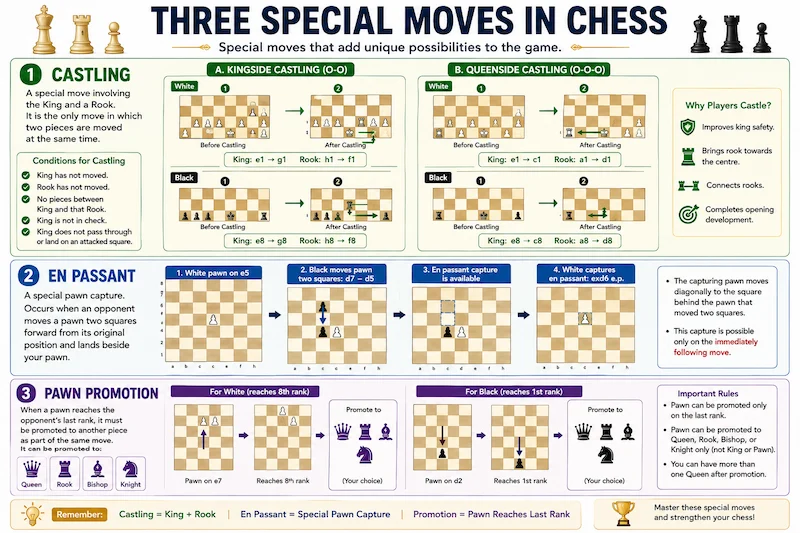
Special Moves in Chess
Chess has a few special moves that do not follow the ordinary movement pattern of the pieces. These moves are important because they can change the position significantly and are frequently used in practical games.
The three principal special moves are:
- Castling
- En Passant
- Pawn Promotion
Understanding these rules is essential before moving on to check, checkmate, and basic chess strategy. The rules below follow the FIDE Laws of Chess.
Castling
Castling is a special move involving the King and a Rook.
It is the only chess move in which a player moves two pieces as part of the same move.
Castling is commonly used to improve king safety and bring a rook toward the centre of the board.
There are two types of castling:
- Kingside castling
- Queenside castling
Kingside Castling
Kingside castling is performed on the side of the board where the king’s rook begins.
For White:
King: e1 → g1
Rook: h1 → f1
For Black:
King: e8 → g8
Rook: h8 → f8
Kingside castling is often represented in chess notation as:
O-O
Queenside Castling
Queenside castling is performed on the side where the queen begins.
For White:
King: e1 → c1
Rook: a1 → d1
For Black:
King: e8 → c8
Rook: a8 → d8
In chess notation, queenside castling is written:
O-O-O
Conditions for Castling
Castling is legal only when specific conditions are satisfied.
The following conditions must apply:
- The king has not previously moved.
- The particular rook involved has not previously moved.
- There are no pieces between the king and that rook.
- The king is not currently in check.
- The king does not pass through a square that is under attack.
- The king does not finish on a square that is under attack.
Therefore, a player cannot castle simply because the king and rook are in their original positions. The position must also satisfy the king-safety requirements.
Important Point
The rook itself may be under attack without automatically preventing castling.
The critical restriction concerns the king: the king cannot start in check, cross an attacked square, or end on an attacked square.
Why Players Castle
Castling can have several practical benefits.
It can:
- Move the king toward a safer area.
- Bring a rook toward a more active file.
- Connect the rooks after the pieces between them have moved.
- Complete an important part of opening development.
However, castling is not automatically good in every position. Players should consider the position of the opponent’s pieces, pawn structure, open files, and potential attacks before deciding which side to castle.
En Passant
En passant is a special type of pawn capture.
It occurs when an opponent moves a pawn two squares forward from its original position and that pawn lands beside one of your pawns.
Under the specific conditions of the rule, your pawn may capture it as though it had moved only one square.
Example
Suppose:
- White has a pawn on e5.
- Black moves a pawn from d7 to d5, moving two squares.
- The Black pawn now stands beside the White pawn.
White may capture en passant:
e5xd6 e.p.
The White pawn moves to d6, while the Black pawn on d5 is removed from the board.
Important En Passant Rule
The opportunity to capture en passant exists only on the immediately following move.
If the player does not make the en passant capture immediately, the special opportunity disappears.
This is one of the most important details beginners should remember.
Why En Passant Exists
The en passant rule prevents a pawn from avoiding a capture simply by using its initial two-square move to pass through a square where it could otherwise have been captured.
It is a relatively uncommon move for beginners, but it can become important in tactical and strategic positions.
Pawn Promotion
A pawn has another special ability called promotion.
When a pawn reaches the opponent’s last rank, it must be replaced as part of the same move by another piece.
For White, promotion occurs when a pawn reaches:
Rank 8
For Black, promotion occurs when a pawn reaches:
Rank 1
The pawn can be promoted to:
- Queen
- Rook
- Bishop
- Knight
The player chooses which of these pieces the pawn becomes.
Queen Promotion
Promotion to a Queen is the most common choice because the queen is generally the most powerful piece.
For example:
White pawn: e7 → e8 = Queen
The promoted queen immediately becomes part of the position.
However, promotion does not have to be to a queen.
Underpromotion
A player may deliberately promote a pawn to a:
- Rook
- Bishop
- Knight
This is called underpromotion.
Although less common, underpromotion can sometimes be strategically or tactically useful.
A knight promotion is particularly interesting because the knight has a unique movement pattern and may create an immediate threat that a queen would not.
Important Promotion Rule
A pawn cannot be promoted to:
- King
- Pawn
Only a:
Queen, Rook, Bishop, or Knight
can be selected.
A player may also have more than one queen on the board after promotion if another pawn is promoted to a queen.
Special Moves at a Glance
| Special Move | Pieces Involved | Main Feature |
|---|---|---|
| Castling | King + Rook | King and rook move in the same move |
| En Passant | Pawn + Pawn | Special pawn capture after a two-square pawn move |
| Promotion | Pawn | Pawn becomes Queen, Rook, Bishop, or Knight |
Common Beginner Mistakes
Special moves are often misunderstood when first learning chess.
Mistake 1: Castling Through Check
A player cannot castle if the king is currently in check or if the king must cross an attacked square.
Mistake 2: Castling After Moving the King
If the king has moved earlier in the game and later returns to its original square, it cannot castle.
Mistake 3: Forgetting the En Passant Time Limit
En passant must be played immediately after the qualifying two-square pawn move. The opportunity does not remain available for later moves.
Mistake 4: Thinking Promotion Means Only a Queen
A pawn can be promoted to a queen, rook, bishop, or knight.
Mistake 5: Promoting Before the Last Rank
A pawn is promoted only when it reaches the opponent’s last rank.
Easy Way to Remember the Three Special Moves
A simple beginner-friendly formula is:
Castling → King + Rook
En Passant → Special Pawn Capture
Promotion → Pawn Reaches Last Rank
These three special rules add important possibilities to the basic movement of the chess pieces.
Once a beginner understands them, the next major concepts to learn are check, checkmate, and how a player can respond when the king is attacked.
Check, Checkmate and Stalemate
Understanding check, checkmate, and stalemate is essential for every chess player because these concepts explain how a king can be attacked, how a player can defend against that attack, and how a game can be won or drawn.
Under the current FIDE Laws of Chess, a king is in check when it is attacked by one or more opposing pieces. A player may not make a move that leaves their own king under attack. Checkmate occurs when the king is attacked and there is no legal way to remove the threat. Stalemate is different: the player has no legal move, but the king is not in check.
What Is Check?
A king is said to be in check when it is attacked by one or more of the opponent’s pieces.
For example, a rook may attack a king along an open file, a bishop may attack it along a diagonal, or a queen may attack it along a rank, file, or diagonal.
When a king is in check, the player must respond immediately by making a legal move that removes the check.
A player cannot simply ignore check and make an unrelated move.
FIDE’s Laws specifically prohibit leaving one’s own king under attack.
How Check Can Occur
A king may be placed in check by different pieces:
- Queen — along a rank, file, or diagonal
- Rook — along a rank or file
- Bishop — along a diagonal
- Knight — through its L-shaped attack
- Pawn — through its diagonal capturing squares
- King — through its adjacent squares
A king is therefore always required to remain in a legally safe position.
How to Respond to Check
When your king is in check, there are generally three basic ways to respond:
- Move the king
- Capture the attacking piece
- Block the attack, when blocking is possible
The correct response depends on how the check is being delivered.
1. Move the King
The king may move to a safe square where it is no longer under attack.
The destination square must be legal.
The king cannot move onto a square controlled by an opponent’s piece.
2. Capture the Attacking Piece
If possible, the king or another friendly piece can capture the piece giving check.
However, the capturing move must be legal and must not leave the king in check.
For example, if an enemy rook is giving check and another piece can safely capture that rook, the check may be removed.
3. Block the Attack
Some checks can be stopped by placing a piece between the attacking piece and the king.
This is possible when the checking piece attacks along a line, such as:
- Rook
- Bishop
- Queen
For example, if a rook attacks a king along an open file, a defending piece may sometimes move onto an intermediate square and block the attack.
A knight check cannot be blocked, because the knight jumps directly to its destination.
A pawn or king attack also cannot normally be blocked in this way.
What Is Checkmate?
Checkmate is the decisive winning condition in chess.
A player achieves checkmate when:
- The opponent’s king is in check, and
- There is no legal move that can remove the check.
The player who checkmates the opponent’s king wins the game immediately under the FIDE Laws.
Checkmate = Check + No Legal Escape
A simple formula for beginners is:
CHECK + NO LEGAL RESPONSE = CHECKMATE
This is different from simply giving check.
A king can be in check without the game being over because the player may still have a legal way to escape.
Ways to Escape Check
When checking whether a position is checkmate, consider all possible defensive options:
Can the King Move?
Check whether the king has a safe square.
If at least one legal escape square exists, the position is not checkmate.
Can the Attacking Piece Be Captured?
Check whether the checking piece can legally be captured.
If it can, the position is not checkmate.
Can the Attack Be Blocked?
If the attack comes along a rank, file, or diagonal, check whether another piece can interpose.
If a legal block is available, the position is not checkmate.
If none of these possibilities works, the king is checkmated.
What Is Stalemate?
Stalemate is a special type of draw.
A stalemate occurs when:
- The player whose turn it is has no legal move, and
- Their king is not in check.
When this position occurs, the game immediately ends as a draw under the FIDE Laws.
This is one of the most important concepts for beginners because a position that looks like a winning position can sometimes become a draw if the defending player has no legal move but their king is not attacked.
Stalemate Formula
NO LEGAL MOVE + KING NOT IN CHECK = STALEMATE
Checkmate vs Stalemate
The difference between checkmate and stalemate is very small visually but extremely important in terms of the result.
| Feature | Checkmate | Stalemate |
|---|---|---|
| King in check? | Yes | No |
| Legal move available? | No | No |
| Result | Win | Draw |
| Game ends immediately? | Yes | Yes |
The key question is:
Is the king under attack?
If the answer is yes and there is no legal response → Checkmate.
If the answer is no and there is no legal move → Stalemate.
Simple Example of Check
Imagine that a rook is attacking a king along an open file.
If the king can move to a safe square, the position is simply check.
The game continues after the player makes a legal response.
For example:
Rook gives check → King moves to safety → Game continues
The player giving check has created a threat, but has not yet won the game.
Simple Example of Checkmate
Imagine that a queen gives check to the opponent’s king.
Now examine the position:
- The king cannot move to any safe square.
- The queen cannot be captured.
- The checking line cannot be blocked.
There is therefore no legal response.
The position is checkmate, and the player who delivered the checkmate wins the game.
Simple Example of Stalemate
Imagine that the defending king is surrounded by opposing pieces and has no legal move.
However, the king is not being attacked.
If the player has no other legal move with any of their pieces, the position is stalemate.
The result is:
Draw
This is why players must be careful when trying to finish a winning position. Removing all the opponent’s legal moves is not enough; the king must actually be checkmated for a win.
Check, Checkmate and Stalemate at a Glance
A useful way to remember the three concepts is:
Check
King is attacked → Legal response exists
Checkmate
King is attacked → No legal response → Win
Stalemate
King is not attacked → No legal move → Draw
This simple distinction helps beginners understand many basic chess positions.
Why These Concepts Matter
Check, checkmate, and stalemate are not only rules to memorize. They are central to chess strategy.
A player needs to recognize:
- When their own king is threatened
- Whether a checking move can be answered
- Whether an attack is actually checkmate
- Whether the opponent has a stalemate resource
- Whether a winning position can be converted safely
As players become stronger, they learn to calculate these possibilities before making a move.
A Beginner’s Checkmate Test
Whenever you think you have checkmated the opponent, ask:
1. Is the king actually in check?
2. Can the king move to a safe square?
3. Can the attacking piece be captured?
4. Can the checking line be blocked?
5. Does the opponent have another legal response?
If the king is in check and none of the legal responses is available, the position is checkmate.
If there is no check and the opponent has no legal move, it is instead stalemate.
Quick Revision
Check:
The king is under attack.
Checkmate:
The king is under attack and there is no legal way to escape. The attacking player wins.
Stalemate:
The player has no legal move, but the king is not under attack. The game is drawn.
These three concepts form one of the most important foundations of chess. Once a beginner understands them clearly, it becomes much easier to understand how a chess game ends, which will be covered in the next part.

How a Chess Game Ends
A chess game can end in several different ways. The most familiar result is checkmate, but a game may also finish because a player resigns, the position is drawn, or certain FIDE draw provisions apply.
Under the current FIDE Laws of Chess, the principal ways a game can conclude include checkmate, resignation, stalemate, a dead position, agreement to draw, threefold repetition by claim, and the 50-move rule by claim. There are also automatic draw provisions for fivefold repetition and the 75-move rule.
1. Checkmate
The most direct way to win a chess game is checkmate.
A player wins when the opponent’s king is in check and there is no legal way to remove the attack. The game ends immediately when the checkmate position is legally produced.
Checkmate = King in check + No legal response
The player who delivers checkmate wins the game.
2. Resignation
A player may decide to resign when they believe they cannot reasonably continue or avoid losing.
When a player declares that they resign, the game normally ends immediately and that player loses. Under the current FIDE wording, there is one important exception: if the position is such that the opponent could not possibly checkmate the resigning player’s king by any series of legal moves, the result is a draw instead.
Resigning is therefore a normal and accepted part of competitive chess. A player does not have to wait until checkmate occurs.
3. Draw
A draw means that neither player wins.
Chess can be drawn for several different reasons. Some draw situations happen automatically under the Laws, while others require a player to make a correct claim or both players to agree.
Common draw situations include:
- Stalemate
- Dead position
- Threefold repetition
- Fifty-move rule
- Agreement between the players
- Fivefold repetition
- Seventy-five-move rule
4. Stalemate
A stalemate occurs when the player whose turn it is:
- has no legal move, and
- has a king that is not in check.
The game immediately ends in a draw.
This is different from checkmate.
Checkmate: King is in check + no legal move → Win
Stalemate: King is not in check + no legal move → Draw
This is why a player who has a winning advantage must be careful not to accidentally create a stalemate.
5. Threefold Repetition
A game can be drawn by threefold repetition when the same position occurs for the third time, subject to the specific conditions in the FIDE Laws.
Importantly, threefold repetition is not simply about repeating the same moves. The relevant position must meet the requirements concerning:
- The same player having the move
- The same kinds and colours of pieces occupying the same squares
- The same possible moves being available
A player with the move can make a correct claim when the position has occurred three times, or can claim in advance when their intended move will produce the third occurrence.
Important distinction
Threefold repetition → claim
Fivefold repetition → automatic draw
This distinction is important when describing the current FIDE rules.
6. Fifty-Move Rule
The 50-move rule provides a way to claim a draw when the last 50 moves by each player have been completed without:
- any pawn move, and
- any capture.
Under the current FIDE Laws, a player may make a correct claim when the required 50-move condition has been reached or can be reached by their intended move, following the prescribed claiming procedure.
The rule is designed to prevent games from continuing indefinitely in positions where neither side makes progress through pawn moves or captures.
50 Moves vs 75 Moves
Do not confuse the two rules:
- 50-move rule: a player can claim a draw.
- 75-move rule: the game is automatically drawn when the condition is reached, subject to the checkmate exception in the Laws.
7. Agreement to Draw
Players can also agree to a draw during the game.
Under the current FIDE Laws, an agreement to draw is permitted provided that both players have made at least one move. Once the agreement is made, the game ends immediately.
In competitive chess, players may agree to a draw when they judge that the position is balanced, the winning chances are insufficient, or continuing the game is not worthwhile.
However, tournament regulations can impose additional conditions concerning draw offers.
8. Dead Position
A dead position is a position in which neither player can checkmate the opponent’s king by any possible series of legal moves.
When such a position arises, the game is drawn immediately.
This is different from stalemate.
In stalemate, the player to move has no legal move but the king is not in check.
In a dead position, checkmate is no longer possible for either player, regardless of how the game could legally continue.
9. Fivefold Repetition
The current FIDE Laws also provide an automatic draw when the same position has appeared at least five times, subject to the conditions defining the same position.
Unlike threefold repetition, this does not depend on a player making a claim. The game is drawn under the automatic provision.
This is an important distinction for students learning the modern rules:
Three times → claim
Five times → automatic draw
10. Seventy-Five-Move Rule
The current Laws also provide an automatic draw when 75 moves by each player have been completed without a pawn move or capture.
There is one important exception: if the last move results in checkmate, checkmate takes precedence.
Therefore:
50 moves → claim may be made
75 moves → automatic draw, unless the last move is checkmate
How a Chess Game Can End
| Ending | Result |
|---|---|
| Checkmate | Win for the player delivering checkmate |
| Resignation | Win for the opponent, subject to the FIDE dead-position exception |
| Stalemate | Draw |
| Dead position | Draw |
| Agreement to draw | Draw |
| Threefold repetition | Draw by correct claim |
| 50-move rule | Draw by correct claim |
| Fivefold repetition | Automatic draw |
| 75-move rule | Automatic draw, subject to the checkmate exception |
Quick Revision
A beginner can remember the main game-ending concepts like this:
Checkmate → You win
Resignation → Opponent gives up
Stalemate → No legal move, but no check → Draw
Dead position → Checkmate is impossible → Draw
Threefold repetition → Same position three times → Claim
50-move rule → 50 moves each without pawn move or capture → Claim
Agreement → Both players agree to draw
Fivefold repetition → Automatic draw
75-move rule → Automatic draw
Understanding these outcomes helps players recognize not only how to win, but also how a game can legitimately end without a winner.

Chess Notation
Chess notation is the standard method used to record and read chess moves. It allows players, coaches, tournament officials, books, websites, and databases to preserve an entire game move by move.
The FIDE Laws of Chess recognize the Algebraic System as the standard notation system for FIDE tournaments and recommend its use in chess literature and periodicals.
For a beginner, chess notation may look complicated at first, but the basic system is quite simple:
Piece + Destination Square
For example:
Nf3
means that a Knight moves to f3.
What Is Algebraic Chess Notation?
Algebraic notation identifies each move using the coordinates of the chessboard and, when necessary, a symbol representing the piece.
The board has:
- Files: a, b, c, d, e, f, g, h
- Ranks: 1, 2, 3, 4, 5, 6, 7, 8
Together, these identify all 64 squares on the board.
For example:
- a1
- b4
- c6
- e4
- h8
Each square has a unique coordinate.
Piece Symbols
In algebraic notation, pieces other than pawns are represented by capital letters.
| Piece | Symbol |
|---|---|
| King | K |
| Queen | Q |
| Rook | R |
| Bishop | B |
| Knight | N |
| Pawn | No letter |
The Knight uses N rather than K because K is already used for the King.
Examples
Kf2 → King moves to f2
Qd5 → Queen moves to d5
Re1 → Rook moves to e1
Bc4 → Bishop moves to c4
Nf3 → Knight moves to f3
For a pawn, only the destination square is written:
e4
This means a pawn moves to e4.
Files and Ranks
Understanding files and ranks is essential for reading notation.
The files are named:
a b c d e f g h
The ranks are numbered:
1 2 3 4 5 6 7 8
Therefore, a square is written by combining a letter and a number.
For example:
e4
means:
- File = e
- Rank = 4
The same coordinate system is used regardless of which player is reading the notation.
Recording a Normal Move
A normal move by a piece is recorded using:
Piece Symbol + Destination Square
Examples:
Nf3
Knight moves to f3.
Bc4
Bishop moves to c4.
Qd5
Queen moves to d5.
Re1
Rook moves to e1.
For pawns, the piece symbol is omitted:
e4
d4
a5
The FIDE algebraic notation system does not use a hyphen between the piece symbol and destination square.
Captures
When a piece captures another piece, the notation includes an x.
For example:
Bxe5
means:
Bishop captures the piece on e5.
Other examples include:
- Qxd5 → Queen captures on d5
- Rxe4 → Rook captures on e4
- Nxf3 → Knight captures on f3
For a pawn capture, the file from which the pawn moves is written first, followed by x and the destination square.
Examples:
dxe5
gxf3
axb5
The FIDE notation rules specify this format for pawn captures.
Check Symbol
When a move places the opponent’s king in check, the symbol:
+
may be added to the notation.
For example:
Qh5+
means the queen moves to h5 and gives check.
Another example:
Bb5+
means the bishop moves to b5 and gives check.
The check symbol is commonly used in recorded games, although FIDE’s Laws do not require players to record check symbols on the scoresheet.
Checkmate Symbol
Checkmate can be represented by:
#
For example:
Qh7#
means the queen moves to h7 and the move produces checkmate.
The symbol ++ has also historically been used for checkmate in some notation systems, but # is widely used in modern chess notation.
Again, recording the checkmate symbol is not mandatory under the FIDE scoresheet rules.
Castling Notation
Castling has its own notation.
Kingside Castling
Kingside castling is written:
O-O
It involves the king and the rook that begins on the h-file.
Queenside Castling
Queenside castling is written:
O-O-O
It involves the king and the rook that begins on the a-file.
FIDE’s notation appendix gives these as the standard castling abbreviations.
You may sometimes see the character 0 used instead of the letter O in digital systems or publications. The important point is that the notation represents the two types of castling.
Promotion Notation
When a pawn reaches the opponent’s last rank and is promoted, the move is followed by the symbol of the new piece.
For example:
d8=Q
is commonly written to show that the pawn promotes to a queen.
FIDE’s formal algebraic examples also show forms such as:
d8Q
f8N
b1B
g1R
These indicate promotion to:
- Queen
- Knight
- Bishop
- Rook
The exact presentation may vary between chess interfaces, but the essential information is the pawn’s destination and the piece selected.
Disambiguation
Sometimes two identical pieces can legally move to the same square.
In that situation, additional information is required to identify which piece actually moved.
For example, suppose two knights can both move to f3.
The notation may need to specify the file or rank of the knight that moved.
Examples include:
Ngf3
or
Nef3
If the knights are on the same file, the rank may be used instead:
N5f3
or
N1f3
This prevents confusion when recording or studying a game.
Pawn Notation
Pawns are the simplest pieces to record.
A pawn’s normal move is written only with the destination square.
Examples:
e4
d5
c6
There is no P symbol for a pawn in standard algebraic notation.
For captures, however, the pawn’s starting file is included:
exd5
This means:
The pawn from the e-file captures a piece on d5.
En Passant Notation
An en passant capture is recorded using the normal pawn-capture notation, with e.p. optionally appended.
For example:
exd6 e.p.
This indicates that the pawn from the e-file captures en passant on d6.
The FIDE notation appendix specifically gives this form for en passant.
Recording a Complete Game
Chess notation becomes especially useful when recording an entire game.
A game might begin:
1. e4 e5
2. Nf3 Nc6
3. Bc4 Nf6
4. O-O Be7
This tells us:
- White’s first move was e4.
- Black replied e5.
- White developed the knight to f3.
- Black moved the knight to c6.
- White moved the bishop to c4.
- Black moved the knight to f6.
- White castled kingside.
- Black moved the bishop to e7.
A notation record therefore allows someone to reconstruct and study the game without needing the original board.
Why Chess Notation Is Important
Chess notation has several important uses.
1. Recording Games
Players can preserve their games for future analysis.
2. Studying Famous Games
Historical games can be reproduced move by move.
3. Analysing Mistakes
A player can review where a game changed direction and identify better alternatives.
4. Tournament Records
In many over-the-board competitive formats, players are required to record their moves according to the applicable rules.
5. Chess Books and Articles
Chess notation allows positions and games to be discussed without reproducing an entire board for every move.
6. Digital Chess
Chess websites, databases, and software can use standardized notation to store and display games.
Quick Chess Notation Guide
| Situation | Example | Meaning |
|---|---|---|
| Pawn move | e4 | Pawn moves to e4 |
| Knight move | Nf3 | Knight moves to f3 |
| Bishop move | Bc4 | Bishop moves to c4 |
| Rook move | Re1 | Rook moves to e1 |
| Queen move | Qd5 | Queen moves to d5 |
| King move | Kf2 | King moves to f2 |
| Capture | Bxe5 | Bishop captures on e5 |
| Pawn capture | exd5 | e-pawn captures on d5 |
| Check | Qh5+ | Queen gives check |
| Checkmate | Qh7# | Queen gives checkmate |
| Kingside castling | O-O | Kingside castling |
| Queenside castling | O-O-O | Queenside castling |
| Promotion | d8=Q | Pawn promotes to queen |
Easy Formula for Beginners
A beginner can learn algebraic notation using this simple sequence:
1. Find the piece
2. Find the destination square
3. Add x if it is a capture
4. Add + if it gives check
5. Add # if it gives checkmate
6. Use O-O or O-O-O for castling
7. Record the new piece when a pawn promotes
Once these basics are understood, reading a chess game becomes much easier.
Chess notation may initially look like a collection of letters and numbers, but it is actually a compact language for describing chess positions and moves.

Key Takeaways
- Evaluate positions using balanced metrics: material, king shelter, piece activity, pawn levers, and initiative.
- Always identify the board character (open, closed, or dynamic) before committing to a plan.
- Activate passive pieces systematically before initiating pawn breaks or king attacks.
- Maintain active rooks and dynamic king participation throughout all endgame phases.
- Base long-term growth on disciplined self-analysis, structured routine, and continuous tactical refinement.
Frequently Asked Questions (FAQ)
Common questions about advanced positional chess, middlegame planning, rook endgames, and chess analysis.
What defines advanced positional chess?
Advanced positional chess is the deliberate method of building sustained advantages through piece harmony, controlling key outposts, optimizing pawn structures, and creating long-term structural pressure.
How should a player construct a middlegame plan?
Evaluate positional imbalances, isolate a concrete target (such as a backward pawn or weak square), position pieces optimally to increase pressure, and execute appropriate pawn breaks.
What is the most important principle in rook endgames?
Rook activity is paramount. A dynamically placed rook that delivers checks and controls open ranks is generally more valuable than defending passive material.
How should chess engines be used during game analysis?
Always analyze the game independently first to understand your own decisions. Use the chess engine afterward to verify calculations and identify tactical blind spots.
References & Authoritative Sources
For official tournament standards, regulations, and official chess frameworks.
-
FIDE Handbook & Official Laws of Chess
International regulations covering classical play, tiebreaks, and competitive conduct.
Visit the official FIDE Handbook → -
FIDE Rules Commission Documentation
Standard guidelines regarding tournament arbiter decisions and equipment specifications.
Visit the FIDE Rules Commission →
Note: For official competition standards and current tournament regulations, readers should always refer to the latest applicable FIDE regulations and tournament rules.
Explore More Games & Sports
Continue learning with our detailed guides: