
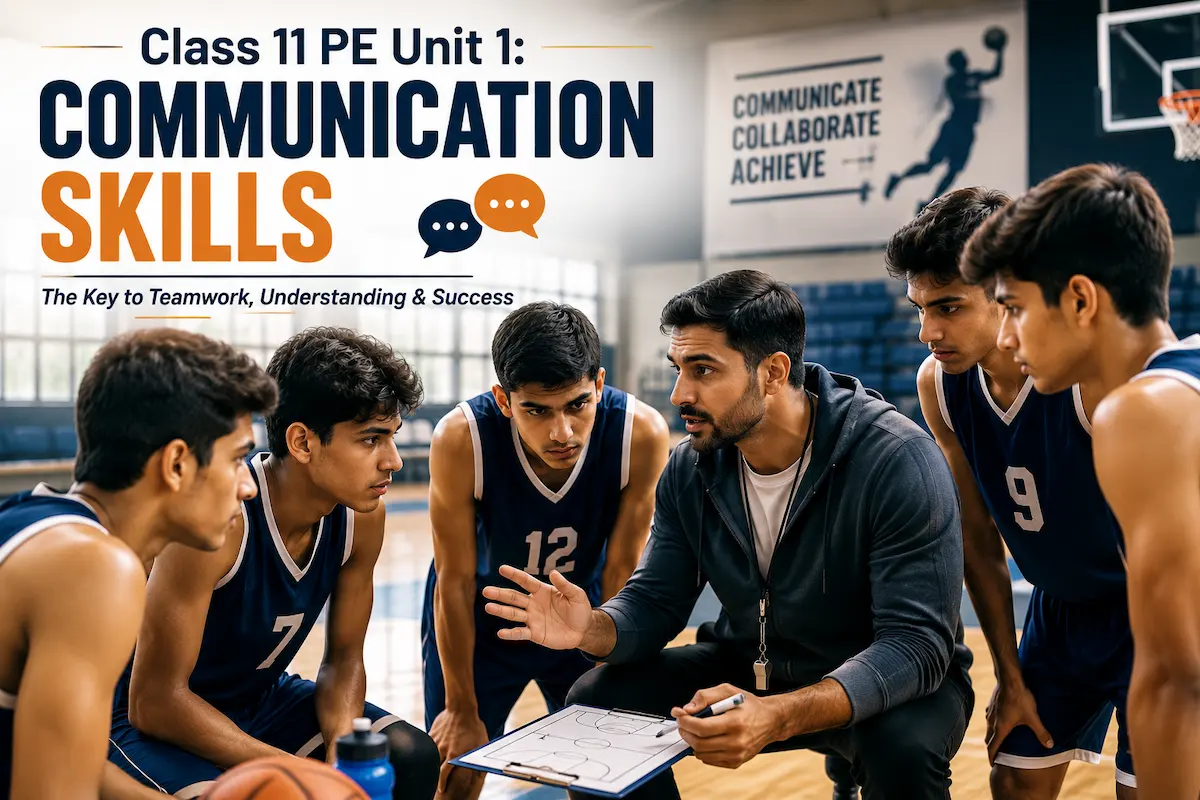
In our daily lives and professional careers, whether we are students, teachers, or Physical Activity Trainers, the ability to communicate effectively is the cornerstone of success. Under the Employability Skills section of the CBSE Class 11 Physical Activity Trainer (Subject Code – 845) syllabus, Unit 1 is entirely dedicated to ‘Communication Skills-III’. In this comprehensive chapter, we will explore the meaning of communication, its underlying processes, various methods of interacting, and the common barriers that prevent effective communication.
As a Physical Activity Trainer or a sports coach, your job extends far beyond merely conducting physical exercises on the ground. You are required to build a strong rapport with your athletes, students, and management. If your communication skills are lacking, your team will struggle to understand your instructions, leading to confusion on the field and poor performance. Therefore, mastering this unit is incredibly important not just for your academic examinations, but for your future career in physical education.
1. Introduction: What is Communication?
The word ‘Communication’ is derived from the Latin word “Communicare”, which translates to “to share.” In simple terms, communication is the process of sharing ideas, thoughts, information, and emotions between two or more individuals. A communication process is only considered successful and complete when the ‘Receiver’ (the person listening) understands the message in the exact same way that the ‘Sender’ (the person speaking) intended it.
Let us understand its role in a sports environment. Imagine you are organizing an inter-house basketball tournament in your school. As a physical education teacher, you need to explain the tournament rules, safety guidelines, and schedules to the participating students. If your voice is not clear, or if the vocabulary you use is too complex for the students to grasp, it will result in absolute chaos on the court. Team coordination will break down, and the event will suffer. Hence, communication is not just the act of speaking; it is the art of being understood.
2. The Process of Communication (The Communication Cycle)

Communication is never a one-way street; it is a dynamic, cyclic process that involves several key elements. For a message to travel successfully from one person’s mind to another’s, it must pass through a specific cycle. Let’s break down the main components of this process:
- Sender: This is the starting point of the communication cycle. The sender is the individual who has an idea, piece of information, or thought that they wish to share. For example, when a coach gathers the team in the locker room to explain a pre-match strategy, the coach acts as the sender.
- Message: The actual information, instruction, or feeling that the sender wants to convey is called the message. If you are instructing a student on how to properly grip a javelin or explaining the dimensions of a volleyball court, those specific details constitute your message.
- Encoding: The process of converting thoughts into a communicable form—such as words, symbols, or gestures—is known as encoding. A sender must encode their thoughts based on the language and comprehension level of the receiver.
- Communication Channel (Medium): This is the pathway or the medium through which the message is delivered. The channel can be oral (speaking face-to-face or using a megaphone on the field) or written (putting up the tournament schedule on the school notice board or sending an email).
- Receiver: The individual or group for whom the message is intended is the receiver. The success of the communication process heavily relies on the receiver’s attentiveness and their ability to comprehend the message. In a school setting, the students or athletes are usually the receivers.
- Decoding: When the receiver attempts to understand the words or gestures sent by the sender, the process is called decoding. The receiver uses their own knowledge, background, and experience to make sense of the message.
- Feedback: This is the final and most critical step in the communication cycle. Feedback indicates whether the receiver has accurately understood the message. When a coach explains a tactical drill and the players nod their heads or say “Yes, Coach,” that is their feedback. Without feedback, the sender can never be sure if the communication was successful.
3. Methods of Communication
To communicate effectively, a Physical Activity Trainer must know how to use different methods depending on the situation. These methods are broadly classified into three categories: Verbal, Non-Verbal, and Visual Communication.
Verbal Communication (Oral and Written)
Verbal communication involves the use of words and language to convey a message. It is further divided into two types: Oral and Written.
Oral Communication: This includes face-to-face conversations, group discussions, public speaking, and telephone calls. On the sports field, this is the most frequently used method. Giving instructions during a quick time-out in a basketball game, motivating a runner during a race, or blowing a whistle to gather attention are all prime examples of oral communication.
- Advantage: The biggest benefit of oral communication is that it allows for instant feedback. You can immediately see if the student understands you.
- Disadvantage: There is usually no permanent record of oral communication, which can lead to forgotten instructions.
Written Communication: This involves expressing words in a written format, such as emails, formal letters, reports, circulars, and SMS. When you write an application to the school principal seeking permission for an athletic meet, or when you draft a team roster to pin on the notice board, you are using written communication.
- Advantage: It provides a permanent, tangible record that can be referenced later.
- Disadvantage: It lacks instant feedback and can be time-consuming to draft properly.
Non-Verbal Communication
Communicating without uttering a single word—through your physical presence, actions, and expressions—is known as non-verbal communication. Studies suggest that in our daily interactions, over 55% of our communication is non-verbal. On the playing field, its importance multiplies exponentially.

Key elements of non-verbal communication include:
- Facial Expressions: Emotions like joy, anger, disappointment, or excitement are first visible on our faces. A coach’s warm smile can boost a young athlete’s confidence, while a frown can instantly signal that a mistake was made.
- Gestures: Using hands and head movements to convey a message. Referees and umpires rely heavily on gestures to signal a foul, an out, or a boundary. In noisy environments like a crowded stadium, gestures are often the only way to communicate decisions.
- Posture: The way you sit or stand reflects your confidence and authority. A Physical Activity Trainer who stands tall with an erect spine and open shoulders commands more respect and attention from students than one who slouches.
- Eye Contact: Maintaining eye contact while speaking signifies trust, honesty, and sincerity. When a trainer maintains eye contact with their team, the players feel valued and recognize that the trainer is fully focused on them.
- Paralanguage: This refers to how you say something, rather than what you say. It includes the pitch, tone, speed, and volume of your voice. An announcement for a sports event requires an enthusiastic and loud tone, whereas comforting an injured player requires a soft, empathetic tone.
Visual Communication
Visual communication involves the use of visual aids that can be seen and interpreted. This includes charts, graphs, maps, photographs, videos, and signs. In modern sports training, visual aids play a massive role.

When a coach stands in the dressing room and uses a whiteboard with markers to draw defensive formations, they are using visual communication. Similarly, showing athletes a video playback of their performance to correct their posture is an excellent example of visual learning. Scoreboards, directional signs in a stadium, and colored cards (red/yellow cards in football) are all visual communication tools that convey critical information instantly.
4. Barriers to Effective Communication
Often, we intend to say one thing, but the listener interprets it completely differently. This happens due to various obstacles known as “barriers to communication.” To be a successful Physical Activity Trainer, you must be able to identify and overcome these barriers. They are primarily categorized as follows:
1. Physical Barriers: These are environmental factors that obstruct communication. The most common physical barrier is ‘noise’. For instance, if you are trying to give last-minute instructions to a runner during an inter-school athletic meet, the deafening cheers of the crowd might drown out your voice. Other physical barriers include large physical distances across a football field, poor lighting, or bad weather conditions that distract players.
2. Linguistic and Semantic Barriers: When the sender and receiver do not share a common language, or when inappropriate vocabulary is used, it creates a linguistic barrier. Every profession has its own technical jargon. If a trainer uses terms like ‘Zone Defense’, ‘Screening’, or ‘Offside trap’ with Class 11 students who are absolute beginners, the students will be entirely confused. Instructions must always be tailored to the receiver’s level of understanding. Keep the language simple and accessible.
3. Interpersonal and Psychological Barriers: These barriers stem from the mental and emotional state of either the sender or the receiver. Emotions like anger, fear, anxiety, and prejudice heavily distort communication. For example, if a student is suffering from severe pre-match anxiety or fear of failure, they will not be able to process the coach’s technical advice, no matter how brilliantly it is explained. Additionally, ‘poor listening skills’ and a ‘lack of interest’ are massive psychological barriers that prevent learning.
4. Organizational Barriers: These are seen in large institutions like schools or sports academies, where communication must follow a strict hierarchy or chain of command. If the physical education department urgently needs new equipment, but the request has to pass through multiple layers of administration, the message might get delayed, distorted, or lost entirely, hampering the sports program.

Four common barriers to communication can affect understanding, coordination, and effective teamwork.5. The 7 C’s of Effective Communication
To ensure that your message is delivered effectively and without distortion, communication experts have established a set of principles known as the “7 C’s of Communication.” A good communicator should ensure their message incorporates these seven elements:
- Clear: Your message must be absolutely clear. You should know exactly what you expect from the receiver. Avoid beating around the bush; come straight to the point using simple, everyday language.
- Concise: Being concise means conveying your complete message in the fewest possible words. On a sports field, time is a luxury. Instructions given during a fast-paced game must be brief and to the point. Eliminate unnecessary words or long-winded stories.
- Concrete: A concrete message is solid and specific, backed by facts and figures rather than vague ideas. For instance, telling an athlete, “You need to run faster,” is vague. However, saying, “You need to complete the 100-meter sprint in under 12 seconds,” is a concrete, measurable, and actionable message.
- Correct: The information you provide must be factually and grammatically accurate. Giving incorrect rules or wrong dates damages your credibility. Ensuring the correct spelling of players’ names on a certificate or providing the exact time for a practice session builds trust and prevents logistical nightmares.
- Considerate: When communicating, you must step into the shoes of the receiver. This is known as the “You Approach.” A considerate trainer takes into account the students’ background, mindset, educational level, and physical limitations. Showing empathy towards a struggling student makes you an exceptional educator.
- Complete: A complete message contains all the necessary facts required by the audience (the Who, What, Where, When, and Why). Incomplete information breeds confusion. Saying, “We have a match tomorrow,” is incomplete. The complete message is, “We have a basketball match tomorrow at 8:00 AM against Ramagya School on Court Number 2. Everyone must report in their kits by 7:30 AM.”
- Courteous: Your communication should always reflect politeness and respect. Speaking with arrogance or constantly shouting creates a toxic environment. A positive, encouraging, and respectful tone motivates students to follow your instructions willingly and fosters a strong team spirit.

6. The Crucial Role of Active Listening
Active listening is an invisible yet indispensable part of effective communication. People often mistake good communication solely for the ability to speak well. In reality, to be a great speaker, you must first be a great listener.
There is a vast difference between simply ‘hearing’ and actively ‘listening’. Hearing is a passive physical process where sound waves enter your ears. Listening, however, is a psychological process that requires focus. It involves absorbing the words, understanding the underlying emotions, and analyzing the context.
As a Physical Activity Trainer, you will frequently need to rely on active listening to understand your students’ physical limitations, injuries, or mental blocks. When a student is talking to you, maintain eye contact, do not interrupt them mid-sentence, and use non-verbal cues like nodding to show that you are fully engaged in understanding their perspective.

Conclusion
The subject of communication serves as a foundational pillar for any Class 11 Physical Activity Trainer student. The primary objective of including this chapter in the CBSE syllabus is to ensure that future trainers and sports professionals are not only physically fit but also articulate, clear, and empathetic in their interactions.
A strong physique and excellent sports techniques are useless if you cannot effectively teach them to others. Mastering your verbal and non-verbal skills, recognizing and eliminating communication barriers, and applying the 7 C’s in your daily routine will not only make you a phenomenal trainer but will also pave the way for success in every aspect of your life.
Unit 1: Communication Skills-III (Chapter Summary)
This unit establishes the foundational concepts of communication for a Physical Activity Trainer. It covers the meaning of communication (derived from “Communicare”) and the complete communication cycle including Sender, Message, Encoding, Channel, Receiver, Decoding, and Feedback. The chapter explains various interaction methods—Verbal, Non-Verbal, and Visual—along with common Barriers (Physical, Linguistic, Psychological) and the proven 7 C’s of Effective Communication. Finally, it highlights the significance of Active Listening in a sports environment.
Frequently Asked Questions (FAQs)
Objective Type Questions (1 Mark)
Q1. The word ‘Communication’ is derived from which Latin word? +
Ans. B) Communicare (which means “to share”)
Q2. Which of the following is considered the final and most critical step in the communication cycle? +
Ans. C) Feedback
Q3. Approximately what percentage of daily human communication occurs through non-verbal methods (body language)? +
Ans. C) 55%
Q4. What type of barrier is caused by loud stadium noise or heavy crowd cheering during instructions? +
Ans. B) Physical Barrier
Q5. Which of the 7 C’s emphasizes using solid facts and figures instead of vague ideas? +
Ans. C) Concrete
Very Short Answer Type Questions (2 Marks)
Q6. Define Communication. +
Ans. Communication is the dynamic process of sharing ideas, thoughts, information, and emotions between two or more individuals. It is successful only when the receiver understands the message in the exact same way intended by the sender.
Q7. What is the role of ‘Feedback’ in communication? +
Ans. Feedback is the final and most crucial step that indicates whether the receiver has accurately understood the message. Without feedback, the sender can never verify if the communication process was successful.
Q8. Give two examples of Non-Verbal communication on a sports field. +
Ans. 1. Hand Gestures: Used by referees to signal a foul, out, or boundary in noisy match environments.
2. Facial Expressions: A coach’s smile to boost morale or a frown to indicate a mistake.
Q9. What is the difference between Hearing and Active Listening? +
Ans. Hearing is a passive physical process where sound waves simply enter the ears. Active Listening is an engaged psychological process that requires focus, understanding underlying emotions, and analyzing context.
Short Answer Type Questions (3 Marks)
Q10. Explain any three elements of the Communication Cycle. +
Ans.
- Sender: The starting point who possesses an idea or information to share.
- Message: The actual information, instruction, or data being conveyed.
- Channel: The medium or pathway (oral, written, or digital) through which the message travels to the receiver.
Q11. Differentiate between Oral and Written communication. +
Ans.
- Oral Communication: Involves speaking face-to-face or via calls. It provides instant feedback but leaves no permanent record.
- Written Communication: Involves emails, letters, and notices. It provides a permanent, tangible record for future reference but lacks instant feedback.
Q12. What are Linguistic and Semantic barriers to communication? Give an example. +
Ans. These barriers occur when sender and receiver do not share a common language or use inappropriate technical jargon. For example, using complex terms like ‘Zone Defense’ or ‘Offside trap’ with beginners who don’t understand sports terminology creates a linguistic barrier.
Long Answer Type Questions (5 Marks)
Q13. Explain the complete Communication Cycle with all its components in detail. +
Ans. Communication is a cyclic process passing through multiple stages:
- Sender: The individual who originates the idea or message.
- Message: The content or information that needs to be communicated.
- Encoding: Converting thoughts into a understandable form of words or symbols.
- Channel: The medium used to transmit the message (oral, written, visual).
- Receiver: The intended target audience or person receiving the message.
- Decoding: The receiver interpreting and making sense of the message.
- Feedback: The final response confirming whether the message was understood correctly.
Q14. Discuss the 7 C’s of Effective Communication in detail. +
Ans. To make communication impactful, a communicator must follow the 7 C’s:
- Clear: Use simple language and come straight to the point without confusion.
- Concise: Keep instructions brief, saving valuable time especially in sports fields.
- Concrete: Back up instructions with solid facts and measurable figures rather than vague statements.
- Correct: Ensure factual, grammatical, and technical accuracy to maintain credibility.
- Considerate: Practice the “You Approach” by keeping the receiver’s background and emotional state in mind.
- Complete: Provide all essential details (Who, What, Where, When, Why) to avoid ambiguity.
- Courteous: Maintain a respectful, polite, and positive tone to build trust and teamwork.
Q15. What are the major barriers to effective communication? How can a Physical Activity Trainer overcome them? +
Ans. Major barriers include:
- Physical Barriers: Environmental issues like background noise or large distances.
- Linguistic Barriers: Language differences and hard-to-understand technical jargon.
- Psychological Barriers: Emotional disturbances like anxiety, fear, poor listening, or lack of interest.
- Organizational Barriers: Strict administrative hierarchies delaying information flow.
Overcoming them: A trainer can overcome these by speaking clearly, avoiding complex jargon for beginners, ensuring quiet environments during briefings, practicing active listening, and maintaining an empathetic approach.