
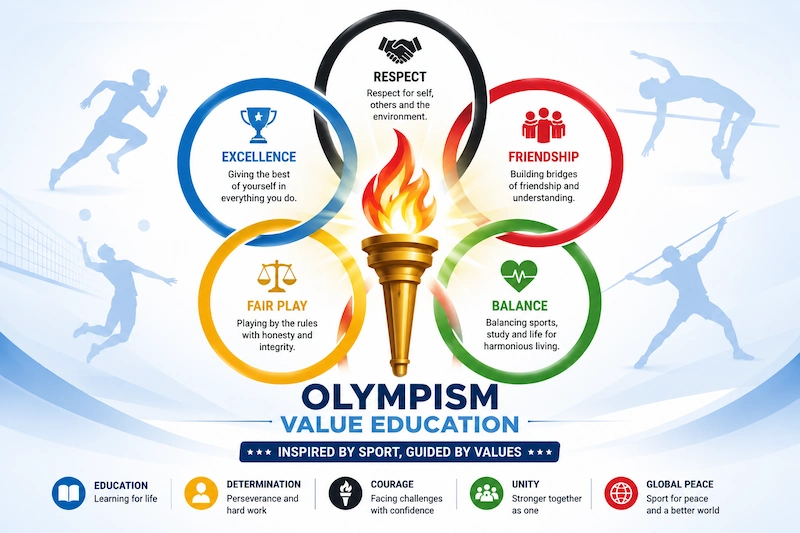
1. Olympism – Concept and Olympics Values
The Olympic Games are not merely a global sporting event held every four years; they represent a much deeper philosophy of life known as Olympism. The concept of Olympism was conceived by Baron Pierre de Coubertin, the founder of the modern Olympic Games. Olympism is a philosophy of life that exalts and combines the qualities of body, will, and mind into a balanced whole. Blending sport with culture and education, Olympism seeks to create a way of life based on the joy of effort, the educational value of good examples, social responsibility, and respect for universal fundamental ethical principles.
The primary goal of Olympism is to place sport at the service of the harmonious development of humankind, with a vision to promote a peaceful society concerned with the preservation of human dignity. To achieve this, the Olympic Movement is guided by three core values:
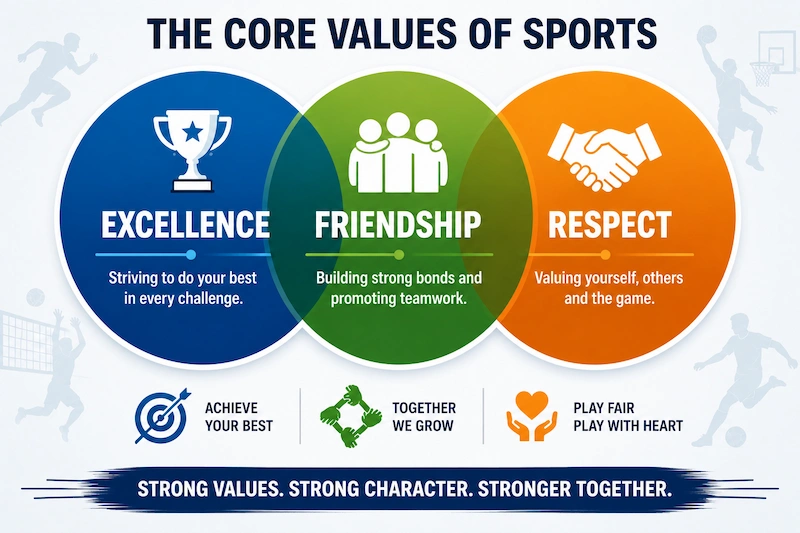
- Excellence: This value is not just about winning or being the absolute best; it is about giving one’s personal best, on the field of play and in everyday life. It involves pushing your own boundaries, striving for progress, and enjoying the healthy combination of body, will, and mind.
- Friendship: This value encourages us to consider sport as a tool for mutual understanding among individuals and people from all over the world. It inspires humanity to build a peaceful and better world through solidarity, team spirit, and joy, breaking down political, economic, gender, and racial barriers.
- Respect: This value incorporates respect for oneself, one’s body, for others, for the rules and regulations of the game, for sport, and for the environment. It stands against any form of discrimination and highly discourages unethical practices like doping. For more about doping, clean sport, and ethical sports participation, see Training & Doping in Sports
2. Olympic Value Education
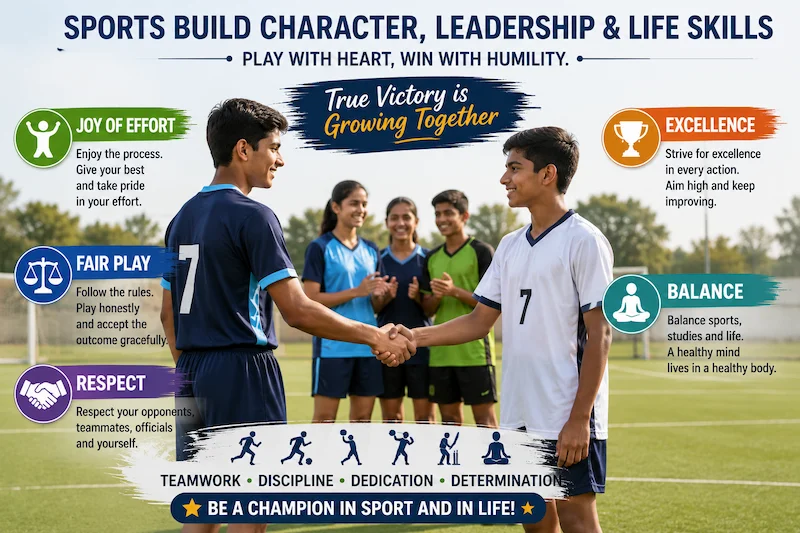
While the core values of Olympism act as the foundation, Olympic Value Education (OVEP) breaks these concepts down into practical, teachable life lessons for students. By participating in physical education and sports, students naturally absorb these five educational themes, shaping their character and moral compass.
- Joy of Effort: Young people develop and practice physical, behavioral, and intellectual skills by challenging themselves. The joy of effort teaches students that the true reward lies in the hard work, the sweat, and the dedication put into a task, rather than just the final outcome or the gold medal. It encourages an active and healthy lifestyle.
- Fair Play: Fair play is a concept that goes beyond strictly following the rules. It means playing with an honest spirit, not cheating, avoiding performance-enhancing drugs (doping), and respecting the referee’s decisions even when they go against your team. It builds integrity and trustworthiness.
- Respect for Others: The sports field brings together individuals from diverse cultures, religions, and economic backgrounds. By playing together, students learn to accept diversity, embrace inclusion, and treat their opponents, teammates, and coaches with dignity. It promotes peace and mutual understanding.
- Pursuit of Excellence: This encourages students to be the best possible version of themselves, not only in sports but in academics and personal life. It teaches that excellence is a journey of continuous self-improvement, setting higher goals, and working relentlessly to achieve them.
- Balance Among Body, Will & Mind: True education is not just about scoring high marks (mind); it requires physical fitness (body) and determination (will). Olympic education teaches students how to harmonize their physical capabilities with mental toughness and emotional willpower, creating a perfectly balanced personality. Students can further explore the relationship between physical fitness, wellness, and a healthy lifestyle in Physical Fitness, Wellness & Lifestyle
3. Ancient and Modern Olympics
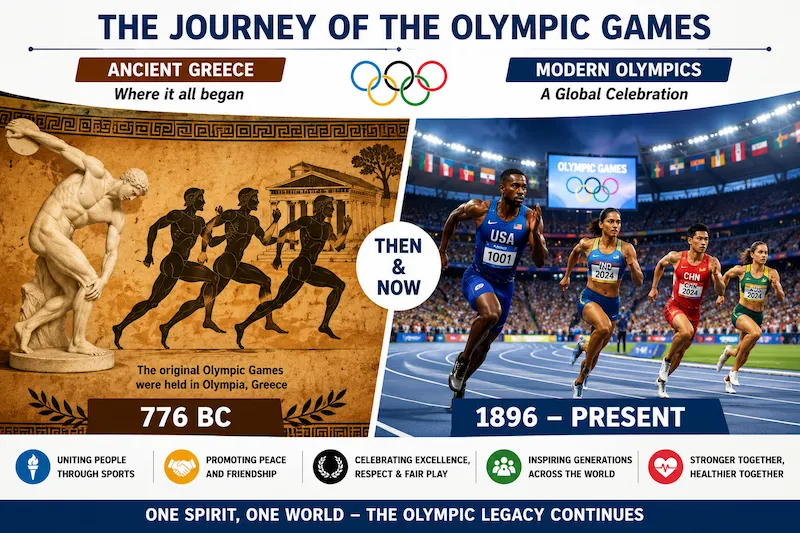
To truly understand the Olympic movement, students must look at its rich historical roots, divided clearly into the Ancient and Modern eras.
The Ancient Olympic Games: The origin of the Ancient Olympic Games is deeply rooted in Greek mythology and religion. They officially began in 776 BC in the valley of Olympia, Greece, held as a religious festival in honor of Zeus, the king of the Greek gods. These games were a highly prestigious event; during the games, a sacred truce (Ekecheiria) was announced, meaning all wars between Greek city-states had to stop so athletes and spectators could travel safely.
Only freeborn Greek men were allowed to participate. The events initially started with a single foot race called the “Stadion,” but gradually expanded to include wrestling, boxing, chariot racing, and the pentathlon. The winners were highly respected and received a simple crown made of olive leaves. However, after the Romans conquered Greece, the Christian Emperor Theodosius I banned the games in 394 AD, declaring them a “pagan” festival.
The Modern Olympic Games: For nearly 1,500 years, the Olympics were lost to history until a French educator named Baron Pierre de Coubertin decided to revive them. Believing that international sports could prevent wars and bring the youth of the world together, he founded the International Olympic Committee (IOC) in 1894.
Thanks to his tireless efforts, the first Modern Olympic Games were held in Athens, Greece, in 1896. Unlike the ancient games, the modern Olympics are open to athletes from all nations, regardless of race, religion, or gender. Today, they have grown into the largest and most celebrated sporting event on the planet, featuring both Summer and Winter Games, as well as the Paralympics for athletes with disabilities. The role of inclusive and adaptive physical education for athletes with disabilities is covered in Physical Education & Sports for CWSN
4. Olympics – Symbols, Motto, Flag, Oath, and Anthem
The Olympic Games are recognized worldwide through their distinct and powerful symbols. These elements are not just decorations; they carry deep meanings representing global unity, peace, and the sporting spirit.
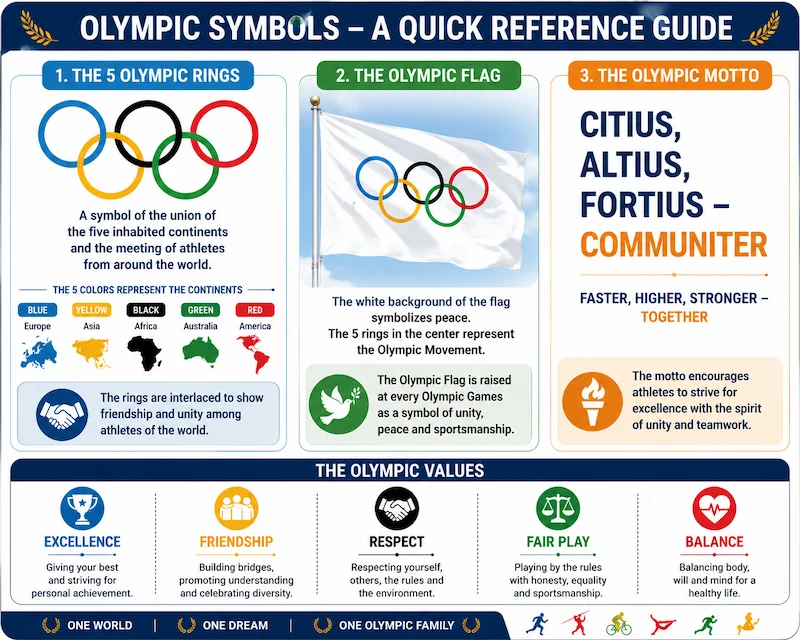
1. The Olympic Symbol (Rings): Designed by Pierre de Coubertin in 1913, the Olympic symbol consists of five interlocking rings of different colors: Blue, Yellow, Black, Green, and Red, resting on a white background. These rings represent the union of the five major continents of the world (Africa, Americas, Asia, Europe, and Oceania) and the gathering of athletes from across the globe. At least one of these six colors (including the white background) is present in the national flag of every country in the world.
2. The Olympic Motto: The original Olympic motto is made up of three Latin words: “Citius, Altius, Fortius,” which means “Faster, Higher, Stronger.” It was proposed by Coubertin upon the creation of the IOC. In 2021, to highlight the importance of global solidarity, the IOC updated the motto by adding the word “Communiter” (Together). The new motto stands as: “Faster, Higher, Stronger – Together.”
3. The Olympic Flag: The Olympic flag features the five interlocking rings on a plain white background. It was hoisted for the first time at the 1920 Olympic Games in Antwerp, Belgium. The white background symbolizes peace and truth.
4. The Olympic Oath: During the opening ceremony, a representative athlete, judge, and coach from the host country hold a corner of the Olympic flag and take an oath on behalf of all participants. They pledge to respect the rules, commit to a sport without doping and drugs, and play in the true spirit of sportsmanship for the glory of sport and the honor of their teams.
5. The Olympic Anthem: Also known as the Olympic Hymn, it is a musical piece composed by Spyridon Samaras with lyrics written by Kostis Palamas. It was first performed at the inaugural Modern Olympics in Athens in 1896 and is officially played while the Olympic flag is being raised during the opening and closing ceremonies.
5. Olympic Movement Structure
The massive scale of the Olympic Games requires flawless global coordination. The Olympic Movement is governed by a highly structured network of organizations, each playing a specific role in developing sports worldwide.
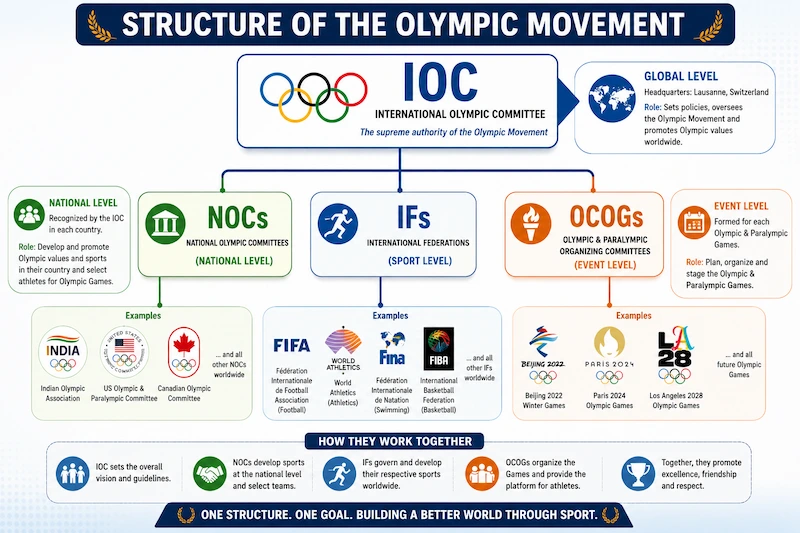
1. The International Olympic Committee (IOC): The IOC is the supreme authority and the governing body of the global Olympic Movement. Founded by Pierre de Coubertin on June 23, 1894, it is a non-governmental, non-profit organization headquartered in Lausanne, Switzerland. The IOC is responsible for selecting the host cities for the Olympic Games, managing the broadcasting rights, and ensuring that the Olympic values are upheld globally. It essentially acts as the umbrella organization for world sports.
2. National Olympic Committees (NOCs): While the IOC operates globally, NOCs represent the Olympic Movement in individual countries. Their mission is to develop, promote, and protect the Olympic Movement within their respective nations. For example, the Indian Olympic Association (IOA) is the NOC for India. The NOCs are entirely responsible for selecting and sending their country’s athletes to the Olympic Games. Currently, there are over 200 recognized NOCs worldwide.
3. International Sports Federations (IFs): IFs are international non-governmental organizations recognized by the IOC that administer one or more sports at the global level. While the IOC manages the event itself, the IFs manage the specific rules, technicalities, and global rankings of their respective sports. Examples include FIFA (for football), FIBA (for basketball), and BWF (for badminton). During the Olympics, the IFs assume the technical control and direction of their sports.
4. Other Members (OCOGs): When a city is chosen to host the Olympics, an Organizing Committee for the Olympic Games (OCOG) is formed. The OCOG is responsible for the actual physical planning of the event, including building stadiums, managing transport, arranging athlete villages, and selling tickets. Once the games are concluded, the OCOG is eventually dissolved.
Chapter 2: Olympism Value Education
This chapter traces the glorious journey of the Olympics, starting from the Ancient Olympic Games held in Greece to the revival of the Modern Olympic Games in 1896 by Baron Pierre de Coubertin. It deeply explores the philosophy of Olympism, which blends sport with culture and education. Key elements such as the Olympic Flag, Rings, Motto, and Oath are explained, highlighting the core Olympic values of Excellence, Friendship, and Respect. Furthermore, it outlines the structure and functions of governing bodies like the International Olympic Committee (IOC) and the Indian Olympic Association (IOA).
Frequently Asked Questions (FAQs)
Objective Type Questions (1 Mark)
Q1. Who is known as the father of the Modern Olympic Games? +
Ans. B) Baron Pierre de Coubertin
Q2. What does the Latin word ‘Fortius’ mean in the Olympic Motto? +
Ans. C) Stronger
Q3. In which year were the first Modern Olympic Games held? +
Ans. A) 1896 (in Athens, Greece)
Q4. The five intertwined rings of the Olympic flag represent: +
Ans. B) Five continents of the world
Q5. Who was the first President of the Indian Olympic Association (IOA)? +
Ans. C) Sir Dorabji Tata
Very Short Answer Type Questions (2 Marks)
Q6. What is Olympism? +
Ans. Olympism is a philosophy of life created by Pierre de Coubertin. It exalts and combines the qualities of body, will, and mind into a balanced whole. Blending sport with culture and education, Olympism seeks to create a way of life based on the joy of effort, educational value of a good example, and respect for universal ethical principles.
Q7. Write the names of the colors used in the Olympic Rings. +
Ans. The Olympic symbol consists of five interlaced rings of different colors. From left to right, the colors are Blue, Yellow, Black, Green, and Red. The background of the flag is pure white.
Q8. What is the significance of the Olympic Flame? +
Ans. The Olympic flame is a symbol of continuity between the ancient and modern Olympic Games. It represents purity, the endeavor for perfection, and the struggle for victory. It is lit in Olympia (Greece) and carried via torch relay to the host city, keeping the spirit of the games alive.
Q9. What is the updated Olympic Motto? +
Ans. The original Olympic motto was “Citius, Altius, Fortius” (Faster, Higher, Stronger). In 2021, the International Olympic Committee (IOC) updated it by adding the word “Communiter” (Together). So, the new motto is “Citius, Altius, Fortius – Communiter” (Faster, Higher, Stronger – Together).
Short Answer Type Questions (3 Marks)
Q10. Explain the core values of Olympism. +
Ans. The three core values of Olympism are:
- Excellence: It means doing one’s best, both on the field of play and in life. It is not just about winning, but participating and making progress against personal goals.
- Friendship: It encourages athletes to consider sport as a tool for mutual understanding among individuals from all over the world, overcoming political and economic differences.
- Respect: It involves respect for oneself, one’s body, rules and regulations of the sports, opponents, and the environment.
Q11. Write a short note on the Indian Olympic Association (IOA). +
Ans. The Indian Olympic Association (IOA) was established in 1927. Sir Dorabji Tata was its first President and Dr. A.G. Noehren was its first Secretary General. It is the governing body responsible for selecting athletes to represent India at the Olympic Games, Asian Games, and other international athletic meets. It promotes Olympic values and sports development within India.
Q12. What are the rules for competitors in the Ancient Olympic Games? +
Ans. The Ancient Olympic games had very strict rules for participation:
- Only freeborn Greek men were allowed to participate. Slaves and foreigners were strictly prohibited.
- Competitors had to stay in Olympia for one month before the games for training and practice.
- Women were not allowed to participate or even watch the games.
- Athletes were required to compete naked to show physical perfection.
Q13. What is the Olympic Oath? +
Ans. The Olympic Oath is a solemn promise made during the opening ceremony. An athlete from the host country holds a corner of the Olympic flag and takes the oath on behalf of all competitors. It states a commitment to participate in the games respecting the rules, engaging in true sportsmanship, and committing to a sport without doping and drugs.
Long Answer Type Questions (5 Marks)
Q14. Discuss the history and significance of the Ancient Olympic Games. +
Ans. The Ancient Olympic Games originated in Greece around 776 BCE and were held every four years in the sacred valley of Olympia. They were celebrated as a religious festival in honor of Zeus, the king of the Greek gods.
Key Features:
- Events: Initially, the only event was a short sprint called the “Stade”. Later, sports like wrestling, boxing, chariot racing, and the pentathlon were added.
- Awards: There were no medals. Winners were awarded a sacred olive wreath (kotinos) made from the branches of the sacred olive tree in Olympia. Winners brought immense honor to their city-states.
- The Olympic Truce: A sacred truce (Ekecheiria) was declared before the games, ensuring safe passage for athletes and spectators by suspending all wars between Greek city-states.
- Decline: The games continued for nearly 12 centuries until they were abolished by the Roman Emperor Theodosius I in 393 CE, who considered them a pagan cult.
Q15. Describe the formation, role, and main functions of the International Olympic Committee (IOC). +
Ans. The International Olympic Committee (IOC) is the supreme authority of the Olympic Movement. It was founded on 23rd June 1894 in Paris by Baron Pierre de Coubertin. Its headquarters is located in Lausanne, Switzerland.
Role and Functions of IOC:
- Host City Selection: The IOC is solely responsible for deciding which city and country will host the upcoming Olympic Games.
- Enforcing Rules: It creates, maintains, and enforces the rules and regulations outlined in the Olympic Charter.
- Promoting Sports: It encourages and supports the organization, development, and coordination of sports and sports competitions globally.
- Anti-Doping Campaign: The IOC leads the fight against doping in sports to ensure fair play and protect the health of athletes.
- Promoting Equality: It strongly acts against any form of discrimination affecting the Olympic Movement and promotes the participation of women in sports at all levels.
Q16. Elaborate on the educational values of Olympism and how they impact society. +
Ans. Olympism is essentially an educational movement. Pierre de Coubertin believed that sports could help educate youth and build a better, more peaceful world. The educational values of Olympism include:
- Joy of Effort: Educating youth that genuine satisfaction comes from giving 100% effort, hard work, and pushing one’s limits, regardless of whether they win or lose.
- Fair Play: Teaching athletes to abide by the rules honestly. Cheating or using performance-enhancing drugs destroys the very essence of sportsmanship.
- Respect for Others: Olympism teaches young people to accept diversity. Athletes learn to respect their competitors irrespective of their race, religion, gender, or nationality, fostering global peace.
- Pursuit of Excellence: It motivates individuals to continuously improve themselves physically, mentally, and socially.
- Balance of Body, Will, and Mind: Education should not just be intellectual. Physical education combined with mental resilience builds a complete, well-rounded personality capable of facing life’s challenges.