

1. Definition and Importance of Anatomy and Physiology in Exercise and Sports
To become a successful athlete or a highly effective coach, one must deeply understand the human machine. This understanding comes from two fundamental branches of biology: Anatomy and Physiology. Though they are closely related and studied together, they focus on different aspects of the human body.
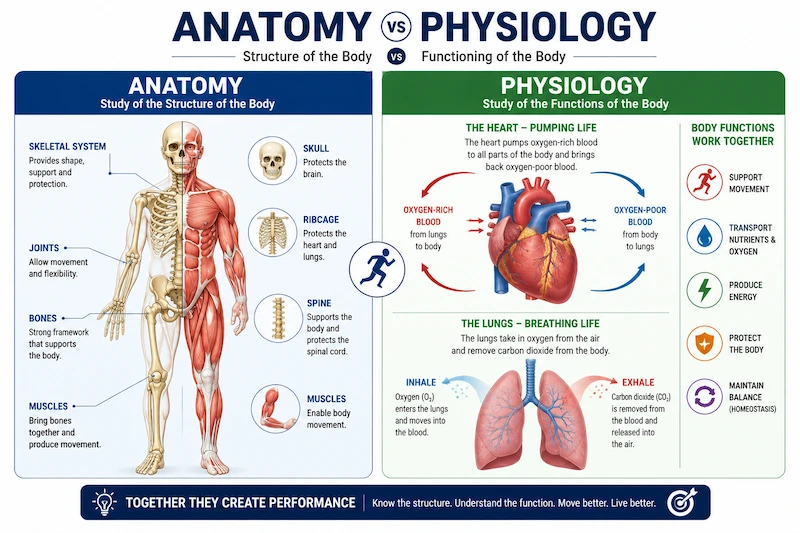
Definition of Anatomy: Anatomy is the scientific study of the physical structure, shape, and size of the human body and its various parts. It deals with how muscles, bones, organs, and tissues are organized and connected to one another. For example, knowing that the femur is the longest bone in the thigh is an anatomical fact.
Definition of Physiology: Physiology is the study of the functions and processes of the human body. While anatomy tells you where a muscle is, physiology tells you how that muscle contracts, how the heart pumps blood, or how the lungs exchange gases during heavy exercise.
Importance in Exercise and Sports:
- Understanding Body Capabilities: It helps coaches understand the structural limitations and genetic strengths of an athlete. For instance, a person with a naturally larger lung capacity is physiologically better suited for marathon running.
- Prevention of Sports Injuries: By understanding the exact structure of bones, ligaments, and joints (Anatomy), athletes can use correct biomechanical postures to avoid dangerous injuries like ACL tears or shoulder dislocations. The application of body movement and mechanical principles in sports is explained in Fundamentals of Kinesiology & Biomechanics in Sports
- Designing Training Programs: Physiology helps in understanding how the body reacts to different training loads (like weightlifting vs. sprinting). Coaches can design scientifically accurate training sessions, managing rest and recovery based on how the heart and muscles function. These training principles are covered in Training & Doping in Sports
- Rehabilitation: When an injury occurs, knowledge of anatomy and physiology is absolutely crucial for physiotherapists to safely rehabilitate the specific torn muscle or broken bone and bring the athlete back to peak performance.
2. Functions of Skeletal System, Classification of Bones, and Types of Joints
The human skeletal system is an internal framework made up of 206 bones in an adult body. Without this rigid structure, the human body would simply collapse into a shapeless mass of tissues.
Functions of the Skeletal System:
- Support and Shape: It provides a solid framework that supports the body and maintains its specific shape and posture.
- Protection: Bones act as a hard shield for delicate internal organs. For example, the skull protects the brain, and the rib cage protects the heart and lungs.
- Movement: Bones act as levers. When muscles (which are attached to bones) contract, they pull on the bones, creating bodily movement.
- Mineral Storage: Bones store vital minerals like calcium and phosphorus, releasing them into the bloodstream when the body needs them.
- Blood Cell Production: The soft, spongy tissue inside long bones, called bone marrow, produces red blood cells, white blood cells, and platelets.
Classification of Bones: Bones are categorized based on their shape and size:
- Long Bones: Act as levers for movement (e.g., Femur in the thigh, Humerus in the arm).
- Short Bones: Provide stability and support with little movement (e.g., Carpals in the wrist, Tarsals in the ankle).
- Flat Bones: Protect internal organs and provide large areas for muscle attachment (e.g., Scapula/shoulder blade, Sternum, Skull bones).
- Irregular Bones: Have complex shapes for specific functions (e.g., Vertebrae in the spine).
- Sesamoid Bones: Small, round bones embedded within tendons to protect them from stress (e.g., Patella or kneecap).
Types of Joints: A joint is a point where two or more bones meet. They are classified into three types based on their mobility:
- Immovable (Fibrous) Joints: These joints do not allow any movement at all. (e.g., the joints between the bones of the skull/cranium).
- Slightly Movable (Cartilaginous) Joints: These allow a very limited range of motion, connected by cartilage. (e.g., the joints between the vertebrae in the spine).
- Freely Movable (Synovial) Joints: These allow maximum movement and are crucial for sports. They include Hinge joints (elbow, knee) that move in one direction, and Ball-and-Socket joints (shoulder, hip) that allow movement in almost all directions. The measurement of joint range of motion and flexibility is discussed in Test, Measurement & Evaluation

3. Properties and Functions of Muscles
The muscular system is responsible for every single movement in the human body, both conscious (like throwing a ball) and unconscious (like the beating of the heart). There are over 600 muscles in the human body, making up about 40% of our total body weight.
Properties of Muscles: Muscle tissues possess four highly unique physical properties that allow them to function effectively during physical education and sports:
- Excitability (Irritability): This is the ability of the muscle tissue to receive and actively respond to a stimulus (a signal) sent by the nervous system or brain. Without this, your muscles wouldn’t know when to move.
- Contractility: Once a muscle receives a signal, it has the unique ability to contract, meaning it becomes shorter and thicker, generating force. This pulling force is what creates human movement.
- Extensibility: This is the ability of a muscle to be stretched or extended beyond its normal resting length without tearing. This property is crucial for flexibility in sports like gymnastics.
- Elasticity: After a muscle has been stretched or contracted, elasticity is the property that allows the muscle to quickly snap back to its original resting length and shape.
Functions of Muscles:
- Producing Movement: Skeletal muscles are attached to bones via tendons. When they contract, they pull on the bones, enabling actions like walking, running, jumping, and lifting.
- Maintaining Posture: Even when you are sitting still, specific core and back muscles are constantly making micro-contractions to keep your body upright against the force of gravity.
- Generating Heat: Muscle contractions require energy, and a significant byproduct of this energy usage is heat. This is why you feel hot and sweat during exercise. In cold weather, your muscles rapidly contract (shivering) to generate body heat.
- Circulation and Digestion: Cardiac muscles keep the heart pumping blood continuously. Smooth muscles, found in the walls of the intestines and blood vessels, help push food through the digestive tract and regulate blood pressure. For a detailed understanding of how muscle force creates body movement, see Fundamentals of Kinesiology & Biomechanics in Sports

4. Structure and Functions of Circulatory System and Heart
The circulatory system, also known as the cardiovascular system, is the body’s massive internal transportation network. During intense sports, muscles require an enormous amount of oxygen and nutrients, which are delivered exclusively by this system.
Structure of the Circulatory System: The system is comprised of three main components:
- Blood: The liquid fluid that acts as the transport medium, carrying oxygen, nutrients, hormones, and waste materials.
- Blood Vessels: The pipeline network of the body.
- Arteries: Thick, elastic vessels that carry oxygen-rich blood away from the heart to the body.
- Veins: Vessels equipped with one-way valves that carry oxygen-poor blood back to the heart.
- Capillaries: Microscopic vessels where the actual exchange of oxygen and carbon dioxide takes place within the muscle tissues.
- The Heart: The central powerhouse of the circulatory system. It is a muscular, fist-sized organ located slightly to the left in the chest cavity.
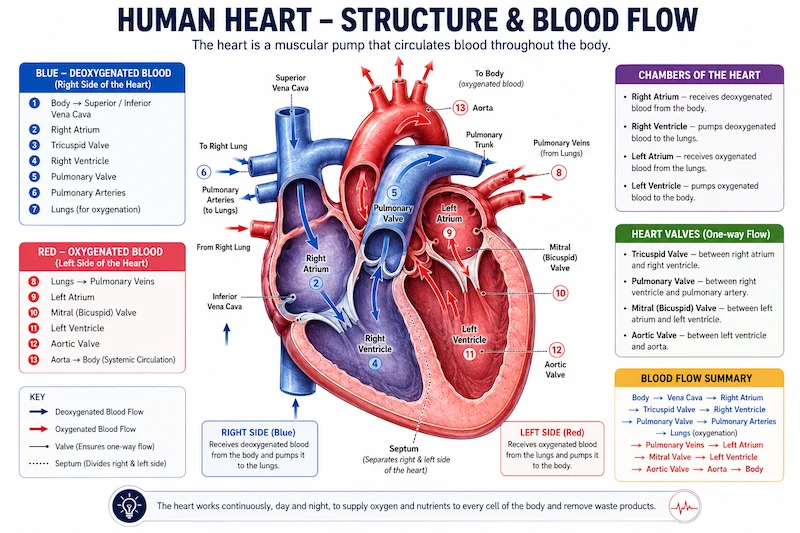
Structure of the Heart: The human heart is divided into four distinct chambers:
- Right Atrium (Upper) & Right Ventricle (Lower): These chambers deal with deoxygenated (impure) blood. They receive blood from the body and pump it into the lungs for purification.
- Left Atrium (Upper) & Left Ventricle (Lower): These chambers deal with oxygenated (pure) blood. The left atrium receives pure blood from the lungs, and the powerful left ventricle pumps it out to the entire body. Valves (like the Tricuspid and Bicuspid valves) act as doors between these chambers, ensuring blood only flows in one forward direction.
Functions of the Circulatory System:
- Transportation of Oxygen and Nutrients: It continuously delivers life-saving oxygen from the lungs and energy (glucose) from the digestive system to the working muscles.
- Removal of Waste: It collects metabolic waste products, such as Carbon Dioxide (CO2) and lactic acid produced during heavy exercise, and transports them to the lungs and kidneys for removal.
- Temperature Regulation: During a heavy workout, the circulatory system pushes blood closer to the skin’s surface, allowing excess body heat to escape, thus preventing heatstroke. The importance of cardiovascular endurance and its measurement is covered in Test, Measurement & Evaluation
5. Structure and Functions of Respiratory System
While the circulatory system transports oxygen, it is the respiratory system that actually captures that oxygen from the environment and brings it into the body. Efficient breathing is the secret behind the stamina of elite endurance athletes.
Structure of the Respiratory System: The respiratory tract is a continuous pathway through which air travels. Its main parts include:
- Nose and Nasal Cavity: The entry point. It contains small hairs and mucus that filter out dust, and it warms and moistens the incoming air before it reaches the lungs.
- Pharynx (Throat) & Larynx (Voice Box): The air passes down the throat and through the voice box, which is protected by a flap called the epiglottis (preventing food from entering the windpipe).
- Trachea (Windpipe): A strong tube supported by C-shaped cartilage rings that keep the airway permanently open.
- Bronchi & Bronchioles: The trachea splits into two main branches (Bronchi)—one entering the left lung and the other entering the right. Inside the lungs, they divide further into millions of tiny, tree-like branches called Bronchioles.
- Alveoli: At the very end of the bronchioles are microscopic, balloon-like air sacs called alveoli. This is where the magic happens; they are surrounded by blood capillaries, and the actual exchange of oxygen and carbon dioxide takes place here.
- Diaphragm: A large, dome-shaped muscle located just below the lungs. It is the primary muscle responsible for the physical act of breathing.
Functions of the Respiratory System:
- Exchange of Gases: The primary function is to supply the blood with Oxygen (which is then used to burn glucose and create energy) and to expel Carbon Dioxide (a toxic waste gas produced by cells) from the body.
- Vocalization: As exhaled air is forced out of the lungs, it passes through the vocal cords in the larynx, vibrating them to produce sound and speech, which is essential for communication in team sports.
- Olfaction (Sense of Smell): The upper part of the nasal cavity contains specialized receptors that allow humans to detect smells and odors in their environment.
Mechanism of Breathing: The process is divided into Inspiration (inhaling) and Expiration (exhaling). During inspiration, the diaphragm contracts and moves downwards, creating a vacuum that sucks air into the lungs. During expiration, the diaphragm relaxes and moves upwards, forcing the carbon dioxide-rich air out of the body. For more information about the role of respiratory capacity in physical fitness and endurance, see Physical Fitness, Wellness & Lifestyle

Chapter 7: Fundamentals of Anatomy, Physiology and Kinesiology in Sports
This chapter introduces the basic concepts of Anatomy, Physiology and Kinesiology in relation to Physical Education and sports. Anatomy deals with the structure of the human body, while Physiology explains the functions of the body’s organs and systems. Kinesiology deals with human movement and helps in understanding efficient sports movements. Knowledge of these subjects is important for understanding body structure, exercise responses, movement efficiency, sports performance and injury prevention.
Frequently Asked Questions (FAQs)
Objective Type Questions (1 Mark)
Q1. What does Anatomy mainly deal with? +
Ans. A) Structure of the human body
Q2. Which branch deals with the functions of the human body? +
Ans. B) Physiology
Q3. Kinesiology is primarily concerned with: +
Ans. A) Human movement
Q4. Which system is mainly responsible for transporting oxygen and nutrients throughout the body? +
Ans. B) Circulatory system
Q5. Which system provides the framework and support for the human body? +
Ans. C) Skeletal system
Very Short Answer Type Questions (2 Marks)
Q6. Define Anatomy and Physiology. +
Ans.
- Anatomy: The study of the structure of the human body and its parts.
- Physiology: The study of the functions and working of the human body and its organs.
Q7. What is Kinesiology? +
Ans. Kinesiology is the scientific study of human movement. In Physical Education and sports, it helps in understanding how the body moves and how movements can be performed efficiently.
Q8. Mention any two functions of the skeletal system. +
- It provides support and shape to the body.
- It protects important internal organs.
- It helps in movement by providing attachment points for muscles.
- It stores minerals such as calcium and phosphorus.
Q9. Name any two body systems important for sports performance. +
Ans. Two important body systems are:
- Muscular system
- Cardiovascular/Circulatory system
- Respiratory system
- Skeletal system
Short Answer Type Questions (3 Marks)
Q10. Explain the importance of Anatomy in Physical Education and sports. +
Ans. Knowledge of Anatomy is important because:
- It helps understand the structure and arrangement of bones, muscles and joints.
- It helps teachers and athletes understand body movements during sports activities.
- It assists in selecting appropriate exercises and movements.
- It contributes to injury prevention by improving understanding of body structures.
Q11. Explain the importance of Physiology in sports. +
Ans. Physiology is important in sports because:
- It explains how body systems function during exercise.
- It helps understand the body’s response to physical activity.
- It helps in planning suitable training programmes.
- It helps understand fatigue, recovery and adaptation to exercise.
Q12. Explain the importance of Kinesiology in Physical Education and sports. +
Ans. Kinesiology is useful because:
- It helps understand human movement.
- It helps analyse sports skills and body movements.
- It helps improve movement efficiency and technique.
- It can help identify inefficient movement patterns and reduce injury risk.
Q13. Explain the role of the muscular system in sports activities. +
Ans. The muscular system plays an important role in sports because muscles:
- Produce force required for movement.
- Maintain posture and body stability.
- Help perform actions such as running, jumping, throwing and lifting.
- Work with bones and joints to produce coordinated movement.
Long Answer Type Questions (5 Marks)
Q14. Explain Anatomy, Physiology and Kinesiology and their importance in sports. +
Ans. Anatomy, Physiology and Kinesiology are closely related areas that provide a scientific foundation for Physical Education and sports.
- Anatomy: It deals with the structure of the human body. Knowledge of bones, muscles, joints and organs helps understand body structure.
- Physiology: It deals with the functions of the human body and its systems. It helps understand how the body responds and adapts to exercise.
- Kinesiology: It is the study of human movement. It helps analyse movement and improve sports technique.
- Sports Performance: Together, these subjects help athletes understand body movement, improve technique and develop appropriate training programmes.
- Injury Prevention: Scientific knowledge of body structure, function and movement can help reduce improper movement and injury risk.
Q15. Explain the major functions of the skeletal system. +
Ans. The skeletal system performs several important functions:
- Support: It provides the basic framework and shape of the body.
- Protection: Bones protect vital organs such as the brain, heart and lungs.
- Movement: Bones act as levers and provide attachment points for muscles.
- Mineral Storage: Bones store important minerals, especially calcium and phosphorus.
- Blood Cell Formation: Bone marrow is involved in the production of blood cells.
Q16. Explain the role of the circulatory and respiratory systems during exercise. +
Ans. Both systems work together to supply oxygen to working muscles and remove carbon dioxide.
- Respiratory System: It brings oxygen into the body through breathing and removes carbon dioxide.
- Gas Exchange: Oxygen passes into the blood in the lungs, while carbon dioxide passes from the blood into the lungs.
- Circulatory System: The heart pumps oxygen-rich blood to the working muscles.
- Nutrient Transport: The blood also transports nutrients and other substances required by tissues.
- Exercise Response: During exercise, breathing rate and heart rate increase to meet the greater oxygen and energy demands of the working muscles.
Q17. Explain the role of the muscular system in sports performance. +
Ans. The muscular system is essential for almost every sports movement. Its major roles include:
- Movement: Muscles contract to produce movements such as running, jumping, throwing and kicking.
- Force Production: Muscles generate the force required to overcome resistance.
- Postural Stability: Muscles help maintain body posture and stability.
- Joint Movement: Muscles work with bones and joints to create controlled movement.
- Sports Performance: Muscular strength, endurance and coordination contribute significantly to efficient sports performance.