


1. Definition and Importance of Kinesiology and Biomechanics in Sports
To understand how an athlete hits a perfect six in cricket or throws a javelin for a record distance, we must study the science of human movement. This science is primarily divided into two closely related fields: Kinesiology and Biomechanics.
Definition of Kinesiology:
The word Kinesiology is derived from two Greek words: “Kinesis” meaning motion or movement, and “Logos” meaning to study. Therefore, Kinesiology is the scientific study of human movement. It combines the knowledge of anatomy, physiology, and mechanics to understand how muscles and bones work together to create movement. For a detailed understanding of the anatomical structures and physiological functions involved in movement, see Fundamentals of Anatomy & Physiology in Sports
Definition of Biomechanics:
Biomechanics is a sub-discipline of Kinesiology. It is formed by two words: “Bio” meaning life or living organisms, and “Mechanics” meaning the field of physics that deals with forces and motion. Thus, Biomechanics is the study of the structure and function of the biological systems of humans using the laws and principles of physics.
Importance in Physical Education and Sports:
- Improving Performance: Biomechanics helps coaches analyze an athlete’s technique frame-by-frame. By making minor scientific adjustments to their posture or release angle, an athlete’s speed, power, and overall performance can be drastically improved.
- Preventing Injuries: By understanding the limits of human joints and the forces acting on the body during landing or tackling, biomechanics helps in developing safe playing techniques that prevent severe injuries (like ligament tears).
- Improving Technique: It helps in identifying mechanical errors in an athlete’s movement. For example, a swimmer can learn how to reduce water drag and move faster using less energy.
- Designing Sports Equipment: The principles of biomechanics are actively used to design lighter, more aerodynamic, and safer sports gear, such as shock-absorbing running shoes, aerodynamic cycling helmets, and lighter tennis rackets.

2. Principles of Biomechanics
Biomechanics relies heavily on the fundamental laws of physics to explain how the human body moves. Sir Isaac Newton’s three laws of motion act as the core principles of biomechanics in sports. Understanding these principles allows athletes to manipulate forces to their advantage. The application of biomechanics to athletic movement is closely related to the study of Anatomy & Physiology in Sports
1. The Law of Inertia (Newton’s First Law):
This law states that a body at rest will remain at rest, and a body in motion will remain in motion at a constant speed in a straight line, unless acted upon by an external force.
- Application in Sports: A football resting on the penalty spot will not move until a player applies muscular force to kick it. Similarly, a sprinter running at full speed cannot stop instantly at the finish line; their body’s inertia carries them forward until friction and gravity slow them down.
2. The Law of Acceleration (Newton’s Second Law):
This law states that the acceleration of an object is directly proportional to the force causing it and inversely proportional to the mass of the object ($Force = Mass \times Acceleration$).
- Application in Sports: If you throw a shot put (heavy) and a baseball (light) with the exact same amount of muscular force, the baseball will travel much faster and further because it has less mass. To make a heavy object accelerate, you need to generate massive force.
3. The Law of Action and Reaction (Newton’s Third Law):
This famous law states that for every action, there is an equal and opposite reaction.
- Application in Sports: When a high jumper pushes their foot hard down into the ground (Action), the ground pushes back with the exact same amount of force upwards (Reaction), lifting the athlete into the air over the bar.
4. Principle of Stability:
Stability is the ability of the body to maintain its balance. A lower Center of Gravity and a wider Base of Support increase stability. For example, a wrestler bends their knees and spreads their legs wide to avoid being pushed over by their opponent.
3. Kinetics and Kinematics in Sports
When analyzing the motion of an athlete or a piece of sports equipment, biomechanics uses two distinct approaches: Kinematics and Kinetics. While they sound very similar, they measure completely different aspects of movement.
Kinematics (The “What” of Motion):
Kinematics is the branch of biomechanics that describes the motion of a body without considering the forces that caused that motion. It focuses strictly on the geometry and visual path of the movement. When studying kinematics, we look at variables like:
- Displacement & Distance: How far did the athlete or the ball travel?
- Velocity & Speed: How fast is the athlete running, or what is the speed of the hockey puck?
- Acceleration: How quickly is the athlete increasing their speed?
- Sports Example: When a cricket coach uses a video camera to track the exact curved path (trajectory) of a bowler’s delivery or measures the release angle of a javelin, they are studying Kinematics. They are only looking at the motion itself, not the muscle effort behind it.
Kinetics (The “Why” of Motion):
Kinetics is the branch of biomechanics that studies the actual forces that cause, modify, or stop a motion. It does not just look at the movement; it looks at the invisible pushes and pulls creating that movement. When studying kinetics, we look at variables like:
- Internal Forces: The pulling force generated by the muscles pulling on the bones.
- External Forces: Gravity pulling an athlete down, friction between the shoes and the track, or air resistance slowing down a football.
- Sports Example: When a scientist measures how much physical pressure (force in Newtons) a weightlifter’s feet apply to the floor to lift a 150 kg barbell, or calculates the torque in a golfer’s swing, they are studying Kinetics.

4. Types of Body Movements
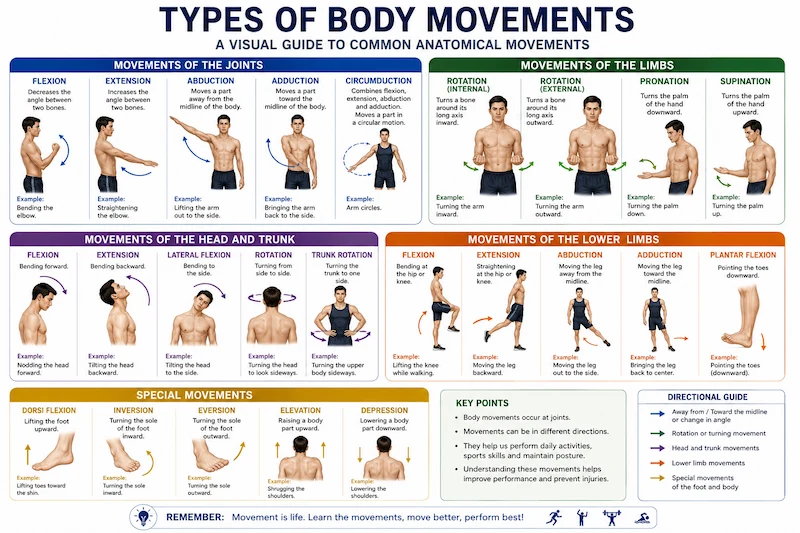
The human body is capable of performing a wide variety of movements, primarily occurring at the freely movable synovial joints. In physical education, specific anatomical terms are used to describe exactly how the limbs and body parts move. The structure and classification of joints are explained in Fundamentals of Anatomy & Physiology in Sports
1. Flexion and Extension:
- Flexion: It is a bending movement that decreases the angle between two body parts or bones. For example, bending your elbow to bring your hand toward your shoulder (like a bicep curl) is flexion.
- Extension: It is a straightening movement that increases the angle between two body parts. For example, straightening your arm back out after a bicep curl, or straightening your knee while kicking a football, is extension.
2. Abduction and Adduction:
- Abduction: Movement of a body part away from the midline (center) of the body. For example, lifting your arms straight out to the sides (like the wings of an airplane) is abduction.
- Adduction: Movement of a body part towards the midline of the body. For example, bringing your arms back down to your sides after holding them out is adduction.
3. Rotation and Circumduction:
- Rotation: A bone revolving around its own single longitudinal axis. For example, turning your head from side to side to say “no” is neck rotation.
- Circumduction: A complex, circular movement combining flexion, extension, abduction, and adduction. The joint acts as a pivot, and the far end of the limb draws a circle in the air. For example, a cricket bowler rotating their entire arm in a large circle before delivering the ball.
4. Supination and Pronation (Specific to Forearm/Foot):
- Supination: Rotating the forearm so the palm of the hand faces upwards (like holding a bowl of soup).
- Pronation: Rotating the forearm so the palm of the hand faces downwards (like dribbling a basketball).
5. Axis and Planes – Concept and its application in body movements
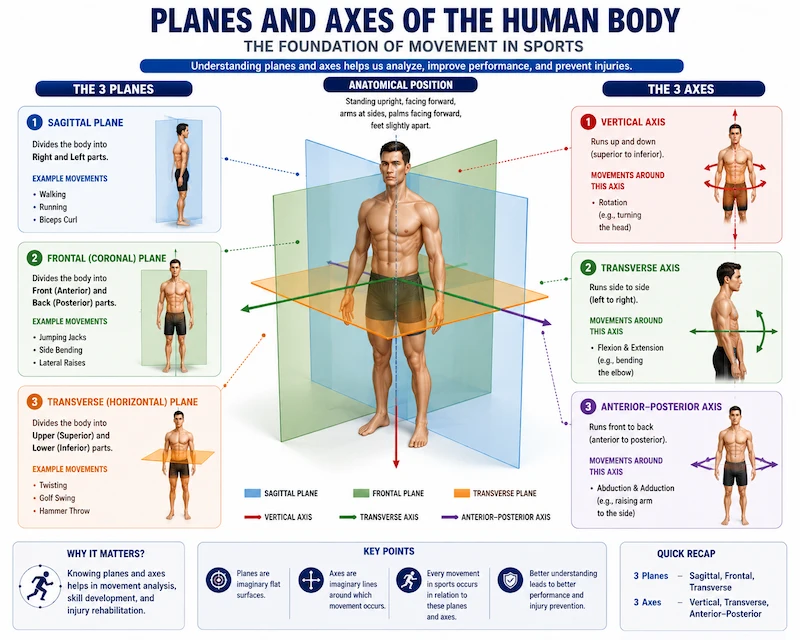
To accurately describe and analyze human movement, biomechanics uses an imaginary mapping system consisting of Planes (flat surfaces) and Axes (straight lines) running through the body. All human movements occur in a plane and around an axis.
The Concept of Planes:
A plane is an imaginary flat surface that cuts the body into two halves. There are three fundamental planes:
- Sagittal Plane: Cuts the body vertically into left and right halves. Movements in this plane go forward and backward. (Example: Walking, running, or doing a somersault).
- Frontal (Coronal) Plane: Cuts the body vertically into front and back halves. Movements in this plane go side to side. (Example: Jumping jacks or a cartwheel).
- Transverse (Horizontal) Plane: Cuts the body horizontally into upper and lower halves. Movements in this plane involve twisting or rotation. (Example: A discus thrower spinning or a dancer pirouetting).
The Concept of Axes:
An axis is an imaginary invisible rod or line passing through the center of a joint, around which the body part actually rotates. There are three axes:
- Frontal (Coronal) Axis: Runs horizontally from left to right.
- Sagittal (Anteroposterior) Axis: Runs horizontally from front to back.
- Vertical (Longitudinal) Axis: Runs straight down from top to bottom.
Application in Body Movements (The Golden Rule):
The golden rule of biomechanics is that the axis of movement is always perpendicular (at a 90-degree angle) to the plane in which the movement occurs.
- Flexion & Extension: These movements (like a bicep curl) occur in the Sagittal Plane and rotate around the Frontal Axis.
- Abduction & Adduction: These sideways movements (like jumping jacks) occur in the Frontal Plane and rotate around the Sagittal Axis.
- Rotation: These twisting movements (like turning your head or spinning) occur in the Transverse Plane and rotate around the Vertical Axis.
Chapter 8: Fundamentals of Kinesiology and Biomechanics in Sports
Kinesiology is the scientific study of human movement, while Biomechanics applies mechanical principles to understand movement, forces and sports performance. Kinesiology helps explain how the body moves, while biomechanics helps analyse the forces, motion, angles and mechanics involved in movement. These concepts are important for improving sports technique, performance and injury prevention. :contentReference[oaicite:3]{index=3}
Frequently Asked Questions (FAQs)
Objective Type Questions (1 Mark)
Q1. What is Kinesiology? +
Ans. B) Scientific study of human movement
Q2. What does Biomechanics primarily study? +
Ans. A) Mechanical aspects of human movement
Q3. Which branch of biomechanics describes motion without considering its causes? +
Ans. B) Kinematics
Q4. Which branch of biomechanics deals with forces causing motion? +
Ans. B) Kinetics
Q5. Which anatomical plane divides the body into right and left parts? +
Ans. C) Sagittal Plane
Very Short Answer Type Questions (2 Marks)
Q6. Define Kinesiology and Biomechanics. +
Ans.
- Kinesiology: It is the scientific study of human movement.
- Biomechanics: It is the study of mechanical principles and forces involved in human movement and physical activity.
Q7. Differentiate between Kinematics and Kinetics. +
| Kinematics | Kinetics |
|---|---|
| Describes motion. | Explains the causes of motion. |
| Focuses on speed, distance, displacement, time and angles. | Focuses on forces such as muscle force, gravity and friction. |
The comparison is illustrated in the Chapter 8 kinematics-versus-kinetics infographic. :contentReference[oaicite:4]{index=4}
Q8. Name the three anatomical planes of the human body. +
Ans. The three anatomical planes are:
- Sagittal Plane
- Frontal or Coronal Plane
- Transverse or Horizontal Plane
Q9. What is meant by Flexion and Extension? +
- Flexion: A movement that decreases the angle between two bones, such as bending the elbow.
- Extension: A movement that increases the angle between two bones, such as straightening the elbow.
Short Answer Type Questions (3 Marks)
Q10. Explain the importance of Kinesiology in sports. +
Ans. Kinesiology is important in sports because:
- It helps understand human movement and body mechanics.
- It helps analyse muscles, joints and movement patterns involved in sports skills.
- It helps improve movement efficiency and sports technique.
- It assists in identifying inefficient movement patterns.
- It contributes to better performance and injury prevention.
Q11. Explain the importance of Biomechanics in sports. +
- Helps analyse forces and motion involved in sports skills.
- Helps improve sports technique and movement efficiency.
- Helps understand the effects of gravity, friction and ground reaction force.
- Helps improve performance by applying mechanical principles.
- Helps reduce the risk of injury by improving movement mechanics.
Q12. Explain the three anatomical planes of the human body. +
- Sagittal Plane: Divides the body into right and left parts. Flexion and extension commonly occur in this plane.
- Frontal/Coronal Plane: Divides the body into front and back parts. Abduction and adduction commonly occur in this plane.
- Transverse Plane: Divides the body into upper and lower parts. Rotational movements commonly occur in this plane.
The Chapter 8 plane-and-axis infographic identifies these three planes and their movement examples. :contentReference[oaicite:5]{index=5}
Q13. Explain the three axes of human movement. +
- Vertical Axis: Runs from superior to inferior. Rotation occurs around this axis.
- Transverse Axis: Runs from side to side. Flexion and extension occur around this axis.
- Anterior-Posterior Axis: Runs from front to back. Abduction and adduction occur around this axis.
These three axes are represented in the Chapter 8 anatomical planes and axes visual. :contentReference[oaicite:6]{index=6}
Long Answer Type Questions (5 Marks)
Q14. Explain Kinesiology and its importance in Physical Education and sports. +
Ans. Kinesiology is the scientific study of human movement. It helps explain how the body moves and the factors that influence movement.
Its importance in Physical Education and sports includes:
- Understanding Movement: It helps understand how different body parts move during physical activities.
- Muscle and Joint Analysis: It helps identify the muscles and joints involved in different movements.
- Skill Improvement: It helps analyse sports techniques and improve movement efficiency.
- Performance Enhancement: Efficient movement patterns can improve sports performance.
- Injury Prevention: Understanding movement mechanics can help identify inefficient or unsafe movement patterns.
Q15. Explain Biomechanics and its importance in sports. +
Ans. Biomechanics applies principles of mechanics and physics to human movement. It studies forces, motion, levers, angles, energy and other mechanical factors involved in physical activity.
Its major importance in sports includes:
- Analysing sports movements and techniques.
- Understanding forces acting on the body.
- Improving efficiency of sports skills.
- Helping athletes optimise technique and performance.
- Reducing injury risk through better movement mechanics.
Q16. Explain the different types of body movements with suitable examples. +
| Movement | Meaning | Example |
|---|---|---|
| Flexion | Decreases the angle between two bones. | Bending the elbow. |
| Extension | Increases the angle between two bones. | Straightening the elbow. |
| Abduction | Movement away from the body’s midline. | Raising the arm sideways. |
| Adduction | Movement toward the body’s midline. | Bringing the arm back to the side. |
| Rotation | Turning a body part around its axis. | Turning the head sideways. |
| Circumduction | Circular movement combining flexion, extension, abduction and adduction. | Arm circles. |
| Pronation | Turning the palm downward. | Rotating the forearm so the palm faces down. |
| Supination | Turning the palm upward. | Rotating the forearm so the palm faces up. |
These movements are illustrated with directional arrows in the Chapter 8 body-movement visual. :contentReference[oaicite:7]{index=7}
Q17. Explain the relationship between anatomical planes, axes and body movements. +
Ans. Body movements occur in relation to specific anatomical planes and axes. The planes are imaginary flat surfaces through which movement occurs, while axes are imaginary lines around which movement takes place.
| Plane | Related Axis | Common Movements |
|---|---|---|
| Sagittal Plane | Transverse Axis | Flexion and Extension |
| Frontal Plane | Anterior-Posterior Axis | Abduction and Adduction |
| Transverse Plane | Vertical Axis | Rotation |
Understanding planes and axes helps in analysing sports movements, improving technique, developing skills and reducing injury risk. :contentReference[oaicite:8]{index=8}
Important Exam-Oriented Questions
Q18. What is the difference between Kinematics and Kinetics in sports biomechanics? +
Ans. Kinematics describes the characteristics of motion such as speed, distance, displacement, time, angle and trajectory. It focuses on how an object or body moves.
Kinetics studies the forces responsible for producing or changing motion, such as muscle force, gravity, friction and ground reaction force. It focuses on why motion occurs.
Q19. How does biomechanics help in improving sports performance? +
Ans. Biomechanics helps athletes and coaches analyse movement, identify inefficient techniques, understand forces acting on the body and optimise sports skills. This can improve movement efficiency, performance and safety.
Q20. Why are planes and axes important in sports? +
Ans. Planes and axes provide a framework for describing and analysing human movement. They help teachers, coaches and athletes understand the direction and type of movement involved in sports skills, which supports technique improvement and injury prevention.