

1. Concept and Principles of Sports Training
When we watch an Olympic sprinter run a 100-meter dash in under 10 seconds, we are witnessing the result of years of grueling, highly calculated preparation. This preparation is what we call sports training.
Concept of Sports Training: In physical education, sports training is not just about randomly running on a field or lifting weights until you get tired. It is a highly scientific, pedagogically planned, and systematic process of preparation. The ultimate goal of sports training is to improve an athlete’s physical, psychological, technical, and tactical capabilities to achieve the highest possible performance in a specific sport.
Principles of Sports Training: To ensure that training is effective and safe, coaches strictly follow certain fundamental principles. Without these principles, an athlete will never reach their peak potential and will likely suffer injuries. Understanding the psychological factors that influence an athlete’s performance is also important, as discussed in Psychology & Sports
- Principle of Continuity: Training must be a continuous, year-round process. If an athlete takes long, unnecessary breaks, their physical fitness levels (stamina, strength) will drop rapidly. Consistency is the key to success.
- Principle of Specificity: Training must be highly specific to the sport the athlete plays. For example, a marathon runner needs to focus on cardiovascular endurance and long-distance running, while a weightlifter must focus entirely on explosive muscular strength.
- Principle of Individual Differences: Every human body is genetically different. A training program that works perfectly for one athlete might cause severe fatigue in another. Coaches must design individualized training loads based on an athlete’s age, gender, recovery rate, and physical capacity.
- Principle of Rest and Recovery: A highly intense workout breaks down muscle fibers. The actual muscle growth and fitness improvement do not happen during the workout; they happen while the athlete is sleeping and resting. Without proper recovery, training is useless. The relationship between training, recovery, and overall fitness is also connected with Physical Fitness, Wellness & Lifestyle

2. Training Load: Over Load, Adaptation, and Recovery
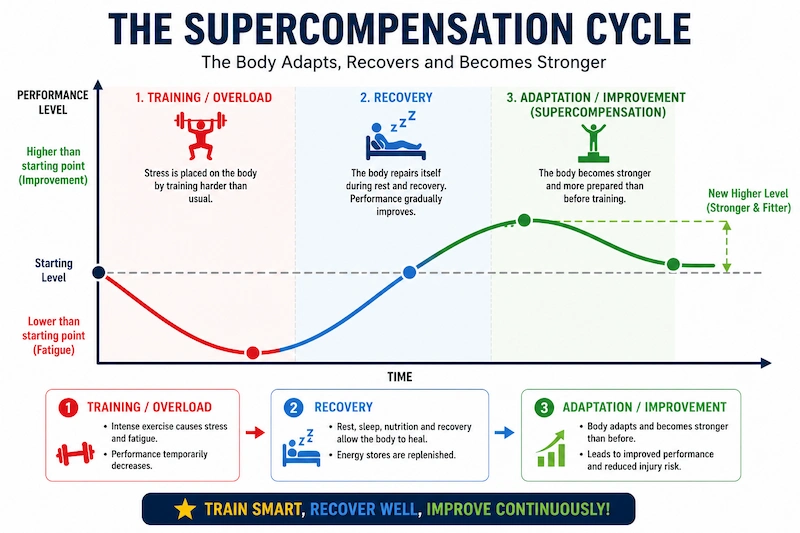
The human body is an incredibly smart machine. If you want to make it stronger, faster, or more muscular, you have to force it to adapt by putting it under stress. This scientific cycle of stressing the body and letting it heal is the foundation of physical transformation.
1. Concept of Training Load: Training load refers to the total psychological and physiological demand or stress placed on an athlete’s body during a training session. It is calculated by the volume (how long you train) and intensity (how hard you train).
2. The Concept of Overload: If you go to the gym and lift a 10 kg dumbbell every single day for a year, your muscles will stop growing after the first few weeks. Why? Because the body has gotten used to that weight. Overload means that to continuously improve fitness, the training load must be greater than what the athlete’s body is normally accustomed to. You must safely and progressively increase the weight, speed, or distance to keep challenging the body.
3. The Concept of Adaptation: When a coach applies an overload, the athlete’s body gets stressed and tired. However, during the rest period, the body biologically adjusts and repairs itself to handle that specific stress better the next time. This biological adjustment—where muscles become denser, lungs hold more oxygen, and the heart pumps blood more efficiently—is called Adaptation.
4. The Role of Recovery: Adaptation is completely impossible without Recovery. If an athlete continuously overloads their body without taking rest days, taking proper nutrition, or getting 8 hours of sleep, their performance will heavily decline. This dangerous state is called “Overtraining Syndrome,” which leads to severe muscle tears, chronic fatigue, and a weakened immune system. The connection between muscular function, cardiovascular response, and exercise adaptation is explained in Fundamentals of Anatomy & Physiology in Sports
3. Warming-up & Limbering Down – Types, Method & Importance
No professional athlete ever steps onto the field and instantly starts sprinting at top speed, nor do they immediately sit down in a chair the second a match ends. The transition from rest to extreme physical activity, and back to rest, must be gradual.
1. Warming-up: Warming-up is a preliminary exercise routine performed immediately before the main physical activity or competition. Its purpose is to prepare the body and mind for intense exertion.
- Types:
- General Warm-up: Includes basic activities like light jogging, jumping jacks, and simple stretching. It raises the core body temperature of anyone, regardless of their sport.
- Specific Warm-up: Involves movements directly related to the actual sport. For example, a cricket fast bowler will practice bowling action with a lighter ball, or a basketball player will practice layups.
- Importance: Warming up increases blood circulation, ensuring working muscles get enough oxygen. It lubricates the joints with synovial fluid, makes muscles highly elastic, and drastically reduces the chances of muscle pulls, cramps, and ligament tears.
2. Limbering Down (Cooling Down): Limbering down is a set of light exercises (like slow walking and deep static stretching) performed immediately after a heavy training session or match. It is the process of gradually bringing the hyperactive body back to its normal resting state.
- Importance: During an intense match, a toxic byproduct called lactic acid builds up in the muscles, causing stiffness and pain. Limbering down keeps the blood flowing gently, which flushes out this lactic acid. Furthermore, if you stop running suddenly, blood pools in the legs, which can cause dizziness or fainting. Cooling down safely lowers the elevated heart rate and blood pressure. The role of muscles, the circulatory system, and the respiratory system during exercise is explained in Fundamentals of Anatomy & Physiology in Sports

4. Concept of Skill, Technique, Tactics & Strategies
In the sports world, people often use words like ‘skill’ and ‘technique’ or ‘tactics’ and ‘strategies’ as if they mean the exact same thing. However, in sports coaching, these four terms represent completely different stages of athletic intelligence and execution.
1. Technique (The “How”): Technique is the basic, mechanically and scientifically sound way of performing a physical movement. It is the fundamental action. For example, in cricket, keeping your elbow high, your head still, and stepping towards the pitch of the ball is the correct technique for hitting a cover drive.
2. Skill (The Application): While technique is mechanical, skill is the ability to apply that technique effortlessly in a real, unpredictable game situation. An athlete has achieved a ‘skill’ when the movement becomes automatic, highly coordinated, and they can perform it successfully against a live opponent. Anyone can learn the technique of a basketball free-throw in an empty court, but sinking that shot in the final second of a noisy championship game is a skill. The scientific study of movement, force, and technique is covered in Fundamentals of Kinesiology & Biomechanics in Sports
3. Strategies (The Master Plan): A strategy is the grand master plan made before the match even begins. It is decided by the coach and the captain in the locker room, based on studying the strengths and weaknesses of the opposing team. For example, a football team deciding a day before the match that they will play a strictly defensive “park-the-bus” formation to secure a draw against a much stronger team is a strategy.
4. Tactics (The On-Field Adjustments): While a strategy is pre-planned, tactics are the real-time decisions and instant adjustments made during the match to gain a quick advantage. If a bowler notices that a batsman is struggling with short balls in the first two deliveries, instantly changing the plan to bowl a bouncer on the next ball is a tactic. Tactics are used to execute the broader strategy.

Chapter 10: Training & Doping in Sports
Sports training is a systematic process designed to improve fitness, develop sports performance and achieve specific goals. Important training areas include endurance, strength, speed and flexibility. Training principles such as overload, progression, specificity, reversibility and recovery help organise effective training. :contentReference[oaicite:2]{index=2}
The chapter also deals with doping and the importance of clean sports, including fair play, health, integrity, respect and true sporting spirit. :contentReference[oaicite:3]{index=3}
Frequently Asked Questions (FAQs)
Objective Type Questions (1 Mark)
Q1. What is sports training? +
Ans. B) A systematic process to improve performance
Q2. Which of the following is a component/type of sports training? +
Ans. D) All of the above
Q3. Which principle means that training should match the demands of the sport? +
Ans. A) Specificity
Q4. Which principle involves gradually increasing training demands? +
Ans. B) Progression
Q5. What is the purpose of a warm-up? +
Ans. A) To prepare the body for activity
Q6. What is doping in sports? +
Ans. B) Use of banned substances or methods for performance enhancement
Very Short Answer Type Questions (2 Marks)
Q7. Define sports training. +
Ans. Sports training is a systematic and planned process of preparing an athlete physically and functionally to improve sports performance and achieve specific goals.
Q8. Name four important principles of sports training. +
Ans. Four important principles are:
- Continuity
- Specificity
- Individual Differences
- Rest and Recovery
The Chapter 10 training infographic presents these principles as interconnected principles that work together.
Q9. What is overload in sports training? +
Ans. Overload means placing a greater-than-usual training demand on the body so that it is stimulated to adapt and improve.
Q10. What is recovery in sports training? +
Ans. Recovery is the period in which the body rests and repairs itself after training. Adequate rest, nutrition and sleep support recovery and help the athlete prepare for further training.
Q11. What is the difference between technique and skill? +
| Technique | Skill |
|---|---|
| The correct and efficient way of performing a basic movement. | The ability to perform the technique effectively in a competitive situation. |
| Usually developed through controlled practice. | Requires adaptation, coordination and performance under pressure. |
Short Answer Type Questions (3 Marks)
Q12. Explain the importance of sports training. +
Ans. Sports training is important because it:
- Improves physical fitness and sports-specific abilities.
- Develops endurance, strength, speed and flexibility.
- Improves sports technique and skill.
- Helps athletes achieve specific performance goals.
- Supports long-term athletic development.
The Chapter 10 visual identifies endurance, strength, speed and flexibility as key training areas. :contentReference[oaicite:4]{index=4}
Q13. Explain the principles of sports training. +
- Continuity: Training should be regular and consistent over time.
- Specificity: Training should be related to the demands, skills and goals of the sport.
- Individual Differences: Training should be adjusted according to the individual’s ability, fitness level and response.
- Rest and Recovery: Adequate recovery allows the body to repair, adapt and prepare for further training.
Q14. Differentiate between warm-up and limbering down. +
| Warm-up | Limbering Down |
|---|---|
| Performed before the main activity. | Performed after the main activity. |
| Prepares the body for exercise. | Helps the body recover after exercise. |
| Uses dynamic movements. | May include relaxed/static stretching. |
| Helps prepare muscles and the cardiovascular system for activity. | Helps relaxation and recovery after activity. |
Q15. Differentiate between strategy and tactics. +
| Strategy | Tactics |
|---|---|
| Overall plan prepared before the match. | Quick decisions and adjustments made during the match. |
| Focuses on the broader game plan. | Focuses on immediate situations. |
| Considers goals, style of play and opponents. | Responds to changing game conditions and opponent actions. |
Q16. What are the major problems associated with doping in sports? +
Ans. The major problems associated with doping include:
- Unfair advantage over other athletes.
- Health risks.
- Disqualification and sporting penalties.
- Damage to an athlete’s career and reputation.
These four consequences are specifically highlighted in the Chapter 10 anti-doping material. :contentReference[oaicite:5]{index=5}
Long Answer Type Questions (5 Marks)
Q17. Explain the major principles of sports training. +
Ans. The major principles of sports training are:
- Continuity: Training should be regular and consistent. Long-term and continuous training is important for lasting improvement.
- Specificity: Training should be designed according to the demands of the particular sport, skills and performance goals.
- Individual Differences: Every athlete is different. Training should consider individual fitness, ability, age and response to exercise.
- Rest and Recovery: Adequate rest is necessary for the body to repair, recover and adapt.
These principles work together to support fitness, performance, injury prevention and long-term development.
Q18. Explain the different types of sports training. +
Ans. The Chapter 10 material identifies the following major training areas:
- Endurance Training: Develops the ability to continue physical activity for longer periods.
- Strength Training: Develops the ability of muscles to produce force.
- Speed Training: Develops the ability to perform movements quickly.
- Flexibility Training: Develops the range of movement and flexibility of the body.
- Circuit Training: Combines different exercises in an organised circuit to develop multiple fitness qualities.
- Plyometric Training: Uses explosive movements to develop power and rapid force production.
The Chapter 10 visual lists endurance, strength, speed, flexibility, circuit and plyometric training among its key training topics. :contentReference[oaicite:6]{index=6}
Q19. Explain technique, skill, strategy and tactics in sports. +
- Technique: The correct and efficient way of performing a basic movement.
- Skill: The ability to perform a technique effectively during a game or competitive situation, including under pressure.
- Strategy: The overall plan or approach prepared before the game or match.
- Tactics: The decisions and adjustments made during the game according to the changing situation.
Together, technique, skill, strategy and tactics contribute to complete sports performance.
Q20. Explain doping in sports and why athletes should avoid it. +
Ans. Doping refers to the use of prohibited substances or methods to obtain an unfair performance advantage in sports.
Athletes should avoid doping because:
- Health Risks: Doping can create serious risks to an athlete’s health.
- Unfair Advantage: It compromises fair competition and the principle of equal opportunity.
- Disqualification: Athletes who violate anti-doping rules may face sporting penalties and disqualification.
- Career Damage: Doping can damage an athlete’s reputation and career.
- Sportsmanship: Clean sport promotes fair play, integrity, respect and true sporting spirit.
The Chapter 10 material contrasts doping with clean sports and highlights fair play, integrity, respect and true spirit. :contentReference[oaicite:7]{index=7}
Important Exam-Oriented Questions
Q21. What is the role of rest and recovery in sports training? +
Ans. Rest and recovery allow the body to repair itself after training. Proper recovery helps replenish energy, supports adaptation and prepares the athlete for subsequent training. It is therefore an essential part of a planned training programme.
Q22. Why is specificity important in sports training? +
Ans. Specificity ensures that training activities are related to the particular sport, skills and goals of the athlete. It makes training more relevant to the demands of actual sports performance.
Q23. Why is clean sport important? +
Ans. Clean sport is important because it promotes:
- Fair play
- Integrity
- Respect for opponents
- Healthy competition
- True sporting spirit
The Chapter 10 material presents clean sports as a combination of fair play, integrity, respect and true spirit. :contentReference[oaicite:8]{index=8}
Q24. How can proper training help an athlete achieve better performance? +
Ans. Proper training provides a systematic way to develop the physical qualities and sports skills required for performance. When training is continuous, specific and individually adjusted, and combined with adequate recovery, it can support improved fitness, better skills and long-term performance.
Q25. What is the difference between training and doping? +
| Training | Doping |
|---|---|
| Systematic process of developing fitness and performance. | Use of prohibited substances or methods for performance enhancement. |
| Based on exercise, practice, recovery and proper planning. | Violates clean-sport principles and anti-doping rules. |
| Supports healthy long-term development. | Can create health, disciplinary and career risks. |